Remove The Hounder Of Aaron Swartz

If you are furious at the Justice Department's hounding of a brilliant young activist, and don't know quite what to do, how about signing the petition to remove the prosecutor. Money quote:

A prosecutor who does not understand proportionality and who regularly uses the threat of unjust and overreaching charges to extort plea bargains from defendants regardless of their guilt is a danger to the life and liberty of anyone who might cross her path.

Fight back here against a DOJ run amok. Update from a reader:

Be careful about this. I'm a (state) prosecutor, and it's perilous business to say who's responsible for the management of any one case.

In some, it may well be that the lead prosecutor (here, US Attorney Ortiz) directed assistants to treat Swartz as they did. Certainly she bears ultimate responsibility for her office's actions. But you can't be sure that an overzealous deputy, or even line assistant isn't the one to blame. All you can say for sure is the office messed up, and it would be disappointing to react against the wrong individual. 

Similarly, for a view at the various incentives and strings pulling at any one US Attorney, and a lesson on how easy it is to misassign "blame," consider the (true) case of "Fast & Furious," per Forbes.

Pot Paternalism

116486193

Dreher and Frum argue that poorer Americans need to be protected from legalized marijuana. Kleiman intervenes:

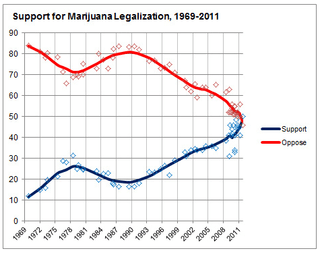
Legalizing marijuana would make it easier for people to smoke pot. Some of those people would benefit from having that option; others would make choices they would come to regret. On average, the more socially advantaged will make better choices, and be better positioned to recover from their bad choices, than the less socially advantaged. To that extent, legalization favors the privileged over the less-privileged. Screen shot 2013-01-14 at 12.36.41 PMBut keeping marijuana illegal creates a different sort of temptation, by expanding the range of illegal money-making options. Compared to theft, commercial sex work, or hard-drug dealing, pot-dealing is less edgy and less risky.

Some of the people who take it up (not very many, in my view) may be better off than they would have been doing legal work; others will be better off than they would have been doing alternative illegal work. But, inevitably, some people will yield to the temptation for a quick buck and wreck their lives in doing so. And like those who yield to the temptation to smoke too much pot, they’re likely to come from the bottom half of the income/status distribution, not the top half. Just how damaging your youthful pot-dealing arrest will turn out to be could depend very strongly on how good a lawyer your parents can find for you.

On balance, are poor neighborhoods made better off by maintaining cannabis prohibition? Maybe so. But opponents of legalization haven’t made that case in anything like adequate detail.

For my part, I simply cannot understand how the alleged harm of pot can possibly outweigh the harm of being labeled a felon for the rest of your life, denied job opportunities, stigmatized and marginalized from mainstream society forever because of a mistake made early in your teens. And what exactly is the harm in marijuana? It can harm the development of the young brain – which is why I favor legalization because it enables us better to keep it away from kids. If you smoke it, it can be bad for your lungs – but pales in comparison with tobacco, which is usually smoked far more often than a joint. But vaporizers – which convert the THC into vapor – can largely mitigate any lung damage.

So a question to my friends Rod and David: why not make far more dangerous cigarettes illegal? They're more addictive and more harmful. Their response to the double standards charge is to accept it, but to argue that legalizing any more substances that might provide pleasure and relief is ipso facto a bad thing. This is simple Puritan paternalism. And like marriage equality, with each generation, it is collapsing under the weight of its own illogic.

(Photo: Getty. Chart: Nate Silver.)

Drum, Lead And Crime, Ctd

Drum defends his thesis, that lead exposure is a major cause of crime, against Manzi’s criticisms:

Far from being an exotic, hard-to-believe explanation for the rise and fall of violent crime, the truth is that lead is actually an explanation that makes perfect sense. After all, we have multiple prospective studies that associate lead with arrest rates for violent crime in individuals. We have MRI studies showing that lead affects the brain in ways likely to increase aggression levels. We have copious historical evidence of the effect of high doses of lead on workers: for years people said it made them “dumb and mean.” We have medical studies showing that prisoners convicted of violent crimes have higher lead levels in their teeth than similar populations. We have studies linking lead exposure to juvenile delinquency. Dose-response effects litter the literature. And much, much more.

In retrospect, if I were writing my article over again I’d begin with this evidence. I chose to begin with the population studies mainly for narrative purposes, but I think that was a mistake because it led a fair number of readers, like Manzi, to believe that the Reyes paper was the linchpin of my argument. But it’s not. It’s just one confirming piece in an ocean of evidence.

Quentin Tarantino Is Not A Slave

The director's refusal to talk about the effects of violent media consumption is making the rounds:

Frum is taken aback by Tarantino's word choice:

"Don't ask me a question like that …. I am not your slave and you are not my master." You'd think a man who'd spent the past year and a bit immersed in a movie about the antebellum South might see the difference between this one unwelcome moment in his ultra-luxury movie promotion tour and the real experience of slavery: a lifetime in bondage, exploitation, and degredation, but … no. Slavery – like the suffering of the Jews in Nazi-occupied Jews – seems interesting to Tarantino mostly as a prophylactic against those who accuse him of delighting in sadism for its own sake.

Meanwhile, Waldman finds no link between violent media consumption and violence:

[I]f exposure to violent media was a significant determinant of real-world violence, then since media culture is now global, every country would have about the same level of violence, and of course they don't. Japan would be the most violent society on earth.

Have you seen the crazy stuff the Japanese watch and play? (Two words: tentacle porn. Don't ask.) But in fact, Japan is at or near the bottom among industrialized countries in every category of violent crime, from murder to rape to robbery. There are many reasons, some of them cultural, some of them practical (like the fact that it's basically illegal for a private citizen to own a gun there), but the point is that even if all that violent media is having an effect on Japanese psyches, the effect is so small that it doesn't make much of a difference on a societal level.

Christopher Ferguson has more:

Youth violence has declined to 40-year lows during the video-game epoch, and countries that consume as much violent media as we do, such as Canada, the Netherlands, and South Korea, have much less violent crime, even if you factor out gun violence.

Academic Articles For All?

The death of Aaron Swartz, who potentially faced significant jail-time for downloading JSTOR files, has sparked debate about public access to academic research. Freddie DeBoer’s view:

Here’s the point I want to make about journal archive access: I have never talked to anyone– arts, professional schools, humanities, social sciences, or STEM– who was opposed in theory to the idea of free access. You’ve got to do something to rebuild the revenue streams of the academic journals, many of which operate at a loss already. But as a principle, giving people free access to journal articles is as close to a universal stance as I can think of among academics. Why wouldn’t it be? Researchers believe that their research has value, that it matters, and they want it to be read.

Caleb Crain is conflicted:

I come by my ambivalence about JSTOR honestly. On the one hand, I’ve written a handful of the articles in it, none of which I ever have been or ever will be paid for, and all of which I wish could circulate freely. And on the other hand, I tap the database almost every working day and find it invaluable, and I know that few worthy things happen in our society unless they can be monetized. If Aaron’s goal was to protest the commercialization of scholarship, I’m not sure he picked the best target. JSTOR is a non-profit, probably better understood as one of the damaged offspring of American higher education than as an active villain.

I would think that colleges and universities with massive endowments would be able to afford to lose some of the revenues they get from keeping their research papers sealed off from the public. If only in the general interest of liberal learning. Online courses have made lectures effectively free for milions, but the feds get to force a young and brave genius into suicide for wanting to spread scholarship around the world. The whole thing, in my view, is obscene and the more I think about it, the angrier I become and the more ashamed I am that I did not cover this case earlier.

Ending Republican Nihilism, Ctd

Ross contemplates the fallout of a GOP-induced credit crisis for the US:

Note that it’s perfectly sensible for Republicans to negotiate over how the debt ceiling is to be raised — to haggle over the extension period and the combination of Democratic and Republican votes, for instance, and to look for a small-ball deal on spending to give cover to the legislators who cast those votes. But there simply isn’t a way for the G.O.P. to win anything big here, given the correlation of political forces in Washington D.C. and the country as a whole. And the fantasy of leveraging the debt ceiling to “force” the White House to dramatically cut entitlements, if actually pursued rather than just entertained, would quickly put the Republican Party on the path to losing the more modest leverage that it currently enjoys.

Contempt Dripping From Every Sentence, Ctd

Bus-stop

A reader writes:

Annie Lowrey's ending to that DC piece dripped with just as much condescension as the beginning: 

On the final spot on our tour, Abdo took me to his newest, biggest project. We drove north on North Capitol Street, as if we were driving out of the District, to a shabby and decidedly unhip neighborhood called Brookland. It is a mostly older, mostly lower-middle-class neighborhood, underserved by grocery stores and restaurants and overlooked by many of the young professionals farther south in Bloomingdale or Shaw or Capitol Hill.

Really? Brookland may not be Bloomingdale (where Lowrey lives), but to describe it "as though we were driving out of the District" is ludicrous. You've lived here for five years and you think Catholic University is out of the District? It's less than two miles from her own neighborhood and just three from the Capitol, closer than Georgetown, Woodley Park, or Cleveland Park. And "mostly lower-middle-class" sounded off to me as well. A quick search of Census data: the neighborhood's median household income is $72k and 38 percent of the households make more than $100k. Those numbers may be low for the area but it's still a neighborhood full of great old houses that regularly sell for more than $500,000.

Another:

It was such a lazy, wrong-headed piece, I don't even know where to start.  How about the fact that her basic premise (exploding federal workforce leads to an economic boom in DC) is completely backwards: DC the city has boomed precisely while the federal workforce stagnated or fell through the '90s and 2000s (see chart here).

DC actually was collapsing in population and wealth through the previous four decades, when federal employment WAS growing tremendously. The real story of DC's revival is much more complex, but you could start with our series of pragmatic yet idealistic city leaders. Mayor Anthony Williams's crucial, far-reaching downtown redevelopment plans kicked things off, and his work was continued ably by Adrian Fenty and Vincent Gray. Many, many folks have worked their asses off to make DC a better, more livable city, which I feel privileged to have witnessed in the last several years living here. One person who has advocated tirelessly for smart growth policies, from a blog and local activist network, is Dave Alpert of Greater Greater Washington. Lowrie dismissively refers to his work as a "yuppie blog." What the fuck?

If you thought she treated Logan Circle roughly, get a load of her visit to my home, or "a shabby and decidedly unhip neighborhood called Brookland." Did Jim Abdo take her by Menomale, the best-rated pizza place in DC, opened in Brookland in 2012, making RIDICULOUSLY good Neapolitan pizzas (with excellent gluten-free options)? Or the awesome new Cuban place, Little Ricky's? Or the blocks upon blocks of beautiful, varied bungalows with lovely gardens east of 12th St. NE? If not, would it have killed Lowrie to do five minutes of basic research herself on the neighborhoods she was visiting?

Ugh. Thanks for being there to give some voice to DC's frustration at the NYC condescension.

Another:

Annie Lowrey is a pompous ass, but as a long-time DC resident I plead guilty to the charge that we're fashion victims.  One of my favorite blogs of all time is DC Style Sheikh; the writer catalogued the horrors in men's fashion around him (sadly, he stopped last year). But it's good enough for government work!

(Photo by DC Style Sheikh)

Ending Republican Nihilism, Ctd

On using the debt ceiling as ransom, it's hard to put it better than our newly re-elected president:

To even entertain the idea of this happening, of the United States of America not paying its bills, is irresponsible. It’s absurd. As the speaker said two years ago, it would be — and I’m quoting Speaker Boehner now — "a financial disaster not only for us but for the worldwide economy." So we got to pay our bills. And Republicans in Congress have two choices here: They can act responsibly and pay America’s bills or they can act irresponsibly and put America through another economic crisis.

But they will not collect a ransom in exchange for not crashing the American economy. The financial well-being of the American people is not leverage to be used. The full faith and credit of the United States of America is not a bargaining chip.

And they’d better choose quickly because time is running short. The last time Republicans in Congress even flirted with this idea, our triple-A credit rating was downgraded for the first time in our history, our businesses created the fewest jobs of any month in nearly the past three years, and ironically, the whole fiasco actually added to the deficit.

I like this new forcefulness, don't you? He's not uncompromising on new deficit reduction measures – just on refusing to pay the bills Congress has already incurred. And he's right to take the fight to them – because the GOP is the single greatest threat not just to the American economy right now but to the global one as well. There is no party in the democratic West that comes close to their extremism: the British Tories have spent the last years doing all they can to avoid a credit downgrade; ditto the French right. But these fanatics want to save this country's fiscal standing by destroying it. They must be stopped – and the president is not the one who can really do it. Only we can. Public opinion must rally like never before to expose and defang the lunatics running the GOP asylum. And fast.

Quote For The Day II

"I want to sit down and get his view points on Israel, our greatest ally. I want to see… why he chose to oppose the Iraq War, which I think was a wise choice now that we know all the conditions," – Senator Joe Manchin of West Virginia.

"Our greatest ally"? Greater than the UK, whose soldiers died and are still dying in large numbers in Iraq and Afghanistan? Or every other NATO ally, committed to regard an attack on any member as an attack on itself? Or the many Arab states who fought alongside the US in the first Gulf War?

But at least we know that Manchin's foreign policy judgment is sound. After all, who would doubt that the Iraq War was, in retrospect, a "wise choice"?

Update: I think I read Manchin's statement incorrectly. It's not completely clear but it's more likely as I now see, thanks to readers, that he was referring to Hagel's opposition to the Iraq war as the "wise choice." Apologies.

Dish Independence: Reader Reax III

Image001

We have received about 4,000 emails since our declaration of independence on January 2, mostly from readers having just signed up for the new Dish. I have been trying to respond to as many as I can, while the Dish staff has been helping to compile all of your constructive feedback regarding our new experiment. So a lot more of your ideas and criticisms are still to come. But first, here are some of the most touching emails from our in-tray:

I just paid $500 in equal measure to the frustration, humor, and intelligence the blog has brought over the last 11 years I've been reading.  I might not donate that much again, but this time I owed you. You were very kind a few years ago to post a number of posts of mine on an anti-gay speech/assembly/etc bill in Nigeria, effectively identical to the one in Uganda.  It meant a lot to a lot of people to get that kind of exposure so quickly in the US.  I still hear from "pen-pals" in Nigeria.

Good luck with the experiment!

Another:

First time writer here. I want to applaud your team's decision to move to a subscription service. The Dish has been a part of my daily routine through college, while I was an expat in Sierra Leone (where your site took 5 minutes to load) and Syria (where your site was often blocked), and now as a policy analyst in DC. In fact, it may be the only thing that has stayed stable across the years and continents. At $20/year, this subscription has the best use-value of anything I'll purchase this year (so much so that I tossed in a bit extra). Good luck and come back and ask for more if you need to. I'm sure most of us would be willing.

Another:

I just completed the purchase of a $100 membership and hope all of your readers who can afford it will buy in at a higher level. I can imagine new startups are expensive, even if it involves blogging. I am an avid Dish Head, and as a 60-year-old African-American woman living in Indiana, I probably don't fit your typical reader profile. I don't do Twitter, but if I did I would be following you and Josh Marshall over at TPM. You both are the best in the blogging business. Good luck with the new venture. I have no doubt it will be a tremendous success.

Another:

I've been dismayed at how few truly successful journalists – the kind of people who can actually afford to take professional risks – have taken management positions or created a single job for an up-and-comer. Now, we're not all born managers, of course, but do I think that we journalists often lose sight of the fact that starting a business is often a deeply noble act.

I'm proud of the Dish because I realize that you guys could surely have negotiated a more lucrative contract with another publisher, made a ton of money, and continued to do great work. You'll do great work, I know, but this new path has the potential to be so much more. The fact that you're turning down easy money (and the easy respectability of operating under a large media company) and taking a risk to create something new is just so damn inspiring. Thank you.

I just gave you 50 bucks and, whatever the ultimate price is, I'm looking forward to reading your work for many, many years to come.

Another asks:

Have you thought about taking us all on a cruise like they do at the NRO?

Er, no. I have thought of taking all the award nominees on a cruise and as soon as it debarks, climbing into a lifeboat pronto. Previous reader reaction to the launch here and here. If you would like to become a founding member of an independent, ad free Dish, subscribe here for just $19.99 a year (or more if you are able and feeling generous).

(Image created by a Dish reader, natch)