Yglesias Award Nominee II

“The world has changed beneath us. Shrillness and extreme language are driving away the voters who could help us build a majority. We’re not speaking to them as reasonable conservatives. Republicans have to decide if they want to govern or play ideological parlor games. Young people today have a more tolerant, hands-off perspective. Their libertarian philosophy, for example, has to be taken into consideration. Yet we keep projecting anger at the gay community and the Hispanic community, even though they’re open to many of our ideas,” – Jim Gilmore, former RNC chair and governor of Virginia.

More evidence of this.

Vegan Ethics, Ctd

A reader writes:

A reader cited 9.5 billion animals slaughtered each year in the U.S. Another side of the question is would it be better if these animals never lived at all? Because that’s what would happen if we were all vegans.  If we could ask them, what would the animals say? I suspect a dairy cow might think that being born and having a life in exchange for milk was an acceptable bargain, while a crated veal calf might think a brief life of misery was not. We raise domesticated animals for our own benefit, but as a result billions exist who would not otherwise.

Another:

I lived a very strict vegan lifestyle for nearly two years in my late teens. I was motivated by the ethical arguments surrounding the conversation. John Robbins’ Diet for a New America changed my life. While I am no longer vegan, I can state that it impacted by life beneficially on many levels. I was forced to learn to cook for myself as there was not a lot of vegan restaurant options in Northern Nevada in the ’90s. I learned to eat and love healthy, whole foods that I would have not dreamt to even consider palatable in my earlier years.

Most importantly, I would say that my vegan years color my understanding of capitalism. Factory farming is a detestable system that is hidden from the vast majority of the population. They are animal concentration camps that are kept out of sight because of the horrors found within. These farms are highly efficient, but they come at cost to our environment and our humanity. My time as a vegan taught me that my money is powerful, that it can go to evil places if I’m not careful. Veganism taught me to be as moral a consumer as I can be.

Rhys Southan rejoins the debate by responding to Dish readers via email:

Thank you for starting a discussion around my essay, “The vegans have landed.” I’m writing to respond to some of the criticisms of the essay that that you received and quoted in “Vegan Ethics, Ctd,” which are similar to some of the other comments I’ve seen.

Continue reading Vegan Ethics, Ctd

Capturing Tragedy

6a00d83451c45669e2017ee807ff6c970d-800wi

In the wake of the Newtown shootings, NPR ran an item accompanied by the above picture. The news outlet was later contacted by the woman shown in the picture, Aline Marie, who noted that “no one asked [her] permission to post [the picture].” Coburn Dukeheart relates her feelings about the experience:

“I sat there in a moment of devastation with my hands in prayer pose asking for peace and healing in the hearts of men,” [Aline Marie] recalls. “I was having such a strong moment and my heart was open, and I started to cry.” Her mood changed abruptly, she says, when “all of a sudden I hear ‘clickclickclickclickclick’ all over the place. And there are people in the bushes, all around me, and they are photographing me, and now I’m pissed. I felt like a zoo animal… yes, it was a lovely photograph, but there is a sense of privacy in a moment like that, and they didn’t ask.”

Dukeheart also spoke with the photographer, Emmanuel Dunand:

[W]hen he took Marie’s photo, he knew she was suffering, but that he simply didn’t want to bother her. He thought that leaving her alone was the most respectful thing to do.

NPR solicited reader comments on whether photographers should “interact with their subjects in moments of grief” to ask permission and names, or if it is “more respectful to leave them alone.” Dukeheart summarizes the responses here.

(Photo: Aline Marie prays outside St. Rose of Lima church in Newtown, Conn., on the day of the school shooting. Marie noted in her message to NPR that she was “not asking [them] to take the photo down, nor [was she] offended.” By Emmanuel Dunand/AFP/Getty Images.)

Not So Identical

Priscilla Long explains a misnomer:

Identical twins can be up to 12 percent different. This being the case, the term “identical” has been replaced by “monozygotic.” The difference is caused by epigenetics, which is, in [The Epigenetics Revolution author Nessa Carey’s] words, “the set of modifications to our genetic material that change the ways genes are switched on or off, but which don’t alter the genes themselves.” … Carey encourages us to think of DNA as a script, rather than a template. With a template you stamp out identical gingerbread cookies. With the same script you can make two very different movies. My monozygotic twin and I, whether because of environment, predilection, or epigenetic switches, are two very different movies.

The Economy Goes Negative

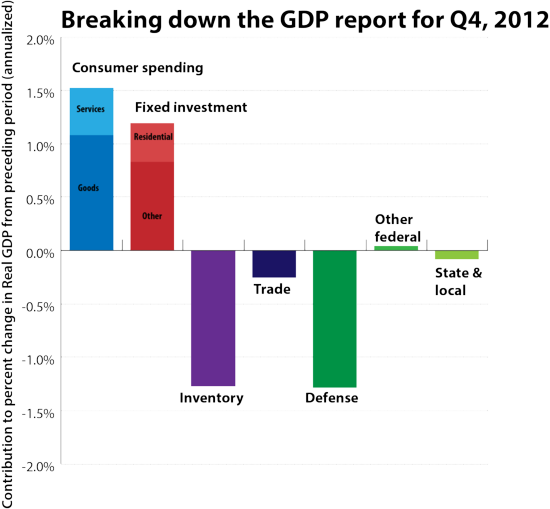
Q4 GDP was -0.1%. Dylan Matthews breaks down the decline:

6a00d83451c45669e2017c366dbdcf970b-550wi

Plumer looks at the causes of the economic contraction. The big one:

Government defense expenditures plunged by a staggering 22.2 percent between October and December. According to the Bureau of Economic Analysis, the Pentagon spent significantly less on just about everything except military pay. Had the Pentagon not cut back on spending, the economy would have grown at a weak but positive 1.27 percent pace.

Neil Irwin says this was “a bad quarter for the U.S. economy, but not nearly as bad as the overall negative number would suggest”:

A drop in business inventories was the second major drag on growth. Firms drew down their inventories by more than $40 billion, which subtracted 1.25 percentage points from GDP growth. With companies focusing on selling goods already sitting on their store shelves and in their warehouses, production in the nation’s farms and factories was not as high as one might expect given consumer and business spending. But businesses can’t simply run down their inventories forever, and that bodes well for future growth. Final sales, which add inventories back in, rose at a 1.15 percent rate.

John Cassidy points out another factor:

The final reason for the shocking G.D.P. figure was a sharp fall in American exports, sufficient to knock nearly one per cent off the growth figure. This was the first drop in exports since the first quarter of 2009. If sustained, it would be very worrying—indeed, it would raise the spectre of another global recession. But the world economy doesn’t look that bad. Europe and Japan are still in poor shape, but growth in China and other developing countries appears to be picking up. The latest forecast from the International Monetary Fund is that the world G.D.P. will expand a bit faster this year than last year (3.5 per cent compared to 3.2 per cent). Even if global growth merely holds up at last year’s levels, U.S. exports should pick up a bit.

Drum wishes the report “persuaded some people that government spending really does affect economic growth”:

Continue reading The Economy Goes Negative

An Early Non-Adopter

Matt Lewis quits Twitter. And gets a life. Update from a reader:

Matt Lewis didn’t quit Twitter. He complained about people being too snarky on it while making a lame joke at Manti Te’o’s expense, said he made a private account for his friends and used the Wayne LaPierre embarrassment as his “people were mean and made too many jokes” example, which is a terrible example because if anyone deserved to have jokes made at their expense, it was Wayne LaPierre during that speech. At no point does he write that he quit Twitter.

Love the blog and was happy to contribute as a member. Keep up the great work, just didn’t enjoy Matt Lewis’ piece this morning and thought your link missed his point.

The Last, Feeble Case Against Marriage Equality

Here’s one of the main arguments (pdf) of Paul Clement, who is defending DOMA before the Supreme Court:

It is no exaggeration to say that the institution of marriage was a direct response to the unique tendency of opposite-sex relationships to produce unplanned and unintended offspring. Although much has changed over the years, the biological fact that opposite-sex relationships have a unique tendency to produce unplanned and unintended offspring has not.  While medical advances, and the amendment of adoption laws through the democratic process, have made it possible for same-sex couples to raise children, substantial advance planning is required. Only opposite-sex relationships have the tendency to produce children without such advance planning (indeed, especially without advance planning).

Weigel raises an eyebrow:

[O]ne of the ways gay couples find children to raise is by adopting them — adopting children who are the unintended product of opposite-sex relationships. In all seriousness, did no one proofread this?

Chait further unpacks the illogic:

[T]he problem here is that you can’t discriminate against people without good cause. You need some distinction to justify it. The traditional distinction that straight people raise kids doesn’t work, since gay couples can do that too. So Clement fell back on arguing that only straight couples have unplanned children. Gay couples don’t get drunk and wake up pregnant. It is, to say the least, ironic that after years of using alleged gay social irresponsibility as a rationale for discrimination against gays, heterosexual irresponsibility is now a rationale for discrimination against gays.

And it’s all they’ve now got: keep gays out of marriage because straights can get knocked up accidentally (and for some reason need an exclusive institution to keep up appearances). But I still fail to see how gays’ ability to get married somehow reduces the availability of straight shotgun marriages. There just isn’t a trade-off here. It’s win-win: for marriage, for gays and for straights.Unless you are working from a premise that gays are icky and their very inclusion in civil marriage inherently debases it.

Which is why David Blankenhorn’s new venture is so worth supporting. It gets us out of the gay-straight division and back to the real question: how civil marriage can help a society rear children more effectively and foster more responsible and happy adults. If you’re a conservative who believes this helps society stay stable, you will, like Blankenhorn, at some point leave the focus on what you’re against to regain the focus on what you are for.

The NFL: NASCAR With Human Beings, Ctd

A reader writes:

Following up on this, Dan LeBatard’s recent article, “Jason Taylor’s pain shows NFL’s world of hurt,” is a harrowing must read. As a big football fan who nevertheless understands the hypocrisy of my fandom, this details things happening that are more brutal, crude and neanderthal than I would have guessed. I wonder what would happen if more people knew.

A reader defends the organization:

You say the NFL is beginning to look more and more like Big Tobacco but I have yet to see a timeline of research that definitively proves the NFL had the same sort of knowledge on the dangers of concussions that tobacco companies had on tobacco use. The most damning part of the tobacco lawsuits always seemed to be how they knew about and had funded the research showing the incredibly high rates of cancer associated with smoking. They then continued to pretend that cigarettes were actually good for you. The NFL hasn’t done THAT.

Continue reading The NFL: NASCAR With Human Beings, Ctd