A Poem For Sunday

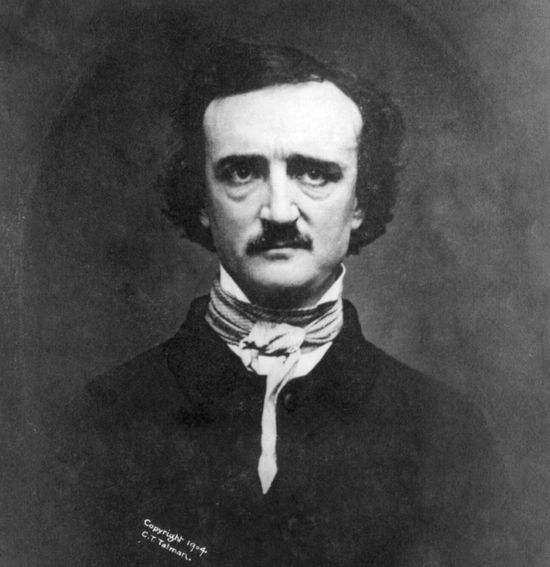
Edgar_Allan_Poe_2

"From Childhood's Hour" by Edgar Allan Poe (1809-1849):

From childhood’s hour I have not been
As others were; I have not seen
As others saw; I could not bring
My passions from a common spring.
From the same source I have not taken
My sorrow; I could not awaken
My heart to joy at the same tone;
And all I loved, I loved alone.
Then—in my childhood, in the dawn
Of a most stormy life—was drawn
From every depth of good and ill
The mystery which binds me still:
From the torrent or the fountain,
From the red cliff of the mountain,
From the sun that round me rolled
In its autumn tint of gold,
From the lightning in the sky
As it passed me flying by,
From the thunder and the storm,
And the cloud that took the form
(When the rest of Heaven was blue)
Of a demon in my view.

(A photograph of Poe in 1848, via Wikimedia Commons)

“Let The Children Come To Me”

Mark Galli searchingly meditates on the perils and promise of Christian parenting:

[T]he fact that children are often oppressed in religious households suggests that there is indeed something in religion which tempts parents in this way. That temptation is the inherent human fascination with law and control. People become religious for many reasons, good and bad. One for many is that their lives are completely out of control morally and socially, and they see in religion a way to bring order to the chaos. Religion as inner police. Such adherents are attracted to religions, or denominations within religions, that accent discipline and obedience. This happens — surprisingly — even in Christianity.

This is surprising because the New Testament message is about freedom from law, and being grounded in grace. "For freedom Christ has set us free," proclaimed Paul in his most profound exposition of grace. The fact that even some Christians fail to grasp the radical nature of God's unconditional love suggests just how deeply we humans are embedded in a world ruled by law, expectations, duty, control and obedience. We naturally imagine that Christianity is just a nicer form of this basic reality. The message of grace is so radical that it is simply hard to hear it for what it is.

Saving The Sounds Of America

Work Hard, Play Hard, Pray Hard is a collection of music from 1923 to 1936 that includes "songs of labor and occupation, hardship and loss; dance tunes, comic numbers, and novelties that provided distraction and fun; and the hymns and sacred pieces that reached beyond the raw material of daily existence for something enduring." John Jeremiah Sullivan considers his own secular appreciation of gospel music:

I felt the peculiar mixed admiration that non-believers get in the presence of great religious music, equal parts awe and alienation. You’re transported by the song, but you observe it from the outside—picturing the singers, their faces full of impenetrable faith. That congregation wasn’t singing to me, except insofar as they hoped to save me, to save passing motorists who might dial in their program. Yet there was a feeling, on my end at least, of overlap. For two or three minutes we shared the sensation of reverence itself, of bowing before something magnificent. For me, the thing was the music alone. 

In a positive review Pitchfork touched on the fortuitous discovery of the music:

The bulk of the sides on Work Hard, Play Hard, Pray Hard were salvaged by guitarist and nascent archivist Nathan Salsburg. Nearly three years ago, a friend of Salsburg's called to say that he'd stumbled upon a trove of old and abused records in the home of a Kentucky man who died a week earlier. That night, Salsburg dug through boxes of ketchup bottles and old 78-rpm records in a dumpster outside of the late man's home, steadily realizing that he'd found more than the standard collection of grandparent vinyl. Despite his early skepticism, Salsburg knew that the records amassed by Don Wahle– an enigma with an almost entirely unknown backstory, aside from the dilapidated boxes of music and record catalogue receipts Salsburg rescued– transmitted tales of folk and country music in America that were either previously obscure or altogether untold. … When [Wahle] died, they almost passed along with him.

Sample more of the songs here

(Above: Easter Day by The Dixon Brothers, which is among the songs featured on Work Hard, Play Hard, Pray Hard)

Can Justice Be Done?

Daniel Baird wonders:

The trouble with retributive justice is that a literal reading of the “eye for an eye” passage leads to morbidly comical conclusions and boundless forms of cruelty. In many situations, it is not even clear what an appropriate equivalent means: one rabbi noted that if a blind man puts out someone’s eyes, it is impossible to blind him in return. In the case of extreme crimes, such as Bernardo’s or Breivik’s, or horrors as immense as the Holocaust, no punishment could compensate for the victims’ suffering. Jesus’ direction “Ye have heard that it hath been said, an eye for an eye, and a tooth for a tooth: But I say unto you, that ye resist not evil: but whosoever shall smite thee on thy right cheek, turn to him the other also” is not so much a criticism of the rabbinical courts of the Second Temple period, which were notably humane (crucifixion was a Roman practice, and capital punishment was used sparingly under the Pharisees). Rather, it was a way of pointing out that retributive justice can devolve into vengefulness as destructive as the crime itself.

Mental Health Break

Robert T. Gonzalez applauds:

Take a minute to appreciate this breathtaking time-lapse compilation of yawning petals, stamens and pistils, created by Czech photographer Kate Pruskova. … . All the flowers in the video were picked from either Pruskova's garden or her mother's. The footage comprises over 7,100 images and took over 730 hours to photograph. 

The Struggle For A Critic’s Soul

David Mikics profiles literary critic Harold Bloom, capturing how a "cataclysmic midlife crisis" generated his most enduring work, The Anxiety of Influence:

For months, he was stricken with insomnia and unable to read. What saved him, when he could read again, was Emerson, the inescapable American Romantic thinker. Emerson is the apostle of the self that, no matter how severe the blows of fate it suffers, returns to its own light and recovers its strength. The pessimistic angel with whom Emerson competes for Bloom’s soul is Sigmund Freud, the 20th century’s far darker believer in fundamentally ironic lives: We do not—we cannot—know the truth about what we’re doing, Freud insists. Whether we are daring or cautious in our loves, these loves cannot sufficiently transform us. Every bout of eros leads us back to the parents whom we first struggled with, and who always win the battle. From this point on, Bloom became locked between Freud and Emerson in agonized, fruitful tension.

Bringing The Outdoors To The Masses

Central_Park_New_York_City_New_York_23_cropped

The site Gilded Birds asks an array of thinkers to discuss a seminal object of beauty. In a recent installment, the philosopher Joshua Cohen chose New York City's Central Park, claiming that its "hard to think of other places that so fully combine beauty with being public":

The ambition of the designers, Frederick Law Olmsted and Calvert Vaux, was to give people the experience of being in the Adirondacks. Wealthier New Yorkers in the middle of the nineteenth century could afford to go the Adirondacks. The Park was designed to give people who couldn’t get there that same experience of being in nature. So the park provides an experience of beauty and is also, as you say, driven by a remarkable intellectual idea: the democratic idea of an experience of beauty for the people. Moreover, you have the extraordinarily obsessive and creative execution, down to the finest detail, of that intellectual idea.

It's also a feat of engineering:

First, because the park is two and a half miles long, the Central Park Commission said that there had to be four cross-streets that connected the east and west sides of Manhattan. … It was done in 1858, ten years before dynamite was invented. Central Park is filled with very old, hard rock, so they had to use gunpowder to create the transverses. In fact it took more gunpowder to build Central Park than was used by both sides in the battle of Gettysburg.

(Photo of one of Central Parks bridges, no two of which are identical, via Wikimedia Commons)

The Gay Gatsby?

Greg Olear makes the case that Nick Carraway, the protagonist of The Great Gatsby, is gay and in love with the novel's eponymous character. The biographical details that provide the initial impetus for Olear's suspicions:

Here’s what we know about Nick Carraway, from what he tells us in the first few pages of the book: he was born in 1896, so is about the same age as Fitzgerald; he went to Yale, as his father did before him; he fought in the First World War; he resembles his “hard-boiled” great uncle; his aunts and uncles are worried about him; he is, at age 25-26—his birthday is the summer solstice, and occurs during the action of the book—still single. Reading between the lines, we deduce that there is something unusual about him, something that concerns his family. So far, Nick’s is exactly the profile of a (closeted) gay young man in a prominent Middle Western family in 1922.

Face Of The Day

Varanasi_CF006929_dish

Michael Zhang spotlights the portrait series, “Holy Men,” of religious ascetics from around the world, by photographer Joey L:

Joey traveled to India (for the third time) in March 2011 and spent a month creating more photos of wandering monks in Varanasi, the holiest of the seven sacred cities in Hinduism and one of the oldest cities in the world.

Joey explained the project to Zhang:

I began the Holy Men collection with a photo series from the North of Ethiopia focusing on Coptic Christianity. In this new series, Sadhus and religious students are the featured subjects. Although Coptic Christian monks and Sadhus live in different corners of the world, the connection all these subjects have to each other is profound. Almost every major religion breeds ascetics; wandering monks who have renounced all earthly possessions, dedicating their lives to the pursuit of spiritual liberation. Their reality is dictated only by the mind, not material objects. Even death is not a fearsome concept, but a passing from the world of illusion.

Follow Joey's work on his blog, Twitter and Facebook or watch a documentary on his series, here.

(Vijay Nund performing morning rituals in the Ganges River, the most sacred river in Hinduism.)