Self-Driving Sticker Shock

Drive-thrus may take awhile to adjust to self-driving cars:

Owen Thomas argues that a “a true self-driving car is far from hitting the market” because “the massive array of sensors Google has to install in its cars alone costs $250,000 or more.” Timothy Lee disagrees:

Obviously, most people can’t afford the monthly payments to buy a $300,000 self-driving car outright. But lots of people could afford to buy 10 or 20 percent of a $300,000 vehicle’s time. And most people don’t use their cars more than 10 or 20 percent of the time. So many modestly affluent consumers will find it practical to sell the BMW and just take a self-driving taxi everywhere they go.

Bill Howard describes how Audi and Toyota are taking a more incremental approach:

[Both] are displaying cars that are self-driving at times, and showcase the building-block technologies available today that can assist drivers, especially on limited access roads or on crowded city streets… The building blocks help avoid accidents in urban areas; on limited access highways, they guide, correct and warn. Both automakers are also trying to control expectations for anywhere, anytime self-driving cars. Lexus likens its robocar to a “co-pilot” while Audi talks about “piloted driving,” as in auto-pilot functions on a plane.

The Personal Touch, Ctd

David Sessions takes the debate over the narcissism of young writers a step further, broadening the issue from revealing personal secrets to that of deploying a writerly persona:

Plundering your own perspective for material is also a way of spending the principal. Your current perspective, especially if you are young, is pretty limited, and the world it encompasses is constantly shifting and evolving. Maybe if you’ve worked in a field or government position for decades, your perspective is substantial enough on that particular issue to sustain a lifetime’s worth of blogging. But for most of us that’s not the case, and our perspective very quickly becomes a shtick, a rote performance, a reflexive mechanism for avoiding critical thought that rivals the "ritualized viewlessness" of traditional journalism. Pretty soon, you’re saying the same thing over and over, and realizing how often you use the same arguments, back them up with the same old links, etc. I realize this problem is not the internet’s fault, as many print-newspaper opinion columnists are some of the worst incarnations of it, but I think the pace and exposure of blogging intensify it.

To be a fresh and relevant writer means, I think, that you have to be something like a fresh and relevant person, one who reads slowly and widely, has idiosyncratic interests, goes new places, meets new people, and regularly changes their mind. Feeling my own perspective plundered and empty over the years has pushed me to appreciate the value of, if we use Nolan’s terms, "building up the principal."

He concludes:

The more you can be forced past your current perspective, and not just by other bloggers and journalists, the better. The more you can participate in something besides consuming media and blogging, the better. The more you can really learn about something the better; good writing can’t survive all that long on nothing but voice and other people’s reporting.

Musicals, Then And Now, Ctd

A reader writes:

Megan McArdle is way off base on this one. What is precisely so depressing about Les Miz – a titanic bore on stage and a risible film now snookering viewers at a cinema near you – is that the work of Rodgers, Hart, Lerner, Loewe, etc. once represented popular taste. This was the music to which my working-class parents listened, daily. They knew many of the songs by heart. The joys of that music is that it communicates to all audiences. To see the public turn to shows like Les Miz, with their sledgehammer melodies and thudding lyrics is to weep for what once was.

It’s a paradox of the American theatre: One the drama side, things are looking very good indeed. The current crop of young playwrights is among the best I’ve ever seen. But the creation of an effective mainstream musical of any sophistication and taste is, increasingly and unhappily, a lost art.

I must add that it is rather strange to hear these sentiments from David Denby, who once wrote a bizarre essay in which he tried to explain the theatre was worthless – and, most of the time an embarrassing experience – whereas film eternally retained the potential for greatness. But maybe he’s had a Saul of Tarsus experience about the stage.

Another:

To a more sophisticated musical ear, Les Mis is a snore. It's basically a Popera, pop music with operatic passion.  Modern ears are less trained to harmonic nuances of past composers (Kern, Rodgers, Loewe, Loesser, Bernstein, et.al; most of these composers trained classically, or had arrangers who had). You only need to look at the state of music education in this country to see why.

When I first heard Les Mis 20 odd years ago, while in grad school for music, I was appalled at its harmonic simplicity. Watching it on Christmas Day, I wept through the the whole thing, not minding so much that Hugh Jackman was singing a part much too high for him, or that Russel Crowe seemed like a somnambulant on a precipice half the time and was ahead of the beat constantly. Les Mis isn't about nuance, chic style, harmonic sophistication, even necessarily good singing!. It's the emotional impact that matters, hitting you relentlessly with it's hit themes over and over again. Knocking away the hard places in the heart and like opera, bringing about a catharsis.

Another:

Sorry, McArdle doesn't get it.  Denby isn't talking JUST about "musical comedies of yesteryear."  Has she never heard of West Side Story, Gypsy, Company, Sweeney Todd?  They all have dark moments and characters.  It's not that Denby wants silly, frothy musical soufflés and McArdle, and by extension "ordinary people," want sentimental work.  It's about craft and language. Denby's point is that the composers he mentions were far more inventive, rich, sophisticated, surprising, and interesting than the Les Mis guys. 

I'm all for simple (versus simplistic) and what great musical theater is/was is even more impressive that is was often done as musical comedy.  Ever sit and play through Loesser's Guys and Dolls?  Yes, compared to Les Mis it's practically Wagnerian in harmonic and melodic complexity and richness.  But: it's clear in concept, and it sings.  West Side Story was deemed unmelodic by many when it opened.  The success of the movie four years later had more to do with it's canonization.

McArdle is correct that time, and familiarity can make art understood and accepted.  Familiarity breeds comfort.  I doubt Les Mis' stock will rise in coming decades.  If anything it has already been overexposed and added time won't shore up it's surfacey quality. The problem with Les Miz has nothing to do with what they attempted to do, that was admirable and right in the tradition of the greatest musicals.  It's that they did it so … mediocrely.  It's all in the execution.  If I want big, self-important works that grind me into submission with their earnest artlessness I'm sure I could find many a 19th Century opera to do that (cue Meyerbeer!), with the added benefit of even more length!

You tell me ultimately who is a more interestingly drawn and full-bodied character: Rose from that "trifle" Gypsy or the very serious Javert?

Update from another:

I nominate the entire Les Mis thread for a Poseur Alert. What snobbery.
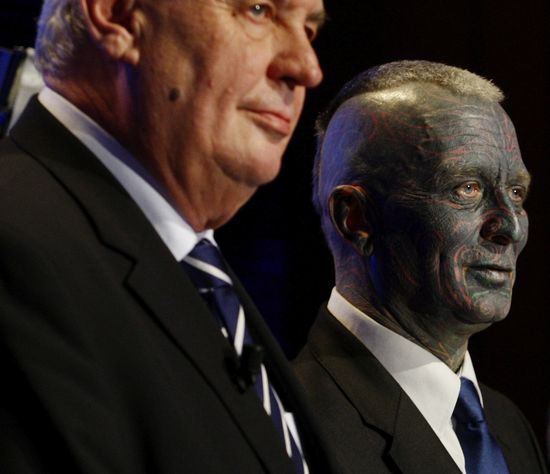
Face Of The Day

159304024

Presidential candidates Milos Zeman (L) and Vladimir Franz (R) attend the last television pre-election debate of all nine candidates ahead of the presidential elections on January 10, 2013, in Prague, Czech Republic. Czechs will choose their next president from nine candidates in the first direct presidential elections on January 11 and 12. By Martin Divisek /VLP/isifa/Getty Images.

Brennan: Second Time Around, Ctd

After reading Dan Klaidman's reporting and my reasoning, Conor still has qualms about Brennan:

Many critics of the drone program, myself included, regard these alleged, proposed changes as improvements on the status quo, but let's be clear about exactly how little that actually means. Internal executive branch procedural changes may be prudent, but that does not make them a "check" on President Obama, who can reverse them at his pleasure, as can any of his successors in the White House. If Brennan were truly an advocate of "checking the president's power to kill by drone," he would be calling for constraints to be imposed by the judiciary or the legislature.

Tim Weiner sees the Brennan nomination differently:

Brennan has a once-in-a-generation opportunity to make the CIA what its creators intended: a small, smart, sharply focused espionage organization providing the president with the best intelligence billions of dollars can buy. Let’s hope he succeeds. Because if intelligence fails us again, and we are hit with a third Pearl Harbor, get ready to kiss your cherished Constitutional liberties goodbye.

Most Vulnerable, Least Culpable

David Roberts digs up an old paper [pdf] on the relationship between temperature fluctuations and economic growth in different countries and considers its implications:

Data from the past can tell us something important: countries’ baseline vulnerability to heat… Normal heat fluctuations hurt poor countries but not rich countries. Why? Part of it is that poor countries are more dependent on agriculture, which is sensitive to heat. But the biggest reason is access to energy, or more specifically, something wealthy countries take for granted: air conditioning. It’s hard to exaggerate the effect air conditioning has had in unlocking economic growth. (Of course, burning coal to air-condition buildings also accelerates climate change, so, ha ha, irony!)

Poor countries… are getting screwed right here and now. And they will get screwed harder and harder in coming years, suffering the effects of carbon emissions for which they are not responsible.

An Ice Cube That Cuts You Off

After blacking out from drinking too much and waking up in the hospital, Dhairya Dand got creative to ensure it never happened again:

I made self-aware glowing ice-cubes that beat to the ambient music. The electronics inside the ice-cubes know how fast and how much you are drinking. The cubes change color from green to orange to finally red as you keep drinking beyond the safety limit. If things get out of control, the cubes send a text to your close friend using your smartphone.

Emil Protalinski is impressed:

What do you do when you have too much to drink? Most people whine and groan. Some get a hangover. Others declare they will never drink again! … [N]ot only did Dand go way beyond what most people would do to make sure he never has a terrible night of drinking again, but he actually created a device that would help him out. All he has to do is remember to bring and use the ice cube.

To See What Is In Front Of One’s Nose

I’m struck by the following sentences in Politico today:

Chuck Schumer is quietly letting out the word: He’s far from sold that Chuck Hagel will be a staunch advocate of Israel.

Isn’t the job in question defense secretary of the United States? Why should an American defense secretary be required to “staunchly advocate” for the interests of another country that isn’t even in NATO? Or put it another way: can you imagine a leading Senator demanding that a defense secretary be a staunch defender of Canada? Or Germany? Or Serbia? The double standards here are gob-smacking.

Covering Up Climate Change, Ctd

The NYT has announced that it is closing the Environment desk and reassigning all its reporters in the coming weeks. Katherine Bagley conveys the reasoning behind the move:

[T]he change was prompted by the shifting interdisciplinary landscape of news reporting. When the desk was created in early 2009, the environmental beat was largely seen as “singular and isolated,” [managing news editor Dean Baquet] said. It was pre-fracking and pre-economic collapse. But today, environmental stories are “partly business, economic, national or local, among other subjects,” Baquet said. “They are more complex. We need to have people working on the different desks that can cover different parts of the story.”

Andrew Revkin, who writes the Dot Earth blog hosted by the NYT, believes the editors when they “insist that this move will not diminish or dilute the paper’s commitment to sustained, effective environmental coverage.” His one caveat:

What’s happening in the paper’s newsroom (and much more so in other newsrooms!) is not specific to the environment. As today’s post noted, the religion and education desks have had a smilar fate… [B]ackground financial pressures, building around the industry the same way that heat-trapping greenhouse gases are building in the atmosphere, are what will erode the ability of today’s media to dissect and explain the causes and consequences of environmental change and the suite of possible responses.

Sheldon Toplitt is skeptical about Baquet’s claim that the move isn’t about cost-saving:

Looks as if the Times is less focused on Going Green than it is greenbacks going away as advertising revenues and paper edition circulation decrease.

Earlier coverage of how the press is covering climate change here.