Floating Through Life

Robert Krulwich explores how zero gravity affects the everyday habits of astronauts:

I know that an exercise bike in space is not like an exercise bike on Earth, because up there they don't have seats — none at all. "You don't need a seat," says Williams, because you don't have to deal with your center of gravity. Seats are for settling. There's no weight to settle. "Actually, I haven't sat down for six months now," she says. All you do is put your feet on the pedals and pump.

"Sleeping free" is something that takes practice, since covers float away and there is no lying "down":

Dan Barry, another astronaut, once told me he likes to sleep in a fetal curl, knees to chest. But in space you can't do that, because you're being pulled equally in all directions, so your body just naturally wants to open up. As soon as you doze off, you unfurl into the letter "C." On the first few nights in space, he Velcro-taped himself to his knees.

The Daily Wrap

159130471

Today on the Dish, Andrew continued to dispute neocon qualms about Hagel’s foreign policy realism and found signs that their philosophy’s prestige is on the wane. He took apart Richard Socarides’ hypocrisy regarding Hagel’s record on gay rights and pondered whether or not the whole affair has humbled AIPAC. Looking at the bigger picture, Andrew pegged the nomination as the latest move in Obama’s long game, where Hagel will allow for sensible defense cuts in order to sustain our spending at home.

In other political coverage, we rounded up more thoughts on the platinum coin and revisited Drum’s connection of lead and crime. Meanwhile, even the conservative-leaning Rasmussen registered the Tea Party’s decline, while Paul Waldman wondered if Obamagate will ever arrive. Goldblog spoke up for conceal-carry permits while Pareene updated us on the lucrative trade of right-wing snake-oil.

In foreign affairs, Assad’s latest speech contained the hubris of fallen dictators. Flynt and Hillary Mann Leverett insisted that the West ignores the progress on women’s rights in Iran, Jada Yuan outlined the danger of filming polo in Afghanistan, and André Barcinski measured the huge strides in the Brazilian economy.

In assorted coverage, we studied the possible benefits of hunting on the ecosystem and surveyed the amount of climate-driven damage that battered the US in 2012. Hélène Mialet described how a systematized community can spark a singular moment of genius, Gary Marcus insisted that it’s never too late to pick up a new skill, and Bruce McCall counted the comedians from Canada. Christoper West reflected on the sensual and the divine while Roxana Robinson celebrated the stillness of the morning. We paused for a tribute to California’s TV personality Huell Howser. We then charted the ludicrous rise of college textbook prices, Laura Vanderkam found that the people who buy self-help books aren’t the ones that really need them, and Norm MacDonald asked whether New Year’s resolutions could be ignoble.

In more miscellania, we took at tour of that diner from every movie, slowed down to hang with sloths during our MHB, overviewed some VFYW construction in Wan Chai, Hong Kong, witnessed two sad faces seeing their dad off to deployment, and pinched our noses at an Ayatollah air freshener. The winner of this week’s VFYW contest, featuring Tehran, is here. We also continued to take on more thoughts from readers about the .99 pricing scheme for Dish subscriptions and delved into the continued evolution and improvement of online advertising. But we still have no plans to host ads on the new Dish, so you can help support us  here.

– B.J.

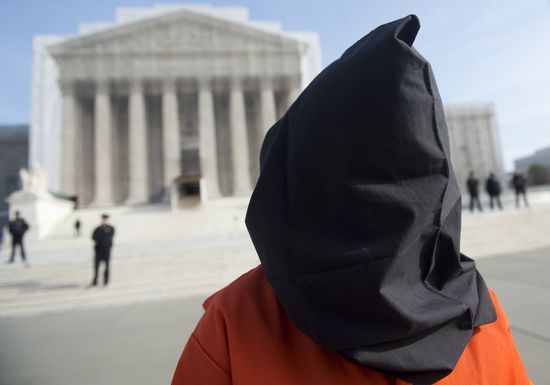
(Photo: A protestor wears an orange prison jump suit and black hood on his head during protests against holding detainees at the military prison in Guantanamo Bay during a demonstration in front of the US Supreme Court in Washington, DC, on January 8, 2013. This weeks marks the 11th anniversary of the opening of the prison. By Saul Loeb/AFP/Getty Images)

Of Sex And God

Roseedge

"We are rarely presented with an authentically fulfilling trajectory for our desires… If we are created for infinite satisfaction, we really only have three choices about what to do with our desire in this life: We will become either a stoic, an addict, or a mystic. The stoic squelches desire out of fear, while the addict attempts to satisfy his desire for infinity with finite things, which, of course, can’t satisfy. That’s why the addict wants more and more and more. The mystic, on the other hand — in the Christian sense of the term — is the one who is learning how to direct his desire for infinity toward infinity," – Christopher West, whose new book is Fill These Hearts.

“The Paradox Of Self-Help”

Laura Vanderkam uncovers the contradictions of the American penchant for self-improvement:

[T]he people who buy these books are, like all book buyers, "pretty comfortable," says John Duff of Penguin. "It’s going to be that middle-class person, reasonably well-educated" and in "very rarefied" company, as "our market for all books is really very limited. Most people stop reading when they leave school." Those who don’t stop probably have their acts together.

Call it the paradox of self-help. "The type of person who values self-control and self-improvement is the type of person who would seek more of it in a self-help book,"Whelan says. "So it’s not the unemployed crazy lady sitting on the couch eating potato chips who reads self-help. It’s the educated, affluent, probably fairly successful person who wants to better themselves."

Boom Times For Brazil

158845834

André Barcinski observes how the country has advanced economically:

In November, 2012, one new shopping mall was opened every three and a half days in São Paulo. Luxury stores such as Chanel, Bulgari, and Prada are always packed. Airports are also filled to capacity: in 2011, domestic plane passengers surpassed bus passengers for the first time. Last year, Brazilian tourists spent over twenty-one billion dollars overseas, a thirty per cent increase in comparison to 2010. It is no coincidence that the United States recently adopted measures to facilitate the issue of visas for Brazilians. For any Brazilian over twenty, this is big news. We used to spend endless hours in line at the American Consulate, begging for a visa. Now, they encourage us to go to the U.S. and spend our money.

He credits "social assistance programmes, huge discoveries of deep-water oil fields, the development of the ethanol industry and advances in agricultural technologies" for the improvements. But he fears that easy credit in the country will doom the country:

In June 2012, almost a third of all credit card holders in the country were at least 90 days late on their payments. Economists fear mass default.

(Photo: People watch fireworks along Copacabana Beach in Rio de Janeiro on January 1, 2013, during celebrations by over three million people attending New Year's Eve festivities. By Ari Versiani/AFP/Getty Images)

Faces Of The Day

159109611

A soldier from the Netherlands embraces his crying children prior to him being transfered to Turkey from Eindhoven Military Airport on January 8, 2013 in Eindhoven, Netherlands. This advance party of Dutch and German troops will fly to Turkey to prepare for the arrival of the Patriots with the main body of European soldiers arriving later in the month. By Dean Mouhtaropoulos/Getty Images.

A Criminal Environment, Ctd

Ronald Bailey finds Kevin Drum's article on crime's connection to lead incomplete:

Drum is right that exposure to lead increases the chances that a person will suffer the sorts of neurological damage that lowers their intelligence and lower intelligence is well-known to correlate with increased criminality. Reducing such exposures has no doubt contributed to our happily falling crime rates. But it is likely that other factors including more policing, more incarceration, less crack, increased concealed carry, and other such efforts to control crime have contributed as well.

Deborah Blum makes related points. Drum clarifies:

It's true that one researcher has suggested that lead can explain 90 percent of the rise and fall of crime, but that's very much the high end of the estimates in the field. I'm a lot more comfortable with an estimate of around 50 percent, something I should have made clearer in the text of my piece. In other words, lead probably explains a very big chunk of the rise and fall of postwar crime in America, but it doesn't trump everything else. Drugs, poverty, urban gang warfare, education, policing tactics, and other things also play a role.

How Much Is A Penny Worth In Business? Ctd

Readers expand the discussion on whether the Dish should just bump up its $19.99 subscription price to 20 bucks:

Apparently it's is also effective to drop the $ sign on prices.

Another reader:

According to at least one study on the penny (pdf), the true purpose of having prices end in .99 is not to "trick" consumers into believing that an item costs less than it really does.  Rather, stores use these prices to deter theft by employees.  If something is priced with an even amount, say $20, the consumer is likely to pay with exact change.  It's fairly easy for a cashier to just pocket the $20 bill without ever ringing up the purchase.  If an item is priced at $19.99, the cashier will probably have to make change.  It'll be pretty obvious if she takes a penny out of her pocket, so she will have to enter the purchase into the register.

Thought this theory might be of interest to you.  And, if true, it implies that it is pretty pointless to price something at $19.99 over the Internet.

Another:

Steven Landsburg offered this explanation of 99-cent pricing in his 1993 book, The Armchair Economist: Economics and Everyday Life:  

The phenomenon of "99-cent pricing" seems to have first become common in the nineteenth century, shortly after the invention of the cash register. The cash register was a remarkable innovation; not only did it do simple arithmetic, it also kept a record of every sale. That’s important if you think your employees might be stealing from you. You can examine the tape at the end of the day and know how much money should be in the drawer.

There is one small problem with cash registers: They don’t actually record every sale; they record only those sales that are rung up. If a customer buys an item for $1 and hands the clerk a dollar bill, the clerk can neglect to record the sale, slip the bill in his pocket, and leave no one the wiser.

On the other hand, when a customer buys an item for 99 cents and hands the clerk a dollar bill, the clerk has to make change. This requires him to open the cash drawer, which he cannot do without ringing up the sale. Ninety-ninecent pricing forces clerks to ring up sales and keeps them honest." (http://books.google.com/books?id=qTBgMMxeJ5IC&pg=PA19)

It's a cute theory, but even Landsburg notes some holes. What about states with sales tax, where an item priced in whole dollars would still require change? And why has it persisted, even after the advent of scanners and electronic registers that record sales even when no change is required?

The question seems particularly troubling to economists, because a strong consumer preference for $19.99 over $20 would seem to wreak havoc with the notion of consumers as rational actors. Nevertheless, over the last twenty years, a growing number of empirical studies and experiments have confirmed that 99-cent pricing actually works.

One explanation is for that success is that 99-cent pricing signals to consumers that the item is a bargain, because it's most often used on bargain goods. Consumers aren't buying these items because they mistakenly think that missing penny makes them meaningfully cheaper, the theory suggests, but because they've been flagged as discounts.

A second is that consumers – or at least, some significant subset of consumers – process prices in two discrete units, before and after the decimal. Some people, perhaps don't find it worthwhile to invest the time and effort necessary to pay close attention to prices, and merchants calibrate their pricing to take advantage of their inattention.

You've actually been running your own experiment, with interesting results. There is, practically speaking, no real difference between those sums. At the moment, all contributions are voluntary – even the leaky paywall hasn't yet been put in place – and it's hard to believe that readers who will voluntarily hand over $19.99 would begrudge you the additional penny. And although subscribers are prompted with the $19.99 minimum, they have to manually enter the amount, and it's easier to just put down $20.

Indeed, that's exactly what nearly two thousand of them did. The only catch? Twice as many took the trouble to type out $19.99. I'd say that's fairly solid data in support of the theory that $20 just feels like more money – and that many readers are more likely to take the plunge and invest in the site if that threshold isn't crossed.

Previous parts of this thread here and here.
Hollywood’s Favorite Diner

In a roundup of the most popular film and TV shooting locations, a cafe in LA stands out:

The Quality Cafe doesn't even function as a real diner anymore. It stopped serving meals in 2006, but it's been doing pretty well for itself as a film location over the past few decades … So now you know: If you ever get the feeling that all the diners used in Hollywood movies look the same, that's because they probably are.