Should Citizens Be Allowed To Carry Handguns?

Goldblog defends conceal carry:

The population of concealed-carry permit holders in the U.S. now exceeds 9 million, and this group is responsible for very little crime — they commit crime at a rate lower than the general population, and lower than police officers, and they certainly, as a rule, don't open fire on anyone who looks threatening. They are not the problem, and concealed-carry generally is not the problem. It may even be part of a solution, until such time as a giant magnet appears over the continental U.S. and sucks into the sky America's civilian-owned weapons, or until the gun control movement convinces the majority of Americans who believe in private weapons ownership to open a debate about the 2nd Amendment.

Anticipating Obamagate

Waldman wonders if Obama will ever have a legitimate scandal:

If it is going to happen, history tells us we should be on the lookout starting about a year from now, since Year Six of a two-term presidency has been a fruitful time for scandal. Bill Clinton's affair with Monica Lewinsky came to light in January 1998, at the start of Clinton's sixth year in office. Iran-Contra was revealed in November 1986, in the sixth year of Reagan's presidency. The Watergate break-in occurred in 1972 while Richard Nixon was running for re-election, but the revelations played out slowly enough that he didn't resign until his sixth year in office, in August 1974.

How Much Is A Penny Worth In Business? Ctd

Screen shot 2013-01-06 at 5.14.30 PM TP2

A handful of readers differ from the previous ones who protested the .99 pricing:

I'll tell you right now, it works for me.  And I like it. Even at the dollar level: I feel better paying $199 for something than I do $200. I'm not tricked into thinking I'm somehow paying less than I am, but at some emotional level I mind parting with the money less when it's presented to me in that way. So perhaps I *am* being tricked, but I like it.

Another:

I, for one, think the $19.99 pricing was sheer genius. I mean, look at all of the folks who have paid more for a Dish subscription. That kind of pricing just begs someone to throw in a bit more. I paid $25. (I think that's what I gave Obama – multiple times.)

Another:

To all those who want to pay $20 rather than $19.99:

Shortly before my mother died in 2006 at the age of 83, I witnessed her arguing with a checkout person about two pennies' difference in the price of a single item. I remember becoming somewhat embarrassed for holding up the rather long line. In the end, my mother prevailed. On reflection now, isn’t that how the Depression-era kids built a strong country? And we boomers are squandering the whole thing, penny by penny. I think you should stick with the 99 cents meme.

Another:

You'll notice that most really high end restaurants are priced with round dollars (in fact, if they want to look even more premium and their menu designer is worth his salt, they'll drop the .00 ending altogether), while value restaurants like diners are more likely to use the .99. This concept applies across most industries. So I guess you gotta choose how you want people to perceive your product. Is your product a bang for your buck? Or are you a premium brand?

One more:

For me, the psychological difference between $19.99 and $20 is all about the relationship between the buyer and seller. If I'm giving money to a real person that I know, I'm going to give $20. $19.99 is more like some sort of "easy payment" I send to some faceless company. As a reader of your blog, I feel like I know you, so it'd be awkward to do $19.99. Louis CK is also someone I feel that I know through his work, so paying $5 instead of $4.99 for his latest album makes sense, and in some way makes the transaction feel a bit more personal.

The link to pay $19.99, 20 bucks, or more for an independent, ad-free Dish is here. The whole staff is working overtime to roll out the new site by February 1st.

(Chart from TinyPass. Statistics current as of 5 pm Sunday.)

Old Dogs Can Learn New Tricks

Gary Marcus critiques the notion "that you can’t do certain things—like learn a language, or learn an instrument—unless you start early in life." A medical example:

Amblyopia is a visual disorder in which the two eyes don’t properly align; sometimes it’s called “lazy eye.” The standard medical advice is to treat your child early, by getting them to wear an eye patch over the good eye (in order to strengthen the weak one). If you don’t treat the problem early, you can just forget about ever fixing it. Just after my book went to press, however, Dennis Levi, the dean of the School of Optometry at Berkeley, conducted a brilliantly simple study that was easy to conduct, yet would have seemed like a waste of time to anybody steeped in critical-period dogma. Levi and his collaborator stuck eye patches on the good eye of adult amblyopics, aged fifteen to sixty-one, whom everyone else had written off on the presumption that they could not learn anything new. He then set his subjects down at a video game—a first person shooter called Medal of Honor: Pacific Assault, to be exact—and told them to have fun. Levi found that his subjects got better at virtually every aspect of visual perception he could measure. It wasn’t that it was too late for adults to overcome amblyopia, it was that the myth of critical periods had kept people from trying.

Canada’s Top Comics

Bruce McCall rounds them up:

There are actually funny Canadians alive today, but all nine of them moved to the U.S.A., and once they got here they renounced their Canadian cultural heritage, the way Mick Jagger renounced his English accent. Mike Myers never makes Mountie jokes. Jim Carrey declines to send up the toonie, Canada’s hilarious two-dollar coin. You have to scour Wikipedia to confirm the Canadianness of Mort Sahl, David Steinberg, Michael J. Fox, Catherine O’Hara, Seth Rogen, the late John Candy and Phil Hartman, and that guy from that sitcom, you know the one. America absorbed Canadian comedians, or, Canadians would say, Canadian comedians absorbed America.* Lorne Michaels, the Darth Vader of American comedy, harvests all the comedic talent in his native land as ruthlessly as Major League Baseball loots the Dominican Republic of shortstops.

Max Fisher flags the Jim Carrey bit seen above:

Note that it’s only self-mocking on the surface: It’s actually a fairly cutting portrayal of American ignorance toward Canada. "You Americans might like to tease us," he seems to be saying, "but we’re laughing right back."

The Top Of The Food Chain’s Responsibilities

Bird watching has convinced Doctor Science of the necessity of hunting:

[B]irders notice problems of wild animal overpopulation, as well as rarity. In many parts of the U.S., including New Jersey, there are serious overpopulation problems with Canada Geese and especially with White-Tailed Deer[pdf]. Deer don't just strip gardens of almost everything except daffodils[3] and peonies[4], they can devastate all the natural undergrowth in an area, with terrible effects on native plants and animals.

This is in addition to the direct risk to humans of deer-car collisions and of Lyme Disease. Every experienced driver I know in my area has hit a deer at one point or another[5], and everyone who spends a lot of time outdoors has had Lyme Disease.

Shooting In A Warzone

Jada Yuan covers Buzkashi Boys (trailer above), which is on the Oscar short-list for short films. It features "the Afghan national sport of buzkashi, which is kind of like polo, played atop horses, but with a headless, disemboweled goat carcass as the ball." On the dangers of shooting the film in Afghanistan:

The most significant precaution was the decision to make it a short film. A feature would have required them to stay at certain locations for weeks at a time, whereas with a short, they could be in and out of locations in a single day. They streamlined the script to 29 minutes and shot the two buzkashi matches in the film in bits and pieces over sixteen days of filming. To keep their crew of 45 to 50 safe, it was imperative to keep the production a moving target. “We kept our ear very closely to what was going on, and we didn’t tell anybody where we were shooting or when we were shooting,” said [director Sam] French. “If we were going to shoot in Murad Khane [Kabul’s Old City, where the blacksmith shop was located] on Thursday, then Tuesday night we’d call the crew and say, ‘Actually, we have to shoot tomorrow,’ so the timing was varied. We were aware of those issues.”

Starting The Day In Silence

Novelist Roxana Robinson muses on why she writes in the morning, filled with anecdotes about her preference for instant coffee and quiet interactions with her husband. Why she avoids reading the paper or watching the news:

One glance at the headlines, the apprehension of the dire straits of the world, and it would all be over. The membrane will be pierced; it will shrivel and turn to damp shreds. I will find myself thrust into the outside world, my opinions required on unfaithful politicians and the precarious Middle East and the threat of global warming: I should really take action. The voices of the outside world are urgent and demanding.

So I don’t read the news or listen to it. Nor do I make a single phone call, not even to find out if the plumber is actually coming that day to fix the sink, which he has failed to do now for five days in a row. One call and I’m done for. Entering into the daily world, where everything is complicated and requires decisions and conversation, means the end of everything. It means not getting to write.

The Daily Wrap

159072924

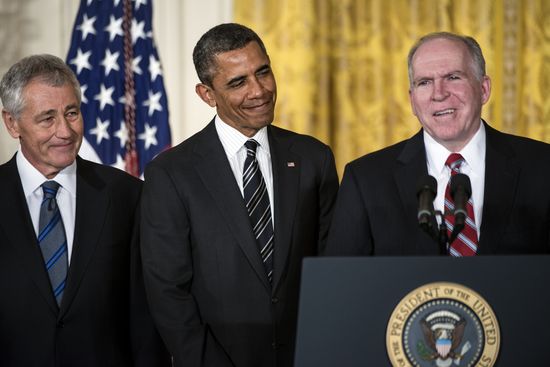
Today on the Dish, Andrew explained why Chuck Hagel’s nomination signals a more honest foreign policy, viewed it as a strike against anti-Semitism, and looked forward to the debate it will spawn in the Senate. He fielded the stream of neocon objections to the nomination throughout the day, from Hewitt-nominee Ed Koch to Elliott Abrams to Bill Kristol (who actually recommended Hagel for George W. Bush’s VP once upon a time). He also found Hagel’s evolution on gay rights as encouraging rather than cause for concern. Similarly, Andrew saw the nomination of John Brennan – one-time torture apologist – as a promising influence on the runaway drone war. Andrew also revisited the defense of Zero Dark Thirty - which Glenn Kenny praised as art precisely for its moral ambiguity – and he saw eye-to-eye with Maggie Gallagher on digital media.

In other political coverage, we sketched a gloomy picture of the GOP’s continued scorched-earth policy in fiscal cliff negotiations and lamented the lack of courage in either party to face up to the necessity of shared sacrifice. In contrast, a visit to The American Conservative and The American Prospect’s new shared office gave us a glimpse of actual political civility. We also surveyed a new study on climate change and learned that the biggest obstacle to action is – surprise! – politics. Drum came down hard on the platinum coin, Evan Soltas considered some alternatives to raising minimum wage, and Bill Bishop noted how few counties switched parties this past election season. We explored some reasons why so few women identify as libertarian while Glenn Reynolds earned himself a Yglesias Award nomination by offering the GOP a choice between intolerance and reality. Beinart pointed to signs that the Republican candidate in 2016 will likely make this choice and run against the party.

Looking abroad, Neil Shea anticipated that Afghan leaders will have a seriously difficult time adjusting to US withdrawal, while Jason Miklian tracked the passage of conflict diamonds through India. Finally, Green Movement skeptics Flynt and Hillary Mann Leverett argued that Ahmadinejad leaves behind a significant economic legacy.

In assorted coverage, we took a look at Michael Apted’s ambitious attempt to document the better part of people’s lives in the British class system in his series 56 Up, and Stephen Marche analyzed the TV series Girls as a reflection of this generation’s "new narcissism." Caitlin Bruner introduced us to Iamus, an artificial intelligence that writes classical music, and we caught up with an older friend, the World's Best Pickpocket, who divulged his methods. Esther Inglis-Arkell gave us an idea of what might produce the perfect spacecraft fuel. We felt a warm breeze from Granada, Nicaragua in today’s VFYW, pumped iron during our MHB, and urged readers to scroll through lackluster alternative book covers for today’s Hathos Alert. 

In Dish independence news, we continued to air questions and commentary about the new model and let you know that we passed the $440,000 this afternoon. We still have a long ways to go to hit our target, so please consider becoming a member of an independent, ad-free Dish here

– B.J.

(Photo by Brendan Smialowski/AFP/Getty Images)

The Sweet Sounds Of Algorithms

Researchers at the University of Málaga in Spain have built an AI program named Iamus, which composes classical music “at the touch of a button.” Caitlin Bruner explains:

The project is slightly different from other work in artificial intelligence, with the research team mapping out the program as not to outdo composers, but be able to compete on the same level. Constantly adding source material to the software, Iamus can develop, learn, and create more complex structures, just as a composer becomes more practiced with age.

(Video: a performance of an Iamus composition.)