“I stopped the [syndicated newspaper] column because it interfered with building a more direct relationship with my readers through email and the web,” – Maggie Gallagher.
See? We don’t disagree on everything.
“I stopped the [syndicated newspaper] column because it interfered with building a more direct relationship with my readers through email and the web,” – Maggie Gallagher.
See? We don’t disagree on everything.
Train your eyes on this:
A blemish or an opportunity? My view is that it’s both. We have an unusual opportunity to grill a nominee over the vital issues of torture and accountability, drones and secrecy. We need more sunlight – including public access to the Senate Intelligence Committee’s definitive report on the torture program under Bush-Cheney. But the Brennan hearings are a start.
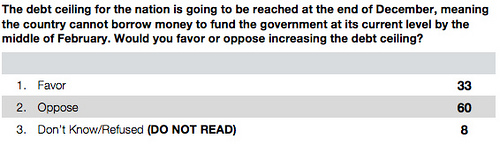
Recent polling has convinced many Republicans that they have the upper hand on the debt ceiling. Jonathan Bernstein isn't buying it:
[T]hat people think “raise the debt limit” is bad tells us nothing about how they would react to an economic crash caused by government default. As for spending, it’s well known that generic calls to “cut spending” are popular, but so is increasing spending on virtually every individual program the government actually spends money on. In any actual battle, Republicans will eventually be identified by specific cuts (even if they resist supporting specific cuts, Democrats will fill in the blanks). In other words, this kind of polling tells us absolutely nothing about how a real debt limit fight, much less a default, would play out in terms of public opinion.
I wish I were so certain. But if there's one thing we know about the great American public right now it is that it is firmly in favor of no cuts on spending, no increases in taxation, and no raising of the debt ceiling limit. Very few of our actual politicians, including president Obama, has been bold enough to tell them that this is impossible, and that they are effectively big babies, incapable of making basic choices about what to pay for, and how. In that sense, what America truly lacks right now is a real conservative: a Thatcher figure who can insist that things have to paid for or cut, and that you cannot have it both ways. Neither side has that courage, and since Reagan, it has been a truism that stark fiscal honesty with the public is political death.
But that's precisely why we have the debt we have and the impasse we have. And if Obama pretends that we can resolve this by revenues alone, he is part of the problem, not the solution.

A quote from 2002 worth re-reading today:
"If disarmament in Iraq requires the use of force, we need to consider carefully the implications and consequences of our actions. The future of Iraq after Saddam Hussein is also an open question. Some of my colleagues and some American analysts now speak authoritatively of Sunnis, Shiites and Kurds in Iraq, and how Iraq can be a test case for democracy in the Arab world. How many of us really know and understand much about Iraq, the country, the history, the people, the role in the Arab world? I approach the issue of post-Saddam Iraq and the future of democracy and stability in the Middle East with more caution, realism and a bit more humility… Imposing democracy through force in Iraq is a roll of the dice. A democratic effort cannot be maintained without building durable Iraqi political institutions and developing a regional and international commitment to Iraq's reconstruction. No small task."
Now let's take a look at the record of Bill Kristol, who, unlike Hagel, didn't serve in uniform. Here's how he attacked Hagel at the time:
Iraq's uncertain future, as opposed to its totalitarian present, has become the principle [sic] concern of many realists. "What comes after a military invasion?" Senator Chuck Hagel would like to know. "Who rules Iraq? Does the United States really want to be in Baghdad, trying to police Baghdad for twenty or thirty years?" … Predictions of ethnic turmoil in Iraq are even more questionable than they were in the case of Afghanistan. Unlike the Taliban, Saddam has little support among any ethnic group, Sunnis included, and the Iraqi opposition is itself a multi-ethnic force…
[T]he executive director of the Iraq Foundation, Rend Rahim Francke, says, "we will not have a civil war in Iraq. This is contrary to Iraqi history, and Iraq has not had a history of communal conflict as there has been in the Balkans or in Afghanistan…"
Which one would you trust to have input on foreign policy in the coming years? A pro-Greater Israel fanatic who has been proven definitively wrong about almost everything in the past decade? Or one of a handful of senators who stood up against the tide for war and his own party and asked all the questions I didn't?
(Photo via TPM: "Chuck Hagel and his brother Tom sit on an armored personnel carrier in Vietnam in 1968. More photos here.")
In one of their more desperate moves, the neocons, who have shown zero interest in the plight of gay servicemembers in the past, decided to play the gay card. Some of them may even have shoveled money at the Log Cabin Republicans to get them to reverse position on the Purple Heart Republican (LCR won't tell who financed the Hagel smear ad in the NYT). But the reality is that Hagel has clearly evolved, which again offers an opportunity, not a threat:
The charges of Hagelian insensitivity to gay rights, based on several of past votes and one 1990s comment, have largely evaporated. Hagel, like most of the country, has “evolved” on the issue. If the question comes up in the hearings, it will be as a coming out party for acceptance of the gay rights revolution by the Republican establishment. Those who have been involved in the struggle will cheer, as indeed will many who have done no more than observe, often skeptically, from the sidelines.
It seems to me that politically-attuned gays, far from engaging in AIPAC-style smearing, should be thrilled to see a Republican military figure openly backing open gay military service as a nominee for defense secretary. He's a blow both to the neocons and the Christianists. Which, believe it or not, is why many of us supported Obama in the first place: a voice of reason against the fanaticism, utopianism and cant of the Bush-Cheney-Rumsfeld years.
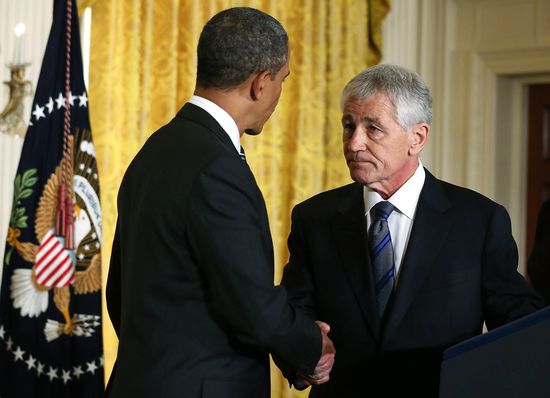
(Photo: U.S. President Barack Obama shakes hands with former U.S. Sen. Chuck Hagel (R-NE) during a personnel announcement in the East Room at the White House on January 7, 2013 in Washington, DC. Obama has nominated Hagel for the next Secretary of Defense and Deputy National Security Advisor for Homeland Security and Counterterrorism John Brennan to become the new director of the CIA. By Alex Wong/Getty Images)

Granada, Nicaragua, 10 am
The neocon once wanted Hagel for vice-president under George W. Bush. No accusations of anti-Semitism then.
We promised to keep you informed about progress. Over the weekend, we passed the critical, symbolic figure of $420,000. At last count this afternoon, we're at $440,000 in pre-subscriptions. That's a staggering number in less than a week.
It has died down, of course, after an initial rush. But we know there are serious Dish-lovers out there reading this who have not yet subscribed. We're only half-way up our fiscal cliff for the year – so we still badly need your support. If you want to keep this blog alive and well and making trouble for the indefinite future, you can get your pre-subscription here. My post explaining the whole ad-free, reader-based model is here.
Become a member for only a nickel a day in under two minutes here.
Stephen Marche investigates:
This month, The Carrie Diaries relaunches the Sex and the City franchise while Girls starts up its second season. The contrast is stark: In the old narcissism, we have dumb, beautiful moneyed people trying to become more beautiful and more moneyed. In the new narcissism, we have smart, unattractive poor people trying to confront their pervasive, intense self-obsession. All of the best shows on television, the most urgent, most relevant pop culture of the moment — Louie, Community, the upcoming season of Arrested Development — reflect us as we are: narcissists in search of a cure from ourselves.
[Girls] really is legitimately the marker of a generational turn.
There were women like the women on Girls fifteen years ago. I remember them. They had graduated from the Ivy Leagues, they didn't have good jobs right away, and they were so obsessed with the drama of their own potential that they forgot to do anything. They were writers who talked about what it meant for them to be writers rather than paragraph structure. The brilliance of Lena Dunham — or one of them anyway — is that she's aware of this self-induced crisis. In one of the final scenes of last season's Girls, her boyfriend screams at her, "You love yourself so much," and then gets hit by a truck because he's not paying attention to the world around him. Exactly. She has been self-aware enough to pass through narcissism, at least partially.
 The Dish