Why Hagel Matters

Hagel_GT

According to various reports, Obama will nominate Chuck Hagel for defense secretary. Beinart puts the nomination in context:

What makes Hagel so important, and so threatening to the Republican foreign-policy elite, is that he is one of the few prominent Republican-aligned politicians and commentators (George Will and Francis Fukuyama are others, but such voices are rare) who was intellectually changed by Iraq. And Hagel was changed, in large measure, because he bore within him intellectual (and physical) scar tissue from Vietnam. As my former colleague John Judis captured brilliantly in a 2007 New Republic profile, the Iraq War sparked something visceral in Hagel, as the former Vietnam rifleman realized that, once again, detached and self-interested elites were sending working-class kids like himself to die in a war they couldn’t honestly defend. 

To my mind, this is his core qualification. Unlike so many of the lemmings and partisans of Washington DC, Hagel actually called out the catastrophe of the Iraq War as it happened. The neocons cannot forgive him for exposing what they wrought on the nation and the world. For good measure, he has a Purple Heart and has served in combat. Not easy to say about most of the Iraq War armchair warriors and war criminals.

Which is to say, as Chuck Todd said this morning, this nomination is about accountability for the Iraq War. All those ducking responsibility for the calamity – Abrams, Kristol, Stephens – are determined that those of us honest enough to resist, having supported in the first place, be erased from history. Or smeared as anti-Semites. Or given that epithet which impresses them but baffles me: "outside the mainstream". Rephrase that as – after initial support – being "outside the Iraq War mainstream" in DC – and you have a major reason to back him. Ambers explains the personal background:

Why isn't Obama replacing Panetta with a Democrat? Simple: Of all the possible candidates, he trusts Hagel. Hagel was the head of Obama's intelligence advisory board, and was a frequent informal "red cell" brain that Obama privately turned to when he wanted a second opinion. He has been picking Hagel's brain on subjects as diverse as Afghanistan, China, special operations force posture, and intelligence for several years now. (Hagel has all the required clearances.)

Greenwald's view:

All of the Democratic alternatives to Hagel who have been seriously mentioned are nothing more than standard foreign policy technocrats, fully on-board with the DC consensus regarding war, militarism, Israel, Iran, and the Middle East. That's why Kristol, the Washington Post and other neocons were urging Obama to select them rather than Hagel: because those neocons know that, unlike Hagel, these Democratic technocrats pose no challenge whatsoever to their agenda of sustaining destructive US policy in the Middle East and commitment to endless war.

Kristol fumes:

[I]f you read the oeuvre of Hagel's defenders, you'll see that Hagel must be appointed in order to spite many of his critics, whom they deeply dislike. Hagel’s defenders are welcome to their dislikes. But dislike of hawks, neocons, or friends of Israel isn't really a good reason to select Chuck Hagel. And there's something comical about many of the defenses of Hagel. His defenders rise up in high dudgeon to condemn Hagel's critics as smear merchants for criticizing Hagel as anti-Israel and soft on Iran—and then, if they're among the honest Hagel defenders, they praise Hagel for being anti-Israel and soft on Iran.

The language! We're not talking about dislike of people. We're talking about dislike of the mindset that got us into the Iaq War. We're talking about dislike of those who refuse to take moral responibility for anything and actually believe, with the blood of tens of thousands on their hands, they have some right to question a veteran with two Purple Hearts. They need a reality check: Obama won the election, not Romney. It says a huge amount about the Greater Israel lobby that they assume that national elections in no way should impede their usual control of Middle East policy in Washington. Just showing them that the battle to retrieve our democracy from lobby groups is worth something.

And Hagel is not anti-Israel. Kristol is anti-Israel, having fanatically supported this Israeli government's suicidal behavior, and the toxic, illegal social engineering on the West Bank that will render Israel either a non-democracy or a non-Jewish state. Ackerman argues that Hagel is more hawkish than his reputation would suggest:

Hagel earned his reputation as a skeptic of American military adventurism, as anyone who remembers his consistent criticism of the Iraq war will remember. But that criticism has blown Hagel’s reputation for dovishness out of proportion: after all, he voted in 2002 to authorize the war. National Journal’s Michael Hirsch insightfully argues Hagel’s reward for asking hard questions about the war is to have official Washington forget the rest of his record.

Tomasky thinks Obama is picking Hagel to help him trim the defense budget:

Making defense cuts a part of any budget/sequester deal is a must. Obama can't afford a secdef who talks the way Leon Panetta talked, about how this or that cut would be devastating. Hagel probably won't do that because a Republican can more credibly stand up and say no, we don't need X weapon system or two more carriers or whatever it is than a Democrat can.

Larison expects Hagel to be confirmed:

Yes, McCain and the usual hard-liners will grandstand during the hearings, but they likely would have done that anyway, and I doubt that there most Senate Republicans want to be seen blocking Hagel. Not only would that be an extraordinary thing to do in response to any Cabinet nomination, but it would be unheard of to do it to a former colleague and a member of their own party. Republican hard-liners will do what they can to make the hearings a tiresome and drawn-out process, but in so doing they will simply be reconfirming why the public doesn’t trust them and why Hagel was the right choice.

And that is the real opportunity of this nomination. At the hearings, we can see McCain's vision versus Hagel's, and see the difference between a man who refuses to adjust his global mindset after Iraq and a man who has had the strength and character to do so. So many Americans are likely to agree with Hagel over military restraint, diplomatic patience, and cutting defense bloat. The reason the Greater Israel lobby is in such a froth is that the weakness of their arguments could be publicly exposed – by a Republican. And there isn't enough AIPAC money and intimidation to stop that happening.

(Photo: Senator Chuck Hagel (R-NE) speaks at the Vietnam Veterans Memorial March 26, 2007 in Washington, DC. By Win McNamee/Getty Images)

The Logistics Of Leaving

158708318

Neil Shea examines a hurdle in US efforts to leave Afghanistan – reconfiguring the locals' mindset:

The elders have stopped talking. They listen to a soldier explain to them for the third or fourth time how the new system is supposed to work. "You can’t come ask us to build you a madrassa or a clinic or a well anymore," the soldier says. "You have to go to your own government."

It is the language of leaving, of withdrawal. But it doesn’t work. No matter how many times the soldier says it, the elders pause and then repeat a list of things they want. A madrassa, a clinic, a well. The soldiers can do nothing; the message does not sink in. They say it again anyway, because that’s what they must do. No, you can’t come to us and the cycle is old and new, beginning and ending.

Recent Dish on Neil's previous post in the series, on the mutts of war, here and here.

(Photo: An Afghanistan National Police official is directed by an Afghan police officer during a training exercise at a police academy outside Herat on December 25, 2012. The cadets have to complete an eight-week course before graduating. Until now the training has been done by Afghan and forces from NATO's ISAF coalition but now it is run by Afghan personnel alone. By Aref Karimi/AFP/Getty Images)

An Alternative To Raising The Minimum Wage

Evan Soltas suggests increasing the Earned Income Tax Credit:

Liberal arguments for increasing the minimum wage have a fundamental flaw: They restrict the set of policy choices to either a minimum wage increase or doing nothing. That means they overlook the single most important federal policy for the poor: the Earned Income Tax Credit.

The EITC is a measure in the federal tax code to support the living standards of the poor without creating a “welfare trap” by diminishing the incentive to work. Economists widely consider the credit a success for reducing poverty while increasing employment. Created in 1975, the credit has been successively expanded in five times since. It is now the nation’s largest anti-poverty transfer program.

Map Of The Day

Flipped_Counties

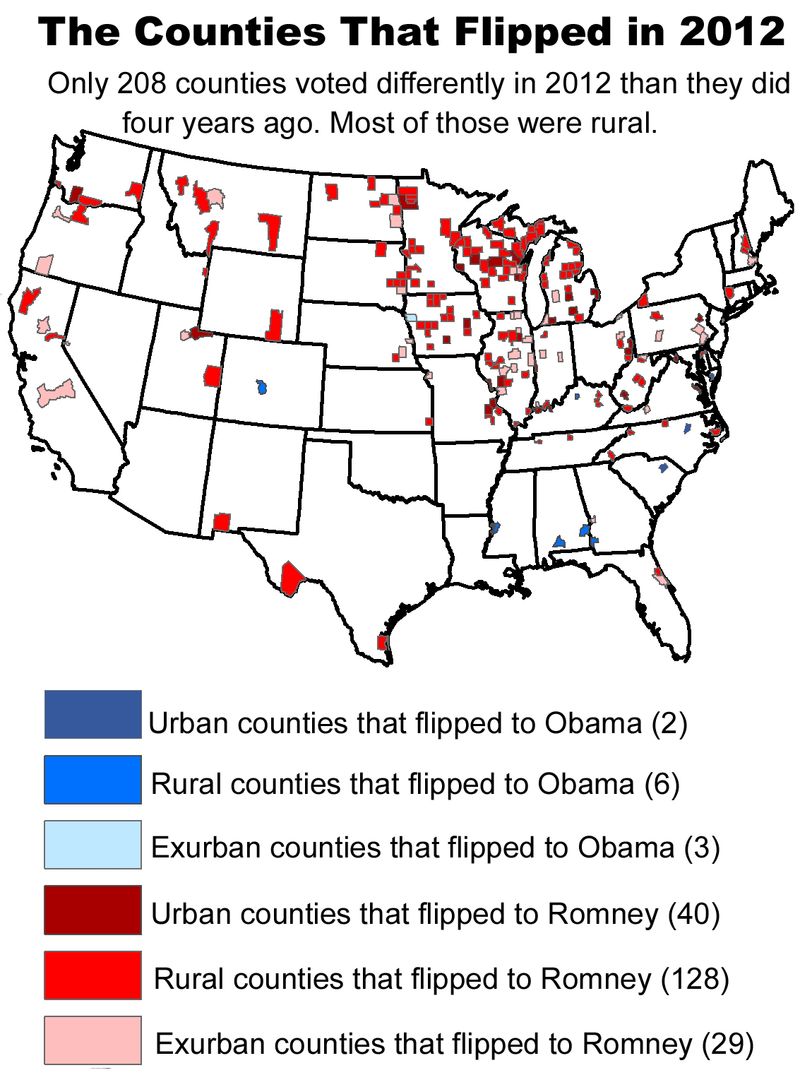
Bill Bishop, who provides the above map, compares county-level voting from 2008 to 2012 and finds that "[o]nly 208 counties changed allegiance in 2012 out of more than 3,100 counties that cast votes." He provides some perspective:

Statistician Robert Cushing checked all the presidential elections in the last 100 years and found that, on average, 24 percent of all counties switch parties from one election to the next. The 208 counties that changed from 2008 to 2012 amounted to less than seven percent of all counties. That is the fewest flippers of any election in the last century.

A Conflict Diamond Is Forever

Jason Miklian spotlights the Indian city of Surat, a way station for most of the world's diamonds – both legal and otherwise:

Here in Surat, dirt-cheap wages and loose regulations have created a dream environment for the global diamond industry. It has turned a sleepy provincial town into a new megacity within a single generation, a business center where more than 90 percent of the world's unpolished diamonds are now processed and polished. Individual stones can change hands up to a dozen times over a matter of weeks in polishing houses that grab from piles of legal and illegal stones like mix-'n'-match candy bins. Deciphering clean from dirty becomes nearly impossible. Once the Gujarat Mail [train] reaches the end of the line in Mumbai, the stones have had their damning histories washed away, and buyers ship more than $40 billion of certified merchandise annually out of a country that international authorities say is clean. But if you own a diamond bought in the 21st century, odds are it took an overnight journey on the Mail. Odds are too, you'll have no idea where it really came from.

The Weekend Wrap

Chapel

This weekend on the Dish, we provided an array of religious, books, and cultural coverage. In matters of faith, doubt, and philosophy, David Attenborough recalled his vision of nature without man, T. M. Luhrmann emphasized the spiritual dimension of drug-induced altered states, Victoria Beale lambasted recent books from Alain de Botton's "School of Life" imprint, and readers responded to Maurice Sendak's moving thoughts on death. Walter Russell Mead reflected on the entrepreneurial spirit of American religion, Jay Michaelson critiqued the new film adaptation of Jack Kerouac's On the Road, and Christian Wiman explored the language of faith. Beth Haile dissected the moral theology of Les Mis, Katy Waldman hailed Milton's Paradise Lost as a progenitor of science fiction, and David Bentley Hart contemplated the religious contours of modernity.

In literary and arts coverage, Jacob Leland mused on the meaning of gluttony in famous books from the early 20th century, Hannah Rosefield deconstructed the role of obesity in literature, and Edith Zimmerman argued there's no such thing as good advice. Amy Whitaker stalked Harper Lee, Zadie Smith offered insight into how books impact the way we view ourselves, Hamilton Nolan ripped into the narcissism of young writers, Ed Park located the source of the P.G. Wodehouse's enduring popularity, and John Banville ruminated on Rainer Maria Rilke's Letters to a Young Poet. Carolyn Abbate explained how opera has evolved, Laurie Fendrich appreciated the rogue art critic Dave Hickey, and Norman Lebrecht eviscerated the Mozart industry. Read Saturday's poem here and Sunday's here.

In assorted news and views, William Pesek assessed the evolving political crisis sparked by the gang-rape and death of a 23-year-old woman in India, Amanda Marcotte pondered the implications of Internet vigilantism, James Panero put the digital age in the context of other information revolutions, Jesse McDougall explicated the science of time and space, and NASA considered lassoing an asteroid to bring it into the moon's orbit. Ben Robinson revealed the secrets to success on The Price is Right, Justin Amirkhani went behind the scenes at Medieval Times, Christian DeBenedetti tracked the rise of a black market for craft beer, Megan Garber remembered the Swedish physician who invented the exercise machine, and new research supported the case for nature's cognitive benefits. FOTD here, MHBs here and here, VFYWs here and here, and the latest window contest here.

In case you missed it, read Andrew's declaration of Dish independence and all other coverage and explanation of the decision here. Find out about our core strength – amazing readers – here. And please consider becoming a member here.

– M.S.

(Photo by Flickr user Randy OHC)

Improving The Payday Loan

Silicon valley startups, such as ZestFinance, founded by the former chief information officer at Google, Douglas Merrill, are starting to tackle the challenge of "subprime" borrowers. Marcus Wohlsen explains how finely tuned algorithms could be key to lowering the high rates often charged to them:

In theory, the high cost of a traditional payday loan stems from the greater risk a lender takes advancing cash to someone who can’t qualify for other forms of credit. Some critics contend payday lenders charge usurious rates to trap borrowers in a cycle of debt they can’t escape. But even lenders acting in good faith can’t offer the low rates made possible by ZestFinance’s algorithms, Merrill says.

Using data-crunching skills polished at Google, Merrill says ZestFinance analyzes 70,000 variables to create a finely tuned risk profile of every borrower that goes far beyond the bounds of traditional credit scoring. The more accurately a lender can assess a borrower’s risk of default, the more accurately a lender can price a loan. Just going by a person’s income minus expenses, the calculus most often used to determine credit-worthiness, is hardly enough to predict whether a person will pay back a loan, he says.

"Our finding, much like in Google search quality, is that there’s actually hundreds of small signals, if you know where to find them," Merrill says. For instance, he says, many subprime borrowers also use prepaid cellphones. If they let the account lapse, they lose their phone number. Would-be borrowers who don’t make keeping a consistent phone number a priority send a “huge negative signal.” It’s not about ability to pay, he says. It’s about willingness to pay.

Chart Of The Day

Screen shot 2013-01-01 at 7.46.46 PM

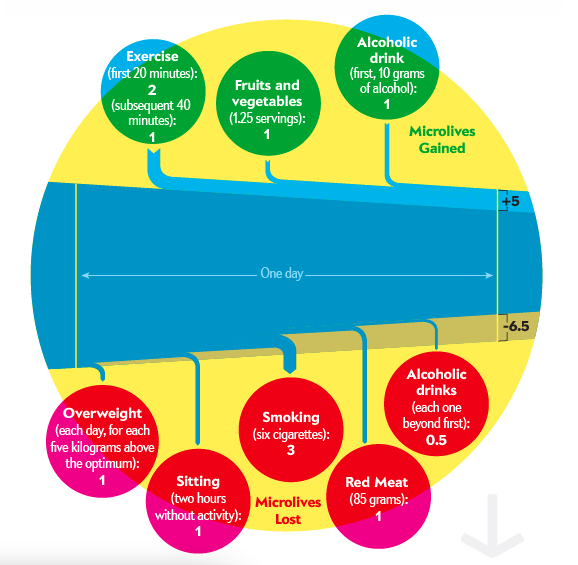
Mark Fischetti offers this chart to those struggling with kicking a bad habit:

"I hate when someone tells me that something is risky," says David Spiegelhalter, a professor of risk assessment at the University of Cambridge. "Well, compared to what?" To answer his own question, Spiegelhalter converted reams of statistical risk tables into a simple metric: a microlife—30 minutes.

(Chart by Jen Christiansen)

The Decline Of Tinkering, Ctd

A reader writes:

Tinkering is not actually declining. While it may not take the form of a Jobs & Wozniak, there are plenty of tinkerers taking old objects and trying to improve them or create something new out of them. A whole new culture has formed around that very idea to the point where there are magazines dedicated to the craft (Make Magazine among others), Internet programs (Revision 3) and even fairs. Make Magazine has Makerfaire with San Francisco, NY, UK and Detroit as the main sites with smaller versions around the world. These events are heavily attended by a diverse audience that includes everyone form science geeks to families. Tinkering has taken different forms where people build their own 3d printers, robotics and other electronics. It isn’t gone, it’s just moved into a more modern age thanks to tinkerers like Jobs & Wozniak.

Another:

I think that you are missing the tinkering that is going on now days. Consider the Raspberry Pi computer selling for just $35.

This is a modern tinkerer's dream box and an entire ecosystem has sprung up around it with projects, daughter cards – all sorts of stuff. For example, the latest post on a projects website is "How to build a virtual analogue synthesizer using Raspberry Pi." You can't get more tinkerer than that! And that is only one of the new small, cheap -dare I say disposable – micro PCs out there.

Another:

If, as Foege writes, "tinkering is making something genuinely new out of the things that already surround us," I'd say that the number of tinkerers is many times that of the golden era of the '70s. It's just that people are tinkering with code rather than hardware. All those apps for the iPhone and Android? Thousands represent the product of tinkering, in which developers take existing resources like an operating system and a widget set and produce something new enough that people are willing to spend time on it or even spend money for it.

“It Makes Me Cry Only When I See My Friends Go Before Me” Ctd

A reader writes:

I could go on for pages about why I willingly and eagerly subscribed to the Dish yesterday (and paid more than the asking price).  But only your blog brings me things like the 5-minute animation of Terri Gross's interview with Maurice Sendak, which just now rendered me weeping over my lunch as I heard him describe his love for the world and for his friends who have died.  I had to go over to lock my front door, turn off the overhead lights to get some semblance of privacy, and only in writing you this email am I finally composing myself.

Another:

When he told Ms. Gross that he "hopes he goes first so he doesn't have to miss her" – you could hear Ms. Gross get taken aback, and I was too.  I simply cannot think of a nicer thing to say to another human being.  Leave it to Mr. Sendak to find the single nicest sentiment ever.

Another reader moved by the interview:

I also took your reader-centric survey a while ago and need to change a response. Until this article, I was an under-35 who had never cried as a result of a story on The Dish … no more.

Another:

Because I hadn't known much about Mr. Sendak's personality or personal history before listening to that show, the earlier interview (and the earlier part of the clipped interview) provided the remarkable context for his aging observations and attitude, from a person who doesn't seem disposed toward sentimentality.  I have seldom heard someone so intelligent be so open and apparently honest about their thoughts about life's many difficult troubles, god, and growing old, and in such concise fashion.  Some of the very aspects I so cherish about The Dish, actually, and also one of the things that Terri Gross is so often able to nudge her guests toward.

Mr. Sendak says he only cries when his friends go first.  I generally only cry when I encounter fundamentally poignant stories that make me deeply happy – if I had to force myself to cry as an actor, I would think of someone who is severely disabled who works for years, with the help of friends and family, to get to the point where they can complete a given task – to be dramatic, let's say a marathon.  I envision that person's friends and family waiting at the finish line in the cold and dark, at 4:30 in the morning (19 hours after the race started), long after everyone else had gone home, jumping up and down and cheering as their loved one completes the last block.

I was all but bawling as I sat in the Comcast parking lot last May when I heard Mr. Sendak ever so momentarily render Terri Gross speechless as he communicated how meaningful their relationship was to him.

When I composed myself, I called my wife and told her it was a must must listen (and then returned the modem).  I am not sure she ever listened to the broadcast, so I am glad you reminded me and that the NY Times and you shared this with a wider audience.

Another:

The animation of the Gross/Sendak bit is nice, but one reason Sendak opens up to her is that they had been talking for over twenty years. One of last year's great "long listens" was the replay of all their interviews, as you find here. Fresh Air rebroadcasted segments upon Sendak's death. You can hear his voice age and change after his stroke, and you can hear his concerns darken and deepen. Give yourself the time for it and you won't be sorry.

Another sends the above video:

If you haven't seen the Spike Jonze documentary about Sendak, it is wonderful.