Gaming The Price Is Right

With the advice of repeat contestants and a bunch of spreadsheets, Ben Robinson reveals some of the secrets to success on the show:

You show up early (though not as early as you had to in the Bob Barker days), you sit around, and you get interviewed in a group of about 15 or 20. That interview is the lone means producers have of selecting the nine contestants who’ll be called out of the audience of 300. The goal is to toe the line between enthusiasm and transparent, annoying fakeness. Nobody knew if I should shave my beard or not.

The hot-tub showcase winner, the last one I consult, has the most compelling advice. She offers hugely valuable trip-pricing info—domestic or Caribbean trips run $6-7K, Euro ones more like $11K—and she wildly contradicts the others on the question of enthusiasm. Go completely bonkers, she tells us, and as long as we’re as young and good-looking as I’ve claimed, one person from our group of four will get on.

Or you could take shrooms before the show, like the bearded dude seen above did. Just don’t take forever to make a bid like Mary did.
A Victimless Bloodsport

Justin Amirkhani goes behind the scenes at Medieval Times, interviewing his friend, the knight Max Shkvorets:

When I asked if he ever got too invested in the imagination of the show, Max told me, "It’s a little bit of an unhealthy way to think about things, but I remember the very first time I won a fight as the red knight and I got to kill a guy. For a split second after I killed him, I felt in it—completely in it—I had just killed a man for someone’s amusement and felt the glory of the Earth."

Amirkhani nods:

Although I had only seen the show once before meeting the cast, I completely understood their sentiments. As Max explained it to me, "Combat is literally the purest form of drama." It’s the reason you get a thrill when watching a clip of a lion taking down a zebra and the reason folks gather around to gawk at people brawling in the streets. [… Medieval Times] lets the audience bask in their natural desire for carnage without any of the first world guilt that comes from watching people permanently destroy themselves for someone's entertainment.

Liquid Gold

Christian DeBenedetti tracks the rise of a black market for craft beer:

It’s illegal to sell beer for consumption without a license, but thousands of beer auctions on eBay have successfully closed. Their vendors have managed this by listing Beer their wares as "collectible containers" lacking any valuable contents, an obvious dodge that infuriates many brewers. The deals have seemed to flout both U.S. law and the site's own guidelines, and have often resulted in eye-popping prices—like this $1,300 sale of a single 12-ounce bottle. In one of the most galling recent examples, a seller in Vermont resold a magnum of sour beer blended by Belgian Lambic master Armand Debelder for Debelder’s wedding (starting bid, $90; winning 20th bid, $1,322). …

Are some brewers merely aping the outrageous price hikes and marketing-motivated affectations of wine? Perhaps. But many beers are worthy of the cellar; as [Kirk Kelewae, service director of New York’s Eleven Madison Park] says, "Aged beers can be a remarkable experience." What’s more, a move toward extravagance isn’t so much a modern fad as a return to beer’s high-society past. (Catherine the Great of Russia, for instance, commissioned age-worthy, English-brewed imperial stout for her court.)

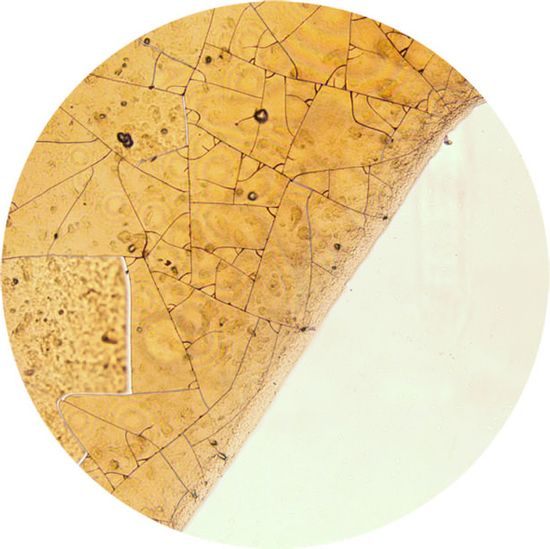
(Image: Beer under a microscope, from the series Fingerprints of Drinkable Culture, by photographer William LeGoullon, via Petapixel)

Literature As Harsh Mirror

In a wide-ranging interview, Zadie Smith offers insight into how we view ourselves, both inside and outside of books:

You’re so used to this kind of smoothness in writing, this feeling that you, the reader, or you, the writer, are this great empathic, wondrous soul. I would love to be that, but of course when we see the way we behave in the world really to other people, we’re confronted with a different version of who we are. Not just this wonderful, tolerant, broad person who sees humanity and everything, but someone a little more narrow, self-defended, sometimes cruel, sometimes selfish. I wanted to try and show that. And also, someone who—people who live in a city, who are able to switch off these famous values of empathy and tolerance and love quite suddenly when you need to. Or if you need to. I wanted to be honest about that experience, but it’s not something you want reflected back at you perhaps, it’s not a pleasure. But reading can be many things: sometimes it can be a pleasure, sometimes it’s a bit tougher. It’s a broad church that way.

A Poem For Saturday

Bedforsafe2

"Safe" by Aaron Smith:

We weren’t supposed to touch
              the guns lined up
under our parents’ bed, rifles
              for hunting, pistols for protecting
our home. The carpet was burning
              lava, we’d dangle our feet,
the barrels mysterious beneath us.
              Headstands on the floor,
inches from accident, from sadness,
              and always we knew not to tell.
Nobody home, I lay my body the length
              of the bed, all the barrels
facing out. I pressed my back against
              their silent ends, metal tips
poking neck and spine—a firing squad!
              a stickup! Sometimes I’d face
them, a microphone, or love
              their tiny lips—tongue-deep
between my teeth—practicing the first kiss
              the way my sister used her fist.

(From Appetite by Aaron Smith © 2012. Used by permission of the University of Pittsburgh Press. Photo by Flickr user JD_WMWM)

Stalking Harper Lee

In search of the famously reclusive author, Amy Whitaker arrived in Monroeville, Alabama, on the weekend of Lee’s birthday, where she met a friendly guide from the local museum:

Dawn is at her lemonade stand when I arrive in the town square. I will later realize that Dawn was an outsider herself, and this status makes her — through holistic and simple empathy — part of the welcoming committee or membrane of the town. Museum volunteers surround her, already staged around the courthouse to welcome visitors for that evening’s sold out show of the To Kill a Mockingbird play the town puts on each spring. Dawn, who has only just met me, makes introductions. They ask if I have heard about the "mystery guest" at lunch today. I have missed Harper Lee’s cameo by two hours. Apparently, the Alabama Writers Symposium — idiot-savant stalker luck, take two: it is the weekend of their meeting — gives an annual Harper Lee Award, this time to Fannie Flagg. Miss Lee was not expected. They tell me that someone stopped by to visit her that morning and told her they were giving the award. She replied, "That sounds nice. Can I have one too?," and then came along.

Whitaker didn't meet Lee, but she didn't consider the trip a bust either:

Harper Lee’s own life sounds fascinating, and I start to fantasize that she is a person I would have liked to be friends with, or even who is a little bit like myself. But to make her a character instead of a person — even inside her own mythology — is not as interesting as the living breathing life-as-art practice of all the townspeople who guard her privacy fiercely, who work as the bank CEO by day and play Atticus by night, and who print me a volunteer nametag even though I can’t give directions to anything but the ladies room, and offer me Styrofoam cups of Malibu Tropical Mojito out of a giant Capri-Sun container as we chat with Miss Stephanie backstage during the play.

For another great take on stalking a writer's hometown, revisit Mira Ptacin's pilgrimmage to E.B. White's cabin.

Nature Without Humans

David Attenborough recalls his own vision of it:

We built a hide on a big billabong and got there at about three o’clock in the morning, a couple of hours before sunrise. And the sun comes up, and you see this billabong thronged with magpies, geese, herons, cockatoos, kangaroos, coming down to drink, marine crocodiles. You had a vision of the natural world, a Rousseau-esque kind of thing. You suddenly held your breath, because you were in a strange, godlike thing; you saw the world as it was without humanity in it. And then suddenly something happened – I forget what it was, someone made a noise or something – so the whole thing was gone. But that was a moment of perception which haunts you.

You can watch the unembeddable trailer for his new series on the Galapagos here. After producing 60 years of programming, Attenborough admits he is still "flabbergasted" by nature all the time:

I wasn’t involved in filming it, but a friend of mine was up in the Andes filming the courtship display of a particular hummingbird, a high-altitude hummingbird. The female was trying to advance, and the male was coming and going, "prrrrrrt", and then it was gone. You think, "Oh, that’s OK" – but then my pal had the wit to shoot it at 250 frames [a second] and you suddenly saw the complexity of the display. It was astounding, all at this very, very high speed.

The moment you say that, you think of the timescale of hummingbirds, the speed of their hearts and the temperatures at which they operate. Their timescales are quite different. You suddenly realise your own limitations: how your sensory perceptions are governed by your heart rate. I thought that was so exciting, and it taught you so much, not only about how complex nature is, but about how impoverished your perceptions can be, governed as they are by your human condition.

Fat In Fiction

Hannah Rosefield deconstructs the role of obesity in literature:

In 2010, 33.3 percent of American adults were overweight, and another 35.9 percent obese. Yet fiction has largely ignored this worldwide expansion of waistlines. The average character in today’s novel is no fatter than the average character in a novel published 10, 50, or 200 years ago. In "On Being Ill" (1926), Virginia Woolf notes how strange it is that illness should feature so little in fiction. Her explanation for why this might be applies equally to fatness — not because fat is or is not an illness, but because both are species of physical experience, and literature, for the most part,

does its best to maintain that its concern is with the mind, that the body is a sheet of plain glass through which the soul looks straight and clear, and, save for one or two passions such as desire and greed, is null, and negligible, and nonexistent.

Woolf knows, as every one of us does, that this is nonsense, that "all day, all night the body intervenes; blunts or sharpens, colours or discolours." But it is hard, almost impossibly hard, she suggests, to convey physical experience in words. To record in language "the daily drama of the body" — healthy or sick, fat or thin — would need "the courage of a lion tamer; a robust philosophy; a reason footed in the bowels of the earth."

Jessa Crispin broadens the conversation: 

The question might be reworded from "Where are all the fat characters in literature?" to "Where are all the fat characters in literature whose fatness is not the central issue of the novel?" I'm kind of blanking on that one. It's like abortion in literature. Where are the abortions in literature that are not the central problem of the book? Can a character just have an abortion and not have it be like the worst thing that has ever happened?

D.G. Myers pushes back against Crispin's analogy.