DIY Abortions

Ada Calhoun reports on them:

[W]hile obtaining an abortion at a clinic is becoming harder, home abortion has never been easier or safer. In 2012, women have two resources that previous generations did not: abortion pills and the Internet. The combination of two drugs—Cytotec (Misoprostol) and Mifeprex (Mifepristone, known as RU-486 in trials) is 95 to 99 percent effective at ending a pregnancy in the first nine weeks, according to Ibis Reproductive Health’s Daniel Grossman, an expert on medical abortion. (Cytotec is 85 to 90 percent effective on its own.) "Essentially they induce an abortion similar to a spontaneous miscarriage," says Grossman of the drug combination. …

Determining how many American women have had home abortions is exceedingly difficult: 

The Centers for Disease Control and Prevention does not track illegal abortions. There is no blood test for drugs like Cytotec, and so such an abortion is indistinguishable from a natural miscarriage, even to a doctor. However, the proliferation of online dispensers suggests a rising demand. There are thousands of websites selling Cytotec for as little as $45 to $75 (compared with $300 to $800 for a legal medicated abortion in a clinic). Some claim to offer the harder-to-come-by Mifeprex, but may in fact be peddling Cytotec, or aspirin, or nothing at all. (Possible sources for the drugs include Mexico, where Cytotec is available over the counter, or even the United States, since it’s also prescribed here as an ulcer medication.)

The Weed Gender Gap, Ctd

A reader writes:

The continuing discussion on the weed gender gap compelled me to email the Dish for the first time. I am a daily smoker (when I can afford it) and enjoy getting high much more than getting drunk. Especially the after effects. When living with my girlfriend (also a regular smoker) in England during our studies, I always picked up for us. Now that I am living back in the States and she is still in England, I get a little nervous when she goes to pick up. I am sure she is fine but I can't help my feelings.

Another:

I don't know any women my age (40) who are daily pot smokers.  First of all, the munchies; we actually try to avoid hunger and getting fat.  Secondly, responsible people don't smoke pot when they're pregnant and nursing. Finally, it's not really attractive to be a daily pot-smoking woman. Unfair or not, it's just socially less acceptable for women to smoke pot regularly.

2nd Amendment Fixation

Conor Friedersdorf has a great rant against it:

I believe in an individual right to bear arms, and I have no problem with Americans who advocate on behalf of that right. If the feds start rounding up innocents to slaughter I have no problem with an armed citizenry fighting back. But folks who want to guard against a tyrannical government are foolish to focus on the 2nd Amendment while abandoning numerous others for fear of terrorism. The right to bear arms is the costliest liberty we have, in terms of innocent lives lost as an unintended byproduct; it is very unlikely to be exercised against the U.S. government in the foreseeable future; and its benefits are less important to securing liberty than habeas corpus and due process, as the experience of other free peoples demonstrates. I understand why people advocate on behalf of the right to bear arms, despite its costs; I don't understand why so many behave as if it is the most important safeguard against tyranny to maintain.

The Year In Cannabis, Ctd

A reader writes:

I think it's a bit premature to go around claiming that cannabis changes the teenage brain. Further, even if it does, how can we be certain that such changes are always bad? See this article, "Teen Marijuana Use May Show No Effect On Brain Tissue, Unlike Alcohol, Study Finds." 

By the way, I recall reading years ago of a psychologist who claimed that her adolescent patients who'd smoked had better personalities – more and better humor, greater compassion, sense of sharing and community, etc. This is little more than an anecdote, but it resonated with me. 

Another proposes we legalize pot for some teenagers:

As a 16-year-old student in Portland, Maine approximately the correct age range for that study, I want to contribute my two cents. The first thing that popped into my head while reading your post was the problem we have with teenage drinking in the US. Teenagers are not supposed to drink, because it is dangerous to their health. We are told over and over again that it stunts brain development, that it's illegal for teenagers, that it's something designed for only adults to do in moderation. As you said, that we should wait.

The problem with this approach is that is not working, in any way, shape or form.

If you were to conduct a poll of my classmates (I go to a small school where everyone knows each others business, otherwise I wouldn't make such assumptions), I would guess that 50 out of 65 have drunk alcohol with peers at least twice in the last six months. 25 out of 65 drink on a regular basis (such as every weekend), and a few even probably have driven while intoxicated (although they would never admit it). As for marijuana usage, my school is probably a skewed sample, as we are predominately white, rich and hipster, which together creates one of the biggest regular marijuana-smoking bases. I'd say that my school is probably twice what the survey reported. There are at least 10 or so kids in my 250 student high school who smoke consistently every day. 

While your point about anti-cigarette campaigns is valid, the huge problem with alcohol consumption (and current pot usage, as well) shows that prohibiting teens from doing an activity that makes them popular and happy (most of the time) does little to stop them doing it. I believe the solution would be to encourage us to make safe choices, but let us actually make the choice legally. In Europe, where the drinking age is 16-18, teens don't think it's cool to get shit-faced; they social drink, like adults. I have a friend from England recently came to an American boarding school, and thought that the alcohol usage by teens was hilarious, the stigma ridiculous. They all know that we're doing it, so why do they get so mad? 

This technique is a parenting style that my parents have always criticized. Parents who are strict with internet usage, with cell-phones, with sleepovers and "friend time," end up driving their kids to rebellion and reckless behavior. We don't want to create an even worse problem with marijuana than we have, and we REALLY need to do something about teenage drinking.

For me personally, I drink occasionally and have never smoked, but I see what happens to my classmates and to other teenagers. Pot can destroy the academic life of a student. There is one boy in my class who got some of the best grades and now barely hands in his homework. I'm not saying weed makes you dumb, because he's still really smart, but his future will be affected because he longer has any kind of motivation or drive. Alcohol is destroying the lives of thousands of teens, and more than that, people dig out the booze whenever anyone wants to have a good time. It's stupid, and frankly kind of annoying. 

It's more than than just legalizing weed; it's about letting us make our own educated choices. We have to make our own mistakes, and we ARE going to make them, but the less it's an act of rebellion, the safer we will be.
The Fiscal Cliff Deal: Reax II

Obama's reaction to the House passing the Senate's bill:

Sarah Binder puts the deal in perspective:

This week’s drama is a good reminder of the difficulty Congress faces in legislating solutions to long-term problems. Imposing costs today to secure benefits tomorrow puts legislators at risk for voter backlash. Myopic policies for myopic voters, Ed Tufte once wrote. The result is that Congress more often plays a new round of kick the can than tackles solutions to its fiscal mess. This time, Republicans think they will have the upper hand, as the parties go to battle over what it will take to raise the government’s debt ceiling. I suspect any solution will involve a new set of future deadlines intended to force Congress to legislate. Deja vu all over again.

Dave Weigel notes that most House Republicans voted against the Senate's bill. Daniel McCarthy adds:

The Tea Party is meant to ensure that the next go round will be different, but the Tea Party is part of the problem. In the absence of a real opportunity to shrink government, many of its activists would settle for wrecking government — which is what failing to raise the debt ceiling and let Uncle Sam to pay (or at least charge off) his bills amounts to. A wreck was also what some were hoping the fiscal cliff would produce. But there’s nothing conservative about that, and policy-by-catastrophe is detrimental to the cause of small government in the long run.

Paul Waldman's related thoughts:

[M]any of today's most conservative Republicans don't care all that much about the fortunes of the GOP. They didn't get where they are by toiling away on the lower rungs of the party ladder, patiently working their way up. They see themselves as brave mavericks, bucking the party establishment to promote their ideological agenda. I'm sure that for more than a few of them, a bipartisan chorus of voices screaming, "Are you f-ing crazy???" does nothing but convince them that they're right.

Yglesias weighs in:

If you don't think we should be worrying about the budget deficit, you shouldn't be enthusiastic about the overall state of FY 2013 fiscal policy but you should still think this deal is clearly superior to the fight-like-a-dog-for-the-extra-two-hundred-billion-bucks option.  That's why Paul Krugman—who's normally eager to castigate Obama for weak negotiating—is so soft on this deal. It's also why David Brooks, who's a true blue grand bargaineer, is so upset about it. Obama started this process with stated goals that were much more Brooks' than Krugman's. And relative to those goals, he played his hand relatively weekly and ended up achieving surprisingly little progress. But those goals weren't really so important. And relative to the goals that are important—minimizing economic damage in 2013, minimizing cuts in useful spending—the deal that ultimately got made was a pretty good one.

Noam Scheiber worries about future legislative fights:

[The fiscal cliff negotiations] affirmed to Republicans that Obama will do pretty much anything he can to avoid a debt default, regardless of what he says. It affirmed the White House anxiety that the GOP might not blink before we default. To put it mildly, that's quite an asymmetry. I want to believe the president can get through the next stage in this endless budget stalemate without accepting some of the more dangerous spending cuts conservatives are demanding. But at this point I’m having a hard time seeing it.

Ezra Klein also sizes up future negotiations:

[T]he Republicans aren’t quite as crazy as they’d like the Democrats to believe. They were scared to take the country over the fiscal cliff. They’re going to be terrified to force the country into default, as the economic consequences would be calamitous. They know they need to offer the White House a deal that the White House can actually take — or at least a deal that, if the White House doesn’t take it, doesn’t lead to Republicans shouldering the blame for crashing the global economy. That deal will have to include taxes, though the tax increases could come through reform rather than higher rates.

Earlier reaction here.

DIY Typecasting

Jordan Fischer critiques the trajectory of Judd Apatow's career:

This Is 40 seems to be almost the definition of a screenwriting non-challenge — it's so thoroughly The Judd Apatow Story that for the third movie in a row, he's cast his actual wife and actual kids as thinly veiled caricatures of his actual wife and actual kids. (The always-appealing Paul Rudd returns as a somewhat handsomer Apatow.)

Now, don't get me wrong; I actually find Leslie Mann — Mrs. Judd Apatow — funny and talented. And yes, his kids, like many kids, are cute. But his path-of-least resistance casting and thin plotting seem to point to an increasing solipsism in his work; a diminishing curiosity about anything in the world that's not right in front of his nose. 

Megan Daum also finds the film wanting:

[I]n “This is 40,” Apatow seems to be really trying to say something profound about marriage and the difficulties of getting older. The problem is it’s almost as if he’s a fourteen-year-old imagining what it’s like to be forty (“that’s like, really old—but at least you can have nice cars!”) and the result is that the movie is a stunning misrepresentation of life at any stage.

How Much Do Americans Walk?

Wayne Curtis reviews recent research:

A study published in 2010 rigged up 1,136 Americans with pedometers, and concluded that we walk an average of 5,117 steps every day. (No surprise: that was significantly less than in other countries studied — both Australians and the Swiss walked around 9,600 steps daily, and the Japanese 7,100.)

It wasn't always this way:

Undertaking a 10- or 15-mile mile walk was once something Americans might do routinely in an afternoon. No special note was made of it. In 1906, just as cars were coming into vogue, the nation was afflicted by a small outbreak of long-distance walking — multi-day walking races and long-distance walkers seemed to be tromping everywhere. A splenetic editorial in American Gymnasia magazine took a dim view of the attention being lavished on the long-distance walks. "It is simply another mark of the degree of physical degeneracy (is that too strong a term?) of the present day that long walks are uncommon enough to excite special attention — not 1,200 mile walks but even 50-mile trips. And for most of us ten miles is a distance to cover which we must use much effort, and having made it are quite sure to indulge in self-praise."

Small Towns On The Big Screen

Good depictions of small-town life are underrepresented in the arts, according to Terry Teachout:

"Every great man nowadays has his disciples, and it is usually Judas who writes the biography," said Oscar Wilde. I've noticed something similar when it comes to fictional treatments of small-town life in America, most of which are the work of bright, embittered émigrés who couldn't wait to grow up, move to the big city, and write novels, most of them bad, about how much they hated their childhoods. …

For the most part, you have to look to films, not novels, to get a clear sense of small-town life, and it's surprising–or maybe not–how few of the ostensibly serious ones hit the mark at all squarely. By far the most convincing cinematic portrayal of a small town that I know is Kenneth Lonergan's You Can Count on Me, a modest little masterpiece that gets absolutely everything right. Peter Bogdanovich's The Last Picture Show comes close, but it's too harsh to be entirely persuasive, at least to me.

Saving Money By Not Driving, Ctd

A reader writes:

Eric Jaffe's description of the pricing of automobile insurers is decidedly incorrect.  As a pricing actuary for a top 10 U.S. insurer, I can assure you that most, if not all of the top 20 companies, already factor into the price of auto insurance the amount of miles driving. In our company's parlance, this variable is called "annual mileage." All other rating variables being equal, somebody who drives, say, 12,000 miles a year already pays considerably more (more than twice as much) than somebody who drives only 3,000 miles annual miles. 

What is emerging in the field of auto insurance pricing is what's referred to as "usage-based insurance". A small device installed in the car measures "how you drive."  It measures abrupt lane changes, accelerations, heavy breaking, etc.  Ideally, the "usage-based" data will allow insurers to more accurately predict risk and therefore differentiate premiums more appropriately.

America’s Hub

3033152813_fe84870062_o

Edward McPherson pens a sprawling homage to Dallas:

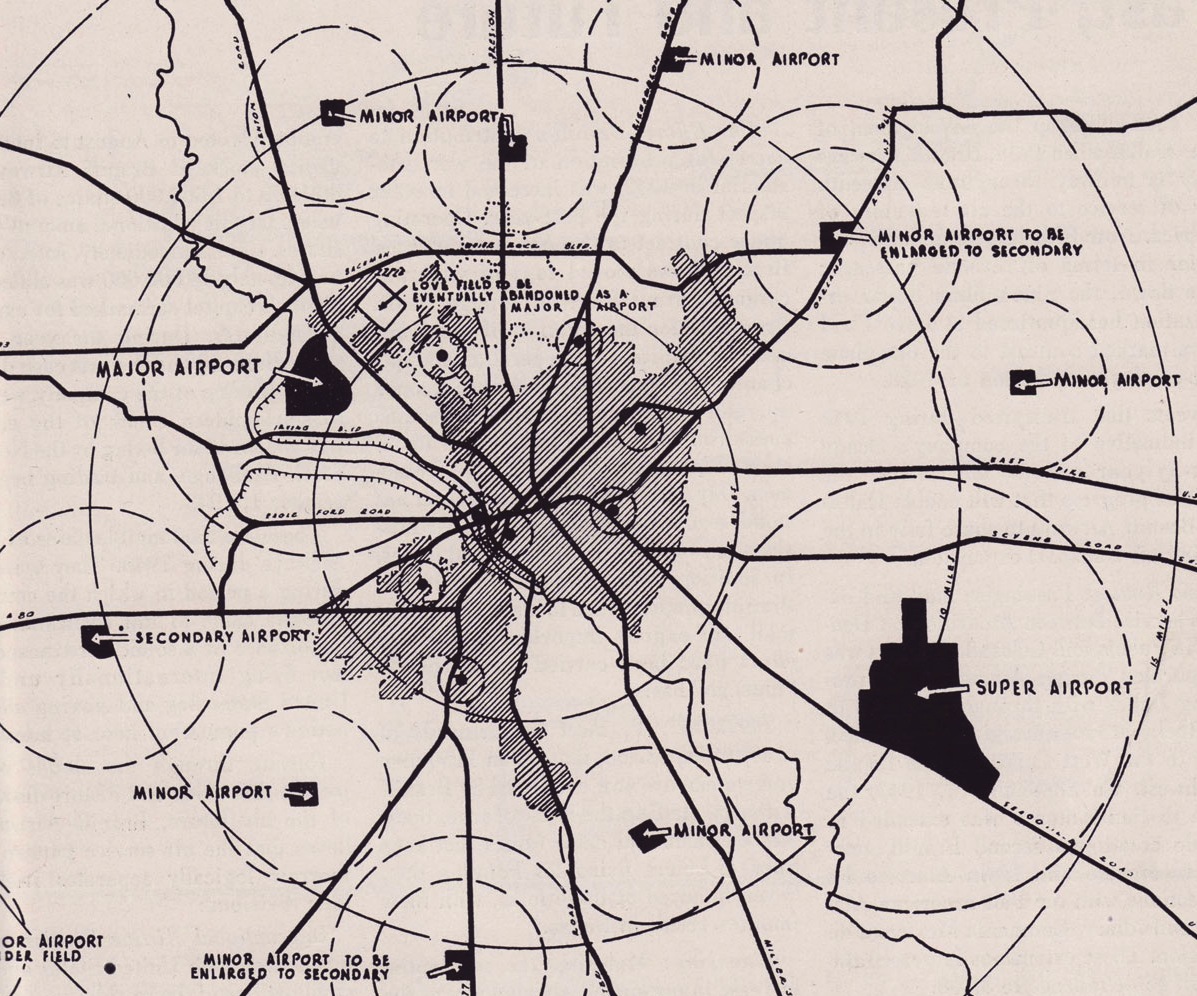
Dallas is an underdog. Landlocked, not blessed by a navigable waterway, Dallas made itself into a transportation hub by sheer will. Charles Lindbergh, at a banquet in Dallas in September of 1927, told the city, "Keep your airport—it will place you among the commercial leaders of the world." A midcentury scene: an aviation company is considering moving to Dallas. The president of the company is heard saying the runways at Love Field aren’t long enough by 2,000 feet. Three hours and forty minutes pass. The phone rings; it’s the city council. Thanks to an emergency bond measure, crews will begin lengthening the runways on Monday.

But Dallas eventually outgrew Love Field and built itself a bigger airport, Dallas-Fort Worth International, which opened in 1974 and now sprawls some twenty-seven square miles, making the airport the third largest (in terms of size) and fourth busiest (in terms of takeoffs and landings) in the world. You could fit JFK, LAX, and O’Hare within its boundaries and still have room to park. Thanks to DFW, the people of Dallas are within four hours of every major U.S. city in the lower forty-eight.

("Dallas' 1946 urban plan (somewhat comically) assumed that most people, by the year 1980, would be commuting to work by air. … The super airport would eventually become D/FW Airport," by Justin Cozart)