The Season For Conceiving

Birthday_Map

Beth Skwarecki admires Matt Stiles’ heat map of birth dates and wonders why so many births happen in the fall:

Several factors might be at work here. One popular explanation is that it’s there is a “Christmas effect” resulting from either holiday merriment or being snowed in with nothing better to do. Both explanations have their weaknesses. For example, does your snow/holiday season start around October … or ever? Plus, I’d expect the major sexy holiday to be Valentine’s Day — and yet there is no uptick in births in early November. But this is, in fact, a testable hypothesis: What happens in other countries and climates?

Data from northern Europe show a strong seasonality trend, and this is a region that has a major winter holiday and plenty of snow. The problem is, conceptions there are lowest in winter — and they correlate inversely with the darkest days, not the holiday season. This pattern puts the major peak of births in spring; much of Europe has this spring peak, in contrast to the autumn peak in the US. But since 1970 or so, the pattern in Europe has been shifting, with autumn becoming the major peak. The reason isn’t clear. One paper suggests that partners who are separated might get together for the holidays. Another points out that decreasing spring conceptions could correspond with a declining trend in the European tradition of August vacations.

Evolutionary Nostalgia

Marlene Zuk contemplates what she calls our “paleofantasies”, the “idea that our modern lives are out of touch with the way human beings evolved and that we need to redress the imbalance”:

If they had known about evolution, would our cave-dwelling forebears have felt nostalgia for the days before they were bipedal, when life was good and the trees were a comfort zone? Scavenging prey from more-formidable predators, similar to what modern hyenas do, is thought to have preceded, or at least accompanied, actual hunting in human history. Were, then, those early hunter-gatherers convinced that swiping a gazelle from the lion that caught it was superior to that newfangled business of running it down yourself? And why stop there? Why not long to be aquatic, since life arose in the sea? In some ways, our lungs are still ill suited to breathing air. For that matter, it might be nice to be unicellular: After all, cancer arises because our differentiated tissues run amok. Single cells don’t get cancer.

She zooms out:

It’s common for people to talk about how we were “meant” to be, in areas ranging from diet to exercise to sex and family. Yet these notions are often flawed, making us unnecessarily wary of new foods and, in the long run, new ideas.

Guess Which Buzzfeed Piece Is An Ad, Ctd

Derek Thompson, moderator of last week’s throwdown, sounds off:

I wish both sides conceded one final point to the other. I wish Ben conceded that BuzzFeed advertorials are intimate mimics of BuzzFeed articles — it’s not unreasonable to be confused once or twice — and it creates a tension with transparency. BuzzFeed is trying to make ads that are as charming and delightful as articles, but the more clearly they say WARNING THIS IS A WEB ADVERTISEMENT, the more likely people are to ignore their charming delights, because we have been taught to ignore all Web ads. I wish Andrew had paused in his fiery attack on advertorials and BuzzFeed to acknowledge something simple: Advertising does a good thing in the world. It pays great journalists to find and tell the truth. It’s a tradition worth preserving through both experimentation and severe transparency.

I thought I did say that at one point. Advertizing has long been an essential revenue source for journalism, and I am a big fan of it. The Dish has run a “Cool Ad Watch” for years, we’ve been paid in the past by media institutions that get a lot of money through ads, and I sure haven’t ruled out having them in the future, if a subscription-only model cannot get us enough revenue to roughly maintain the budget we had last year at the Beast.

My issue is with advertizing that is crafted in-house by the publication for clients and that is designed to look almost exactly like a regular editorial page and nowhere has the word “advertisement” on it to separate it from editorial copy. I notice that such ethical clarity is still not considered even at the Atlantic.

You can smell the bullshit a mile away. The very phrases – “sponsored content”, “native advertizing” – are as accurate as “enhanced interrogation.” It’s either an advertisement or your media company is producing content. Creating editorial content for advertizers for money, rather than for readers for its own sake, is a major shift in this industry. There is an obvious solution, as Derek suggests. It is to make the advertorials look more different from editorial than they now do and slap a clear word ADVERTISEMENT on top of it.

If that ethical labeling ruins your business model, it’s proof that your business model isn’t ethical. Right? Or am I missing something?

Are There Limits To A Father’s Love?

Will McDavid considers the relationship between love and justice in Andre Dubus’ brilliant short story, “A Father’s Story,” in which the main character, Luke Ripley, refuses to divulge that his daughter killed a pedestrian in a car accident:

[T]he movement of atonement comes to its highest pitch in relation to the father’s betrayal of ethics. Ethics is rational, clear and defined, but the aesthetic is turbulent, unpredictable – “she woke what had flowed dormant in my blood since her birth.” Our aesthetic hero sacrifices himself, sacrifices ethics and justice, throws it all out on account of love. Luke Ripley’s arguments with God about whether or not he had done the right things raise the question of whether ethics can ever be suspended by love, and this cuts, in the most concrete way, to the struggle of faith – Jacob’s wrestling with God in the wilderness (the question of whether a deceiver can receive blessing), the question of love suspending ethics.

And it does, because love trumping truth is weakness to the world (“foolishness to the Greeks”), but it’s the one and only place where the gap can be bridged. The impossibility of communication is ever-present in the sphere of abstract truth, but in action united with emotion – i.e. fatherly love – something is communicated, and whatever it is fulfills the promise of the “awful solitude of the heart,’ that is, the promise of solitude’s negation, that the difference, in some way, can be annulled, and the disparate joined:

So, He says, you love her more than you love Me.
I love her more than I love truth.
Then you love in weakness, He says.
As You love me, I say, and I go with an apple or carrot out to the barn.

A Poem For Sunday

SONY DSC

“Year After Year” by Caroline Knox:

The mower releases a scent
of autumnal flat creeping thyme.
Not only thyme but salt, magical seasonings.
Among those present,
the fox’s bark, the sound of owl’s wings.

Hence this set piece in ode mode with end rhyme,
but not standing on ceremony
beside flora that hurricanes volunteer
and granite outcroppings, a natural history,
hand over hand and year after year.

(Reprinted from Flemish © 2013 by Caroline Knox. Reprinted with permission of Wave Books and the author. Photo by Flickr user dbaron)

How The Oscars Have Aged

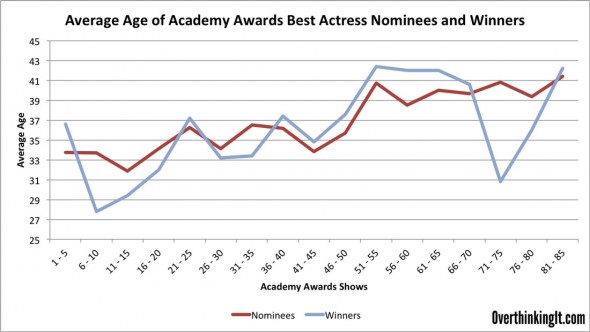
Matthew Belinkie wondered whether Hollywood prizes beauty over age. He crunched some numbers:

Best Actress nominees used to be about 34. Now they’re over 40. Best Actor nominees have jumped up nearly a decade. Best Supporting Actress remains refreshingly random. As for the winners, those are only 1/5th the data so the lines are far more erratic. It seems that despite Hollywood’s youth-obsessed reputation, the big prizes are going to older and older thespians.

Why It’s Different This Time

It’s not just the fact of a papal resignation, it’s the lack of an obvious successor, the relatively large number of cardinals for whom this will be their second conclave (50 compared with just two last time around), the maelstrom of scandal that may or may not have precipitated the Pope’s decision to quit, and the new – actually old – rule that requires a two-thirds majority for any Pope to emerge, however long that takes. John Allen has a solid, very helpful primer on the whole thing here.

Non-Sponsored Quote For The Day

“Here’s a little story that might shed some light on this. Several years ago, a friend of mine came over and noticed a three-ring binder sitting on my desk. It was full of stories clipped from the LA Times. “Why did you save these?” he asked. I told him to take a closer look. “Do you notice anything similar about them?”

Nope. Finally I pointed at the bylines. They were all by me, written when I interned at the Times during college.

The moral of the story is that people who don’t inhale news simply don’t notice bylines. They’re practically invisible. It’s possible this is different at BuzzFeed, where reporters develop a loyal following, but I doubt it. I’ll bet 90 percent of their readers never even notice their bylines.

And I’m pretty certain the folks at BuzzFeed know this perfectly well. They do everything they can to make advertising look staff-written, including in tone, style, and format, but leave themselves an out by putting corporate bylines on the ads and pretending that everyone will notice them. Hey, it says Sony Entertainment Network at the top! What more do you want? I imagine this is a glimpse of our future.

You have been warned,” – Kevin Drum. We sure have been.

A $45,000 Consolation Prize

Samantha Bonar examines the swag bag that all Oscar nominees will receive:

The gift-bag items run the gamut from trips to Australia, Hawaii and Mexico to gift certificates for injectable fillers to condoms to tequila to hand-illustrated tennis shoes to gluten-free macarons. The highest-ticket item ($12,000) is a stay at a choice between two luxury resorts in Australia — one located atop the Great Barrier Reef, the other in the middle of the Outback. The bag also includes a $7,400 gift certificate from a home-design firm and something called the Vampire Facelift, valued at $5,000.

Amazingly, this is relatively cheap:

[T]he bag has hit its lowest value in five years. In fact, it has decreased every year since 2010, when the goods were worth a record $93,108, thanks to a $45,000 safari tour.