Culturally Out Of Tune

Alex Pappademas deems the Oscar category of Best Song “a travesty-generating machine“:

 Here’s the problem: Everyone in the Academy gets to vote for Best Song, but only composers and songwriters get to make nominations, so the Best Song category continues to honor traditionally composed-and-written show-tune-style pop-vocal songs throughout the ’60s and ’70s, effectively looking the other way as genres like rock, soul, funk, and disco (i.e., music by artists who aren’t in the Academy) transform the sound of American film. The 1964 Best Song Oscar goes to “Chim Chim Cher-ee” from Mary Poppins; the Beatles’ title song from A Hard Day’s Night isn’t nominated. The 1967 award goes to “Talk to the Animals” from Doctor Dolittle; Simon and Garfunkel’s “Mrs. Robinson,” written for The Graduate, isn’t nominated. The 1969 award goes to “Raindrops Keep Fallin’ on My Head”; the Byrds’ “Ballad of Easy Rider” isn’t nominated.

His proposed fix:

Instead of — or, OK, fine, in addition to — a category honoring written-to-order movie songs, we need an Oscar for Best Soundtrack, one that would recognize the use of music in films regardless of that music’s provenance. We give awards to adapted screenplays; why can’t we honor the curatorial ambition and taste behind music-saturated movies like Django and Silver Linings Playbook or even Pitch Perfect, movies in which previously released songs are arguably as crucial to the storytelling as a traditional score would be?
Leaping Through The Other Side

This embed is invalid

From Simone Weil’s Gravity and Grace:

A case of contradictories which are true. God exists: God does not exist. Where is the problem? I am quite sure that there is a God in the sense that I am quite sure that my love is not illusory. I am quite sure that there is not a God in the sense that I am quite sure nothing real can be anything like what I am able to conceive when I pronounce this word. But that which I cannot conceive is not an illusion.

Bill Vallicella muses on this passage, which he summarizes as “you must stop thinking and see“:

Weil’s thesis is that there is a divine reality, but it is inconceivable by us. She is saying that access to the divine reality is possible through love, but not via the discursive intellect. There is an inconceivable reality…

How then interpret the Weilian sayings? What Weil is saying is logically nonsense, but important nonsense. It is nonsense in the way that a Zen koan is nonsense. One does not solve a koan by making distinctions, distinctions that presuppose the validity of the Faculty of Distinctions, the discursive intellect; one solves a koan by “breaking through to the other side.” Mystical experience is the solution to a koan.

Recent Dish on Weil here.

Is Zero Dark Thirty Morally Corrupt?

Now let’s hear from the theologians. Samuel Freedman notices how the movie has set up a rather narrow debate:

By the first argument, the film is flawed because it does not follow the historical record. By the second, the film is flawed because torture does not work. What neither argument takes up, but what some theologians have been wrestling with throughout the “global war against terror,” is what a civilized society should think about torture even if it does work.

My italics. I have never argued that torture can never work in extracting truth. I have always argued that even though it may do so, that truth is always riddled with lies and things people will say just to stop the severe suffering they are being forced to endure by other human beings. It can and is routinely used by the powerful to frame the powerless; it makes a mockery of any sort of due process; it corrupts and destroys the soul of the torturer as much as it does the soul of the tortured, which is designed to be broken. I do trust the professional interrogators who almost unanimously back up Ali Soufan’s argument in the NYT – the torture is far, far less effective than traditional, ethical interrogation in gaining critical intelligence, and was completely unnecessary after 9/11, employed by terrified, panicked men with minimal moral reflection – and retroactively justified by an assault on the rule of law and the integrity of the English language.

And let us be clear: the example deployed to justify it by advocates such as Charles Krauthammer – the ticking time bomb scenario – has still not occurred since 9/11. Even once. The reality of America’s torture program was legitimized by a hypothetical that was a fantasy.

But for me, as for many, torture is an absolute evil – i.e. morally unjustifiable under any circumstances – for the reasons this evangelical statement on the matter elucidates:

“When torture is employed by a state, that act communicates to the world and to one’s own people that human lives are not sacred, that they are not reflections of the Creator, that they are expendable, exploitable, and disposable, and that their intrinsic value can be overridden by utilitarian arguments that trump that value. These are claims that no one who confesses Christ as Lord can accept.”

“So do these harsh techniques work?” asked the president, who had once said that his favorite philosopher was Jesus. (I’m relying on the Woodward account.)

I recommend Dubya ask Jesus whether that question isn’t itself proof of how thoroughly he – and all the Christians involved in torturing other human beings –  lost their way so completely.

Faces Of The Day

airline_passenger_portraits

Andy Cush spotlights an older project that’s taken on a whole new relevance:

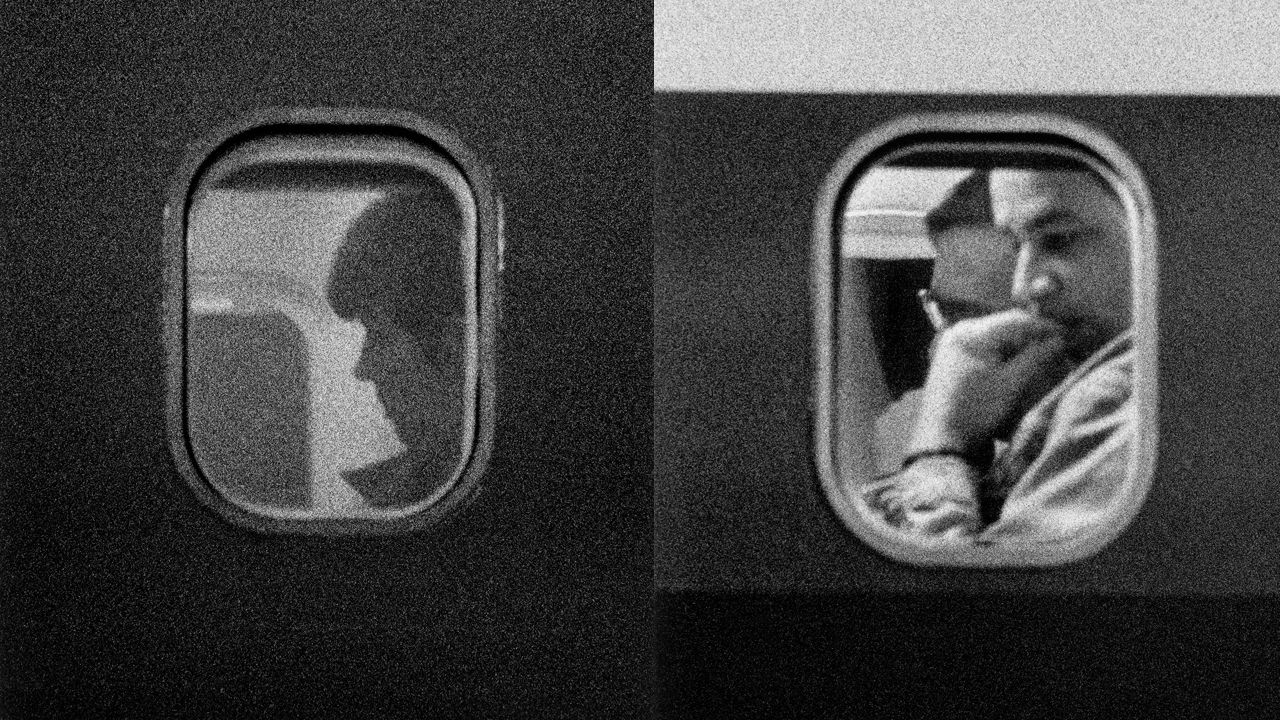
Photographer John Schnabel took these eerie stills using means that might have landed him in jail or an interrogation room today: by standing at the end of a runway with a telephoto lens, snapping pictures without anyone’s permission. The work was done in the mid-90s, but is now being released in a book entitled Passengers“It was a different time and there was not the same kind of suspicion of cameras,” he told Wired. “There wasn’t such a sensitively about the airport.” Something about the graininess of the images necessitated by the zoom lens lends them an uncanny sadness that highlights the anonymity of the people inside.

Jakob Schiller respects the universality of the shots:

Schabel won’t reveal the names of the airports where he shot because he likes the idea of placeless-ness and the way it relates to air travel. Just because you change planes at the O’Hare in Chicago doesn’t really mean you’re in Chicago. When you’re flying you’re not really anywhere. Without any geographic identifiers and without any captions, Schabel’s photos blend together the same way the fields blend together at 30,000 feet or the airport buildings blend together as passengers switch aircraft.

(Photo courtesy of Twin Palms Publishers)

A Novel Life

800px-Virginia_Woolf_Painting

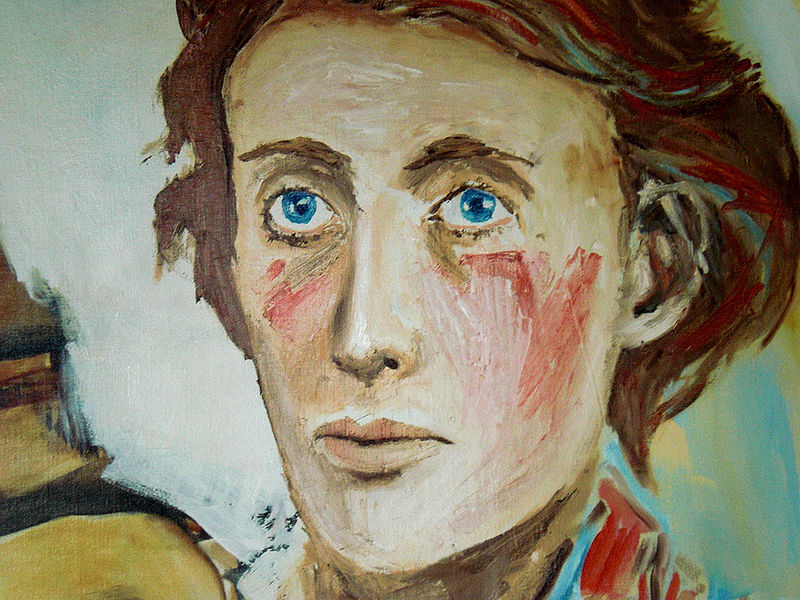
Jeannette Winterson sees Virginia Woolf’s Orlando, the tale of a man who wakes up after sleeping for a week only to discover he has become a woman, as a pivotal moment in the novelist’s writing career:

Orlando refuses all constraints: historical, fantastical, metaphysical, sociological. Ageing is irrelevant. Gender is irrelevant. Time is irrelevant. It is as though we could live as we always wanted to; disappointments, difficulties, sorrow, love, children, lovers, nothing to be avoided, everything to be claimed. Not locked. Not limited. Ecstasy. …

Orlando, written as a romp, a love letter, a gay book in every sense of the word, turned out to be the engine of an exploding freedom in her style. Writing Orlando did Woolf good. Begun as a gift to Sackville-West it became a gift to herself. It is the most joyful of her books. Woolf’s mind was always first-rate, but when she came to write her next book, A Room of One’s Own (1929), she carried across the full-heartedness of Orlando. A Room of One’s Own is a masterpiece because it is more than a polemic; when she writes about women, about men, about the interplay of the mind, about creativity – above all, about writing – all her thoughts are steeped in feeling. The tract is much more than an argument; it is a passion for life as it could be lived.

(Portrait of Woolf by Christiaan Tonnis, via Wikimedia Commons)

Art Against Time

Michael W. Clune uses Orwell’s 1984, along with a host of other literary and creative works, to explore the artist’s search for “a forever-new image” to overcome time’s defeat of novelty:

Here is another way to present the deep question 1984 raises: Why does Orwell love it when a poet like Shakespeare renews a reader’s sensation of the surface of the earth, but hate it when Big Brother does the same thing to Winston? I’ve suggested that the weakness of actual art—its lack of permanent novelty—is something many writers dream of overcoming. And in the very act of wrestling with the fading of aesthetic freshness, Keats, De Quincey, Orwell, and myriad other artists, literary and otherwise, have done some of their most powerful work.

But ultimately, we need to consider the possibility that art’s weakness—the fact that even the greatest work is immeasurably less effective as a means of arresting time than the oppression Orwell imagines—is part of what we love about art. The art of the unreasonable Romantics offers us a rich vein of insight into the operation of time in human life. Their writing also suggests that art is where we experiment with technologies for stopping time that we know—or hope we know—will never work.

The End Of The Universe

Irene Klotz reports on how the discovery of the Higgs boson particle – if it is in fact the “god particle” that accounts for how matter gets its mass – may give us our first idea of the lifespan of the universe. The truly final countdown would thus calculate out to “many tens of billions of years from now”:

“Essentially, the universe wants to be in different state and so eventually it will realize that. A little bubble of what you might think of an as alternative universe will appear somewhere and then it will expand out and destroy us. So that’ll be very dramatic, but you and I will not be around to witness it,” [theoretical physicist Joseph] Lykken told reporters before a presentation at the American Association for the Advancement of Science meeting in Boston this week. “There will be a new universe, a much more boring universe, so I hope this doesn’t happen,” he added.

Previous Dish on the Higgs boson here.

Law Of The Lamb

From Adam Kirsch’s review of David Nirenberg’s new book, Anti-Judaism: The Western Tradition:

Paul, whose epistles instructed small Christian communities in the Near East on points of behavior and doctrine, was writing at a time when Christianity was still primarily a Jewish movement. In his desire to emphasize the newness of his faith, and the rupture with Judaism that Jesus Christ represented, he cast the two religions as a series of oppositions. Where Jews read scripture according to the “letter,” the literal meaning, Christians read it according to the “spirit,” as an allegory predicting the coming of Christ. Likewise, where Jews obeyed traditional laws, Christians were liberated from them by faith in Christ—which explained why Gentile converts to Christianity did not need to follow Jewish practices like circumcision. To “Judaize,” to use a word Paul coined, meant to be a prisoner of this world, to believe in the visible rather than the invisible, the superficial appearance rather than the true meaning, law rather than love. More than a theological error, Judaism was an error in perception and cognition, a fundamentally wrong way of being in the world.

The problem, as Nirenberg argues in the richest sections of his book, is that this is an error to which Christians themselves are highly prone. Paul and the early Christians lived in the expectation of the imminent end of the world, the return of Christ, and the establishment of the new Jerusalem. As the end kept on not coming, it became necessary to construct a Christian way of living in this world. But this meant that Christians would have need of law and letter, too, that they would need to “Judaize” to some degree.