Life Without Redemption

In an incisive review of John Gray’s latest book, The Silence of Animals, Richard Holloway explains the essence of the political theorist’s approach to human nature:

Gray believes that humanity’s obsessive search for a cure for its own ills is its most dangerous disease. Here, he both commends and condemns the religious approach to the problem. He commends it because, unlike the optimistic humanism of the new atheists, it understands the incurable sickness of the human soul and has been rich in stories that express it. Where he departs from religion is in its myth of supernatural rescue and salvation. Realistic in its assessment of the human condition as fallen and self-obsessed, Christianity pulls a metaphysical rabbit out of the hat by promising that, while we are unable to save ourselves, there is one who will rescue us from the bondage of our own nature and deliver us into a state of eternal bliss.

The “new note” that appears in this most recent work:

To his prophetic contempt for those who destroy others in the name of their theories has been added a lyrical new theme he calls “godless mysticism”, through which he calls us to an attitude of contemplative gratitude for the only life we will ever have. He writes: “Godless mysticism cannot escape the finality of tragedy, or make beauty eternal. It does not dissolve inner conflict into the false quietude of oceanic calm. All it offers is mere being. There is no redemption from being human. But no redemption is needed.”

Relatedly, in an interview about his new book, JP O’Malley asks Gray, “Why do you dispute the notion that knowledge is a pacifying force?” Gray’s answer:

Well there is this notion in some intellectual circles that evil is a kind of error: that if you get more knowledge you won’t commit the error. People often say: if we get more knowledge for human psychology won’t that help? No. All knowledge is ambiguous in this way. The Nazis were very good at using their knowledge at mass psychology. Or if you were a Russian revolutionary like Lenin, you might use the knowledge of the causes of inflation to take control of the central bank, create hyper-inflation and bring about your revolutionary project. So knowledge can never eradicate the conflicts of the human world, or produce harmony where there are conflicting goals to start with. Because knowledge is used by human beings as a tool to achieve whatever it is they want to achieve.

No Wrong Way To Pray

Giles Fraser ruminates on the subject:

Some people, I suppose, may think of prayer as a peculiar way of making things happen in the world. And it would indeed be a quite a fringe benefit to religious belief if it granted believers the ability to change the course of the universe simply by closing their eyes, squeezing their hands together, and submitting a request to the divine omnipotence that things be otherwise. Yes, it is easy to be sarcastic at the philosophical naivety of this view. But is this really what people do?

The great Michael Ramsey, archbishop of Canterbury throughout the 1960s, was once asked how to pray. “I just get down on my knees and hope for the best,” he replied. In other words, there is not much that you have to do other than make time for it. For Ramsey, prayer was not the heaping up of pious chatter. It was not a peculiar way of getting things done in the world. Rather, it was about listening and waiting – being attentive to that which is beyond oneself, a form of concentration on that which is other.

Even non-believer Andrew Brown found meaning in prayer while attending a recent Church of England service:

I’m happy to kneel in prayer even though I can’t believe there’s anyone out there: not even the congregation, who are too busy lost in their own ritual. But it’s a cure for haste and pride and self-pity just to wait and listen, even if there is no one to hear. I even went up to the communion rail to take a blessing. Why not? What harm can blessing do? I don’t suppose that most, or any, of the congregation were theologians, and in any case I am never quite sure what theology means: it always appears to me as a purely rhetorical performance. So I didn’t wonder what it was like to believe in the Trinity, or even the resurrection, or any of the miracles. I’ve no idea if anyone in the church was really capable of such things, in any sense that I can understand.

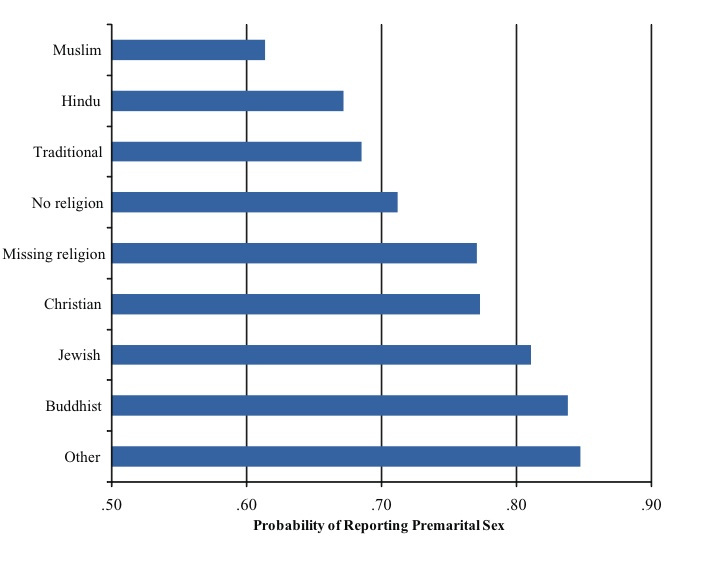
Which Religions Are The Most Chaste?

religion-chart

Kevin Hartnett highlights a fascinating study, “Religion and Sexual Behaviors,” by Amy Adamczyk and Brittany Hayes of CUNY:

All major religions prohibit premarital sex, but Muslims appear to take Islam’s proscriptions especially seriously. Why? Adamczyk and Hayes wanted to know whether the low level of premarital sex among Muslims was more a matter of individual choices (micro level effects) or national cultural forces (macro level effects). To test this, they looked at how the probability of a Muslim woman having had premarital sex changes depending on how dominant Islam is in the country where she lives. They found big effects, leading them to conclude that national culture has stronger effects than individual preferences:

If this woman lives in a nation where 1 percent of residents are Muslim, her predicted probability of reporting premarital sex would be .72. In a nation where 23 percent of residents are Muslim… the woman’s predicted probability would be .61. Finally, in a nation where 90 percent of residents are Muslim…the woman’s predicted probability of reporting premarital sex would tumble to .28.

While the researchers offer explanations for Muslim chastity, they have less to say about why Buddhists—perhaps surprisingly—rank highest in premarital sex. They offer that it could be because Buddhism is not monotheistic and has fewer “strict rules about specific behaviors.” But of course Hinduism is not monotheistic, either, and indeed, the field seems open for a follow-up paper on the religious dimensions of allowance.

Under Covers

[youtube http://www.youtube.com/watch?v=ACALaPcarFM]

Margaret Hartmann shines a flashlight on the “rash of sexting cases” among FBI employees:

The report (pdf) doesn’t list agents’ personal information, but it gives an outline of their behavior and the disciplinary action taken. Interestingly, getting a DUI in your own car, shoplifting from a grocery store, and lying about dating a known drug dealer will lead to dismissal. However, infractions such as “unauthorized use of FBI database to search for information about friends and coworkers,” “broke spouses e-reader in half and pointed unloaded gun at dog’s head,” and “used government-issued Blackberry to send sexually explicit messages to another employee,” will only earn you a suspension.

Similarly, former CIA officer Reuel Marc Gerecht reveals how when he was in the service, “the CIA was a fairly randy place” where “affairs and divorce were almost a rite of passage.” It wasn’t as dangerous as some might assume:

The idea that our enemies will use infidelity against us is not borne out by history. To my knowledge, the CIA has always kept its distance from operations that might pit girlfriend against boyfriend, mistress against lover, or wife against husband. Sex is just too unpredictable to manage in the context of an intelligence operation.

We have a pretty good idea why American officials and soldiers have betrayed their country over the years. The primary reasons: greed, ideology, professional disappointment, narcissism, ethnic loyalties, and the sheer thrill of being a mole. Although it is certainly true that the KGB targeted homosexuals, this was done not because Soviet intelligence thought sexual blackmail was particularly effective, but because the KGB believed homosexuals were more narcissistic, more prone to see themselves as disconnected from the group, than heterosexuals. But there is very little evidence to suggest that in America such targeting ever turned an agent of any value, or probably any agent at all. The odds of using “honey traps” to lead men or women to treason are very small indeed.

Today, sex is a more serious offense in the agency. Gerecht fears that means we’ll “equate fidelity to a spouse with fidelity to a nation”:

There is no correlation between serially cheating in a marriage and compromising loyalty to country. Patriotism is a very different kind of love.

The Average Porn Star

average-face-pornstar-big

most-common-pornstar-names

Jon Millward combed the archives of the Internet Adult Film Database – essentially the Wikipedia of porn – to “find out once and for all which stereotypes about porn stars are true, which are bogus, and what these men and women have been doing for the last forty years.” Among his findings:

[T]he most common bra size for a female porn star is a surprisingly handleable 34B. Not double-D, not even a D. Double-D actually came in 4th, behind B, C and D. The most common set of measurements for the women was 34–24-34. So, if the average female porn star is a 5’5″ woman who weighs 117lbs and has B-cup breasts, what colour is her hair? Blonde, presumably, if my friends’ guesses were anything to go by. Apparently not. Dark-haired porn stars outnumber blonde ones almost 2-to-1.

Amanda Hess throws a little cold water, noting that Millward’s data set is incomplete. But he is the first to admit the study’s limitations:

In order to weed out pages too skimpy to provide any helpful data, Millward kept his analysis to “records for performers whose year of birth was known,” he told me. That means the sample is skewed toward higher-profile performers with available biographical data. That’s why he cautions readers to view the study as one of “porn stars” as opposed to “performers.” And straight, cisgender performers at that: Millward declined to run stats on some stars—gay men and trans performers—to accommodate “the average attention span of a blog reader.” … He hopes to expand his study sample in the future. “I’m sensing a sequel: ‘Going Deeper!'”

A Poem For Saturday

OLYMPUS DIGITAL CAMERA

“Artichoke Heart” by Ibn at-Talla´ (11th century):

Of earth and water, daughter
Yielding her abundance

Only if you wait
Finger-licking at her castle gate

Pale she seems, her haven
Hard of access, a Greek

Virgin, who lingers
Behind a curtain of lances

(Translated by Christopher Middleton and Letitia Garza-Falcón from Spanish versions of the original Arabic. Reprinted with permission from Andalusian Poems, David R. Godine, Publisher © 1993 by Christopher Middleton and Letitia Garza-Falcón. Photo by dospaz)

When Drug Culture Went Highbrow

Robert Morrison credits Thomas De Quincey’s Confessions of an English Opium-Eater:

De Quincey invented recreational drug-taking, not because he was the first to swallow opiates for non-medical reasons (he was hardly that), but because he was the first to commemorate his drug experience in a compelling narrative that was consciously aimed at — and consumed by — a broad commercial audience. Further, in knitting together intellectualism, unconventionality, drugs, and the city, De Quincey mapped in the counter-cultural figure of the bohemian. He was also the first flâneur, high and anonymous, graceful and detached, strolling through crowded urban sprawls trying to decipher the spectacles, faces, and memories that reside there. Most strikingly, as the self-proclaimed “Pope” of “the true church on the subject of opium,” he initiated the tradition of the literature of intoxication with his portrait of the addict as a young man. De Quincey is the first modern artist, at once prophet and exile, riven by a drug that both inspired and eviscerated him.

Some accused De Quincey of encouraging drug abuse. His response:

Teach opium-eating! – Did I teach wine drinking? Did I reveal the mystery of sleeping? Did I inaugurate the infirmity of laughter? . . . My faith is – that no man is likely to adopt opium or to lay it aside in consequence of anything he may read in a book.

Pioneer Prostitutes

Rye Gal

Sex workers were some of the first women in early American settlements:

Take New Orleans, future home of America’s largest licensed red light district. In 1721, there were fewer than 700 men settled in the whole colony of Louisiana, a number which excludes men held in slavery. The French government sent 80 women to the colony by ship, in the hopes that Louisiana’s free men would marry these women and would refrain from having sex with Native American women. Many of the migrant women, however, had been serving time for prostitution charges in French prisons, and upon arriving in the colony found the sex trade provided them more independence than any arranged marriage to settlers.

These women were followed later in the same year by, as legal historian Judith Kelleher Schaffer described them, “other more respectable women.” She continued:

“One historian has remarked on the incredible fecundity [of these new women] and the tragic infertility of the prostitutes, as almost all of Louisiana’s most important families of French descent trace their origin to the former while none claim to have descended from the latter.”

(Photo: “‘Storyville’ Red light district at the start of the 20th century. Seated woman wearing striped stockings, drinking ‘Raleigh’ Rye.” By E. J. Bellocq via Wikimedia)

“Intoxication Without Intent”

Miles Klee considers accidental and involuntary highs:

Any number of drugs can flood our consciousness with faulty perceptions. And if the sensory apparatus isn’t filtering properly, you receive an excess of environmental information when you’re least equipped to handle it. This helps explain why the same drug can generate wildly different results—a CIA field agent whose coffee is secretly spiked with LSD might run screaming into the street, while college buddies can drop a tab and spend all day giggling in a grassy field. The recreational drug user in theory understands that she is messing with her own head. The man who doesn’t know he’s been dosed may conclude that existence has been usurped by mere chaos.