Damming The Stream

Benjamin Lennett sees trouble on the horizon for streaming services like Netflix and Pandora:

First, they came for unlimited data on our smartphones. Now capped plans and usage-based pricing are likely coming to a cable provider near you (and indeed, they’re already here for some). The cable industry claims the move is about fairness: a fair return on their investment and fair pricing. But the egalitarian rhetoric is designed to obscure their more self-interested aims: increasing profits and thwarting competition from online video. …

The large cable companies are determined to prevent mass movement to cord-cutting, in which users give up their cable TV subscriptions and substitute with services like Netflix. How do you prevent this from happening? Data caps and usage-based pricing.

He puts the proposed caps in perspective:

How many hours of online video per month could a user watch with Time Warner’s 5 GB capped plan? About five for a high-quality stream, barely two for HD. By comparison, Nielsen estimated that in 2010, the average household watched 143 hours of television a month. Cord cutting families might be in for some very interesting dinner table conversations regarding dividing up the cable data plan.

The Internet’s Linguistic Borders

nyc-language-tweets

Robin Sloan laments the lack of translation in web culture:

Consider a webcomic like xkcd. It’s a touchstone of internet culture, and yet it’s presented only in English. (There are a handful of unofficial translation sites, but they seem to be spotty at best, abandoned at worst.) You could argue that xkcd’s core audience of programmers, scientists, and students all speak English, wherever they are… but I don’t know. I think there must be a few hundred thousand internet users out of China’s half-billion who would absolutely love the comic—who would feel, as so many xkcd readers do, that it’s somehow speaking to them directly—but whose English isn’t up to snuff. What a thing that would be, to make this bit of culture available to them!

We, the internet culture makers: we don’t translate enough. We don’t push hard enough against these linguistic and social borders. Instead, we pat each other on the back for our elegant file-format choices. Instead, we talk mostly to ourselves.

(Above: Map of the Twitter languages of Manhattan, captured in 8.5 million tweets, between January 2010 and February 2013 by Ed Manley. Interactive version here.)

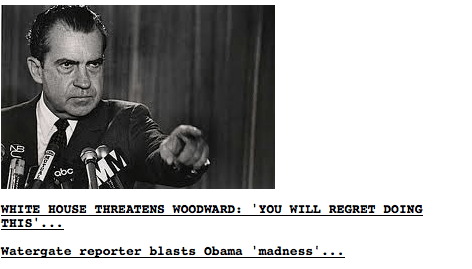
Bob Woodward, Demonstrable Liar

Screen shot 2013-02-28 at 4.04.09 PM

This pioneering journalist has apparently been ominously threatened by the White House for daring to disagree with them. It must have been a harrowing experience. Last night he complained to his fellow stenographers, Mike Allen and Jim VandeHei, about living under this horrifying intimidation:

Digging into one of his famous folders, Woodward said the tirade [from a White House official] was followed by a page-long email from the aide, one of the four or five administration officials most closely involved in the fiscal negotiations with the Hill. “I apologize for raising my voice in our conversation today,” the official typed. “You’re focusing on a few specific trees that give a very wrong impression of the forest. But perhaps we will just not see eye to eye here. … I think you will regret staking out that claim.”

Woodward repeated the last sentence, making clear he saw it as a veiled threat. “ ‘You’ll regret.’ Come on,” he said. “I think if Obama himself saw the way they’re dealing with some of this, he would say, ‘Whoa, we don’t tell any reporter ‘you’re going to regret challenging us.’”

Woodward has called the president guilty of “madness” and of moving the goal-posts by suggesting that the threat of the sequester was designed to facilitate a grand bargain – tax hikes, entitlement and defense cuts combined with tax reform. But that was the point of the sequester; it was a deadly instrument designed to force both parties to compromise – one on taxes, the other on spending cuts. Woodward’s op-ed was untrue, it seems to me, plainly untrue. More to the point he accused the president of madness, even though he has offered a compromise that includes cuts to Medicare as serious as those in Bowles-Simpson, while the Republicans insist on only spending cuts.

Yes, the sequester idea originated with Jack Lew in the Obama administration but was quickly embraced by the GOP and became a rare moment of bipartisan agreement, after the brinksmanship of the debt ceiling battle in 2011. Odd, isn’t it, that Woodward did not, to my knowledge, describe the GOP’s successful and completely unnecessary downgrade of this country’s credit rating as “madness.”

Still the accusation of a threat against Woodward was troubling enough that I was eager to see it substantiated. And here – in the midst of a heated but completely conventional back-and-forth between source and journalist – it is:

I do truly believe you should rethink your comment about saying that Potus asking for revenues is moving the goal post. I know you may not believe this, but as a friend, I think you will regret staking out that claim.

This is what Woodward was claiming was a chilling threat to press freedom! I mean, seriously. What exactly is the threat? This is the final email Woodward sent to Sperling:

Gene: You do not ever have to apologize to me. You get wound up because you are making your points and you believe them. This is all part of a serious discussion. I for one welcome a little heat; there should more given the importance. I also welcome your personal advice. I am listening. I know you lived all this.

Does this read like a man writing to someone threatening him with anything? He even says: “I for one welcome a little heat.” He describes Sperling’s “threat” as “personal advice” as a friend, which it plainly was. Then he goes whining to CNN and Politico that he is victim of government threats for his reporting. That’s a lie, and Woodward has now been exposed as a liar.

Excuse me, but given his reputation as a journalist, that is “madness.”

A Green Lining To Sequestration?

Mike Riggs finds one:

The automatic budget cuts set to take place this Friday might have government contractors on edge, but they could also bring sweet relief for medical marijuana dispensary owners fearful of government crackdowns. According to the OMB’s report to Congress, the Drug Enforcement Administration will lose $166 million from its $2.02 billion staffing and appropriations budget, reducing its funding to 2002-2003 levels, when the DEA first began coordinated crackdowns on medical marijuana dispensaries.

But the DEA arguably has other, bigger priorities now, such as cartels and prescription pill mills. With $166 million less to work with, will the DEA finally have to prioritize its resources?

But:

To be fair: the state-by-state fact sheets the White House released did emphasize decreased funding for drug treatment, which means we’ll find out really quickly whether states and local governments are still interested in diverting addicts from prison to treatment only if the federal government pays them to do so.

Fascist Fashion

original (2)

Annalee Newitz digs up a bizarre relic:

In the late 1920s, a peculiar confluence of fashion and fascism came together in England. The Men’s Dress Reform Party, an outgrowth of the eugenics movement, agitated for men to dress in more beautiful, flowing clothing reminiscent of what they wore during the Elizabethan era. Mostly, this seemed to mean wearing shorts and kilts.

Simon Carter has more:

Today it might seem comical that the MDRP urged men to adopt a more feminine style of clothing.  However the underlying project was more sinister in its efforts to interweave masculinity with the social hygiene and eugenic movements.  Articles supporting dress reform in the New Health Society journal argued that changes in men’s fashion would bring out a male beauty – one that celebrated masculine grace and physique.  The idea was that if middle class men could, through reformed clothing, become more beautiful then they would inevitably also be more attractive to women (i.e. potential mothers) and thus reverse the perceived evolutionary decline of the middle classes:

…a renaissance of beauty for men – true masculine beauty of the body and mind, the bloom of a joyful spirit – might mean happier marriages, well-born and beautiful children, a healthier and more beautiful race (Dion Byngham, New Health Journal, 1932).

(Dress reformers on their way to the MDRP Coronation competition in 1937, via Carter)

The Slow Sequester

David Dayen expects the sequester to phase in gradually:

The problem for the White House, despite outward projections of confidence, is that the sequester simply won’t spool out in spectacular fashion. The biggest near-term hits will be to areas largely invisible to the public, like scientific research or military readiness, or to low-income populations that have scarce political power. Events harming the broad mass of consumers, like airport chaos, mass teacher layoffs or shuttered national parks, won’t kick in for a month or more, whether the administration likes it or not. The President himself admitted this week that the impacts “will not all be felt on day one.”

TNR asked various economists, “Will the sequester start another recession?” Alan Blinder’s response:

I certainly wouldn’t expect the sequester to cause a recession—it’s not big enough. A reasonable guess is that it takes about 0.6 of a percentage point off the 2013 growth rate. That’s based on the amount of spending that would be cut, and a ‘multiplier’ around one. Now, when the economy is struggling to make 2 percent growth, losing about 0.6 percent is hardly welcome. But it’s not a recession. The possible downside, and the hardest part to figure out, is how badly the sequester will dent confidence—creating the feeling that our government is losing its mind—and what that might do to spending. I’ve estimated that as negligible—and I hope that’s right!

The Right To Beg

A. Barton Hinkle covers anti-panhandling laws:

[T]he restrictions on soliciting never seem to apply to teen-agers in bikini tops waving car-wash signs. Or to campaign canvassers seeking petition signatures to get political candidates on the ballot. Or to firemen passing the boot for a local charity. Somehow it’s only the homeless who aren’t supposed to pester anybody.

Courts have struck down panhandling ordinances time and again. In 2011, an Arizona appeals court ruled that Phoenix could not ban panhandling after dark. Last March, a federal judge ruled against Utah’s anti-panhandling law. In August, a federal judge ruled against Michigan’s state law against panhandling in public places. Time and again the courts have found, as the 4th Circuit did last week, that “begging constitutes protected speech.” But cities across the country keep passing anti-panhandling ordinances anyway.

Should Trans Surgery Be Covered?

Gender reassignment surgery just got an unlikely advocate in Emerson College’s Phi Alpha Tau fraternity, which is raising money for one of its own, Donnie Collins, to receive female-to-male breast augmentation. Emerson’s insurance won’t cover the procedure, as it is “common practice for insurance companies to deem female-to-male breast augmentation—or top surgery—as a cosmetic plastic surgery rather than a necessity.” But that tide is starting to turn, as “many of the top American universities” are changing their insurance coverage to include gender reassignment surgery. Julie Hollar puts that progress in context:

Only those transgender youth privileged enough to get into schools like Princeton or Stanford will have access to full health coverage that will enable them to align their gender presentation with their gender identity–which can have important reverberations down the line for their job and life prospects. Not all transgender people want to take hormones or undergo surgery, but for many it is a medical necessity–something both the American Medical Association and the American Psychiatric Association have recognized. …

The real story here is that so many transgender people–those without access to elite higher education or certain Fortune 500 jobs–face serious health care discrimination that puts them at an even greater disadvantage than they already face. If we had a single-payer system, where your health insurance didn’t depend on where you go to school or if you have a certain kind of job, it would still be a struggle to get these things covered, no doubt. But it would be one unified struggle, instead of thousands of disparate ones.

Update from a reader:

I hate to do this, but speaking as an alumnus of Emerson (’08), and an alumnus who transferred from a big state school, I have to throw a bit of water on this “unlikely” development.

For starters, Phi Alpha Tau is not a national fraternity, but one local to the college, and one that is not recognized by any major national organization related to Greek life. Secondly, and more importantly, Greek life at Emerson, a small arts school with a relatively low number of students living on-campus, is pretty minimal in comparison to a big school, like Boston University or Northeastern nearby (I myself recall only ever meeting one person living in a frat, and he was a pledge who bailed after initiation). That, in combination with a higher-than-average percentage of LGBT students, makes this less unlikely and more an outlier to the rest of collegiate Greek life. This is still a positive development, but it would actually bear some weight if, say, this was Chi Phi at BU.