Green Shoots On The Right, Ctd

Douthat sighs:

Until the ideas themselves change, our politics is going to be stuck with the dynamic that Matt Yglesias describes all-too-accurately here, in the context of the minimum wage debate — with Democrats Spring Snowstorm Hits Northern Scotlandproposing questionable policies that nonetheless address real challenges, Republicans declining to counter with serious policies of their own, and Democrats eventually winning the policy debate more or less by default (or else winning politically because the problems keep festering and the G.O.P. just looks out of touch). I don’t think that dynamic can last forever, for reasons I’ve elaborated on before, and I’m hopeful that the 2016 election will be healthier for the right than 2012 turned out to be. But right now, the pattern of the last two political cycles still holds: Real Republican reinvention is a cause in search of a standard bearer, and the right’s reformers are doing a far, far better job proposing solutions to the G.O.P.’s dilemmas (and the country’s problems) than they are persuading actual Republican politicians to embrace them.

Perfectly put. Barro is on the same page:

Unlike many on the right, Gerson, Wehner and Ponnuru have correctly diagnosed the economic challenges that Republicans aren’t addressing. (Gerson and Wehner identify “stagnant wages, the loss of blue-collar jobs, exploding health-care and college costs.”) And they have even advanced some ideas that would improve matters. But the key word there is “some”: All three writers leave unaddressed major Republican stumbling blocks with the middle class. Particularly, they are far from developing health-care and fiscal policies that can serve middle-class interests.

Guess Which Buzzfeed Piece Is An Ad

Since I’m going to be discussing forms of new media revenue with Friend of the Dish, Ben Smith, later today, I though it might be worth noting some aspects of Buzzfeed’s innovative model, i.e. “sponsored content” or “native advertizing”. I should start by saying I’m not trying to criticize anyone who’s trying to make new media work financially. We don’t know what works and there are various options. But Buzzfeed’s model is a hot topic – as was the Atlantic‘s resort to “native advertizing” in the Scientology fuck-up.

So let’s take a specific example which caught my eye the other day. Here is Buzzfeed”s post on Sony’s Playstation 4 posted yesterday at 8.07 pm. Despite being billed as “The Only Post You Need To Read About The PlayStation 4,” it was actually preceded by this post on Buzzfeed the day before about the same event, titled “11 Things You Didn’t Know About PlayStation”. The difference is that the February 19 post was “sponsored” by PlayStation and the February 20 one was written by two staffers with by-lines. Go check them both out and see the differences (an off-white background and acknowledgment of the sponsor) and the similarities (in form, structure and tone, basically identical).

To my eye, the two are so similar in form and content, I have a few questions to ask of Ben later today: were the people who wrote the first Sony-sponsored post employed by Buzzfeed or Sony? Or was it a team effort? If it was a team effort, why no Buzzfeed by-lines? Or did the same people write both the promotional copy and the journalistic copy?

Now go a little deeper on the sponsored page about the PlayStation 4. Here’s a screen shot of what you see on the side:

Screen shot 2013-02-21 at 12.04.18 PM

Were these sponsored or real?

The second post was put up on the same day as the first Sony-sponsored post, with the classic Buzzfeed headline: “10 Awesome Downloadable Games You May Have Missed”. But all of the posts in the sidebar above were sponsored by Sony, even though, as you can see, they are not distinguished as such. Once you slip into the advertorial vortex at Buzzfeed, everything that is advertizing appears as non-advertizing. Just keep clicking. When you’re on Buzzfeed proper (if that’s the right term), the sponsored posts are delineated, ethically, as I noted above, by an off-white color background that subtly makes them different and an acknowledgment of the sponsor.

So I don’t see an ethical line being definitively crossed here – just deliberately left very fuzzy. Maybe I’m old-fashioned but one core ethical rule I thought we had to follow in journalism was the church-state divide between editorial and advertizing. But as journalism has gotten much more desperate for any kind of revenue and since banner ads have faded, this divide has narrowed and narrowed. The “sponsored content” model is designed to obscure the old line as much as possible (while staying thisclose to the right side of the ethical boundary). It’s more like product placement in a movie – except movies are not journalism.

So my core worry is: who writes and composes these sponsored posts? Are they done in collaboration with Sony? Or does Sony do it all? Are any of the sponsored post writers also writing regular posts? If they are, what credibility does Buzzfeed have when actually reviewing PlayStation 4? By the way, here’s the end of their review:

Screen shot 2013-02-21 at 1.29.54 PM

And so we get a tease for what might well be a future Sony-sponsored post. I have nothing but admiration for innovation in advertizing and creative revenue-generation online. Without it, journalism will die. But if advertorials become effectively indistinguishable from editorial, aren’t we in danger of destroying the village in order to save it?

Update: To read the rest of the posts in this thread, go here.

Can The GOP Get Real?

Calling the Hagel confirmation “the most depressing episode in the Republican foreign-policy debate since George W. Bush was president,” W. James Antle III wonders where a “realist caucus” in the party might find a home:

[I]t is worth noting that there are Republican senators currently serving who have gone further on foreign policy and civil liberties than Hagel ever did. A failing of many Republican realists, from Jon Huntsman to Richard Lugar, is that for all they do to alienate the rest of their party, they seldom oppose wars when it matters most. At best they express regret after the fact, before reluctantly supporting the next one. Usually, they confine their complaints to the Sunday talk shows.

Larison takes a more cynical view:

Minimal awareness of past failures might encourage Republican hard-liners to hold their tongues and be less obnoxious in their treatment of one of the relative few elected Republicans that recognized the folly of the war long before any of them did. There is no such awareness, and no desire to acquire it. Put simply, no “realist caucus” emerged in the last two months because most party leaders remain stuck in a fantasy world in which the Iraq war was a great success, uncritical support for all Israeli policies is wise, and unending hostility towards Iran is prudent, and most elected Republicans continue to take their cues on these issues from the people who have been wrong about virtually every major foreign policy issue for at least the last fifteen years.

I fear Daniel is right. And the complete intellectual collapse of neoconservatism misses the point. Neoconservatism was never a merely intellectual movement, apart from its early years. It was also a political operation, managed and directed by political actors, with a media apparatus to smear, ignore or ostracize all critics. It was founded by ex-Trotskyites and found in Bill Kristol such a shameless and brilliant operator, it endures despite being a zombie ideology. Either it will continue to dominate Republican discussion of national security, or it will be outlasted by Obama’s traditionally conservative (and popular) realism in foreign affairs. That’s why Hagel’s nomination matters. It will be the first clear neoconservative defeat since the end of torture and the removal of all forces from Iraq. It could cement neoconservative irrelevance and fanaticism for a long time.

If that settles in after eight years of Obama, it will be the kind of change I never believed could happen. But did.

Incapable Of Correction

Alex Koppelman finds that the Breitbart crew are unapologetic about the “Friends of Hamas” rubbish:

Now, Shapiro and Breitbart.com are refusing to admit that Shapiro made a serious mistake, and attacking anyone who suggests otherwise. This kind of behavior from them is unsurprising, and not just because it’s an outgrowth of the worldview and strategy of their founder, Andrew Breitbart. … To be embarrassed about the story, they’d have to understand that the hypothesis of Shapiro’s story was “Chuck Hagel may have been the recipient of funding from a group called Friends of Hamas,” and they’d have to care about proving it true. Their version of the hypothesis is much simpler, and more vicious: “Someone told us that Chuck Hagel may have been the recipient of funding from a group called Friends of Hamas.” This has the virtue, from a certain perspective, of being completely unfalsifiable—as soon as the source gave them the tip, the story was true by definition and in perpetuity, no matter what.

Jonathan Bernstein wonders whether Breitbart.com will pay a price:

Do pundits and politicians learn to be highly skeptical of the news source and, if it doesn’t clean itself up, eventually shun it — or do they continue to cite it as if it’s totally legitimate? The answers to date suggest that the GOP is perfectly happy to welcome into the tent an organization that is happy to fabricate “news” that supports conservative story lines.

The ones out front deploying this McCarthyite smear are – in the cases of, say, Andy McCarthy and Frank Gaffney – among the very people who once bragged about “creating reality”. In the end, reality in Iraq and Afghanistan destroyed their ideas. But since they cannot confront such an intellectual dilemma, they simply continue to create reality. Fox did it right up to election night. But in the end, as any actual conservative knows, reality always wins. And it’s usually a surprise.

The Millennial Who Fought Back Against Christianism

We have a winner: Zack Kopplin, who, at 19, is facing down the Texas legislature on teaching “creationism” in science classes. Deeply influenced by the catastrophe of the Bush-Cheney years and inspired by the Arab Spring, this young, once-painfully-shy kid now has a cause he will not let go:

Zack and his father were met by a friend, a member of the editorial staff at the Baton Rouge Advocate, who asked: “You see that Jindal passed the creationism law?” The creationism law. The one that allowed the teacher — the public-school teacher — to bring creationism, to bring something Kopplin considered so obdurately nonscientific, into the science classroom. Kopplin knew about the law. And he knew the thing would never pass, because this was 2008 and this was the Western world, and, hell, Bobby Jindal’s got a biology degree from Brown University. This thing would never pass.

And then it did. And Jindal signed off on it. Something clicked.

“I have this idea of what’s right and what’s wrong, and in my mind, I just knew it was wrong,” Kopplin recalls. “And it was a really simple thing for me — this is bad, and it needs to be gotten rid of.”

Know hope.

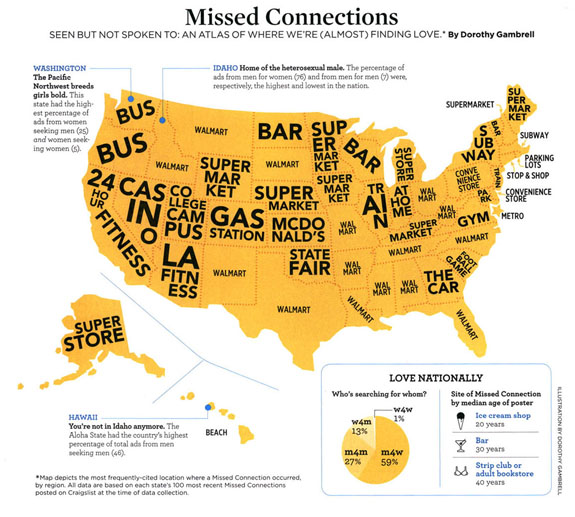
The Saddest Map In America

ZI-1175-2013-J-F00-IDSI-76-1

Yep, there it is: the result of a scholarly study by Dorothy Gambrell of the “missed connections” section of Craigslist. This is where you thought you saw your future spouse or date or hook-up, state by state. It is, in some ways, a sign of where we are now most likely to see people we don’t know in various parts of the country. It’s also a sign of male loneliness or romance: men seeking to find a possible love-mate outnumber women 86 – 14.

Nationally, the chart shows that great arc of life. In your twenties, you are most likely to think you’ve caught the eye of someone in an ice cream shop; in your thirties, in a bar; in your forties, a strip club or adult bookstore (those still exist?).  That sounds like the trajectory of the single male to me, doesn’t it? With almost the precision of a novel.

Now look at the South – more people spy love at Wal-Mart than anywhere else, from Florida all the way to New Mexico. And that thread runs all the way through deep red America. Only Oklahoma cites the state fair as a mixer. The rest see each other under the merciless lighting of the giant super-store. This is how we fall in love or lust, where we flirt and look back: when we’re shopping. The big cities – like NYC and DC – showcase the random human interaction on the subway or metro. The Northwest has it all going on on buses.

A few more gems: California is an actual self-parody (as is Nevada). Rhode Island does not disappoint in sketchiness: parking lots are where love is suspected most often there. But the saddest state of all has to be Indiana. There, the majority of “missed connections” were “at home”.

I say saddest. Maybe they’re just the most honest. Or trapped in a Pinter play.

(Hat tip: Psychology Today)

Ben Shapiro’s Agenda

The man who tried the “Friends of Hamas” smear, among others, to attack Chuck Hagel, once wrote a piece calling for the ethnic cleansing of the West Bank by forcible expulsion of Palestinians. It is, as Goldblog duly notes, a fascist position. Money quote from Shapiro:

After World War II, Poland was recreated by the Allied Powers. In doing so, the Allies sliced off a chunk of Germany and extended Poland west to the Oder-Neisse line. Anywhere from 3.5 million to 9 million Germans were forcibly expelled from the new Polish territory and relocated in Germany… Arab-Jewish conflict is exponentially more volatile than German-Polish conflict ever was. And the solution is far easier. If there was “room in Germany for the German populations of East Prussia and of the other territories,” as Churchill stated, there is certainly room in the spacious Muslim states of the Middle East for 5 million Palestinians and Israeli Arabs. If Germans, who had a centuries-old connection to the newly created Polish territory, could be expelled, then surely Palestinians, whose claim to Judea, Samaria and Gaza is dubious at best, can be expelled.

There is an obvious logic there. It’s just evil. Until the right purges itself of this dreck, it deserves to continue to die.

Does The Middle Class Really Have It So Bad?

flying_cars

Scott Winship pleads with middle-class Americans to recognize their prosperity:

Politics is about prioritizing. The more time, energy, and dollars we spend on the overstated economic problems of the middle class, the less we can devote to the poor. The poor are certainly better off than in past decades, but one in five American household heads still reported that sometime in 2010 they worried about whether their food budget would fall short before the month ended. Only 13 percent of children starting in the bottom fifth will end up in the top two-fifths in adulthood (compared with 63 percent of children who start out in the top two-fifths).

It is time to shift our focus to all that we have rather than that which we do not. It is time to renew our commitment to the American Dream of upward mobility — to help those facing long odds of occupying the most desirable positions — even as we recognize that the broad majority of us have never had it so good.

Tyler Cowen takes on another aspect of Winship’s argument – that, for developed nations, high rates of growth cannot continue indefinitely:

Most importantly, I think high rates of economic growth will resume, at some (unknown) date in the future.  Note that in a very broad data sample, stretching across centuries, rates of growth for the technological leaders are on average rising, as shown by Paul Romer.  It was a big deal in the 17th century when England started to manage an average of about one percent growth a year, but today we would call that a kind of stagnation.  The Great Stagnation is a temporary slowdown in growth, not the permanent end of new ideas.

I find myself wondering if  the Great Dislocation across the globe and the Great Stagnation in the developed world are not two sides of the same coin. We had it easy for so long, then we defeated communism and crikey, as the Aussies say, the world came back to play our own game. We are in an utterly different world than 1989 – let alone the year time stopped for the GOP: 1980.

My worries are that the cultural premise of so much of this debate is that material wealth is the core goal of human society and that its relentless accumulation has no serious consequences on the environment. The first is a surrender to the world which Christianity, if it still existed with any cultural force, should do all it can to resist – because it does not, in the end, make people happy or good. The second is undeniable. Tyler, like Manzi, sees growth as the possible solution to the environmental crisis growth has created. I sure hope they’re right and have come to see the futility of somehow making this growth somehow carbon-free by just taxing or controlling carbon when technology has actually made it cheaper, more plentiful and domestic. But that surely depends on some great technological breakthrough we cannot know or predict. And if we are wrong, and growth creates a carbon Rubicon from which the planet will never be able to escape, then welcome to life on Mars.

Anyway, hope your Thursday is going swimmingly.

(Image from XKCD)

New York Shitty, Ctd

Yeah, the beard looks very scraggly in the video we posted last night. But better than it does now: I just got it butchered by yet another bad New York City barber.

Yes, another of my waxing and waning complaints about NYC is the absence of decent, professional barbershops. Well, I don’t mean an actual absence. They’re everywhere, it seems, and yet almost all of the ones I’ve tried are dreadful.

My starter was a Yelp-recommended, first come, first served joint. I put my name down and was told to come back in 30 minutes. Ok. Back 25 minutes later, I was told it could be done in ten minutes. A further half hour of Angry birds later, I asked when I could get my beard trimmed. 20 minutes. Half an hour later, when they started hedging again when I asked, I left. New York City: wait for almost two hours not to get a haircut.

The next one I tried, I asked if they had wifi so I could blog while I waited. They did, so I asked for the password. Instead of simply telling me, the owner asked me to hand him my iPad (to write it in himself), which he then dropped, causing the screen to shatter on the floor.

Instead of apologizing, he first asked – I’m not making this up – if the iPad looked like that before he dropped it. He then insisted I have it repaired by some dude he knew. I said I’d have it repaired at the Apple Store. He harrumphed. I had a thought they might waive the fee for the beard trim. This is New York City: no fucking way.

Then I tried a third barber – recommended by a friend. The dude turned the beard into a lopsided brick. Aaron had to fix it later, and even now my head looks lop-sided. Maybe I’m just unlucky, but it amazes me that New Yorkers have such an attitude about good service when they are not in the city. Where do their expectations come from? This city has the worst service I’ve ever experienced. Yes, it remains impossible to use Time Warner wifi to listen to music on our sound system without it breaking up every few seconds. Yes, AT&T is still a nightmare. No, it doesn’t really get much better, you just get used to living in one of the least competent, self-loving cities I’ve ever known. Maybe over the years, you slowly develop your known competent individuals. From pharmacists bound by Bloomberg’s nannying to a super-intendent who cannot show up to fix a broken doorlock to even UPS (one of my meds was just “found” on the sidewalk outside my apartment by a neighbor), you just find it harder to live here, even as you’re fleeced everywhere you move. The sidewalks almost suck the money from your pockets and give back attitude in return.

And you wonder why I have no worries about Pret-A-Manger. Fawning would be lovely. But actual, simple competence in this city? A miracle.