The Dish Experiment

The NYT’s Brian Stelter interviewed yours truly about it:

This embed is invalid


If you want to be a part of this, and maybe help kickstart a new, clearer, sustainable model for new media, you can subscribe [tinypass_offer text=”here”]. We need you to make this work, because only you can make this work. My original manifesto for the entire project is here.

Why Don’t We Eat Horse? Ctd

A reader writes:

About three years ago, I was eating at a grotto in Lugano, Switzerland. I saw the word “puledro” on the menu. Not knowing the term, I reasoned that it sounded a bit like “pollo,” so I guessed it was chicken. I ordered it. To my surprise, a steak was brought to the table. I proceeded to eat what was the best steak I’ve ever eaten in my entire life (and I live in Kansas City, so I’ve had a lot of great steaks). The next day I raved about the wonderful steak to my friends. Then I mentioned it to my friend who is the dean of the college where I was teaching that summer. “Steak?” she said, “I didn’t know they served steak there. What was it called?” “Puledro,” I replied. “Oh,” she said, “that means you just ate horse.”

The strange thing is, just knowing this leaves me doubting I could ever order it again. It reveals a lot about how our social custom and schemes of classifying animals and foods according to what is acceptable and unacceptable shape everything about our choices. I don’t plan to eat horse again. But I’d be lying if I pretended it wasn’t delicious!

Another writes:

Mr. Shafer needs to do just a tad more research. We don’t eat horse in the US because horses are not specifically raised for food here. And that is a big problem because the horses that do end up in the food supply are full of a wide variety of chemicals that range from unhealthy to downright dangerous. I have a horse and he routinely gets a number of drugs that are specifically labelled “not for use in animals intended for food”.

Perhaps the most dangerous horse drug, and one of the most commonly used, is phenylbutazone, an anti-inflammatory with such distinct carcinogenic properties in humans that EU specifically forbids horses who have ingested it from being used in human food. It never clears the horse’s system. Horses are not tracked like cattle are in the US. There is no food safety mechanism for horse meat. Horse brokers routinely falsify the documents that accompany slaughter horses that are supposed to certify that the horses are drug free.  So pity the poor Europeans who thought they were eating free range American mustangs and who were getting instead broken-down race horses full of steroids, bute, de-wormer, and other unsavory substances.

In addition, horses are very uneconomic to raise, taking much longer to reach market weight and are therefore less profitable. They are also a mess to slaughter as their blood volume is much greater than cattle, resulting in a waste water nightmare. If you google Kaufman, TX and the closure of Canadian horse slaughter plants, you will learn more than you ever want to know about the environmental downside of horse slaughter.

The horse meat found in the latest scandal came from Romania … who knows what their food safety processes are. I am a horse owner and horse lover. I would never eat horse because of emotional issues but because I know far too much about where the meat came from and how lax the controls on the supply are.

Another:

The reason we don’t eat horses is that our lives depended on them for centuries.  They have killed themselves to be loyal, and they are perceptive and intelligent in a way a cow or a deer or a pig is not.  Our entire civilization was, until recently, based in their labor.  I cannot believe that obtuse reader thinks it’s some weird cultural attachment.  To get a better understanding of their contributions, and to fully understand what kinds of horses wind up in the killing pen, read the bestseller The Eighty-Dollar Champion.

The Caricatures Of COPS, Ctd

A reader quotes another:

The thing with COPS is that there’s an unspoken agreement – the cops will never be embarrassed. Can you imagine the blooper reel they could assemble?

One of the funniest things I’ve ever seen on TV is captured in this YouTube clip [seen above]. A Texas police officer, responding to a fire alarm, runs up to a house and breaks the window in order to rescue the poor old lady sleeping inside. Turns out, he got the wrong house. We then get to watch him have to apologize for attacking the wrong house. When I first saw it, I thought I was watching Reno 911.

A reader writes:

I accidentally found value in COPS about 12 years ago. One evening I needed to take a shower and give my 4-year-old daughter something to do while she was out of my sight for about 20 minutes. I put her favorite tape in the VCR and started it, but I didn’t realize that the tape was near the end. Of course, when a VCR tape ends, TV resumes. When I came out of the shower, I found her glued to the screen watching COPS, which just happened to be on at the same time. She was seriously engaged. She was asking me all kinds of questions about the people in the scenes, and I think the episode she saw was the one where the man hurls himself out of a second-story window.

I ended up having a long discussion with a 4-year-old about the problems of drugs, unplanned pregnancies and other poor choices that people make in life.

We also discussed how both drugs and unplanned pregnancies perpetuate poverty. Now, of course we didn’t talk about it with those big words, but we did effectively have that conversation. I asked her if she wanted to end up like these people, and she said “No!” I told her that if she avoided use of drugs and didn’t get pregnant until after she graduated college and could take care of herself and her child, then she would be much better off.

She became a regular viewer of COPS for the next few months, and she found it fascinating. Since that time, my daughter has paid more attention to news and social issues and she continues to discuss the problems of society. In turn, I learned to never underestimate the capacity of a 4-year-old to understand bigger issues.

Polishing Up The Silver Screen

3633210233_0cab9182ec_b

Mark Lacter reviews iPic, one of many high-end multiplexes emerging around the US:

The cushy recliners were a comfortable distance from one another, and my wife and I received “free” popcorn along with a pillow and blanket (with assurances that they had been cleaned). Servers were everywhere, which made ordering a snap. That said, we were spending $58 to see the only so-so Denzel Washington action movie Flight. Throw in parking and dinner, and we were up to $175—and I still heard a guy in front of us murmuring during parts of the film.

But the amenities may be necessary for an industry struggling to keep people in theaters:

Visiting the neighborhood multiplex is no longer a priority because there are simply too many other ways to watch a movie. In fact, only 26 percent of a typical film’s revenue is generated at the box office; the remaining 74 percent comes from DVD sales, pay-per-view, premium cable, cable, and network television. Still, it’s a critical 26 percent, considering that initial buzz determines success on the other platforms. This is leverage the industry clings to, despite efforts by the studios to shorten the theatrical window to weeks instead of months.

Ann Larie Valentine captions the above photo, from Living Room Theater in Portland, Oregon:

Loved this concept! 30 seat rooms with cozy seats & excellent food & bev choices! At the suggestion of our new buddy Tom Martin, we saw ‘Shall We Kiss’ which I thought was a french Woody Allen film (meaning, I loved it). This was an animated short that played before it.

Face Of The Day

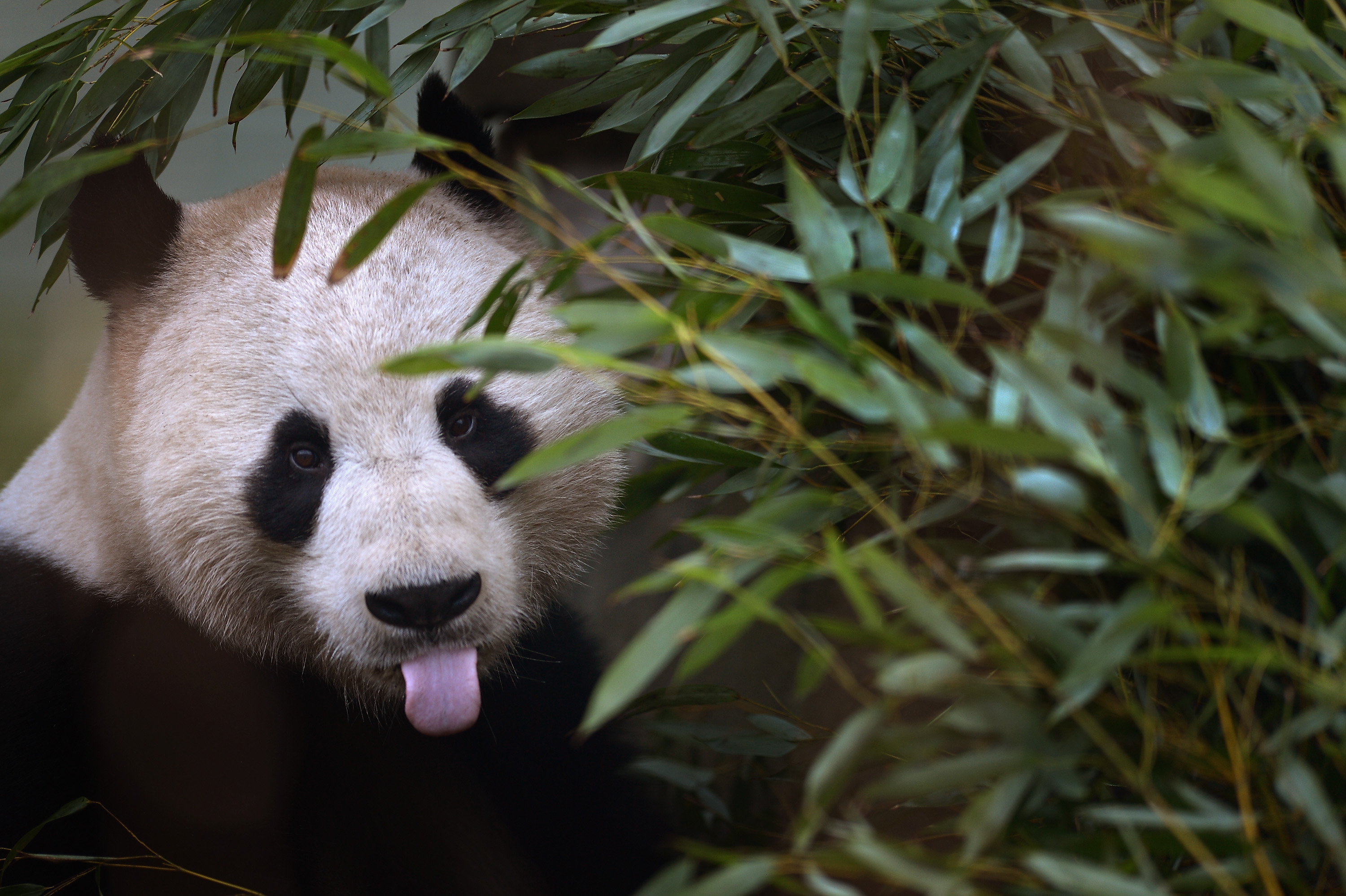
Yang Guang The Male Panda At Edinburgh Zoo Feeding In His Enclosure Before The Breeding Season Begins

Yang Guang feeds on bamboo as he bulks up for the breeding season with partner Tian Tian on February 20, 2013 in Edinburgh, Scotland. Experts at Edinburgh Zoo have announced they expect the giant panda breeding season may be earlier this year, as both Tian Tian (Sweetie) and Yang Guang (Sunshine) have already started to show important changes in their behavior that indicate that they will soon be ready to mate, speculating in four weeks time. By Jeff J Mitchell/Getty Images.

Debating “Southernomics”

Michael Lind, author of Land of Promise: An Economic History of the United Statesconsiders “cheap, powerless labor” to be the “original sin” of the South:

The purpose of the age-old economic development strategy of the Southern states has never been to allow them to compete with other states or countries on the basis of superior innovation or living standards. Instead, for generations Southern economic policymakers have sought to secure a lucrative second-tier role for the South in the national and world economies, as a supplier of commodities like cotton and oil and gas and a source of cheap labor for footloose corporations. This strategy of specializing in commodities and cheap labor is intended to enrich the Southern oligarchy. It doesn’t enrich the majority of Southerners, white, black or brown, but it is not intended to.

He sees the influence of “Southernomics” in calls for guest-worker policies, the fight against unions, and support for the Earned Income Tax Credit. Ed Kilgore acknowledges an historical focus on “low-road” development but resists the claim that it is regionally specific:

Lind appears, however, to be entirely unaware there was a fairly powerful revolt against this model of economic development in the South during the 1980s and 1990s—indeed, it’s one of the things that helped make Bill Clinton famous… The revolt died out during the last decade, in no small part because Democrats lost their competitive status in the region, yielding the field back to atavistic pols like Rick Perry and Nikki Haley, to cite the most egregious examples. But the recent rapid adoption of the low road to development by Yankee pols like Scott Walker is another indicator that it is not some inherent or exclusive product of the evil Southern Character.

Indie Co-Branding

Will Hermes profiles Will Oldham, aka Bonnie “Prince” Billy, a “gifted, eccentric and fairly revered folk-rock singer-songwriter who, for twenty years, has made an art of working outside the mainstream”:

One might sense an irreverent spirit, too, in Oldham’s recent product co-brandings — something that would have once been heresy for an indie act, let alone one of Oldham’s severe standards. In the past few months there has been a Bonnie “Prince” Billy Hawaiian coffee blend, a limited-edition batch of Dogfish Head ale (which comes with an exclusive 7″ single), even a Sanae fragrance blend.

And why not? Why should only megastars like Dr. Dre and Tim McGraw get to co-brand nice stuff? Like Oldham’s own recordings, his co-brands are made by A-list artisans. And like his musical peers, the singer is working at a time when the old career models, especially for indie-rockers, are collapsing. New ones are required, and per usual, Oldham is writing his own script.

How Pay-Per-View Put Boxing On The Ropes

Jonathan Mahler compares pro football’s economic model to boxing’s:

HBO — and later Showtime — didn’t have to worry about satisfying advertisers; it could underwrite fights by making them pay-per-view events. This may have worked as a business strategy (Mike Tyson, in particular, was a cash cow for HBO), but it helped to turn boxing into a niche sport followed only by those willing to pay $59.95 or more to watch big bouts. It also ensured that football would become America’s socially sanctioned, violent sport of choice — and that [boxer] Adrien Broner would never become a household name.

Tomasky nods:

When I lived in New York, I went to the fights once, at Madison Square Garden, at the Felt Forum, just to see what it felt like. It was very retro. This Scottish fighter came in with a full honor guard, bagpipes, kilts, the whole kit. It seemed kind of sad, an attempt to recapture faded glory. And that was 15 years ago or so. Today, who’d care? I bet no Hollywood studio would even make Rocky or Raging Bull today …

19 Degrees Of Separation

opte-1

Hungarian physicist Albert-László Barabási produced a model tracing the interconnecting points of the Internet’s 14 billion pages:

Distributed across the entire web, though, are a minority of pages—search engines, indexes and aggregators—that are very highly connected and can be used to move from area of the web to another. These nodes serve as the “Kevin Bacons” of the web, allowing users to navigate from most areas to most others in less than 19 clicks.

Barabási credits this “small world” of the web to human nature—the fact that we tend to group into communities, whether in real life or the virtual world. The pages of the web aren’t linked randomly, he says: They’re organized in an interconnected hierarchy of organizational themes, including region, country and subject area. Interestingly, this means that no matter how large the web grows, the same interconnectedness will rule. Barabási analyzed the network looking at a variety of levels—examining anywhere from a tiny slice to the full 1 trillion documents—and found that regardless of scale, the same 19-click-or-less rule applied.

J.K. Trotter has some fun with the study:

There isn’t yet a decent explanation for the 19-clicks rule — Barabási thinks it has something to do with the way pages on the Internet are grouped — but then again, there isn’t yet a decent explanation for the Six Degrees of Kevin Bacon rule, either. Of course, that popular movie trivia game (1) was itself inspired by the 1993 movie Six Degrees of Separation (2), which starred Will Smith, and does not feature Bacon. The movie was based on a 1990 play of the same name written by John Guare (3), and while it’s not clear where he got the idea (some say credit the Italian inventor Guglielmo Marconi), the earliest cited proponent of the theory is Hungarian novelist and poet Frigyes Karinthy (4) who is discussed in the 2002 book Linked by Albert-László Barabási (5) who today wrote about how many clicks separate web pages on the Internet (6).

(Image: A visualization of the billions of pages connected through the Internet by Opte Project.)