Giving Up Gluten

Darshak Sanghavi senses a fad:

According to USA Today, up to one-quarter of all consumers now want gluten-free food, even though only one person in 100 has celiac disease, the autoimmune disorder worsened by gluten ingestion. Going gluten-free seems somewhat faddish. The roster of celebrities who’ve gone temporarily or permanently off it includes Chelsea Clinton, Lady Gaga, Miley Cyrus, Drew Brees, and Oprah Winfrey, among many others.

Celiac disease can be diagnosed with a blood test, but people with wheat allergies or gluten intolerance are harder to pin down:

There’s not even a mediocre blood test for gluten intolerance. The diagnosis simply relies on someone’s subjective feelings of bloating, bowel changes, or mental fogginess after eating gluten. This is a set-up for all manner of pseudo-scientific self-diagnoses, especially when you consider that 2 percent of people believe they have illnesses caused by magnetic fields. And yet, a randomized, blinded trial in Italy just showed that one-third of patients with gluten intolerance clearly felt better with gluten-free diets, which confirmed “a distinct clinical condition.” …

This is the most frustrating part of gluten intolerance. There are certainly people who have a problem with gluten that’s not autoimmune or allergic. And yet, the data suggest that almost two-thirds of people who think they are gluten-intolerant really aren’t.

The NYT recently polled some “celiac experts” critical of dieting without a diagnosis. Seth Roberts sighs:

As someone put it in an email to me, “Don’t follow the example of the person who improved her health without expensive, invasive, inconclusive testing. If you think gluten may be a problem in your diet, you should keep eating it and pay someone to test your blood for unreliable markers and scope your gut for evidence of damage. It’s a much better idea than tracking your symptoms and trying a month without gluten, a month back on, then another month without to see if your health improves.”

Thoughts on my own gluten-free diet here and here.

Chart Of The Day

debt knowledge

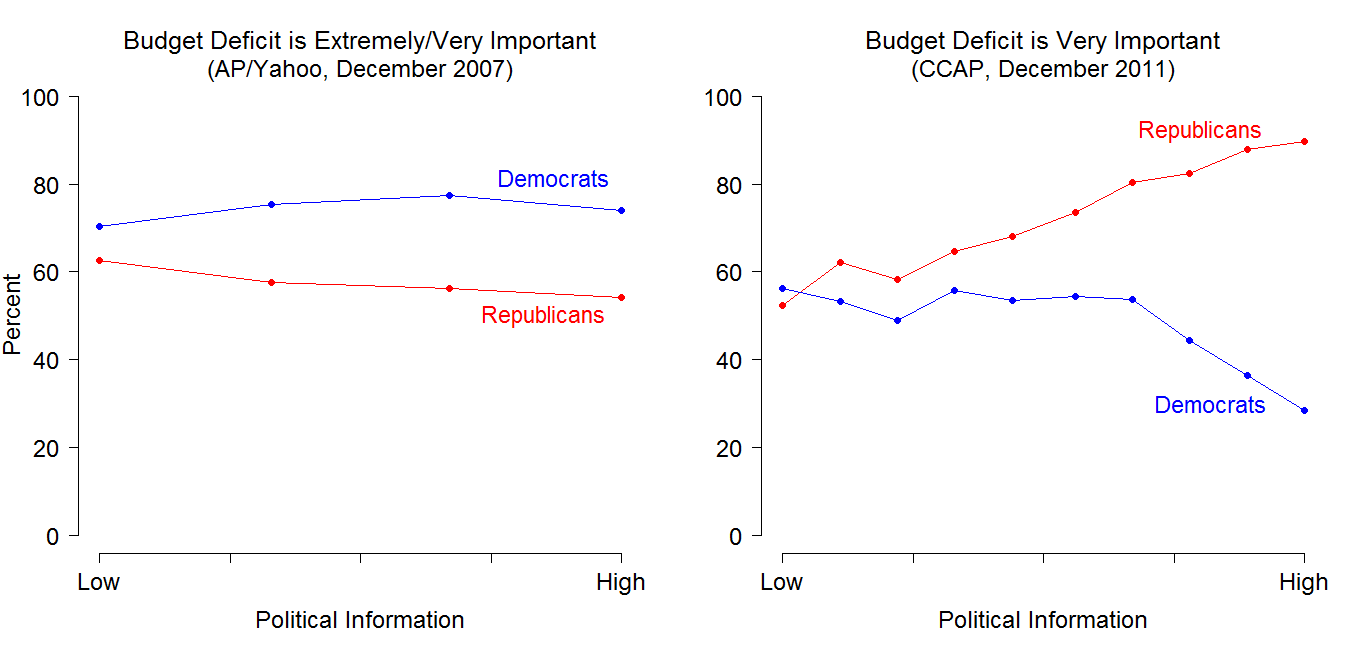
Michael Tesler finds “that public perceptions of the debt’s importance are fundamentally linked to which party is making it an issue”:

Back in December 2007, politically attentive Democrats were 20 percentage points more likely than politically attentive Republicans to say that the federal budget deficit was at least a very important issue. Four years later, though, the most politically attentive Republicans were now a whopping 60 points more likely than their Democratic counterparts to say the deficit is very important.

Yglesias adds:

[I]t’s crucial to understand that the flip-flopping happens with the best-informed people not the worst-informed people. If you’re well-informed you gain a lot of information about “your side’s argument” on the issues of the day and map your opinions to the shifting political currents.

Update from a reader:

I’m sure lots of people are emailing you about this today, but I figured I’d jump in anyway. We were in a very different place in the economic cycle in 2007 and 2011. Basic Keynesianism tells us that deficits are problematic when the economy is at full output but necessary during demand-driven recessions. It’s certainly true that Democrats are more likely to be Keynesians than Republicans, but that doesn’t make the change of opinion flip-flopping. It makes it an informed application of a consistent theory in changing circumstances. Yglesias got serious flack in his comments section for the post you quoted from, for this very reason.

A Dove In Hawk’s Clothing?

How Douthat understands Rand Paul’s strategy:

Paul has done what successful politicians tend to do: He’s picked his battles, done outreach to his critics, and consistently framed his arguments in language that conservative voters and activists understand. This has enabled him to break with the party’s hawkish tilt on a number of substantive questions, from the Libya and Syria debates to issues of executive power to the question of whether containment should be an option for dealing with Iran, without coming in for anything like the attacks that greeted Hagel’s nomination. He’s put his foot in his mouth here and there and taken fire from both his friends and foes along the way, and future world events (particularly events related to Iran) may upset his tightrope walk. But at the moment he seems like living, breathing proof that there’s room for actual foreign policy debate within the Republican coalition, and that not every non-hawk need be dismissed as a RINO and read out of the party.

Larison tackles a section of Ross’s post – on realism in the contemporary GOP.

Printing Your Own Handgun, Ctd

Kelsey Atherton explains the significance of the above video:

The agents provocateur at Defense Distributed welcomed Congress back from recess by releasing a video of a brand new 3-D printed AR-15 receiver being used to fire multiple 100-round magazines. … The last time we saw Defense Distributed test a 3-D printed lower receiver, it broke after 6 shots. The latest video shows that it can survive a whopping 600 shots. This suggests that Defense Distributed has made significant progress toward its goal of building a working 3-D printed gun.

Defense Distributed is the group behind the Wiki Weapon Project, the goal of which is to produce an open-source 3-D printed gun that anyone could make with a 3-D printing machine. Last week, Robert Beckhusen identified one way to control guns once 3-D printed guns become a real possibility:

“Perhaps the only way forward, if we choose to try and control this, is to control the gunpowder — the explosives — and not the actual device,” Hod Lipson, a Cornell University professor of engineering and an early pioneer of 3-D printing, tells Danger Room. The reason, Lipson says, is that it would be the remaining “controlled substance” in a field that’s otherwise uncontrollable, regardless of the shape or size of the firearm that you’re using — or printing. It is the “unifying material everybody would need, and it would be a good target for regulation if people choose to regulate it.”

Beckhusen also wonders about the safety of the hobbyists:

It’s a question whether freely shared blueprints, modified with anonymity — and with zero oversight and regulation — can be truly made safe for the user. Sharing faulty blueprints could also make for a dangerous kind of trolling.

Previous Dish on printed guns here.

An Equal Safety Net

Reacting to big business support for marriage equality, Amy Davidson presents the economic case for equality:

If one believes that protecting children is a priority, then so is same-sex marriage. A third of lesbian couples and a fifth of gay couples who live together already have children, according to the Census, and a lack of access to marriage takes both social and economic security away from them. A widow or widower with a minor child whose income falls below a certain level can get social-security benefits based on the deceased spouse’s earnings—but not if the spouse is of the same sex. The same is true of tax laws, like the one affecting Windsor, that might cost families their homes. Some opponents of same-sex marriage have turned this on its head and wondered if it will cost the government too much money. The answer, according to a Congressional Budget Office study, is that it most likely will not, both because the amounts, though large in the life of, say, a widow with a child, are not so large in terms of the federal budget. The government will also make money from things like imposing the income-tax marriage penalty on more couples, and from some people losing eligibility for benefits when their combined income is calculated. (There are harder-to-answer questions, like how much it might save Medicare if, earlier in life, a person had access to preventive care through a spouse’s insurance.) Marriage equality does not inflate budgets; it removes irrational distortions from them.

Benedict’s Farewell

Rembrandt_Christ_in_the_Storm_on_the_Lake_of_Galilee

Am I wrong to see in this an invocation of the Second Vatican Council’s insistence that the Church is not its hierarchy but the people of God?

It’s true that I receive letters from the world’s greatest figures – from the Heads of State, religious leaders, representatives of the world of culture and so on. I also receive many letters from ordinary people who write to me simply from their heart and let me feel their affection, which is born of our being together in Christ Jesus, in the Church. These people do not write me as one might write, for example, to a prince or a great figure one does not know. They write as brothers and sisters, sons and daughters, with the sense of very affectionate family ties. Here, one can touch what the Church is – not an organization, not an association for religious or humanitarian purposes, but a living body, a community of brothers and sisters in the Body of Jesus Christ, who unites us all. To experience the Church in this way and almost be able to touch with one’s hands the power of His truth and His love, is a source of joy, in a time in which many speak of its decline.

Benedict is a brilliant writer and thinker, one of the original architects, alongside Hans Kung, of the opening of the church fearlessly to the world. And it was his assumption of power, in my view, first as Rome’s doctrinal enforcer, then as its chief investigator of the ubiquitous abuse and rape of children (which must be counted, in my view, as a success in establishing new safeguards but as a terrible failure of accountability and responsibility for the past), and then as its Pope. He pledged to re-convert Europe with a newly authoritarian papacy, a rigid doctrinal discipline, and a purer, older form of Catholicism. He did not just fail; his papacy has been a rolling disaster for the Church in the West.

He lost Ireland, for Pete’s sake, if you’ll pardon the expression. His version of Catholicism entered the public square and has been overwhelmingly refuted, rejected, and spurned by not just those outside the Western church but by so many within it. And in his inability to rise to the occasion of unthinkable evil in the child-rape conspiracy – to clean house by removing every cardinal and every bishop and every priest implicated in any way with it – he has presided over the global destruction of the church’s moral authority. By his refusal to face the fact of huge hypocrisy in the church over homosexuality – indeed to double down on the stigmatization of gay people, reversing previous gradual movement toward acceptance – he has consigned the church to what might well become an institutional tragedy.

I think he knows this and knows he has not the strength to persevere through it. This passage moved me deeply:

I have felt like St. Peter with the Apostles in the boat on the Sea of Galilee: the Lord has given us many days of sunshine and gentle breeze, days in which the catch has been abundant; [then] there have been times when the seas were rough and the wind against us, as in the whole history of the Church it has ever been – and the Lord seemed to sleep. Nevertheless, I always knew that the Lord is in the barque, that the barque of the Church is not mine, not ours, but His – and He shall not let her sink.

The Lord seemed to sleep! He’s blaming the failures of his papacy on God Almighty. But notice the metaphor: the church is a sinkable ship, when left in human hands – in his hands – taking in the water of corruption, hypocrisy, denial, rigidity and above everything else, fear.

If we do not conquer that fear, if we do not rid ourselves of these corrupt old men, and their refusal to listen or converse, if we do not allow priests to know conjugal love and fatherhood, and to bring women to full and equal membership in the church – as Jesus clearly did – then I fear the ship that is the institutional church will sink.

But because we are the church, and every act of love in Jesus’ name is the church, and every sacrifice for another is the church, the actual church can never sink. It is, in his Holiness’s words a “community of brothers and sisters in the Body of Jesus Christ.” It lives on – in the lives of so many, lay and priests and sisters and brothers alike, men and women who have been betrayed by their nominal leaders, even as they witness to Jesus every day of their lives.

This church, whoever is elected Pope, will rise again. It will rise because in a world of such potential destruction, the message of non-violence and peace is more vital than at any time in the history of humankind. It will rise because the global capitalist system, while bringing so many out of poverty, is also now creating vast inequalities and straining the planet’s eco-system with a frenzy that we have an absolute duty to slow and control again. It will rise because the supreme values of the current West – money, power, fame, materialism – are spreading everywhere. And they lead us not to some future hell but to a very present one, in which the human soul becomes a means, not an end, in which human life is regarded as disposable not sacred, in which even the more enlightened countries, such as the US, legitimize the evil of torture and pre-emptive warfare.

We are the second generation of humankind capable of destroying the entire planet with weaponry. We are the first capable of destroying its very eco-system with greed. We need the Gospels more powerfully now than ever – because the stakes have become so great and humankind’s hubris so vast and expansive.

Yes, as a Catholic, I pray for a new Pope who sees this and can speak truth to the power of the world. But as a Catholic, I also know this will change nothing unless we begin that renewal from the ground-up.

(Painting: The Storm on the Sea of Galilee by Rembrandt.)
The GOP’s Long Game

Ezra explains it:

Insofar as there’s a long-term strategy here, it comes down to 2014. Republicans feel that this is a defensive year for them, and if they can resist further tax increases while locking in some spending cuts, that will be more than they could reasonably have expected in the days after the election. But in 2014, they expect the implementation of Obamacare to be a debacle that will give them an opportunity to mount a policy offensive against the White House. If they can just get through this year and get to 2014, their position will strengthen considerably.

Tomasky’s imagines what Republicans are thinking:

As long as we can gum up the works, make it look like Washington can’t do anything, deny Obama any sort of breakthrough victory, then we can head into ’16 in a strong position. We can say the country needs new leadership, the Democrats weren’t able to govern.

Divorce Equality

Jesse Green examines the trials and tribulations of gay divorce:

It’s not a subject that marriage-equality groups tend to trumpet on their websites, but gay couples are at the start of a divorce boom. One reason is obvious: More couples are eligible. According to a report by UCLA’s Williams Institute, nearly 50,000 of the approximately 640,000 gay couples in the U.S. in 2011 were married. (Another 100,000 were in other kinds of legal relationships, such as domestic partnerships.) The marriage rate, in states that allowed it, was quickly rising toward that of heterosexual couples: In Massachusetts as of that year, 68 percent of gay couples were married, compared with 91 percent of heterosexual couples.

Another reason for the coming boom is that while first-wave gay marriages have proved more durable than straight ones (according to the Williams Institute, about one percent of gay marriages were dissolving each year, compared with 2 percent for different-sex couples), that’s not expected to last. Most lawyers I spoke to assume that the gap will soon vanish, once the backlog of long-term and presumably more stable gay couples have married, leaving the field to the young and impulsive.

Susan Sommer, director of constitutional litigation for Lambda Legal, outlines some of the reasons why gay divorce is so necessary on a practical level:

“First of all, you can’t enter into a new marriage, or for that matter a new civil union or domestic partnership. So you can commit bigamy and might be subject to criminal prosecution.” Such “walking bigamists,” accustomed to the more casual ending of past gay relationships, may not even realize they need a divorce. “Or let’s say you and your spouse live in Virginia but got married in New York. You split up but don’t get divorced, because you can’t. One of you steps foot in D.C. because you commute there for work. While you’re in D.C. you are married to that other person even if you haven’t spoken in years. And let’s say you’re in an accident that doesn’t allow you to make end-of-life decisions; that spouse is likely the one who has the right to make decisions for you.

“Or say you never bothered to make wills, and you die. It is that spouse who inherits your property. And if you have made a will, giving your estate to your new partner, the old one is probably entitled to the spousal election, a percentage of the estate that has to go to the spouse regardless, because the law in general says you can’t entirely disinherit your spouse.

“And here’s another: There’s something called the marital presumption. So if you are married to your same-sex spouse but have moved on without getting a divorce, and have a child using an anonymous donor with your new partner, it’s your old spouse who is the presumptive parent of that child. It’s a mess!”

Will America Get “Sucked Into” Syria?

SYRIA-CONFLICT

The Economist calls on America to establish a no-fly zone over Syria, arm the rebels, and recognize a transitional government composed of Assad opponents:

As the world’s superpower, America is likely to be sucked into Syria eventually. Even if the president can resist humanitarian arguments, he will find it hard to ignore his country’s interests. If the fight drags on, Syria will degenerate into a patchwork of warring fiefs. Almost everything America wants to achieve in the Middle East will become harder. Containing terrorism, ensuring the supply of energy and preventing the spread of weapons of mass destruction: unlike, say, the 15-year civil war in Lebanon, Syria’s disintegration threatens them all.

Marc Lynch recently held a roundtable on whether or not to arm Syria’s rebels. Here’s Mona Yacoubian, who is against the idea:

Arming the Syrian opposition remains a bad idea. If anything, Syria’s chaotic evolution toward sectarian civil war vindicates the Obama administration’s caution on the question. The potential is great for unintended consequences:  Arms may fall into the wrong hands, and the United States could get sucked into a long, nasty proxy war that foments spillover across the region. Lessons not only from Afghanistan, but also Libya (from Benghazi to Mali), highlight the deadly pitfalls of funneling arms into conflict. That such an inherently volatile and complicated process can be successfully “managed” requires a significant leap of faith.

Greg Scoblete lists other reasons not to arm the opposition. Among them:

Even though President Obama has been reluctant to throw the full weight of the U.S. behind the effort to unseat the Assad regime, Washington’s involvement in the civil war has crept steadily forward — egged on by a cohort of analysts and politicians whose advice on the Iraq war proved disastrous for the United States. As the U.S. takes additional steps to involve itself in Syria’s civil war, the logic and momentum of even deeper intervention will take hold.

(Photo: A Syrian man reacts while standing on the rubble of his house while others look for survivors and bodies in the Tariq al-Bab district of the northern city of Aleppo on February 23, 2013. Three surface-to-surface missiles fired by Syrian regime forces in Aleppo’s Tariq al-Bab district have left 58 people dead, among them 36 children, the Syrian Observatory for Human Rights said on February 24. By Pablo Tosco/AFP/Getty Images)