How The “Friends Of Hamas” Smear Spread

A few weeks ago, Ben Shapiro of Breitbart.com “reported” that the eerie-sounding, non-existent group “Friends of Hamas” had possibly given money to Hagel. Dan Friedman thinks he unwittingly began this rumor:

On Feb. 6, I called a Republican aide on Capitol Hill with a question: Did Hagel’s Senate critics know of controversial groups that he had addressed? Hagel was in hot water for alleged hostility to Israel. So, I asked my source, had Hagel given a speech to, say, the “Junior League of Hezbollah, in France”? And: What about “Friends of Hamas”? The names were so over-the-top, so linked to terrorism in the Middle East, that it was clear I was talking hypothetically and hyperbolically. …

I am, it seems, the creator of the Friends of Hamas myth. Doing my job, I erred in counting on confidentiality and the understanding that my example was farcical — and by assuming no one would print an unchecked rumor.

Calling Friedman part of the “Obama media”, Shapiro refuses to face reality and further quotes his mysterious original “source.” Meanwhile, Weigel continues to fisk Shapiro.

The Evolving Antichrist

assissi

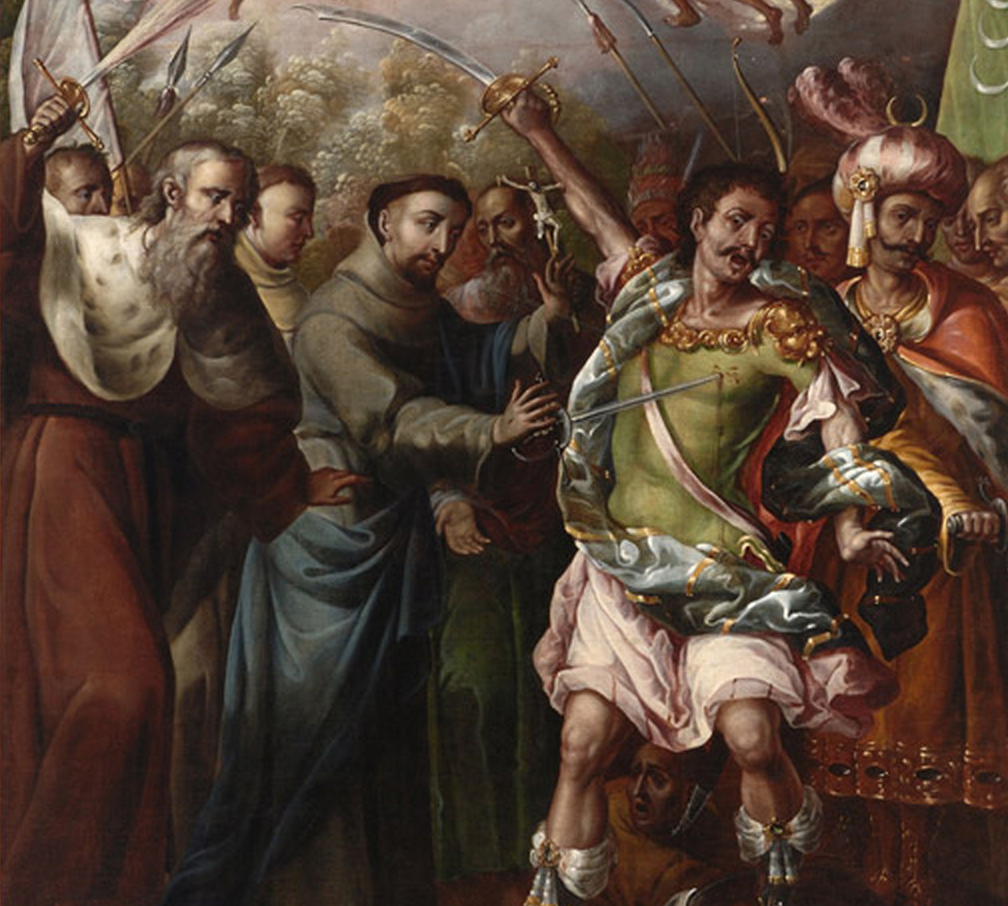
Daniel Burke details the growing tendency among evangelical and fundamentalist Christians to believe that the Antichrist will be Muslim, noting that beliefs about the Antichrist “often [reflect] the era’s deepest anxieties.” But it wasn’t always this way:

For many early Christians…the Antichrist was not a particular person. It was spiritual figure who lurked in the hearts of all believers, luring them toward sin and heresy, said Shuck. By the 12th century, the Antichrist – often seen as a human inhabited by Satan – had become a tool for identifying an enemy, fomenting fear and assembling an army. “The Antichrist moves a long way from Augustine’s view of something that we all face inside us,” Shuck said, “to being very much an external battle with concrete figures.”

Below is the caption for the above painting, “Saint Francis Defeats the Antichrist,” on display at the Philadelphia Museum of Art:

This painting is one of seventeen surviving canvases from a series of forty-nine devoted to the life of Saint Francis of Assisi, commissioned in 1691 from Cristóbal de Villalpando—the preeminent artist of colonial Mexico—for the Franciscan convent in Antigua, Guatemala. In this scene Francis thrusts a sword into the Antichrist’s chest as the prophet Elijah, directly behind the saint, charges brandishing a flaming sword. The Antichrist’s supporters, grouped at the right, recoil in horror. The top of the composition, trimmed off sometime in the painting’s history, showed a battle between angels and demons, whose legs are still visible.

This violent confrontation is not described in any of the biographies of the famously peaceful saint. It was likely devised by the artist with the guidance of his Franciscan patrons, making it the earliest known example of this unorthodox iconography, which is found only in Mexico. The powerful narrative in this painting underscores Villalpando’s flair for the type of dramatic composition that epitomizes the Baroque era.

A Second Skin That Signals Danger

Ackerman explores the possibilites of MIT’s project to sew conductive fibers into uniforms to “allow soldiers’ threads to detect light, heat and sound”:

The fibers could make identifying friendly soldiers on a confusing, smoky, dusty, dark battlefield easier. Shine a laser designator on someone you don’t recognize. If she’s wearing the same uniform as you, the functional microfibers sewn into it would sense the laser and send a data signal back to your shirt. Same with someone’s voice. Heat-sensitive fibers show potential for battlefield medicine: the shape and rate of change of a heat pattern pressed up against the shirt indicate where and how severely someone’s been wounded.

When Should Journalists Accept Gifts?

COVER-590x392

Normally, Jason Plotkin would never take a gift from someone he was covering:

For 20 years since I became a journalist, I have politely turned away and turned down a variety of generous gifts. From homemade jam made by the most adorable elderly women to t-shirts, books and even flowers. To keep a clean ethical line where I don’t put anyone, including myself, in a uncomfortable position, I have politely refused many gifts over the years. And during those occasions, if someone were to mail me something, I still couldn’t keep it. The York Daily Record’s policy is to auction off such gifts and give the money to charity.

But then he encountered a former Marine who insisted on giving him the “cover” seen above:

Something in [the Marine’s] eyes told me he wasn’t going to take “No” for an answer. And to be honest, I was taken aback. For some reason I didn’t want to say no. So I didn’t say “No.” I said “Thank you.”

He now keeps it on his desk. Responding to Plotkin’s story, Steve Buttry zooms out:

Our jobs [as journalists] too often force us to annoy – asking difficult questions, refusing pleas not to publish embarrassing information, intruding on grief and other private situations. I defend (and have practiced) all of those actions and many other unpopular things journalists need to do. But we don’t have to insult people who are being kind in ways that don’t threaten our integrity.

Courting The Dead

According to Tom Jokinen, the rise of cremation has forced the funeral industry to dream up ways of driving “human, breathing traffic to their gates and to create buzz”:

In 1998 the owner of Hollywood Forever, 28-year-old deathcare whiz-kid and technical advisor to the TV series Six Feet Under, Tyler Cassity, told the New York Times that it was his dream to repatriate the remains of Doors singer Jim Morrison from Père Lachaise cemetery in Paris, where he was quietly buried in 1971. It was known that Père Lachaise had grown impatient with Morrison’s pilgrims and the mess they left behind, the graffiti and impromptu shrines, and Cassity had hoped they might do a deal. “We’d give him a special area,” he said. Hollywood Forever was looking to draft a big name corpse, the way hockey teams draft franchise players. The Paris deal never happened, but Cassity made it clear he was open to negotiation with other stars, including those who were still alive.

Something Has To Come First

Linda Besner updates the age-old debate about the chicken and the egg, as scientists have recently claimed to have solved the problem:

The one hailing Team Chicken revolves around a British paper called “Structural Control of Crystal Nuclei by Eggshell Protein,” written by Colin Freeman and John Harding from the University of Sheffield and David Quigley and P. Mark Rodger from the University of Warwick. They used a supercomputer to figure out how eggshells are formed, and it turns out they depend upon a protein found in chicken ovaries called ovocledidin-17. This would mean that an egg can only come into being if formed inside a chicken.

Team Egg’s argument involves less computer modelling and more taxonomy. The question, the Eggers say, hinges on how you define a chicken egg—is it an egg laid by a chicken or an egg from which a chicken emerges? Today’s barnyard Gallus gallus domesticus must have evolved from an earlier thingummy with chicken-like qualities. In 2008, Jonas Eriksson et al. argued that the chicken is a hybrid, the offspring of both the red and the grey junglefowl. At some point (here I’m fudging, because evolution takes longer than this, but you get the idea) something that wasn’t quite a chicken laid an egg, from which something hatched, which tipped over into chickendom. The zygote in which the genetic change happened that created the first chicken was contained inside an egg. So—the egg came first.

Besner sides with Team Egg:

The egg is all surprise, a sphere of unexercised influence, an occlusion. It’s what you have before you know what you have. … If there is a feathered state beyond this, I’m not expecting to get there in this lifetime. I’m not sure I want to; the egg is where the mystery is.

Above video via Kottke:

As the curator of the egg collection at London’s Natural History Museum explains, the double egg is rare but real and results from a fully formed egg being pushed back into the ovary, where another egg forms around it.

Infrastructure Policy’s Shaky Foundation

Shafer wants a smarter infrastructure debate:

The political debate over what to build would benefit if policymakers and the press stopped grouping such disparate public-works categories of surface transportation, airports, waterways and ports, the electricity grid and waterworks all under the all-encompassing rubric of “infrastructure” and started asking narrowing questions. Perhaps the infrastructure pie should be sliced a little thinner so we can ask more precise questions about it. Was some infrastructure overbuilt and not deserving of repair today just because it exists? Does every infrastructure “need” demand a flotilla of dollars from Washington? Must we rescue every aging bridge in rapidly depopulating states like Michigan? Shouldn’t infrastructure projects such as harbor dredging be billed to those who directly benefit from them, and not the government?


Will The Internet Swallow TV?

Ken Auletta checks in on Aereo, which streams bunny-ear TV over the internet:

Why does “old” media, like television, matter? For starters, the average American, according to Nielsen, devotes at least thirty-four hours each week to watching television, plus another three to six hours of recorded programs; less than five hours per week are spent trolling the Internet on a digital device. Poorer people tend to watch more television because they can’t afford other diversions. For those who find cable too expensive, and who live in dense urban areas where roof antennas provide poor TV reception, Aereo may deliver on the promise of “public access” to free, broadcast television (though they would, again, have to pay eighty dollars a year).

Aereo’s founder, Chet Kanojia, understands the stakes. He’s received two rounds of financing totalling nearly sixty million dollars. This year, he plans to roll out a national service by making Aereo available in twenty-two cities, including Boston, Atlanta, and Dallas.

Earlier Dish on Aereo here and here.

Will The Saudis Go Nuclear?

Should Iran get the bomb, a new report (pdf) doubts that Saudi Arabia will follow suit:

The Saudis would be highly motivated to acquire some form of nuclear deterrent to counter an Iranian bomb. However, significant disincentives – including the prospect of worsening Saudi Arabia’s security environment, rupturing strategic ties with the United States, damaging the country’s international reputation and making the Kingdom the target of sanctions – would discourage a mad rush by Riyadh to develop nuclear weapons. And, in any case, Saudi Arabia lacks the technological and bureaucratic wherewithal to do so any time in the foreseeable future. Saudi Arabia is more likely to respond to Iranian nuclearization by continuing to bolster its conventional defenses against Iranian aggression while engaging in a long-term hedging strategy designed to improve civilian nuclear capabilities.

Lynch sees holes in this theory:

The argument is well-made, but I see some key points which remain unresolved. India and Pakistan got away with going nuclear, oil behemoth Saudi Arabia is hardly a prime target for economic sanctions, and Washington doesn’t have a great track record of standing up to Riyadh. What’s more, the authors probably overestimate the rationality and coherence of Saudi foreign policy, which might leap forward out of status concerns or irrational terror of Tehran despite the compellingly logical reasons they shouldn’t.

The Daily Wrap

Obama Urges Congress To Act To Avoid Impending Automatic Budget Cuts

Today on the Dish, Andrew urged conservatives to be responsible stewards for a society disrupted by the march of capitalism. While he applauded Jane Mayer for distinguishing between targeted killings and torture, he went after Obama for eroding that distinction through his inaction over war crimes under Bush. Andrew also agreed with Tomasky that the Republicans are setting themselves up for a “meep-meep” moment on the sequester before checking in on the marriage equality debate in Illinois.

In other political coverage, Simpson-Bowles showed signs of a resurgence, McCain’s douchiness held up Hagel, Frum suggested a surgeon general’s report on gun safety, and a reader reported on federal obstruction of environmental guidelines for pot. Travis Waldron poked holes in Marsha Blackburn’s argument on the minimum wage as Friedersdorf detailed the sexist history behind the policy. The Feds shouldered the load on the healthcare exchanges while Yglesias and Frakt pondered costs and benefits and smokers paid extra. On the papal beat, John Allen Jr. struggled to handicap the coming conclave while Buzzfeed listicle’d Benedict’s glam.

In assorted coverage, Harry Enten debunked the myth of the liberal youth, Ponnuru went tote-to-tote with San Francisco on the plastic bag ban, and gerrymandering may not have mattered in the last election. Benjamin Lessing struggled with the paradoxes of punishing prison gangs, Jamaal Glenn felt constrained by mailing addresses, and Bill Cunningham engaged in covert activism against homophobia. StatsBee mapped out the best places for New Yorkers to get their caffeine fix, Michael Dempster partnered up for the health benefits, and Katherine Bouton navigated hearing loss in the workplace. Mark Linsenmayer waxed philosophical about Groundhog Day, movie theaters rolled out upscale offerings to compete with the couch, and Margaret Heidenry speculated about a resurgence of “spec” scripts.

Elsewhere, Nathan Rabin tried to reclaim country from rednecks, Natalie Shapero revealed how turn-of-the century fictional lie detectors foretold a rethinking of criminality, and Montaigne distinguished “blameless” sneezes from other bodily emissions. On the science side of things, Daniel Engber wondered at the preservation techniques behind Body Worlds, and Dr. Bong Wei endorsed the Armageddon defense against meteors. We set a new standard of adorable in the MHB, traveled from China to Indiana before landing in Cairo for the VFYW contest, got a dose of metal and glass in today’s VFYW, and gazed at a creepy doll in the FOTD.

D.A.

(Photo: Surrounded by first responders who may be impacted by looming budget cuts, President Barack Obama speaks during an event at the Eisenhower Executive Office Building February 19, 2013 in Washington, DC. Obama urged action to avoid the automatic budget cuts scheduled to hit next Friday if Congress does not find a path on balanced deficit reduction. By Win McNamee/Getty Images)