Punxsutawney Plato

Mark Linsenmayer gives Groundhog Day a Platonic spin:

[Bill Murray’s character] ends up in a zen-like peace in the midst of his constant activity. He’s figured out what battles he can’t win (saving a dying hobo’s life, actually seducing the one he loves), what difference he can make (even though presumably the damage to a boy falling out a tree would from his cursed vantage be eternally temporary), how to really make everyone around him feel great, and most of all, he’s trained himself to behave morally. Even though he figures out early on how to successfully rob a bank and so be flush with cash for the rest of the day (and likewise, I’m sure there would be more violent and equally effective means to achieve this), this doesn’t become part of his long-term routine, because he’s already got enough.

On a different picture of human nature, he could have become a serial rapist, newly subjugating the town every day, but this, whether or not he explored such dark avenues in his many months of captivity, is not what ends up being satisfying. Given enough time to reflect on it, he (as any of us would, according to Plato’s picture) seeks the good, and given enough acquired knowledge of himself, of social graces, of material circumstances, he’s able to achieve the good unerringly.

So this tale a counter to the “ring of Gyges” example brought up by Glaucon in The Republic. In that case, Glaucon says that man is fundamentally unjust, because if he had a ring of invisibility and could do injustice without consequence, he surely would. Groundhog Day is a demonstration that on the contrary, though someone with such power would try injustice, given the time to really sort himself out, he would turn to justice after all.

The Price Of A Pack Is About To Go Up

How Obamacare penalizes smokers:

Although low- and middle-income tobacco users will get premium subsidies meant to make health insurance more affordable, that government assistance would not apply to the tobacco surcharge, leaving the smoker to foot the bill. One analysis, prepared by the nonpartisan Institute for Health Policy Solutions, estimated that the tobacco surcharge could cause a low-income individual’s annual premiums to jump from $708 to $3,308.

A major question that remains: “Who counts as a tobacco user in the first place?”:

A smoker who goes through a pack a day likely fits the bill, but what about one who only smokes the occasional cigarette in the bar? The person making a quit attempt? The user of e-cigarettes? These are questions that, 10 months before this provision goes into effect, are still wide open. They are also a great example of why a 900-page law requires thousands more pages of regulation, as the federal government tries to turn relatively vague provisions into concrete law.

Putting The Dead On Display

animatingdead

Daniel Engber visits the Plastinarium, the permanent home to specimens used in the wildly popular traveling show, Body Worlds:

However else one might describe the Body Worlds exhibits—as science or as flimflam—they have done more than any other modern spectacle to bring the human corpse into view. For the first time in recent memory, tens of millions of people in the developed world have had the chance to see cadavers on parade, to view the lifeless bodies of their fellow beings without the intermediation of fear or shame.

As the architect of this experience, and as its tireless proponent, [Gunther von Hagens] has refigured death for modern sensibilities. A plastinated corpse isn’t pickled, like a body in a casket. It doesn’t stink, like cadavers at the morgue. It doesn’t rot or bloat or molder. To see one doesn’t make you sad or sick; it doesn’t fill you with anxiety. The experience is something else instead—an encounter with a memento mori that’s both dry and durable and can be split and peeled without disgust. It’s death denuded of its most gruesome elements, the body as a finely engineered machine.

(Above: “The Lassoer” from the “Body Worlds Vital” exhibit. Photo from the Greater Louisville Medical Society Flickr.)

The Return Of The Grand Bargain?

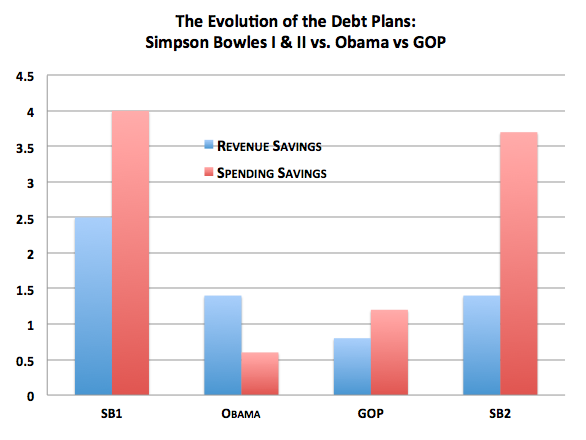
SB Chart

Derek Thompson compares the new Bowles-Simpson plan (SB2 above) to the original (SB1):

I always thought that the most admirable element of the first Bowles-Simpson plan — whether or not you consider yourself a deficit hawk — was the brutal honesty that fulfilling our promise to medically insure the poor and old, while protecting the working poor, while building better roads and broadband, while paying for a military, while doing everything else we’ve come to expect from the government would require tax increases beyond the top two percent. This plan all but gives up on the idea that balancing the budget requires a roughly equal mix of tax hikes and spending cuts.

Sargent adds:

Simpson/Bowles were trying to locate a compromise position that is achievable, given political realities. Perhaps that’s understandable; perhaps Dems are even partly to blame for the fact that the “possible” has been pulled so far in the GOP’s direction. But let’s not call this a “middle ground” or “centrist” position. It isn’t one, unless public opinion and the election’s outcome are to be disregarded entirely in the quest to establish it.

Ezra argues along the same lines:

[T]his plan sacrifices the most useful element of the original Simpson-Bowles effort, which was that it created a model — not the only model, of course — for how you might go about reducing the deficit if you weren’t bound by the various promises, interest groups and political constraints of the two parties. This plan, by contrast, is an effort to split the difference between the two parties while amping up the total deficit reduction.

Gleckman is more positive:

It is still early. With a deadline of March 1, the real drama won’t gear up for at least another week. And it isn’t likely many lawmakers will take up the Bowles and Simpson plan yet. But if Congress and Obama ever decide to actually set serious tax and spending priorities, a consensus budget could well end up looking something like what the two men proposed today.

In an interview, Bowles claims that, after the original plan was released, the White House “said we had too much revenue” and that “being far out front of the president on revenues wasn’t something I wanted to do again.”

Face Of The Day

The Sydney Doll Hospital Centenary

Spare doll heads are seen at Sydney’s Original Doll Hospital in Bexley on February 19, 2013 in Sydney, Australia. Established in 1913 by Harold Chapman, the doll hospital is now run by Geoff Chapman, the third generation of Chapmans to run the business and will celebrate 100 years of repairing all types of dolls, teddy bears, rocking horses, umbrellas, prams and various other items. By Mark Kolbe/Getty Images.

Guns Are Bad For Your Health

Should the Democrats’ gun control efforts fail, Frum suggests steps the Obama administration can take unilaterally:

Congress in the mid-1990s forbade the federal government to fund its own research into the health risks presented by guns. By now, however, enough research has been done by privately funded scholars that the surgeon general could write a report based on existing material. Such a report would surely reach the conclusion that a gun in the home greatly elevates risks of suicide, lethal accident and fatal domestic violence. The first step to changing gun policy is to change public attitudes about guns, as Americans previously changed their attitudes about tobacco and drunken driving. The surgeon general can lead that attitude change with more authority than any other public official.

Why this kind of scrutiny is necessary:

So many gun accidents occur because guns almost never indicate whether a bullet is present in the chamber. A gun owner might remove the gun’s magazine and believe the gun unloaded, when in fact it still contains one potentially deadly shot. Why not require guns to be equipped with indicator lights? Why not require that guns be designed so that they will not fire if dropped? We have safety standards for every consumer product, from children’s cribs to lawnmowers, except for the most dangerous consumer product of them all. Not only that, Congress has actually immunized makers of that product against harms inflicted by unsafe design.

Obamacare’s Left-Leaning Federalism

It’s now official that the federal government will run 26 state healthcare exchanges, mostly in red states:

Exchanges By State

Sahil Kapur analyzes the situation:

“Now, in an ironic way, some of what progressives wanted is going to happen. The national government will be setting the framework for at least half of the country,” Theda Skocpol, a professor at Harvard University and expert on health care politics and policy, said in an email Tuesday. “State-level experiments and variants will often have a more progressive flavor — in the states doing their own exchanges — and of course those may create models that could later spread. Meanwhile, the feds will at least create some consistency.”

The immediate political upshot for leaders of the Republican states that stonewalled the exchanges is that they’ll avoid the wrath of their conservative flanks. And in the long-run, this decision allows them to more easily blame the federal government if things go wrong.

Suderman wonders whether the exchanges will open on time:

[O]fficials at the Department of Health and Human Services, which is heading up the federal exchange efforts, are projecting confidence, promising the exchanges will be open for business this October as called for by the law. But the law’s track record so far does not inspire much faith. Last summer, the American Action Forum found that 47 percent of the law’s implementation deadlines had been missed.

(Map from Kaiser. Interactive version here.)

Totes Dangerous, Ctd

Ramesh recently worried about the health consequences of banning plastic bags:

Jonathan Klick and Joshua Wright, who are law professors at the University of Pennsylvania and George Mason University, respectively, have done a more recent study on the public-health impact of plastic-bag bans. They find that emergency-room admissions related to E. coli infections increased in San Francisco after the ban. (Nearby counties did not show this increase.) And this effect showed up as soon as the ban was implemented. (“There is a clear discontinuity at the time of adoption.”) The San Francisco ban was also associated with increases in salmonella and other bacterial infections. Similar effects were found in other California towns that adopted such laws.

City officials in San Francisco are pushing back on this research:

In a memo (pdf) released earlier this week, [Tomás Aragón, an epidemiologist at UC Berkeley and health officer for the city of San Francisco] explained that this is an example of the “ecological fallacy.” In order to establish a link between the bag ban and illnesses, the authors would have to show that the same people who are using reusable bags are also the ones getting sick. This study doesn’t do that. Aragón also points out that emergency-room data can be very incomplete—under an alternate measure, there’s been no rise in E. coli at all.

Aragón also offers an alternative hypothesis for the recent rise in deaths related to intestinal infections. A large portion of the cases in San Francisco involve C. difficile enterocolitis, a disease that’s often coded as food-borne illness in hospitals. And this disease has become more common in lots of places since 2005, all around the United States, Canada, and Europe (for yet-unexplained reasons). “The increase in San Francisco,” he notes, “probably reflects this international increase.”

Previous Dish on the subject here.

The Cost Of Miracles

Yglesias responds to the now FDA-approved technology that can allow limited sight to the blind through the use of an optical implant, video camera and belt-worn processor:

Of course the ability to cure the blind could also lead to “higher health care costs” (cue threatening music). Most likely it won’t actually make “health care costs” much higher, simply because the share of the population with severe retina damage is pretty small. But it’s still an amazing breakthrough. Restoring the sight of blind people is genuinely miraculous. And further technological breakthroughs to ameliorate more common ailments would be good things, not bad things. Which is why I don’t love the rhetoric of health care costs. Inefficiency is costly, and we should strike to purge it from the system. But new cures may be expensive without being costly at all. Blindness is costly. Chronic lower back pain is costly. Cancer is costly. Finding ways to treat these problems will likely lead to the expenditure of funds on the treatments, but that’s because the treatments are valuable.

Austin Frakt worries about overuse of new technologies:

Sure, restoring sight to people with blindness, relieving back pain, finding and curing cancer are all good to the extent the technologies work relative to alternatives and to the extent they are applied to people who need them. But what you find is that the technology to restore sight is, decades later, enhancing the vision of those with 20-20 sight. You find the cure for back pain that involves advanced imaging isn’t any better than physical therapy, but it is now a multi-billion dollar industry. You find that cancer screening is being applied to people who are at very low risk of cancer and, as a result, that screening is actually causing harm and costing us a fortune.