The View From Your Window Contest: Winner #141

vfyw_2-16

A reader writes:

Pollution, filthy window, characteristic air conditioners, paper over windows across the way (in lieu of curtains or shades) is typical in working people’s homes in China. Probably Beijing, possibly in or near Dashanzi industrial zone and 798 Arts District. Further than that I cannot say.

Another:

I was in Shanghai last summer and this view is reminiscent of the local architecture throughout the non-downtown areas.  So I’ll go with Shanghai as my guess and have a glass of scotch to soothe the trauma of a freshly renewed memory of a horrific cab ride through the city. My driver’s name was Crash … no more needs to be said.

Another:

Several buildings in the picture are very distinctive, so I tried a number of Google searches for “yellow and brown striped building” or “building that looks like it has an alien spaceship on top of it,” but sadly those searches yielded nothing. This place really seems like it could be anywhere cold and industrial, from Baltimore to Beijing. I’ll go with Harbin, China. I took a trip through the area a couple years ago, including a visit to the border with North Korea, and this scene definitely reminds me of the Northeastern Chinese cities that I traveled through.

Another:

I see dreariness, slightly Middle Eastern look but with not enough sat dishes and possibly wartorn. I’ll go with Grozny.

Another:

The pollution is a dead giveaway for a developing country – look at how dirty the buildings are from the coal burning! Beyond that, the color of the buildings and the unique fusion of the single skyscraper in the background suggest a city in Iran, perhaps?

Another:

The smoke and grimy window and American looking buildings and some sort of industry and presumably water cutting off the scenery beyond make me think of Gary, Indiana. A cheap hotel in Gary is my guess.

Another:

Where the meteor dropped some pieces: Deputatskoye, Russia. It’s a neat name even if not a winner. Sure looks like some Russian industrial town.

Another gets the right city:

Bad air, hot climate as suggested by the industrial air conditioners, muslim country as suggested by the one minaret or I’m hoping the Cairo Tower, but probably not.

Cairo, Egypt it is. Another gets more specific:

It didn’t take long to figure out that we’re looking at Cairo: the small striped building in the center is the Falaki Academic Center (part of American University in Cairo), and the distinctive building in the far right background belongs to Banque Misr.  Determining where exactly the photo was taken from proved far more challenging.  As best as I can figure, the photo was taken from the south side of Hussein Hegazy street, looking north into Cairo.

cairo

The adjacent rooftop structures seem to match (are those air conditioning units?), as does the light blue roof on the far left.  Unfortunately, I don’t have a window to highlight. But if it comes down to a tiebreaker this week, I was one of the many people who also identified the correct window last week. Hopefully that counts for something!

So close to breaking the tie, but the prize this week goes to the following reader, who got much more specific and who has also entered a dozen more contests than the previous reader:

A lot harder than last week!  My initial gut reaction was “Arab world” just based on the appearance of the buildings and a sort of resemblance to Amman, which I visited last year.  Amman was out, however, due to the flatness of the terrain visible, and the buildings were not modern enough for the Gulf, so my next thought was Syria.  I spent a while searching skylines of Damascus and then Aleppo with no luck, so I thought about what other cities in the region were big enough to have a view like the contest’s view, and Cairo occurred to me.

I spent another long while poring over skylines before I found the photo attached as “Cairo from old city” (link here).  I’ve put an arrow over the building which I’m pretty sure is the one on the right in the contest photo:

Cairo from old city

Next step: actually find where that is in Cairo.  The big mosque in the foreground was relatively easy – the Mosque Madrassa of Sultan Hassan, taken from the Citadel.  Then, I used the very helpful wikipedia page “List of tall buildings in Cairo” to identify the twin buildings in the far right background as the Nile City towers.  I then used Google maps to make a line-of-sight – somewhere along that line roughly was, if not the Window, then the key tower:

Line of sight

Aha!  If only I had drawn that line the first time around it would have saved me an embarrassingly long time combing the city, because as it happens the tower in question fell right on it!  The Banque Misr headquarters – satellite image attached, link here.  Here it is from the front, I think.

If only that were the actual Window.  I still had some work to do.  The absence of other large buildings and or visible open areas/parks from the shot narrowed down somewhat the possible directions we could be facing, but it took me a while of looking for the second-tallest building in the shot, the one on the far left, until I found this one.

More frustrating streetcombing with Google maps and image search, and another piece of the puzzle fell into place: The orange/tan stripey building in the center-right, midfield of the Window, is the Falaki Academic Center of the American University in Cairo, and is located here.  That would make the black smoke billowing upward in the center of the photo roughly coming from Sheikh Rihan street, the site of recent riots, or possibly from the front of the Egyptian Parliament, which has also seen its share of the riots.

Working backwards (south) from my triangulated points, passing the campus and the Egyptian Parliament, the first set of “roof stuff” that seemed to fit the necessary angle was this building on Hussein Hegazy street (green arrow, not red “A”), so that’s my answer – top floor:

The Window

I searched for the street number google suggested (12 Hussein Hegazy), and came across the Albawtaka Review, an “Arabic independent (non-governmental) non-profit online quarterly concerned with translating English short fiction.” (from here)  That sounds like Dish readership potential, so I’ll hazard that the photo came from their office.

So there we have it.  The first time I think I’ve gotten two windows in a row, and this one being the hardest one I’ve gotten.  Maybe this is my week to win!

Indeed. From the submitter:

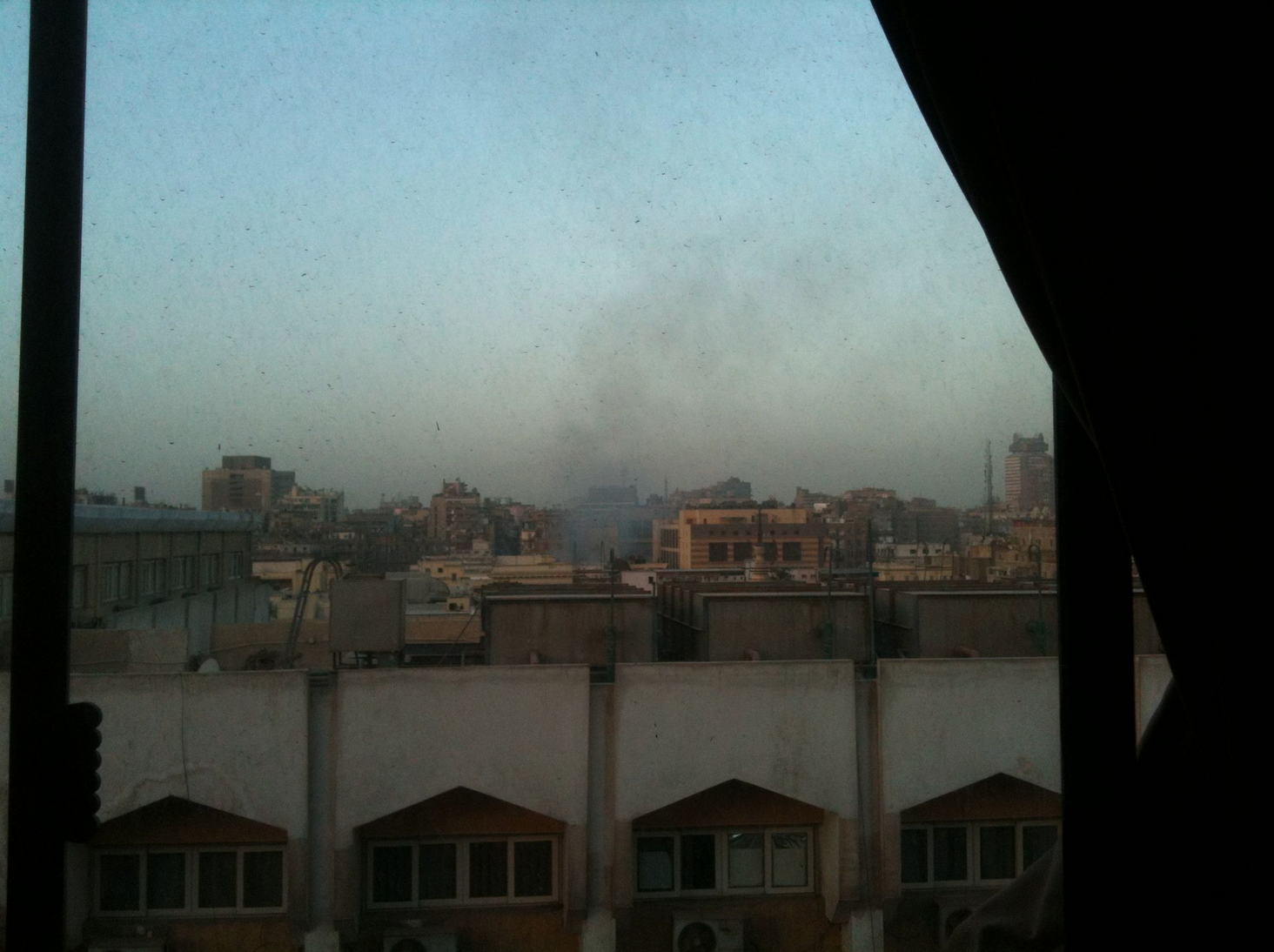
The photo was taken at about 5:15 pm local time on January 26, 2013, in Cairo, Egypt. The smoke rising is from clashes near the interior ministry; my apartment is right next to the Cabinet and near a variety of other government buildings, so when things get hot, protestors head here. With the 2nd anniversary of the revolution yesterday and the government’s announcement of the outcome of trials of those police and protestors involved in the Port Saeed massacre of last year (21 received death, 70 some trials were delayed, including those of all police involved), things are not looking too hot in Egypt right now.

Follow-up from the submitter:

No way you chose my photo! This is excellent, much appreciated. I love the Dish, gonna subscribe now, rather than just mooch off my Google Reader.

In case you need any extra details should some creep figure out exactly where I sleep, I live at 12 Hussein Hegazy Street, in an area of Cairo called Mounira. I’m on the 9th floor (10th by American counting), and this is from the eastern-most window on the floor.

Thanks a lot for all the blogging!

Another close entry from a first-time contestant:

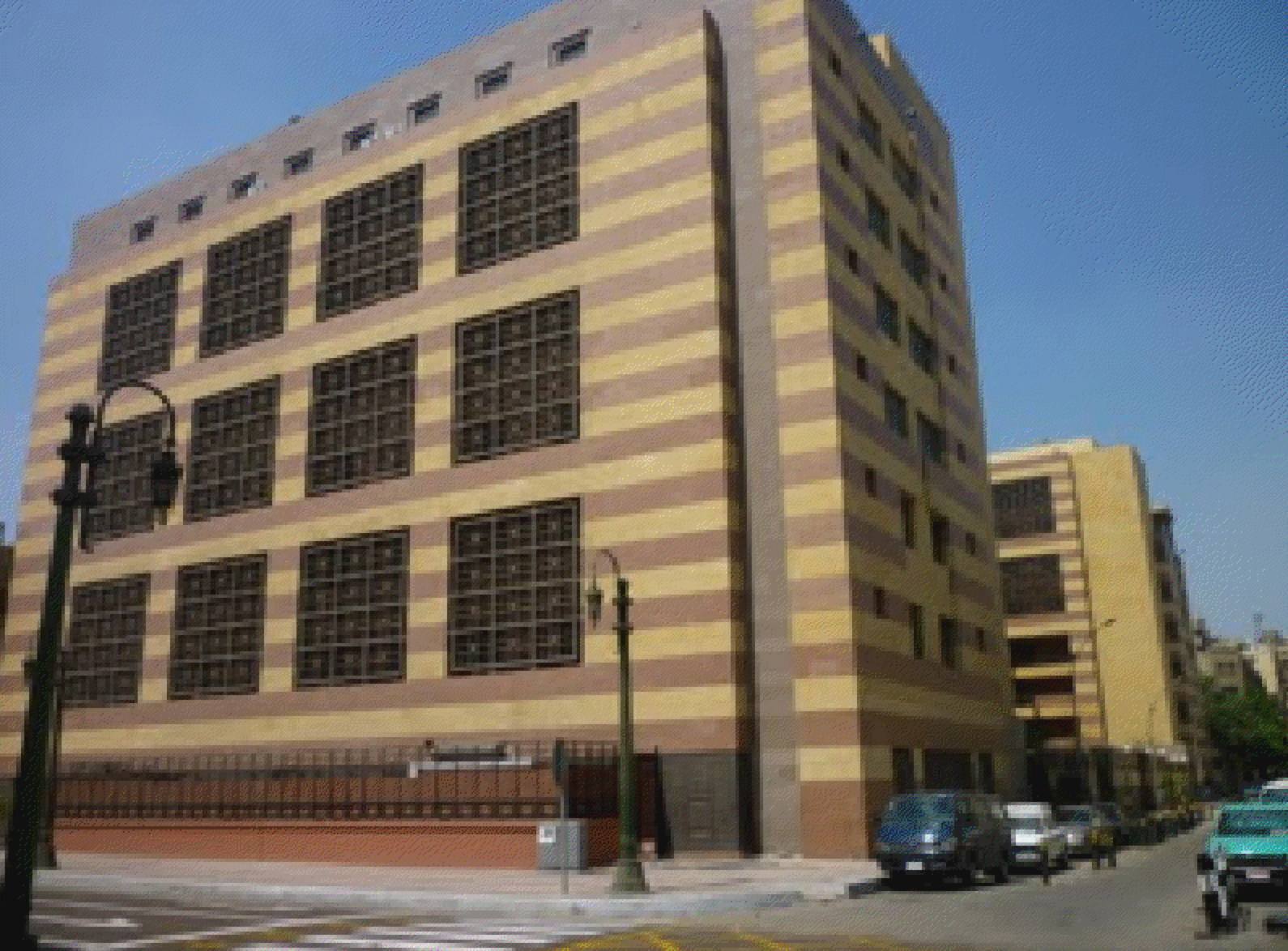
Finally, one that I recognize! This photo is taken in Cairo, Egypt, to the southeast of Tahrir Square. The cityscape immediately made me think Cairo, where I lived for a year back in 2006, but I’ve thought that before and been wrong. After I started looking closely, the striped building in the center looked familiar, and a Google image search confirmed that it is part of the American University in Cairo’s old campus near Tahrir. This building, which is called the Falaki center:

Screen Shot 2013-02-19 at 1.09.05 PM

I’m pretty sure the tall building on the right is the Banque Misr building, which means this photo is facing north. If my extrapolation is correct, the photo was taken on the 7th floor (or thereabouts) at 12 Hussein Hegazi Street, which is just a few blocks from where I used to live. The building in the foreground, with its quintessential third-world bureaucracy architecture, is part of the Ministry of Health, I believe. Tahrir Square is very close, a few blocks to the left of the Falaki building.
One reader totally nailed the right location – down to the exact floor – but he has already won a contest and VFYW book:

That was exhausting. I must have been to every souk and high rise from Amman to Riyadh before finding the right spot. This week’s view, however, comes from the heart of Cairo, Egypt. I believe the shot was taken from roughly the ninth floor of 12 Hussein Hegazy Street. The viewer was looking north, north eastward, with the Misr Bank Tower being the most distinctive landmark on the far right of the image. Egypt’s National Assembly building is only a block away, but it’s hidden from view by the building in the left foreground.

Hussein Hegazy Street is named for the first Egyptian soccer player to play in the professional English soccer leagues, way back in 1911. More recently, the street itself was the location of major protests over union and minimum wage issues in the spring of 2010. Only eight months later and a few blocks away some of those same protesters returned to Tahrir Square as the Egyptian revolution began.

Attached is a labeled, high-resolution satellite view showing your viewer’s position in relation to Tahrir that was taken during the January 2011 revolution:
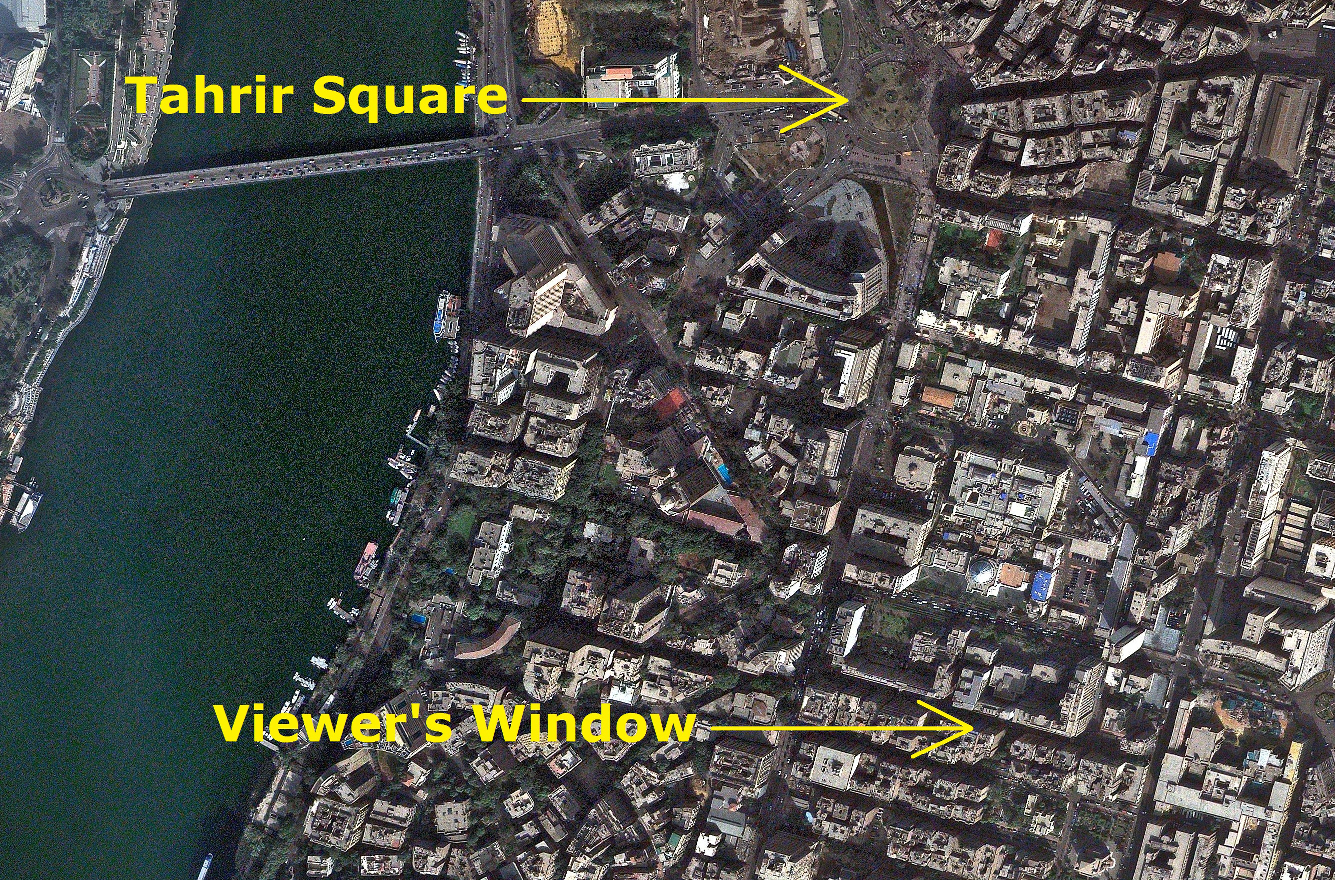
Cairo VFYW Overhead Marked2 - Copy

(Archive)

How Capitalism Creates The Welfare State

SKOREA-SOCIETY-SUICIDE

The two concepts are usually seen in complete opposition in our political discourse. The more capitalism and wealth, the familiar argument goes, the better able we are to do without a safety net for the poor, elderly, sick and young. And that’s true so far as it goes. What it doesn’t get at is that the forces that free market capitalism unleashes are precisely the forces that undermine traditional forms of community and family that once served as a traditional safety net, free from government control. In the West, it happened slowly – with the welfare state emerging in 19th century Germany and spreading elsewhere, as individuals uprooted themselves from their home towns and forged new careers, lives and families in the big cities, with all the broken homes, deserted villages, and bewildered families they left behind. But in South Korea, the shift has been so sudden and so incomplete that you see just how powerfully anti-family capitalism can be:

[The] nation’s runaway economic success … has worn away at the Confucian social contract that formed the bedrock of Korean culture for centuries. That contract was built on the premise that parents would do almost anything to care for their children — in recent times, depleting their life savings to pay for a good education — and then would end their lives in their children’s care. No Social Security system was needed. Nursing homes were rare.

But as South Korea’s hard-charging younger generations joined an exodus from farms to cities in recent decades, or simply found themselves working harder in the hypercompetitive environment that helped drive the nation’s economic miracle, their parents were often left behind. Many elderly people now live out their final years poor, in rural areas with the melancholy feel of ghost towns.

The result is a generation of the elderly committing suicide at historic rates: from 1,161 in 2000 to 4,378 in 2010. The Korean government requires the elderly to ask their families for resources if they can pay for retirement funding – forcing parents to beg children to pay for their living alone – a fate they never anticipated and that violates their sense of dignity. Hence the suicides.

We can forget this but the cultural contradictions of capitalism, brilliantly explained in Daniel Bell’s classic volume, are indeed contradictions. The turbulence of a growing wealth-creating free market disrupts traditional ways of life like no other. Even in a culture like ours used to relying from its very origins on entrepreneurial spirit, the dislocations are manifold. People have to move; their choices of partners for love and sex multiply; families disaggregate on their own virtual devices; grandparents are assigned to assisted living; second marriages are as familiar as first ones; and whole industries – and all the learned skills that went with them – can just disappear overnight (I think of my own profession as a journalist, but it is one of countless).

Capitalism is in this sense anti-conservative. It is a disruptive, culturally revolutionary force through human society. It has changed the world in three centuries more than at any time in the two hundred millennia that humans have lived on the earth. This must leave – and has surely left – victims behind. Which is why the welfare state emerged. The sheer cruelty of the market, the way it dispenses brutally with inefficiency (i.e. human beings and their jobs), the manner in which it encourages constant travel and communication: these, as Bell noted, are not ways to strengthen existing social norms, buttress the family, allow the civil society to do what it once did: take care of people within smaller familial units according to generational justice and respect. That kind of social order – the ultimate conservative utopia – is inimical to the capitalist enterprise.

Which is why many leaders in the nineteenth and twentieth centuries, conservatives as well as liberals, attached a safety net to such an unsafe, bewildering, constantly shifting web of human demand and supply. They did so in part for humane reasons – but also because they realized that unless capitalism red in tooth and claw were complemented by some collective cushioning, it would soon fall prey to more revolutionary movements. The safety net was created to save capitalism from itself, not to attack capitalism.

This is not to argue against the conservative notion that it is precisely because of capitalism that we have to foster greater family bonds, keep marriage alive, communities together. It is simply to argue that to argue for this and the kind of capitalism that Paul Ryan favors is a tall order. And it isn’t working. The forces of global capitalism – now unleashed on an unprecedented global scale with China, Russia, Brazil and India – are destroying the kind of society which allows and encourages stability, traditional families, and self-sufficient community.

One reason, I think, that Obama’s move toward a slightly more effective welfare state has not met strong resistance – and is clearly winning the American argument – is that the sheer force of this global capitalism is coming to bear down on America more fiercely than ever before. People know this and they look for some kind of security. In other words, it is precisely capitalism’s post-1980s triumph that has helped create the social dependency so many conservatives bemoan today. And this time, there is even a sense that whole industries are disappearing faster than ever before – not simply because of outsourcing but because of technology itself, tearing through old ways of life like acid through iron.

It is unstoppable. I fear its power – given that it relies on emitting carbon in vast quantities – will soon make the world less habitable for large numbers of people. I fear it may kill so many species we will have become God on our own earth. And I think an understanding that the state will have to step in to blunt the sharper edges of this newly creative extra-destruction is emerging slowly in the public at large.

Bell was right. Capitalism destroys the very structure of the societies it enriches. But I doubt even he would have anticipated the sheer speed at which this is now happening. It makes the conservative project all but impossible, if still necessary. It does require a defense of the family, of marriage, of personal responsibility. But it also demands a compassion toward the victims of this economic and social change, an understanding of their bewilderment – which can often express itself neurotically in fundamentalist forms of religion or culture.

All I know is that it is a core conservative idea that revolutions can end in nightmares. But we conservatives also long supported and indeed recently breathed new life into the industrial and post-industrial revolution. We see the consequences far beyond the suicides of elderly Koreans. And in my bleaker moments, I wonder whether humankind will come to see this great capitalist leap forward as a huge error in human history – the moment we undid ourselves and our very environment, reaching untold material wealth as well as building societies in which loneliness, dislocation, displacement and radical insecurity cannot but increase. It seems to me this is not the moment for Randian purism.

Do we not as conservatives have a duty to tend to the world we helped make?

(Photo: This photo taken on January 11, 2013 shows an anti-suicide monitoring device (L) installed by the government at Mapo Bridge -a common site for suicides- over Seoul’s Han river. The South Korean capital has installed anti-suicide monitoring devices on bridges over the city after 196 people jumped to their deaths on 2012 according to South Korean officials. The new initiative — in a country with the highest suicide rate among leading developed nations — incorporates closed-circuit television cameras programmed to recognize motions that suggest somebody might be preparing to jump from a bridge. By Pedro Ugarte/AFP PHOTO/Getty Images.)

The GOP’s Sequestration Trap


Tomasky suspects that Republicans will suffer politically if the sequestration cuts go into effect:

[I]t sure isn’t going to be looking very responsible to people, as the March 1 sequestration deadline approaches, for Republicans to be going before the cameras and saying that the cuts are unfortunate but necessary medicine, or whatever formulation they come up with. They’ve wanted these spending reductions for two years. It hardly matters much who invented the mechanism for the cuts. What matters, as the Republicans will find out, is that the people don’t want them.

I believe that is indeed Obama’s long game here. The precedent is the Gingrich government shutdown, which stopped his revolution in its tracks and gave Bill Clinton new political life. When cops are furloughed, when scientists complain about research cuts, when the military-industrial complex revs up its lobbying engines, I just don’t see how the sequester works politically for the GOP. It exists entirely because of their fixation on immediate austerity – despite the awful consequences that policy option has spawned in Europe.

But I don’t particularly like the Dems’ and Obama’s approach either. It may be politically savvy – they are going to target all sorts of populist tax loopholes for the very rich as an alternative to cuts, without making a serious effort to reform the insanely complex tax code as a whole. I’m working on a post on the sequester – and why, however crude and dumb, it may well be the least worst option in front of us. Stay tuned.

How Obama Legitimized Torture

Screen shot 2013-02-19 at 11.42.08 AM

Jane Mayer compares Bush’s torture memos to Obama’s targeted killing memos, and makes a critical distinction that some have tried to elide:

Clearly there are plenty of troubling questions surrounding the Obama Administration’s targeted-killing program. But, that said, are Obama’s drones comparable in terms of human-rights violations, to Bush’s Torture program?

Those who argue so miss an important distinction, one that David Cole also has brought up: torture under all our systems of law—including the laws of war—is illegal. This is true without exception, regardless of the circumstances, including national-security emergencies. Torture is also condemned by every major religion. Waterboarding was, and is, a form of torture. This has been established as far back as the Spanish Inquisition, and as recently as the Vietnam War. To argue otherwise is to legalize criminality. That was what the Bush Administration’s torture memos did. …

Obama, in contrast, has tried to bring his counterterrorism program inside the law by reasserting the criminality of torture and by trying to define which drone strikes are legal. The Obama Administration’s lawyers’ attempt to define those boundaries in their white paper isn’t prima facie scandalous, because the Constitution authorizes lethal combat, unlike torture.

She goes on to make various valid critiques of Obama’s targeted killing program, but the above distinction is worth keeping in mind during these debates. It comes up again and again, on the hard left and, of course, on the hard right. Take this sentence from Jeffrey Rosen, unwilling to accept that some of his legal friends are war criminals:

Although the Obama administration’s brief is directed at the assassination of Americans abroad, the arguments it offers could apply with equal force to the assassination of Americans at home; lawyers for the Bush administration who tried to justify lesser outrages have been pilloried for supporting torture.

But they did support torture, didn’t they? And there is no conceivable way for that to be legal, right? Part of my frustration with this debate from the get-go has been the assumption that the rule of law is something just to get around, rather than to abide by. And so torture is immediately discussed by Greater Israel fanatics like Alan Dershowitz as if it were an actual, live option in a society governed by the rule of law. It is not and for a very long time has not been a legal option, as Dershowitz well knows. And as David Luban recently noted, the crime of torture carries a 20 year prison sentence and the death penalty if the victim is tortured to death, as happened well over a dozen times under the criminal regime of Bush and Cheney. Every single war criminal – except a few grunts at the very bottom of the chain taking signals from their superiors at Abu Ghraib prison – walked free. War criminals who actually destroyed the video evidence of their torture sessions now sit on AEI panels and brag of their criminality to Beltway applause. With perjury a civil suit for sexual harassment, illegality among high oficials led to one president’s impeachment. With the criminal felony of torture, the rule of law matters not at all. We are not even allowed to see the Senate’s report on the torture program.

By allowing all CIA officials who tortured prisoners off any legal hook, and by deciding that Cheney and Bush and the architects of the plainly illegal torture program were easily integrated back into respectable American society – with the chief war criminal, Dick Cheney, still treated as an elder statesman on network television – the Obama administration may have stopped torture but they also helped legitimize it. By refusing to deal with it as a serious crime, they allowed many other Americans to take the same position.

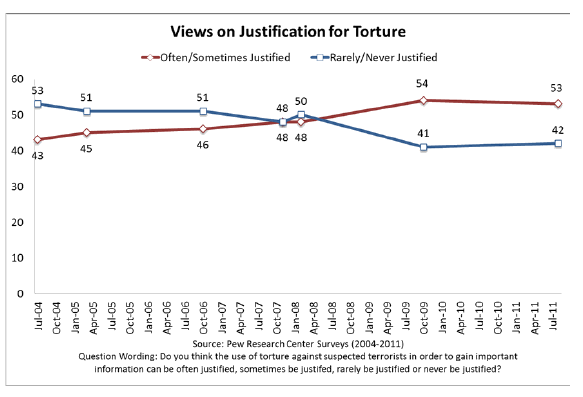
Can you see when public approval for torture begins to rise in the graph above? After Obama and Holder told us it was no big deal, and no one should be held in the slightest way accountable.

McCain: Still A Douche, Ctd

Politico actually managed to use the word “tortured” to describe the long history between Chuck Hagel and the ornery, failed presidential candidate. But class difference is the really telling point:

Among the more than 58,000 Americans killed in the war, 84 percent were enlisted men and all but a sliver of these were without a college degree. Hagel himself had just a few college semesters to his credit. His teenage brother Tom was fresh out of high school when they enlisted in 1967.

More than race or income, it was this education divide — promoted by draft deferments in the 1960s — that most explains those who were in combat in Vietnam and those who were not. That history, which McCain knows, was what made it so striking last week when Cruz, a sophisticated Princeton and Harvard Law graduate, seemed to question Hagel’s patriotism by his line of questioning before the Senate Armed Services Committee.

That was when McCain finally had enough of the newest Joe McCarthy in the Senate. But he was still capable of letting Hagel twist in the wind so his buddy Butters could gain some far right cred in South Carolina.

The Most Caffeinated New Yorkers

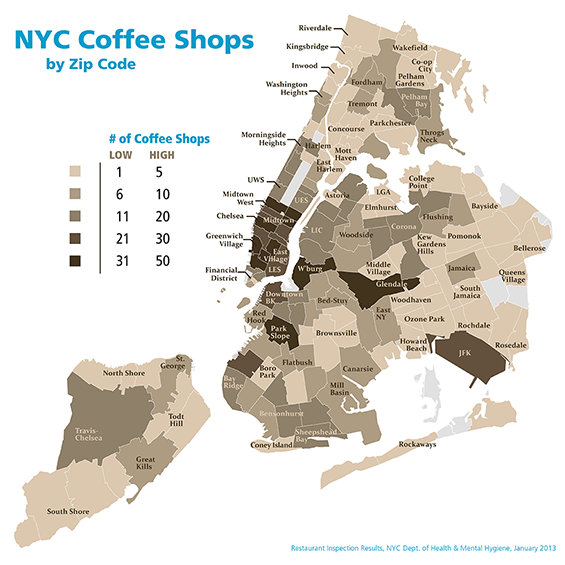
As if they need any more reason to rush. StatsBee plotted out the city’s coffee addiction:

Manhattan neighborhoods have the highest density of cafés per ZIP code. The East Village ZIP code of 10003 has the highest number of shops with 49, closely followed by Midtown/Hell’s Kitchen (10019) with 47. Midtown East (10017) and SoHo (10012) each have 41, and Tribeca/Chinatown (10013) has 40. The non-Manhattan neighborhoods with the highest concentration of caffeine are Williamsburg (11211) with 31 shops, Glendale (11385) with 32 shops, and Park Slope (11215) with 32 shops.

More on the country’s habit in general:

According to Accounting Principals, half of all American workers now buy coffee throughout the week, spending over $5 per work day and about $1,092 annually on coffee. Younger workers (18 to 34 years old) are spending about twice as much weekly on coffee as workers over 45 ($24.74 vs. $14.15).

Cannabis Isn’t So Green, Ctd

A reader complements a recent post on the environment hazards of unregulated pot growing:

My city, Chico, California, tried to develop regulations for the growing of medical marijuana by individuals and for the establishment of dispensaries.  California state law has provisions for both. The city approached the issue as a land-use issue, just as the city or county might regulate other agricultural or commercial uses, or public nuisances.  The city discussion began from a complaint by a resident concerning the odors emanating from a neighbor’s individual grow, odors not only from the marijuana plants when in bloom, but from fertilizers and pesticides.

The city worked on a medical marijuana ordinance for at least 18 months.  The entire process was contentious on many levels.  But the city council and staff kept working on it.  The final proposal included regulations for grows and for dispensaries. Then, just two weeks before the final version of the ordinance was to be voted on, the mayor read a letter at a city council meeting.  It was from the US Attorney for our district.

The letter essentially said that under Federal law, city employees who administered this local ordinance would be subject to prosecution for aiding and abetting the production of a controlled subtance.  That is, a city permit officer granting a land-use permit for an individual grow, or a police officer not arresting someone for growing marijuana, could be arrested.  The police department had been supportive of the ordinance, but no more. The city attorney advised that there was no way to write the local ordinance to protect city employees.  The entire ordinance was scrapped.

Mendocino County had a permitting system that worked well, until a similar threat was made by the US Attorney.  The system was suspended. Worth looking into what happened there – it was administered by the Sheriff. (I have a vaque recollection you reported on this.)

For the record, I do not use marijuana either medicinally or recreationally.  But I am persuaded that legalizing it and regulating it as alcohol is legal and regulated makes better sense than our current system.  And the environmental damage done is one reason.

Country Isn’t So White

While reviewing the compilation Country Funk 1969-1975, Nathan Rabin laments that country music is thought of as “the official music of rednecks, xenophobes, conservatives, and truck-driving suburbanites”:

To me, country is a glorious mutt of a genre that mirrors the eclecticism and disorder of the nation that berthed it. It’s telling that Jimmie Rodgers, the man heralded as “The Father of Country Music,” was a pot-smoking, hard-living bluesman with an inexplicable (and influential) fondness for yodeling, and whose music and persona were deeply linked to black music and culture at a time when the whole nation, not just radio, was segregated.

Rodgers was a primitive American original who paved the way for similarly complicated, contradictory figures like Hank Williams, who famously learned how to play guitar from a black street musician nicknamed Tee Tot and howled the blues with feverish intensity, and Bob Wills, a charismatic bandleader, fiddler, and proto-hype man who perfected a frisky, dance-friendly fusion of country and jazz called western swing. From Willie Nelson (who recorded a reggae album, for God’s sake) to Johnny Cash to Townes Van Zandt, many country icons revered black music and incorporated those influences into their own work.

At The Mercy Of The Paper Trail

Living a nomadic life, Jamaal Glenn is sick of the perfunctory mailing address needed for official business:

Even if I wanted to, I can’t really stop getting mail, or more specifically, I can’t stop needing a mailing address. My mailing address has become much more than a physical location where I sleep at night or a place where I receive physical goods. It has become inextricably and unnecessarily linked with my identity.

Paying for a parking ticket online? I need an address. Donating to a nonprofit online? I need an address. Paying my phone bill directly from my iPhone? PayPaling a friend? Betting on sports digitally? Address. Address. Address.