Why Cosby Wore Cosby Sweaters

This embed is invalid


Hunter Oatman-Stanford tracked down an answer from Cosby show costumer Sarah Lemire:

Lemire says that Cosby often strayed from the script, following his gut if he thought it might get a better laugh. “It was incredible and it came out of nowhere, and the director knew to grab that.” As a result, the show often relied on close-up shots of Cosby to capture such moments of improvised humor. However, tight shots like these caused problems when matching the scenes from two different takes, as a slight difference in costume positioning would become a glaring mistake.

“Usually you don’t do close-ups on TV, and that’s why we started using sweaters,” says Lemire. “As our bodies move around, the clothes are going to shift between the first and second take. If you have a jacket on, and the shirt collar’s in one spot, it’s going to slide off a little on one side or the other, or it might do something else that didn’t match. [Director Jay Sandrich] was a real stickler for things matching, so we just did the sweater thing. I actually sewed his shirts to the sweaters so that nothing moved.”

(Video: Part of Vice’s profile of Koos van den Akker, the Dutch designer of many of the most iconic Billy Cosby sweaters.)

“High Finance”

The Economist reports on investors like Brendan Kennedy, who is hoping to cash in on the cash crop:

At first, Mr Kennedy wanted to create a cannabis-focused venture-capital fund but concerns about legal liabilities, as well as a desire to take majority stakes in portfolio firms, led him and a few partners to set up a different sort of fund, called Privateer Holdings. Its first investment is a website, Leafly, which offers user reviews on dispensaries and varieties of cannabis. An app was created for both Android and iPhones and there are now 50,000 downloads a month (for the forgetful, the password hint is “favourite strain”). Work is proceeding on how to add information on things like each variety’s content of tetrahydrocannabinol (THC), the active chemical in cannabis.

The Polyphonic Novel

Michael David Lukas welcomes the return of books which fall somewhere between a collection of short stories and something bigger:

Think Nicole Krauss’s Great House or David Mitchell’s Cloud Atlas, Jennifer Egan’s A Visit From the Goon Squad or Tom Rachman’s The Imperfectionists. Just as polyphonic music combines melodies to create texture and tension, the polyphonic novel collects a multiplicity of distinct, often conflicting voices around a single place, family, object, or idea. Polyphony widens the novel’s geographic, psychological, chronological, and stylistic range, while simultaneously focusing its gaze. Drawing inspiration from classics like The Brothers Karamazov, The Sound and the Fury, Mrs. Dalloway, and John Dos Passos’s USA Trilogy, contemporary polyphonic novels make music from the messy cacophony that is life in the 21st century.

Why it’s an appropriate format for our times:

With each foray onto the Internet, each ping and clang, we are searching for meaning in a haystack of data, balancing perspectives, trying to find reason in a cacophony of opinion. Is it any wonder we are drawn to fiction that reflects this new way of being, to a form that’s uniquely suited to our fragmented and globalized century?

“The Most Erotic Poet In English Literature”?

Carolyn Kormann praises the erotic poetry of John Donne:

Donne was, in fact, a rake and a bawd before he became a preacher and, in the fullness of time, the dean of St. Paul’s Cathedral, famous for his sermons and celebrated at court. He wrote poetry throughout this checkered, John_Donne_BBC_Newspicaresque career. Almost none of it was published in his lifetime. But the range of the work that survives does include not only canonical love poems like “A Valediction: Forbidding Mourning” but erotica also both intricate and raw.

Donne was born Roman Catholic at a bad time to be a Catholic in England. It was 1572. Queen Elizabeth was having Jesuits hanged, drawn, and quartered. Donne’s great-great-uncle was Thomas More, the author of “Utopia” and a Catholic. He was beheaded during the Reformation. Donne’s brother Henry died of the plague in prison at the age of twenty while awaiting trial for hiding a Catholic priest in his lodgings. Young John was more discreet. He went to Oxford at twelve, but left before turning sixteen to avoid a mandatory oath rejecting Catholicism. He became a law student and, according to a contemporary, “a great visitor of ladies” and “a great writer of conceited verses.” He stayed out of religious debates and sought the divine elsewhere.

Listen to a recitation of Donne’s famous “To His Mistress Going To Bed” here.

(Portrait of Donne, circa 1595, via Wikimedia Commons)

Our Defenses Against Meteors

Are almost nonexistent:

[I]t’s vanishingly unlikely that air defense systems would be able to even make the shot. The Chelyabinsk meteor was traveling at something like 32,000 miles per hour. (A 747′s typical cruising speed? 567 miles per hour.) By the time you notice it, it’s too late to stop it.

Not that you would notice it. Meteors like the one in Chelyabinsk are going to pass through the detection systems that humans have. Telescopes pointed to space are only going to be able to see a ginormous asteroid. Missile warning and air-defense radars run via software that ignores things that aren’t planes and missiles. And the eyes of U.S. military satellites are pointed the wrong way — down toward Earth. The Defense Support Program satellite constellation, for instance, is looking for launches of things like intercontinental ballistic missiles that threaten America, using infrared. But the asteroid is cold until it enters the atmosphere.

How we could prevent a major asteroid strike:

[W]e don’t have to hit the incoming meteor with a nuclear space missile, and we don’t have to deploy a crew of tough-but-sentimental action heroes to the meteor’s desolate surface. We just have to launch something heavy and unmanned to float next to the object long enough to [send] it a fraction of a degree in a different direction so that it misses the “keyhole” approach.

Face Of The Day

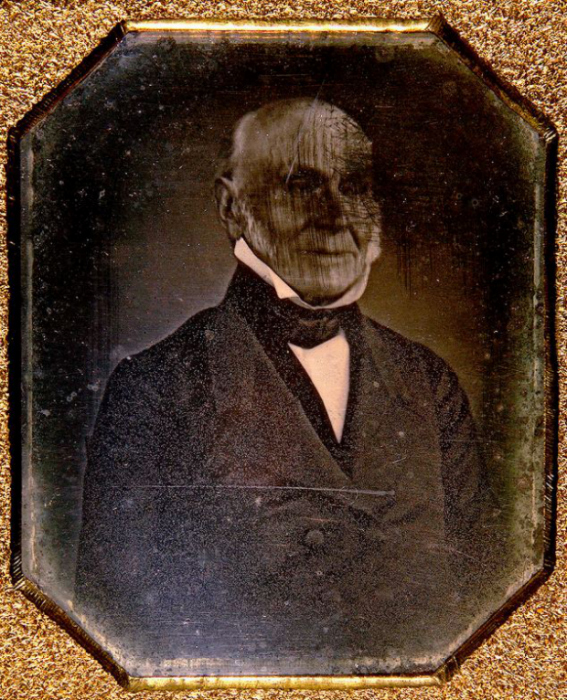
DL Cade admires what may be the oldest surviving photograph of a US president –  a daguerrotype of John Quincy Adams at the age of 76:

It was taken on a trip to New York, during which the president visited Niagara Falls, shook too many hands, visited an all-girls school, and spent some time with a child dwarf dressed as Napoleon. We know these bizarre details thanks to the meticulous diary Adams kept.

Here’s an excerpt from that diary:

The shaking of some hundred hands then followed and on my way returning to Mr. Johnson’s, I stopped and four daguerreotype likenesses of my head were taken, two of them jointly with the head of Mr. Bacon — all hideous.

That sentence is all the attention that was paid to the historic photograph, in a three paragraph entry that devoted almost an entire third to a pebble that lodged itself in the former president’s eye. But then that’s not surprising, as far as he was concerned his photos were “hideous” and “too true to the original.”

Update from a reader:

Mildly interesting presidential trivia related to JQA: Supreme Court Justice Oliver Wendell Holmes had, in his long lifetime, shaken hands with John Quincy Adams (b. 1767) and John F. Kennedy (d. 1963)

Where Have You Gone, Barack Obama? Ctd

Daniel David Luban, in an address to the National Consortium of Torture Treatment Programs on February 13, examined the Obama administration’s record on accountability for torture. The bleak but undeniable truth:

It would be wrong to say that the Obama Administration did nothing to fight the media blitz of the Friends of Torture. They did that one thing—releasing the torture memos.

But their other steps were all in the wrong direction. The most painful thing to understand is how tenaciously the Obama administration has fought any form of accountability for torture. This, I’m afraid, is a depressing story, but it’s one that needs to be told.

The President gave an early hint in an interview ten days before he took office: ‘I don’t believe that anybody is above the law. On the other hand I also have a belief that we need to look forward as opposed to looking backwards.’ He added that he didn’t want the ‘extraordinarily talented people’ at the CIA, who are ‘working very hard to keep Americans safe,’ to ‘suddenly feel that they’ve got to spend all their time looking over their shoulders and lawyering up.’ Transition team staff explained that they feared a CIA “revolt” if Obama prosecuted Bush-­‐era war crimes.

‘Looking forward rather than backward’ became the mantra. Superficially, it sounds like common sense, but a moment’s thought shows how fatuous it is. Would we ever say it about a murderer or a rapist? ‘Let him go – we should be looking forward, not back.’ Of course not.

“In fact, ‘look forward, not back’ sounds more like the pleas of Shakespeare’s arch-­‐villain Richard III. In one scene, Richard the Shameless tries to recruit a woman to help him woo her daughter shortly after he has murdered her sons:

Look, what is done cannot now be amended….
Plead what I will be, not what I have been;
Not my deserts, but what I will deserve. (Richard III, Act 4, scene 4)

The plain fact is that law enforcement demands looking back when the law has been grievously violated. Otherwise we might as well have no law at all.