The Company Of Web Strangers

Adrien Chen didn’t make a friend on Facebook. He met his best friend in a random chat room. So why does society still somehow distrust friendships that start with virtual strangers? Wasn’t that, at one point, the entire promise of the web? For some, of course, serendipity never ended. It’s just beleaguered by Zuckerberg’s “social network”:

If you look to online communities outside of Facebook, strangers are forging real and complex friendships, despite the complaints of op-ed writers. Even today, I’ve met some of my best friends on Twitter, which is infinitely better at connecting strangers than Facebook. Unlike the almost gothic obsession of Catfish’s online lovers, these friendships aren’t exclusively online—we meet up sometimes to talk about the Internet in real life. They are not carried out in a delusional swoon, or by trivial status updates.

These are not brilliant Wordsworth-and-Coleridge type soul-meldings, but they are not some shadow of a “real” friendship. Internet friendship yields a connection that is selfconsciously pointless and pointed at the same time: Out of all of the millions of bullshitters on the World Wide Web, we somehow found each other, liked each other enough to bullshit together, and built our own Fortress of Bullshit. The majority of my interactions with online friends is perpetuating some injoke so arcane that nobody remembers how it started or what it actually means. Perhaps that proves the op-ed writers’ point, but this has been the pattern of my friendships since long before I first logged onto AOL, and I wouldn’t have it any other way.

Rubin Doubles Down

She’s now equating Harriet Miers, a Supreme Court nominee, with Chuck Hagel, a cabinet nominee, as if the Senate should now treat a newly-elected president’s cabinet picks as if they were life-time court appointments. This is now her argument for stopping Obama having the Republican defense secretary he wants:

No [president’s] discretion is owed to confirm someone unfit for the job, who said he couldn’t or wouldn’t do the job. (Hagel denied he’d be a policymaker or would run anything, pleading that it didn’t matter what he thinks.)

Huh? I don’t recall Hagel say he would not be running the Pentagon. He just represents the horrifying fact to Rubin that Netanyahu’s allies won’t.

A Big Fucking Gun

In case you think America’s cultural love affair with grotesque violence is anything new, Chris Dixon visits with individuals “who specialize in the disarming and preservation of live shells and cannonballs” from the Revolutionary War and Civil War. He met one man who is known as the Big Iron Man:

He hands me an iron sphere the size of a billiard ball, part of a load of grapeshot. “Grape was like a big shotgun shell,” he says. “The troops were marching in and they’d fire grape into ’em. Thirty people would just disappear in a mist of red. It was horrible.”

If these weapons inflicted such misery, I ask, why preserve them? “People have been trying to kill each other through all of history,” his wife replies. “Well, this is how they did it from 1861 to 1865. It illustrates not only the advances in technology, but the differences in resources between the North and the South.”

Her husband props his feet up on a fifteen-inch Union cannonball. “The Yanks were throwing these at Battery Wagner on Morris Island,” he says. “That’s solid iron, four hundred and eighty-five pounds. Can you imagine what it took just to handle the cannon that fired this? It would damage a modern warship.”

“If you don’t understand history,” his wife adds, “how can you understand human beings? This isn’t just iron. It’s engineering and technology. It’s the bravery of the soldiers. It’s the sheer foolishness of it all.”

(Image: “200-1b gun on Morris Island. Used for shelling Charleston” via Wikimedia Commons)

Benedict’s Radical Precedent

Pope Benedict XVI Delivers Angelus Blessing - February 17, 2013

In a rather brutal review of Benedict’s failed papacy, theocon Joseph Bottum worries about it:

[T]he modern world doesn’t really need to see in the pope a model of competent administration, nice as that would be. It does need, however, a public reminder that we are not incapacitated as human beings when we age and prepare to die. We are not to be tucked away or compelled by moral pressure to remove our lives and deaths from public view. The older vision of life is the more complete one, and in today’s world, perhaps uniquely, we are in special need of remembering that.

Besides, there remains the problem of political theory that the aftermath of San Celestino’s abdication taught us. If popes can resign, then popes can be forced to resign, notwithstanding the fact that the church believes they are chosen with guidance from the Holy Spirit. And after they resign, what then? What are we to do with them? The sheer presence of a retired pope in a Vatican monastery may prove a burden and distraction for his successor. And if, with Benedict in 2013, a retired pope does not seem to pose a direct political threat, that hardly insures that no future retired pope will prove so. The political portions are part of the pope’s job, too.

I have to say that, as the days go by, the radicalism of this traditionalist Pope’s resignation continues to befuddle me. Like Bottum, I don’t see why he could not have appointed a few capable administrators, cut down on global travel (Wojtila’s peregrinations were unprecedented and unwise), focus on his writing and core papal duties, like celebrating mass on important occasions in Saint Peter’s, but otherwise simply being the Pope.

Maybe his illness is more pronounced than we know; maybe that bump on the head in Mexico was a reminder of his age; maybe the loss of mystery amid social media exposed him more than he ever anticipated; maybe he’s just dead tired (and who could blame him?). But I don’t think the current Queen of England would ever abdicate from old age – even if she were less capable of doing a far more demanding job. Why? Because she understands that she is an institution as well as a human being; and that institution requires careful maintenance. Throwing the rulebook of centuries out of the window – thus changing overnight the entire political nature and context of the papacy – would never occur to her.

So why to Benedict? Was watching John Paul II waste away deter him? Or does he sense or understand, in fact, that what he presided over is and was one of the darkest eras in the church, that the crimes he enabled are so horrifying when viewed in their entirety and his record of negligence and cover-up before and after he became Pope has rendered him morally incapable of leading such an institution – indeed in need of withdrawal, reflection and penitence? He prefaced his resignation with the words: “After having repeatedly examined my conscience before God,  . . . ” A reader notes:

If the reason for the Pope’s resignation was physical inability to do the job, the relevant thing for him to have examined would have been his medical records.  I don’t see where his conscience, before God or otherwise, really fits in — unless he’s referring to something else? Later, the Pope says:  “Dear Brothers, I thank you most sincerely for all the love and work with which you have supported me in my ministry and I ask pardon for all my defects.” (emphasis mine)

Is there an implicit admission of guilt here, an acknowledgment that his “defects” in dealing with “rapid changes” have actually led to the condition he cites, i.e., the church being “shaken by questions of deep relevance for the life of faith”?

I would like to think so. I don’t doubt that Benedict was and is horrified by the ubiquity of child-rape in the institution he effectively ran or co-ran for thirty years or so. And I simply cannot believe that he does not understand his own role in it. John Paul II could sustain some sort of denial. Not Benedict who, since 2001, had every single case of alleged child-rape in the world on his desk. He knows more about the criminal conspiracy the Church was engaged in for decades than any other human being on earth. He knows the darkness within better than anyone else. Maybe he is withdrawing out of fear, trying to ensure his successor doesn’t open up the full files to the world. Or maybe he is doing this radical act to shake the system he knows by now is rotten to its core. I do not know. But to give up hope that someone in the hierarchy of the Catholic Church might actually respond to this massive legacy of child-rape would be to give up on the hope of the Holy Spirit.

We need to let the sunlight in again. We need penitence from the very top. We need more transparency from the Vatican in history. We need to see all the files on all the rapes of children the Church has in its possession. Or rather, the criminal authorities need to see them. It’s odd that defenders of this papacy have always said that at least Benedict did something, unlike John Paul II. And yet they do not see any connection between the worst crisis the Catholic Church has known in modern times and the most radical move by a Pope in seven centuries.

They couldn’t possibly be connected, could they? I don’t know. And we may never know. But go watch Alex Gibney’s earth-shaking HBO documentary Mea Maxima Culpa and think about it. To see what is in front of one’s nose …

(Photo: Faithful hold a banner reading ‘You are Peter, stay’ as they attend Pope Benedict XVI Angelus Blessing at St. Peter’s Square on February 17, 2013 in Vatican City, Vatican. The Pontiff will hold his last weekly public audience on February 27 at St Peter’s Square after announcing his resignation last week. By Giorgio Cosulich/Getty Images.)

Give Up

enhanced-buzz-26906-1360761451-4

Melissa Steffen details what we’re giving up for Lent, as gleaned from Twitter feeds:

If past years are any indication, it’s likely that social media, chocolate, swearing, and alcohol will take top honors among the Top 100 most frequently sacrificed personal vices. Ironically, the analysis came from Twitter’s API, which Stephen Smith analyzes each year to provide a look at what people say they plan to give up for Lent. In 2012, the analysis looked at a series of 300,000 tweets.

The top 10 from 2012:

1. Twitter
2. Chocolate
3. Swearing
4. Alcohol
5. Soda
6. Facebook
7. Fast food
8. Sex
9. Sweets
10. Meat

And number 11? Lent.

(Photo via Instagram.)

Why Hagel Matters

Former Senator Chuck Hagel

As I’ve written before, a huge amount of this is opposition to any US defense secretary who doesn’t see Israel as a 51st state or somehow subject to evangelical theological doctrines that over-rule any diplomatic ones. And insofar as Israel is an issue, they particularly oppose a defense secretary who believes that Israel’s continued settlement of the West Bank is a huge liability for the US in its relationship with the entire Muslim and Arab world and a constant recruiting mechanism for terrorists to attack the West. Then there’s Hagel’s deadly combination of two Purple Hearts and a foreign policy realism versus Dick Cheney’s five deferments in Vietnam and “ignorant interventionism”.

But Josh Marshall also notes the broader generational fact that Hagel and Obama do not see the Middle East as the center of America’s security challenges. As our oil independence grows, the relevance of all those oil-producing despotisms or democracies or failed states declines. And so the worldview that was defined as “mainstream” only a few years ago seriously is being challenged:

Hagel in himself is no singular figure. But he’s part of the Scowcroft/Brezinzski et al. running critique of Bush era foreign policy. It’s not just that he didn’t vote for this or that declaration about the Iranian government or doesn’t toe the Likud line on the Israel/Palestine front. He’s one of those people who just don’t think these issues should be the be all and end all of our role in the world at all. And that’s extremely threatening to some people.

Indeed it is. For that is one reason they get up in the morning. I see Hagel’s nomination as the natural evolution of Obama’s slow but relentless shift of US foreign policy from neconservative dogma to conservative pragmatism (with a few small splotches of idealism). Of course, the neocon fanatics are threatened. As history unfolds, their catastrophic ideology will come to seem the temporary and horrifying exception, not the new rule. And when a member of their own party helps advance their consignment to the dustbin of failed ideologies, you can see why they are having a conniption.

Meep meep.

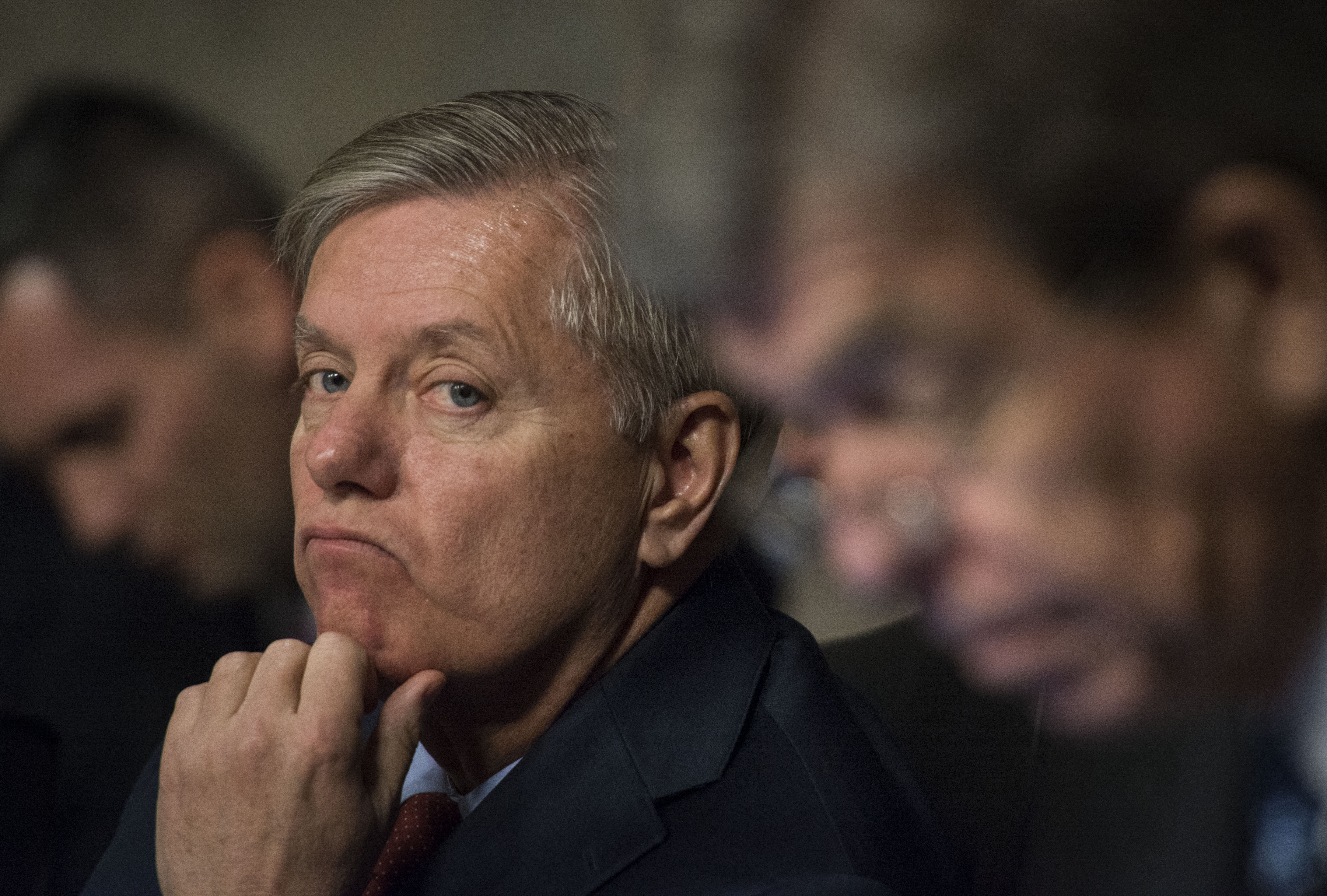
(Photo: Senator Lindsey Graham (R-SC) listens to answers from former two-term Nebraska Republican Senator Chuck Hagel, President Barack Obama’s nominee for defense secretary, testify before the Senate Armed Services Committee on Capitol Hill Thursday, January 31, 2013. By Melina Mara/The Washington Post via Getty Images).

Argo: A Feel-Good Film About America

Roger Ebert reveals his Oscar predictions. He thinks Argo will win Best Picture:

[One] reason Ben Affleck’s film will win this year is that it’s a dashed entertaining example of what Hollywood always knew how to do, and seems to be forgetting: It’s a great story. Lives are at stake, yet comedy sneaks in. There’s a caper needing split-second timing and blind luck. It depends on story and not star power or a franchise. It’s Inspired By a True Story of the best possible kind: It makes the movie industry look good while based on an untrue story.

Alyssa sees other forces at work:

In a pool of strongly politically themed-movies, Argo is at the intersection of two important trend lines. It has a gloss of relevance, but the movie exists at a safe distance from actual events, and from shameful, damaging policies, that remain the subject of heated political debate. For all that we talk about Hollywood liberalism, the Academy appears to be converging around a movie that allows us to feel as good as possible about the way the United States handles the blowback of our foreign policy.

Why Mickey Is For Chuck

This Kaus post is almost a Platonic one. Why, one asks, does Mickey wants Chuck Hagel to become defense secretary? So it will so piss off the House they’ll prevent immigration reform! It takes him a couple of days to come to a brilliant insight like that one, but brilliant it is:

In my lifetime, at least, Washington (in between elections) seems to have operated less like a football game and more like a dysfunctional family. Everyone has to have something to take away or else all hell breaks loose. The more Republicans get out of the next few months apart from immigration, the more they’re likely to let Obama have his amnesty. And the less they get …

Go Chuck!

Go Mickey!