Wilde’s Wife

Reviewing the new biography Constance, Elizabeth Powers ponders what exactly she knew about her husband’s gay affairs:

How much did Constance suspect of Oscar’s transition from dandyism to debauchery, especially since the press contained numerous not-so-subtle allusions to his behavior and since, by 1893, he had “effectively Cyrilwildeentered into a new marriage, with Bosie [Lord Alfred] Douglas,” distancing himself for weeks, even months, at a time from home and hearth? Were her many activities attempts to avoid the obvious? Did none of her friends enlighten her? Was “the Love that dare not speak its name” so unspeakable that she literally could not think it?

Moyle concedes that Constance’s avoidance “is hard to explain, except perhaps in terms of her fleeing from a situation that she did not wish properly to confront.” I wonder if this reticence did not also affect Oscar, who had descended so much into licentiousness that he seemed unable to grasp the extent of his own danger. Friends recommended fleeing abroad after the libel trial, allowing the uproar to die down, but he refused.
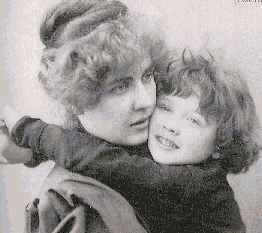
(Photo: Constance Wilde with their child Cyril in 1889)

The Limits Of Orwell

Patrick Kurp cites Irving Howe:

“Part of Orwell’s limitation as a literary critic is that he shows little taste for the prose of virtuosity: one can’t easily imagine him enjoying Sir Thomas Browne. If some windows should be clear and transparent, why may not others be stained and opaque? Like all critics who are also significant writers themselves, Orwell developed standards that were largely self-justifying: he liked the prose that’s like a window pane because that’s the kind of prose he wrote.”

I think that’s why he was so accessible to me as a boy and played such a big part in persuading me that writing was a career well worth pursuing. Because it was so easy to read, so close to the conversational English of actual speaking. Reading Evelyn Waugh or Oscar Wilde is to be transported by sheer style. Reading Orwell, one forgets style altogether. And one meets reality.

Postmodern Passion

Benjamin Nugent describes how a number of his favorite recent novels are stories of romance and courtship, and “get away with great warmth…by using a particular cold vocabulary, the vocabulary of theory.” One example? Jeffrey Eugenides’ The Marriage Plot:

Sometimes, in these novels, discussions of theory are merely juxtaposed with love scenes. But the best ones are those in which theory provides the language that enables the lovers to communicate. In Eugenides’ book, two Brown students, Leonard and Madeline, meet in a semiotics class. When Madeline tells Leonard she loves him for the first time, he finds an ingenious way to slam on the brakes: He digs in her bag for her copy of Barthes’ “A Lover’s Discourse” and points to the section on the words “I love you.”

“The figure refers not to the declaration of love, to the avowal, but to the repeated utterance of the love cry … Once the first avowal has been made, ‘I love you’ has no meaning whatever …”

He smirks, she throws the book at his head. A young lover rejecting another in naturalistic dialogue might feel melodramatic, too hot, too familiar to allow a reader to feel the sting. But because Leonard’s cruelty comes in the form of a quotation about a “figure,” an “utterance” — that is, in the cold jargon of literary criticism — the moment of cruelty feels unconventional, real.

Editing The Greats, Ctd

Pivoting off John Simon’s anecdotes about editing Auden, Lionel Trilling and Jacques Barzun, Alan Jacobs suggests they might point to “a kind of rough Taxonomy of Authorial Character”:

As a Trilling — the character in the middle — I understand the Barzun kind of writer, but struggle to accept the Auden type. I’ve only ever edited one book, on which I worked with my colleague Ken Chase, and in general it was a pleasant experience. But one of the essays — I shall of course never reveal which one — came to us in shocking condition, full of typos and incoherent sentences and undocumented (or incompletely or inaccurately documented) citations. Ken and I probably spent more time on that essay than all the others combined, and it seemed to me then, and seems to me now, that to send an essay to editors in that condition was both unprofessional and arrogant. I’m your editor, not your servant, I thought. But I suppose real professional editors have that thought at least once a day….

David Mills adds:

This, by the way, is a description that would upset some writers — not Alan — who pride themselves on being difficult, because the difficulty they think a marker of their gifts. The real professional engages the editor, assuming he knows what he’s doing and that there’s a reason for his suggestions. The writer may not accept them (I don’t when I’m on the other side of the relation) but he responds to them.

I should add that the taxonomy is incomplete. It doesn’t include, for example, the writer who writes like Auden but acts like Barzun. There are a lot more of these than you might think. And it doesn’t include the writer who writes like Barzun and acts like Auden. Fortunately there are a lot more of these than you’d think.

If Love Were All

Surveying contemporary pop music, Matthew Linder finds that romantic love and sex “are seen as the harbingers of an ultimate transcendent reality, where the physical reaches the spiritual” and the “key to a meaningful existence.” His theologically-inflected critique:

Seeking transcendence through a romantic relationship (as these pop songs do) is what Pastor Timothy Keller refers to as an apocalyptic romance. This term borrowed from cultural anthropologist Ernest Becker is defined as:

If he no longer had God, how was he to do this [find meaning in life]? One of the first ways that occurred to him… was the ‘romantic solution’: he fixed his urge to cosmic heroism onto another person in the form of a love object. The self-glorification that he needed in his innermost nature he now looked for in the love partner. The love partner becomes the divine ideal within which to fulfill one’s life.

Contemporary love songs are a reflection of our culture’s search for ultimate meaning, by thrusting the divine upon an imperfect person. A reversal of the perfect divine who thrust upon himself our flesh to be the bread of life, the living water, make us born again and give us eternal life. Transcendence is found in another person but only in the god-man, not in the person we have turned into a god.

The Prince Of Skepticism

To celebrate their 50th anniversary, The New York Review of Books is making available classic essays from their archives. In this selection from 1971, the political theorist Isaiah Berlin ruminates on Machiavelli’s contribution to the politics of doubt:

If what Machiavelli believed is true, this undermines one major assumption of Western thought: namely, that somewhere in the past or the future, in this world or the next, in the church or the laboratory, in the
speculations of the metaphysician or the findings of the social scientist or in the uncorrupted heart of the simple good man, there is to be found the final solution of the question of how men should live. If this is false (and if more than one equally valid answer to the question can be returned, then it is false) the idea of the sole true, objective, universal human ideal crumbles. The very search for it becomes not merely utopian in practice, but conceptually incoherent … .

After Machiavelli, doubt is liable to infect all monistic constructions. The sense of certainty that there is somewhere a hidden treasure—the final solution to our ills—and that some path must lead to it (for, in principle, it must be discoverable); or else, to alter the image, the conviction that the fragments constituted by our beliefs and habits are all pieces of a jigsaw puzzle, which (since there is an a priori guarantee for this) can, in principle, be solved; so that it is only because of lack of skill or stupidity or bad fortune that we have not so far succeeded in discovering the solution whereby all interests will be brought into harmony—this fundamental belief of Western political thought has been severely shaken. Surely in an age that looks for certainties, this is sufficient to account for the unending efforts, more numerous today than ever, to explain The Prince and The Discourses, or to explain them away?

The Truth In Fiction, Ctd

Ian McEwan admits he’s occasionally doubted the God of fiction:

Like a late victorian clergyman sweating in the dark over his Doubts, I have moments when my faith in fiction falters and then comes to the edge of collapse. I find myself asking, “Am I really a believer?” And then, “Was I ever?” First to go are the disjointed, upended narratives of experimental fiction. Oh well … Next, the virgin birth miracle of magical realism. But I was always Low Church on that one. It’s when the icy waters of skepticism start to rise round the skirts of realism herself that I know my long night has begun. All meaning has drained from the enterprise. Novels? I don’t know how or where to suspend my disbelief. What imaginary Henry said or did to nonexistent Sue, and Henry’s lonely childhood, his war, his divorce, his ecstasy and struggle with the truth and how he’s a mirror to the age—I don’t believe a word: not the rusty device of pretending that the weather has something to do with Henry’s mood, not the rusty device of pretending.

However, a childhood revelation reminds him that fiction can also contain all that’s true:

Things that never happened can tangle with things that did, an imaginary being can hold hands with the flesh-and-blood real. He may live in your house, as a Henry of my own once did, or he may read all that you have read and even make love to your wife. The atheist may lie down with the believer, the encyclopedia with the poem. Everything absorbed and wondered at in the faithless months—science, math, history, law, and all the rest—can be brought with you and put to use when you return yet again to the one true faith.

Recent Dish on the truth in fiction here.