Laughing Through Lent

Peter Leithart uses Shakespeare’s Cymbeline to turn the typical understanding of Lent on its head, arguing that Lent “seems a grim and black season of self-accusation”:

But that’s all superficial. Lent is better understood as a season of Christian comedy. … The knot of misunderstandings and deceptions is the very thing that in Othello or King Lear drives the characters helplessly toward a bloody denouement. Cymbeline avoids the cliff because the final scene is a riot of confession. Shakespeare assembles the remaining characters at a prison and begins to unravel the tangled skein. The queen shows no remorse, but on her deathbed she confesses her intention to feed her husband a “mortal mineral” that would have wasted him away “by inches.” It’s the first domino, and other confessions rapidly follow. Iachimo acknowledges that he lied about seducing Imogen, prompting Posthumus, disguised as a common soldier, to confess his guilt in believing the lie. Imogen, who has no sin to confess, reveals her true identity. Cymbeline’s two sons, kidnapped long before, have wandered into the action, and their true identities are unveiled too.

Leithart concludes:

Comedy happens to characters who share Shakespeare’s belief about human helplessness and express that belief in penitent confession. Helpless self-accusation, it turns out, is the road to joyful restoration. It is a happy Shakespearean (and Christian) paradox that final happiness depends on practices associated with the most somber season of the Christian calendar.
Hair Sacrifice

An interesting story and slideshow from Colors Magazine:

Every day at the Tirumala Venkateswara Temple in India, about 10,000 people sit cross-legged on the floor of the tonsuring room and let one of the 500 temple barbers shave off their hair. For many Hindu pilgrims, the shave is an intensely moving experience, as they believe that by sacrificing their hair here they will gain Lord Venkateswara’s protection and be cleansed of material debts.

Once the hair hits the floor, however, it enters the world of business. The strands are collected by attendants, packed into large steel bins, washed, and sorted according to length and quality. Twice a year, the stored hair is auctioned off and exported, mainly to the USA, UK and China, where it is used to make hair extensions and wigs. Long, untreated Indian hair is in high demand; the temple’s longest hair sells for RS20,000 (US$375) a kilogram.

Last year, amid concerns that buyers were forming a cartel, conspiring to keep bids low, the temple stopped its open auctioning process and began to sell online instead, through secret tenders. So far, it’s proving extremely lucrative; in 2011, the temple sold 561 tonnes of hair for RS2 billion ($36.9 million).

Chart Of The Day

popelanguagechart

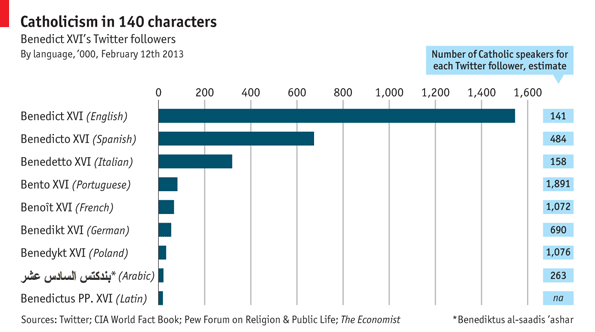
The Economist uses the Pope’s “linguistically notable” abdication – it was announced in Latin – to break down the languages used by Roman Catholics around the world:

What’s more interesting is the choice of languages the Holy See offered official translations for: French, English, German, Italian, Polish, Portuguese and Spanish. Much of the Catholic Church’s recent growth has been in Latin America and Africa. The use of Portuguese, Spanish, and English makes sense for outreach in the Americas. French might be useful for western and central Africa’s elites, but many people in officially Francophone countries don’t speak French. Missing from this list is Arabic, which the Pope tweets in. The Pope’s biweekly catechesis is provided in Arabic, but the weekly “Words of the Holy Father” typically omit the language. Translations in Croatian, spoken by 3.9m Catholics, are sometimes also available. According to our numbers, the Pope’s nine languages on Twitter represent 900m Catholics. Croatian is the only language not on Twitter while regularly available on the Vatican’s website.

Nature’s Unknown Unknowns

Responding to the pitched debate over Thomas Nagel’s Mind and Cosmos, which argues against the sufficiency of materialism to explain the universe, Alva Noë holds that the philosopher was right to emphasize how much of nature still eludes us:

If we really understood what makes a person intelligent, then it ought to be relatively straight forward, at least in principle, to manufacture intelligence. Some people believe that this is possible. Others that we can actually make intelligent machines and robots now. I do not suppose that they are wrong. But I do take it as manifest that we do not know this to be the case. Many mainstream scientists and philosophers believe that true artificial intelligence is at best unfinished business.

As with intelligence, so with life. Some of us are hearty and confident and think we are almost there. Others think there is still a revolution in our future if we are to make sense of intelligence, or of life, as a genuinely natural phenomenon. What kind of disagreement is this? To my mind it is foolish to cast it as a standoff between those who embrace science and admit its stunning achievements and those who reject the project of natural science itself. It is not a conflict between those who know and those who are confused.

Sexually Empowered Poetry

Kate Bolick finds that the poet Edna St. Vincent Millay “was blessed with not only uncommon genius but the romantic Gibson Girl looks prized by her era—winsome face, comely curves, heavy masses of auburn hair—and she wasn’t afraid to use them”:

In 1917 Millay’s first book, Renascence and Other Poems, made her the muse and celebrity of Greenwich Village bohemia, and as fans of her poetry are well aware, she took so effortlessly to the neighborhood’s progressive sexual politics that she fast became its emissary. Millay wasn’t the first woman to tell a lovesick man to just get over it (“And if I loved you Wednesday, / Well what is that to you? / I do not love you Thursday— / So much is true”), but she may have been the first to publish a poem in a respected literary journal saying so. Indeed, she had so many lovers that she hardly took the time to differentiate them in her poems, much to the disgruntlement of her conquests, who’d hoped for at least a compensatory brush with immortality.. …

A generation of “new women” just beginning to flex their own personal agency needed exactly such a voice, and her use of familiar, traditional forms—she was partial to rhyming couplets and the sonnet—helped deliver her version of female independence to a public newly ready to receive it.

Read another meditation on Millay’s pull here.

Map Of The Day

John Del Signore examines the geography of sex in the city:

Real estate website Trulia looked at the ratio of men living alone to women living alone across NYC, subtracting estimates of the gay and lesbian population in order to come up with this map that focuses on “men and women interested in dating someone of the opposite sex.” (For homosexual singles, Trulia points to their “Welcome to the Gayborhood” post.)

Jed Kolko explores national patterns:

[I]n most metros, the neighborhood with the highest ratio of men to women is in or near downtown, as well as in recently redeveloped neighborhoods like Boston’s Waterfront or Long Island City. Even man-rich Rosslyn is a major employment center despite being in northern Virginia, outside of Washington D.C. The neighborhoods with the highest ratio of women to men tend to be more residential, like San Francisco’s Marina and Seattle’s Queen Anne, and more upscale (and safe), like the Upper East Side and Upper Connecticut Avenue.

Browsing For Dates

Rob Horning fears that Internet dating sites trivialize love:

The mission of online-dating CEOs like Sam Yagan of OkCupid and Markus Frind of Plenty of Fish is to convince us that actual dating can and should be more like enjoying a good story; it is entertainment consumption, an individualistic pursuit that takes advantage of the way technology has improved on-demand commerce. Just as CafePress can sell you a customized T-Shirt, why shouldn’t OKCupid aspire to sell you a customized partner? Why not shop for a date when you’re caught in a checkout line or in traffic?

The Pope’s Hidden Injury

La Stampa has some interesting details about what happened when Benedict XVI took his last trans-Atlantic trip to Mexico. It helps explain the resignation:

“At the start of this highly important international trip, the Pope confided he was facing it with a “penitential spirit.” On 25 March, the Pope’s last day in León – the prelate explained – we were in the house of the Capuchin Sisters and Benedict XVI’s head was bleeding as he got up. His collaborators asked him what had happened. The Pope said he had not fallen but had banged into the basis about an hour before the meeting. He had got up to go to the bathroom and as usually happens when one gets up in the middle of the night in a house that is not one’s own, he didn’t find the light switch immediately so he moved about in the dark.”

The Pope had a similar but nastier accident in Inrod, in Italy’s Val d’Aosta region on the night of 16 July 2009. He fell from his bed, fracturing his wrist…

The Mexico incident, which was seen as irrelevant at the time, has been interpreted quite differently by the prelate who was part of the papal entourage, in light of the public revelation made by the director of L’Osservatore Romano. “That day, after dinner – he said – I was told about the jokes exchanged between the Pope and his personal doctor. As he treated the Pope’s head wound, Dr. Patrizio Polisca had remarked: “You see Holy Father why I am so critical of these trips?” With that dash of irony which is so familiar to those who know Benedict XVI well, the Pope replied: “I am also critical…”

The idea that he might have had to stay in Mexico in a hospital and be unable to return to Rome apparently rattled him. My concern is that John Paul II’s constant traveling – unprecedented at the time – could come to be the norm. And it’s brutal on those over 70.