Have The Liberal Hawks Flown Away?

Noticing no movement on Syria, John Allen Gay wonders if we’ve reached the end of liberal interventionism:

[N]ew constraints have arisen abroad that did not exist in liberal interventionism’s 1990s heyday. Russia is no longer a basket case. China’s economy has grown dramatically. The new global balance of power is still unclear, but there is no longer a widespread feeling—as there was just after the Cold War—that America’s example will determine new international norms. The unipolar moment that kept the costs of humanitarian interventions low and thus reduced the urgency of connecting them directly to national interests has ended, and does not appear likely to return in our lifetimes.

Larison suspects that liberal hawks are not vanishing but, unlike neocons, are simply more discerning about where and when to get involved:

While there was significant support inside the administration to intervene in Libya, that is noticeably lacking this time around, so some liberal interventionists may not be interested in berating Obama for “inaction” when he is already coming under attack from Republican hawks for the same thing. In this case, partisan loyalty might actually be blunting interventionist impulses rather than encouraging them. The memory of the Iraq war remains a powerful obstacle to any new war in Syria, but I suspect that the realities of the Syrian conflict are having a far more significant influence in discouraging support for a larger American role there.

Recently, Thomas Wright eschewed terms like neocons and realists altogether, proposing a new division between “shapers” and “restrainers.” He doubts that the recent rise of restrainers in the Obama administration will last:

Restraint is an idea that seems to fit the moment. Americans are tired of war and feel more constrained after the worst financial crisis since the Great Depression. However, over time, the realization will set in that staying out also shapes the world — and probably in a way that is detrimental to America’s interests. It creates a vacuum filled by others. It fuels uncertainty. And it exacerbates crises.

Meat That Isn’t Murder

This embed is invalid


Andras Forgacs, CEO of Modern Meadow, “a company at the forefront of 3D-printed meat and leather” took questions from Redditors a few days ago. On the taste of lab-grown meat:

I’ve tasted it as have my colleagues. We’ve only been able to have small bites since we’re still working on getting the process right. I cooked some pieces in olive oil and ate some with and without salt and pepper. Not bad. The taste is good but not yet fully like meat. We have yet to get the fat content right and other elements that influence taste. This process will be iterative and involve us working closely with our consulting chefs.

Steak isn’t within the realm of possibility at the moment:

Real steak is a big stretch. It won’t be the first product since steak is very hard to make for now. Instead, the first wave of meat products to be made with this approach will likely be minced meats (burgers, sausages, etc.) and pates (goose liver pate, etc.). Also seafood is an early possibility since the texture requires may be easier to achieve than premium cuts. While I doubt anyone will make commercial quantities of premium steak within 10 years, we will eventually get there but it will be an Nth generation product.

China’s Dirty Soil

Christina Larson notes that, despite the attention paid to air and water pollution in China, there is another source of pollution about which we know very little:

[I]nformation about soil pollution remains a “state secret.” Or at least that’s what Beijing lawyer Dong Zhengwei was told when he recently requested data from a government survey conducted in 2006 by the environmental ministry and China’s ministry of land and resources. …

Soil pollution has thus far received fairly limited public attention in China. “You can see with your own eyes when the air is smoggy, or see when the color of a river is wrong, but for soil pollution you need special equipment to check the levels of various elements,” says Chen Nengchang, a scientist at the Guangdong Institute of Eco-environmental and Soil Sciences. Yet, he cautions, the rampant overuse of fertilizer and pesticides in cropland and the seeping of heavy metals—such as lead, arsenic, and cadmium—from factories, smelters, and mines into the ground threaten the safety of China’s food supply.

Fallows recently wondered if such pollution might be causing developmental problems for Chinese children.

Canine “Suicides”

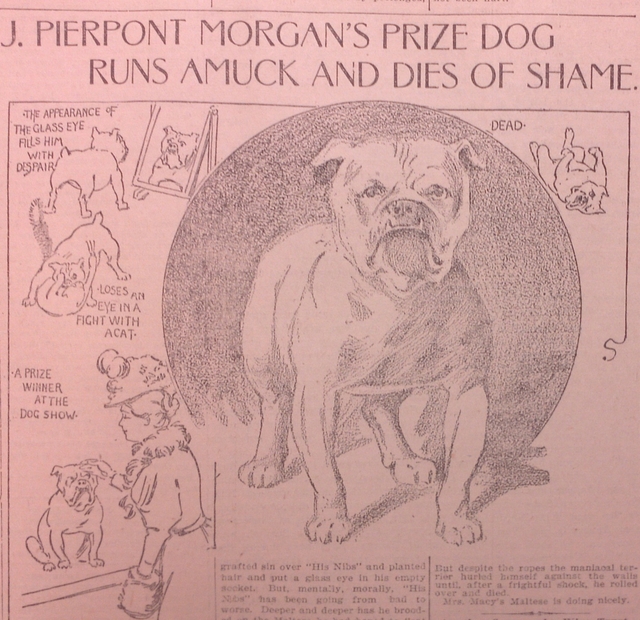
John Patrick Leary recounts how newspapers reported on them:

Dog suicides in 1898 were always male. The suicides were usually expressions of a fragile emotional state. Like [J.P Morgan’s prize bulldog “His Nibs”] their humiliation was provoked by a neglectful family, an unkind mob, or by abuse from boys, women, or cats. Sarah Knowles Bolton, in the 1902 book Our Devoted Friend, The Dog, devoted an entire chapter to dog suicides. For example: Rex, a prize-winning Gordon Setter, was worth $300 and drowned himself after he was kicked on the head by a private watchman. Most suicidal dogs were pure-bred, which presumably led to their emotional fragility: a $10,000 dog in Boston deliberately drowned himself, writes Bolton, after he was devastated by an insult from a thoughtless kennel-keeper.

It was the New York World who declared the end of “His Nibs” a “suicide”:

His Nibs offered the World a golden opportunity to combine animal violence and class conflict in one melodramatic package. For one, His Nibs—a mock aristocratic title given to a self-important person—was supposedly named by Morgan’s servants, who were responsible for looking after their boss’s pet. Add to this the fact that His Nibs was also a bulldog, a breed with a resolutely masculine name that manages, in its appearance, to channel both the confident aggression of male youth and the ineffectual droopiness of masculine old age. That such a dog, pampered by servants, should die at the hands of a woman’s thoroughbred cat and his own wounded vanity, was gravy—and an easy way to mock Morgan’s excesses too.

Yglesias Award Nominee

“Conservatives are trying so hard to highlight controversies, no matter how trivial, we have forgotten the basics of reporting: W5 + H as I learned in grade school, also known as who, what, where, when, why, and how. I think conservatives need to reset some of their reportorial resources to tell the stories that need to be told by focusing on the facts at hand in a world view of the right. We need to establish a baseline for integrity in reporting that then allows us to highlight the truly outrageous. That baseline must be the basics of who, what, where, when, why, and how and it must be set before taking the next step into analysis of motivation and its implications. …

Conservatives must start telling stories, not just producing white papers and peddling daily outrage.  The stories we choose to tell should have all the information we need to be informed of facts and paint a picture of those facts’ impact,” – Erick Erickson. Awards glossary here.

The Graduate Glut

This embed is invalid


Harvard president Drew Gilpin Faust recently criticized [NYT] the Obama administration’s College Scorecard for its focus on graduate earnings. She cited her first low-paying job at the Department of Housing and Urban Development as a valuable experience that would have nonetheless counted against Bryn Mawr, her alma mater, in the Scorecard rankings. Sarah Kendzior argues that Faust’s “life story is a eulogy for an America long past”:

[F]or Faust’s baby boomer generation, the window was open, the opportunities there. Following the paid position she took after her four years of inexpensive college, Faust went on to get a PhD. She graduated in 1975, a year when over half of history PhDs could expect to find a job in their chosen field, and immediately landed a teaching position at the same university where she studied. Today, only 42.6 percent of history PhDs are employed upon graduation, and few in academia.

The current generation is forced into internships and adjunct professorships, positions that “only the well-off can afford to work”:

One wonders how many future politicians, journalists, academics and leaders we are losing because they never have the chance to try.

Caught In A Dragnet-22

In a 5-4 decision on Tuesday, the Supreme Court ruled in Clapper v. Amnesty International that citizens cannot sue the federal government over its secretive warrantless wiretapping program. Julian Sanchez summarizes the Court’s reasoning:

The FAA permits the government to secretly vacuum up Americans’ international communications on a massive scale, without any individualized suspicion—and at least some of that surveillance has already been determined to have violated the constitution by a secret intelligence court. Yet [the Alito-led] majority has all but guaranteed no court will be able to review the constitutionality of the law as a whole by imposing a perverse Catch-22: Even citizens at the highest risk of being wiretapped may not bring a challenge without proof they’re in the government’s vast database. The only problem is the government is never required to reveal who has been spied on.

Scott Lemieux adds:

This case is also an illustration of why the Court’s increasing barriers to granting standing undermine constitutional protections. Alito’s opinion argues that the Court’s standing doctrine “serves to prevent the judicial process from being used to usurp the powers of the political branches.” But as applied to this case the argument is nonsensical. If the Court believes that FISA violates the Fourth Amendment, it does not “usurp” the powers of the White House or Congress to so rule; the Court would be fulfilling its basic constitutional role by protecting individuals from arbitrary government action prohibited by the Fourth Amendment.

Marcy Wheeler further breaks down the ruling here. Greenwald fumes:

The supreme irony here is that when Obama supported this 2008 eavesdropping law, it sparked intense anger among his own supporters as he ran for president. To placate that anger, he vowed that, once in power, he would rein in the excesses of this law that he oh-so-reluctantly supported. He has done exactly the opposite. He just succeeded in pressuring the Congress, with heavy GOP support, to extend this eavesdroppiong law for five years without a single reform. And now his Justice Department has used the five right-wing justices to completely immunize the law from judicial review …

Cindy Cohn and Trevor Timm find a glimmer of hope:

[A]s disappointing as the Clapper decision is, the good news is the decision likely won’t adversely affect our Jewel v. NSA lawsuit, which we argued in district court in December of 2012. Indeed, the Clapper decision makes the Jewel case one of the last remaining hopes for a court ruling on the legality of the warrantless surveillance of Americans, now conducted for over a decade.

The Ninth Circuit has already ruled that the Jewel plaintiffs have standing under settled law. The court’s decision is based on solid ground because we have presented the court with evidence that dragnet warrantless surveillance has already occurred, through testimony and documents from AT&T and NSA whistleblowers. In fact, the court specifically differentiated the two cases in its Jewel opinion: “Jewel has much stronger allegations of concrete and particularized injury than did the plaintiffs in Amnesty International. Whereas they anticipated or projected future government conduct, Jewel’s complaint alleges past incidents of actual government interception of her electronic communications.”

The Daily Wrap

Chuck Hagel Begins His Post As Defense Secretary

Today on the Dish, Andrew welcomed big businesses to the ranks of the marriage equality supporters, raised his eyebrows at news that Benedict will continue to retain his personal secretary even as the latter services the new Pope, and then wondered who would be left at the Conclave if closeted or enabler Cardinals were excluded. Reihan connected the pace of change on the right to the rise of young pundits on the left, Peter Beinart traced the roots of the right’s Hagel hatred to the Dubya era, Frum elucidated his change of heart on marriage equality, and conservative commentators weighed the wisdom of CPAC’s Christie snub. John Cluverius plotted the popularity of government policy, Kent Sepkowitz felt ill over the possibility of sequester cuts to immunizations, and Freddie deBoer was unsatisfied with Sully’s defense of Saletan.

Looking abroad, Jonathan Katz calculated a way to compensate Haitians infected by UN peacekeepers, Naunihal Singh predicted that the next Pope will be an African, and Italian blogger Beppe Grillo threw a wrench into Italian politics. In cannabis coverage, we pondered the forthcoming regulatory framework for marijuana, Robert Frichtel worried about potency, and John Schwartz called for more research on potential health benefits.

In assorted coverage, Alex Knapp ushered in the post-piracy era, rom-coms turned inward, Rebecca Makkai unknowingly committed identity theft, and Sara Naomi Lewkowicz documented domestic abuse. David Roberts heralded the rise of decentralized power systems, Cheryl Katz dredged up some innovative flood management in the Netherlands, and Lucy Weltner questioned environmental vigilantism. The Harvard Grant Study highlighted the importance of intimacy, winning lost out to sportsmanship, and readers debated grocery store layouts while we worked through the work-from-home debate. Hans Rosling illustrated worldwide demographic convergence and Samuel Arbesman found computers that make geniuses look dumb. We pulled a cool ad out of thick air, frolicked through fallen leaves in the MHB, caught a glimpse of a former Cardinal in the FOTD, and enjoyed a seaside sunset in the VFYW.

— D.A.

(Photo: New Secretary of Defense Chuck Hagel is greeted by USMC Lt. General Thomas Waldhauser, who will serve as Hagel’s Senior Private Military Assistant, as he arrives for his first day at the Department of Defense, on February 27, 2013 in Arlington. By Drew Angerer/Getty Images)

What’s The Best Way To Free Mother Earth?

Lucy Weltner considers the legacy of the in-your-face environmentalist Edward Abbey:

Compared to the pragmatic environmentalism of many contemporary lobbying groups, Abbey’s vigilante movement doesn’t make much long term tactical sense. As opposed to presenting the government with viable, environmentally friendly alternatives to copper smelting and fracking, Abbey preaches the wholesale destruction of mining equipment. Instead of appealing to construction workers by providing safer, equally profitable jobs, Abbey’s vigilante idealists turn workers and governments against environmentalism by dynamiting bulldozers. While defending pristine wilderness against construction and degradation, Abbey (and many of his characters) accidentally set forest fires and leave chunks of burning metal strewn on the forest floor.

In fact, there is evidence to suggest that the sort of communing with nature Abbey promotes may be counterproductive to his goals.

An increasing number of studies show residents of less developed natural areas produce larger carbon footprints; the transportation of food and conveniences to off-the-grid areas exacerbates environmental devastation. Moreover, naturalists agree not only development, but also human traffic, threatens the health of pristine ecosystems. Many well-regarded ecological developers support a sustainable model of growth which confines humans to bustling urban centers, warning against too much human interference with wild lands. Perhaps we’d all be better off holed up in our solar powered homes, leaving the environment in peace.

The above photo is by Arty Guerillas, who offers this Abbey quote:

We need wilderness whether or not we ever set foot in it. We need a refuge even though we may never need to go there…. We need the possibility of escape as surely as we need hope.

The Markers Of A Good Life

Charles Barber reviews psychiatrist George Vaillant’s Triumphs of Experience: The Men of the Harvard Grant Study, observations from a 70-year longitudinal study of 268 Harvard students:

The study, a product of the period in which it was conceived, has its limitations. Its only subjects are white, privileged men. Still, many of its findings seem universal. If they could be boiled down to a single revelation, it would be that the secret to a happy life is relationships, relationships, relationships. The best predictors of adult success and well-being are a childhood in which one feels accepted and nurtured; an empathic coping style at ages 20 through 35; and warm adult relationships.

Regarding finances, just one of Vaillant’s 10 measures of adult well-being, men who had good sibling relationships when young made an average of $51,000 per year more than those with poor sibling relationships or no siblings at all, and men who had warm mothers earned $87,000 more annually than those who did not (in 2009 dollars). Overall, reflecting their privilege, the Grant Men made a lot of money. The findings go on and on like that, and the message relentlessly emerges: The secret to life is good and enduring intimate relationships and friendships. Mental health, as Sigmund Freud and Erik Erikson indicated, is embodied by the capacity to love and to work.