Dreher reflects on his sister’s fight with cancer and his return to his hometown:
Cancer makes a mockery of the idea that we can stand on our own two feet. When we are rendered helpless by disease and mortality, we have nothing but our faith, our friends, and, above all, our family to carry us. What if I woke up one morning, as Ruthie had done, to learn from my doctor that I had incurable cancer? Who would care for me and my family? Yes, we had friends in Philadelphia, but we had not lived there long enough—had not lived anywhere long enough—to develop the kinds of relationships that Ruthie had back home. …
We expected our Philadelphia friends, neighbors, and colleagues to be sorry that we were leaving, and they were. What we didn’t expect was folks telling us how much they wished they had a place like St. Francisville to go to. One friend confessed that his parents had raised him to put professional success ahead of everything else in life and to always move for better jobs. And he had. Now that he and his wife were older and their children were gone, they had no real community in which to grow old. They were rich, successful—and alone.
David Blankenhorn, in a conversation with Jonathan Rauch, worries about the marriage class divide:
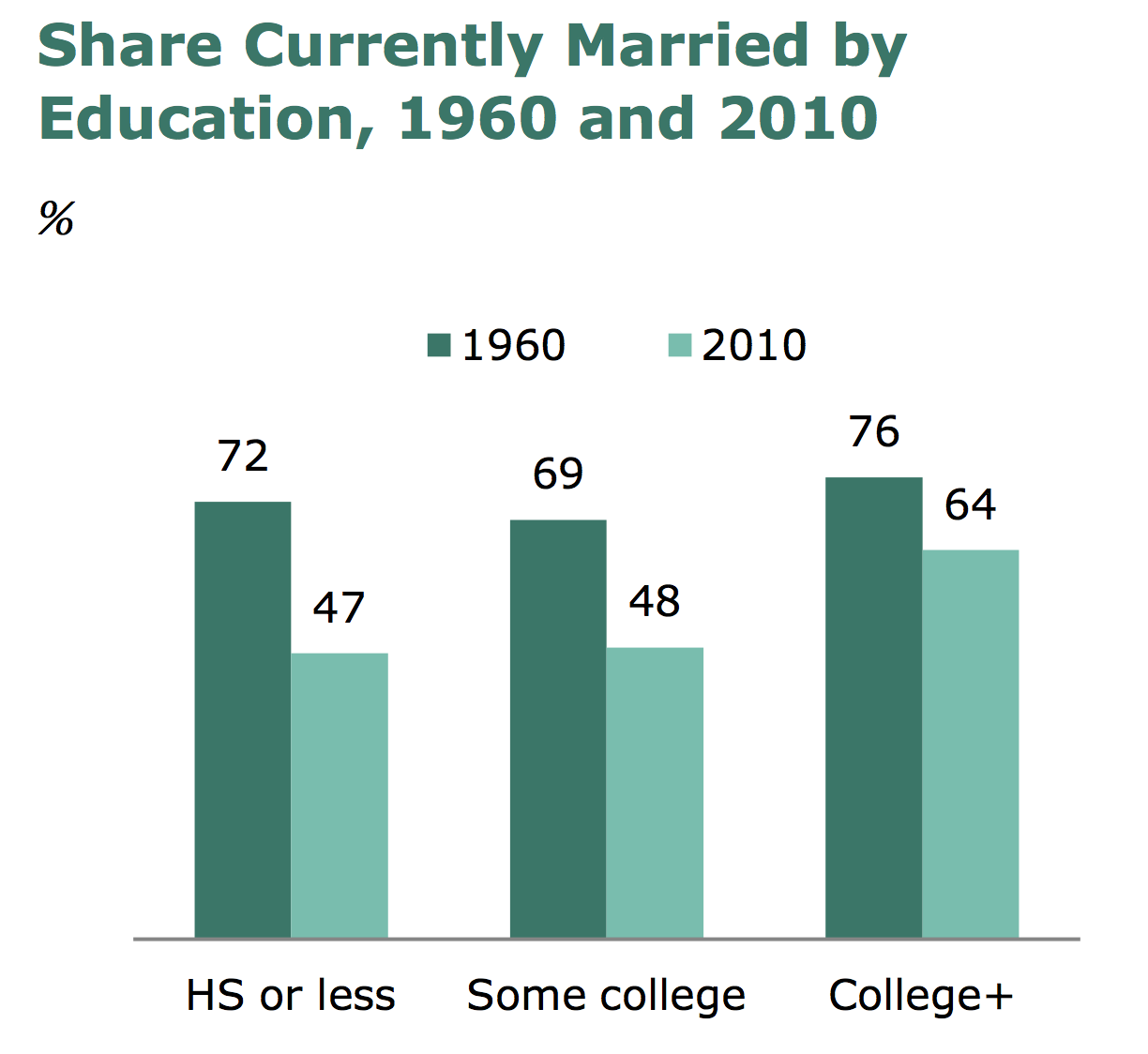
[W]hile marriage equality is winning victories and gaining converts (like me), marriage overall in the United States is fracturing along class lines. Among the 30 percent or so of upscale Americans with four-year college degrees, marriage trends are looking pretty good! (If this group were the entire nation, I’d be as encouraged as I was in the late 1990s.) But among the 60 percent or so of Americans who have high school degrees but not four-year college degrees — the nation’s broad lower middle class and working class — marriage is disappearing, right before our eyes. More and more unwed child bearing, one-parent homes, serial love relationships, chaotic home lives for children, frustrated hopes, bruised lives — the whole sad shebang. And very few people in high places seem to give a damn about it, or even to have noticed.
Rauch adds:
Yes, class bifurcation is the marriage problem of our time. Family instability among the less-educated and rising inequality are two sides of the same coin, each perniciously feeding the other. Yes, it’s tough to do anything about. But yes, I have hope, because we’ve arrived at a moment when, as a society, we can finally take off the culture-war blinders and see the real problem, which is the sine qua non for doing anything about it.
For many years, liberals were loath to talk about marriage and family values because both were code for “beat up on homosexuals.” At the same time, conservatives were loath to talk about inequality and class because both were code for “beat up on free markets.” But the era of gay marriage raises the prospect of a pro-marriage agenda which liberals can embrace as not even slightly anti-gay. And the country’s rapid division into marital and educational haves and have-nots makes inequality a problem that family-values conservatives can’t ignore.
Late last year, during a particularly bad day of fighting between the Free Syrian Army and the Assad regime, a band of rebels took refuge in the basement of an abandoned factory building in Aleppo. They had just lost two men and were in desperate need of more supplies and more fighters. As we all waited for the shelling to stop, I discovered a small hole in one of the factory walls. With that opening providing our only light, I photographed many of the rebels, each with the single item they claimed was the most crucial in their struggle against the government.
The caption for the above photo:
Kachadur Manukian, 25: “They killed my mother and father. I will kill them with my knife. I will kill them like I would kill a goat.”
Piccolomini recently won 2nd prize in the World Press Photo Award for a deeply unsettling photo of an injured baby in Aleppo.
Jen Graves ponders the case of sculptor Charles Krafft, who Graves once praised as iconoclastic and satirical, but is now lending his voice to White Power podcasts:
In 2003, Krafft made a ceramic teapot in the shape of a bust of Hitler, with eerie holes for eyes. A Jewish collector named Sandy Besser, now dead, bought the Hitler teapot and added it to his overtly politically themed collection, which he later donated to FAMSF, where it went on display in 2007. Burgard wrote about it in a catalog as explicitly and clearly antifascist. “These blind-looking eyes also evoke associations with… the world turning a blind eye to the horrors of the Holocaust.” …
[Now] as an experiment, Burgard showed the Hitler teapot to a colleague who had never seen it before and the colleague agreed with Burgard’s original interpretation. What does it mean that when Krafft made this portrait of a demonized Hitler, he was actually beginning to spread the word that the demonization of Hitler has been greatly exaggerated?
Increasingly, we’re starting to see shows and movies where product integration isn’t incidental—it’s the frame for the entire product. And it’s selling companies, rather than discrete products. First, there was CBS’s attempt to put together a show based at Groupon, the online coupon dealer. Now, Vince Vaughn and Owen Wilson are starring in a movie, The Internship in which they’re interns at Google … [I]t’s a win-win for companies who can sell themselves as settings to Hollywood. It’s a good deal for movie or television productions that can get substantial subsidies by setting shows and movies in corporations. But for me, it’s a decided bridge too far.
Wisconsin’s Scott Walker recently became the 13th governor to turn down federal money to expand Medicaid, opting instead to move Wisconsinites between 100% and 200% of the poverty line into the ACA health care marketplaces. Sarah Kliff thinks Walker’s idea “might have legs”:
Walker’s office estimates that, under this approach, the state will extend health insurance coverage to just over 224,000 Wisconsinites. That’s not quite as many as would gain coverage under the Medicaid expansion, although it’s relatively close: 224,580 instead of 252,678. The premiums for those who ended up purchasing coverage on the exchange, instead of receiving it through Medicaid, are relatively low for those right at the poverty level. They would increase as income went up.
With this approach, Wisconsin will miss out on one of the most appealing features of the Affordable Care Act: the federal government footing the entire bill for Medicaid enrollees newly eligible under the health reform law. … Walker expects that enticing [funding] will ultimately get cut back and that could leave Wisconsin on the hook for a bigger chunk of the Medicaid bill than it ever expected.
Obamacare’s exchanges, while seriously flawed, are reformable in a way that Medicaid is not. Indeed, the exchanges could someday be expanded to provide coverage for people who are today on Medicare and Medicaid, resulting in true, long-term entitlement reform. Scott Walker’s plan is a small but important step toward that goal.
Geoffrey Cowley pushes back, writing that “the new state insurance exchanges are designed for employers and middle-class consumers, not for the poor” and that “many people who can’t afford the premiums won’t qualify for assistance”:
Walker’s plan does open the state’s Medicaid program to thousands of childless adults who have languished for years on waiting lists. But to open those slots, it will force thousands of current Medicaid patients—most of them people with children in their care—into the private insurance market. … It’s worth noting that the exchange at the center of Walker’s initiative is the same one he has refused to build in partnership with the federal government. To avoid expanding Medicaid, he is handing off Medicaid patients to another federal program. His tagline for the initiative: “From Dependence to Independence.”
Since you’re already thinking of the song, here you go:
A reader writes:
“Micro-moment of positivity resonance“?! Weak sauce. Weaker than most of the newfangled “scientific” approaches to The Subject of our Human Lives. What Fredrickson describes are what she purports to be a leading researcher of: positive feelings and emotions toward another. That’s not what we mean by really being in love with someone. Love is so much richer and deeper and can be anything but laced with positive emotions. T. S. Eliot gets it:
Who then devised the torment? Love.
Love is the unfamiliar Name
Behind the hands that wove
The intolerable shirt of flame
Which human power cannot remove.
We only live, only suspire
Consumed by either fire or fire.
Another writes:
Leaving aside the Christian framework, the thing that doesn’t ring true about the UNC researcher’s definition of love is that I am often most aware of how much I love someone in those moments when I like them the least.
For instance, when my children are at their most obnoxious, and least pleasant, I become acutely aware of how much concern I have for their own development and their own futures. When they engage in behaviors I would never tolerate in a person I felt no love for, my hopes for what is best for them supercede my own pain, and my own anger.
In essence, I often experience love most in a context where positive emotions are the hardest to be found. In fact, I’d define love as what’s left when the magic is gone, when the warm fuzzies disappear, etc. Love’s what’s there when anyone else would walk away. Because it’s easy to “love” when all is sweetness and light.
Another connected with Fredrickson:
This is the part that hit me the most about the article: “She means that love is a connection, characterized by a flood of positive emotions, which you share with another person—any other person—whom you happen to connect with in the course of your day.” (My italics) I’m in a gay threesome, and I could not agree more. People have always wondered how I get through the day without being jealous. How I used to explain my absence of jealous feelings was that I love everyone differently – my relationship with person X is different than with person Y, because they are different people and we are in different stages of our relationships. And I have always disliked putting people in a hierarchy; “person X is my best friend” has never really made sense to me.
Fredrickson’s description is a way better way to explain it. My best friend is whomever I am communing with at that point in time and getting enjoyment out of it – with whom I am sharing, even if it’s just for a minute or two. I’m focusing on THAT PERSON, and all others fall by the wayside at that very moment. My jealous feelings disappear once I realize that my partners have a right to the same kind of connections.
Another:
I am seven weeks away from marrying the love of my life. We’ve been together for eight-and-a-half years. We’re living in a weird period of impatient anticipation of what we’ve been working toward, what we want. Thus, we’re both prickly (and exhausted from final planning) right now.
Love, I’ve recently recognized, is that moment when you desperately need forgiveness from the one who inspires your best self for having just been, in some small, petty way, your base self.
Kelsey Atherton refocuses the debate over the “targeted killing” memo:
The paper hardly mentions drones. It just sets out rules for a targeted killing policy and lists “pilotless aircraft or so-called smart bombs” as possible tools for carrying out those killings. The policy itself is not technology-specific. Yet somehow drones have become shorthand for targeted killing. Why? While it’s true that drones are the best-known tool for carrying out targeted strikes, they are only one of many methods by which the United States attacks individual terrorists from afar. …
[I]t’s natural to conflate the two, but most drones are used for other purposes, such as surveillance and scouting, and non-drone means have been used for targeted killings. … We may talk about the “drone war” and debate the drone memo, but we’re not really looking at the use of a specific technology. Instead, the “drone debate” is about policy, and how the United States chooses to attack its enemies in the War on Terror. Fancy as modern drones may be, it’s the policy that makes this kind of war new.
“What I’ve said tonight matters little if we don’t come together to protect our most precious resource, our children,” – president Barack Obama, February 12.
“‘Ten civilians were killed last night in a joint Afghan and American operation that took place in Chogam Valley in Shigal District,’ said Fazlullah Wahidi, the provincial governor. He said four women, one man and five children between the ages of 8 and 13 were killed; four teenagers were wounded, three of whom were girls,” – NYT, February 13.

 The Dish