What Is Love?

A unique definition from Barbara Fredrickson:

Fredrickson, a leading researcher of positive emotions at the University of North Carolina at Chapel Hill, presents scientific evidence to argue that love is not what we think it is. It is not a long-lasting, continually present emotion that sustains a marriage; it is not the yearning and passion that characterizes young love; and it is not the blood-tie of kinship.

Rather, it is what she calls a “micro-moment of positivity resonance.” She means that love is a connection, characterized by a flood of positive emotions, which you share with another person—any other person—whom you happen to connect with in the course of your day. You can experience these micro-moments with your romantic partner, child, or close friend. But you can also fall in love, however momentarily, with less likely candidates, like a stranger on the street, a colleague at work, or an attendant at a grocery store.

Relatedly, Nick Olson critiques the notion that love “can be whittled down to the observable moment in which we feel good or when we feel love’s resonance,” and brings Christian theology to bear on the matter:

Ironically, it’s this sort of narrow definition of love which often leads to – and embellishes – our loneliness.

When love’s definition derives from a singular focus on felt moments of happiness, we begin to selfishly seek them out like a high, and this sort of self-absorption perpetuates loneliness. Instead, love is better found in the purposeful gestures that occasion those emotions. We can enjoy the moments of feeling loved for they are part of love’s equation, but, foremost, these feelings ought to inspire a love qualified by gratitude, and then the desire for reciprocation. If love is not only facilitated and occasioned but embodied by persons – an all-encompassing reality to inhabit – then its expressions only make sense if there is a baseline, loving purpose. This purpose finds itself in the Person who is love – not the abstract idea of love. This is the hope found in embracing Christ – love incarnate – who is eternally loving and loved as the second Person in the Trinitarian landscape.
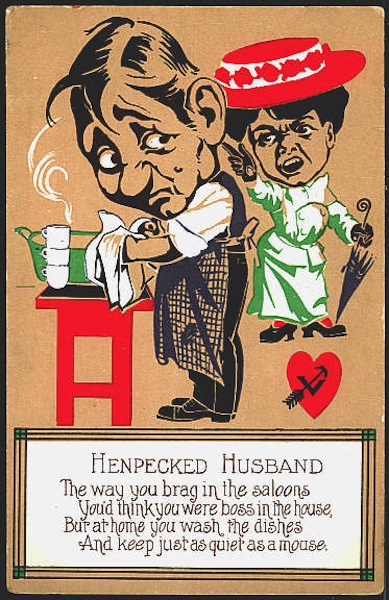

Vinegar Valentines

Lisa Hix unearths a treasure trove of them, which date from the 1840s to the 1940s. Much of the time, the senders weren’t joking:

You have to remember that often they were sent anonymously. They were to say “Your behavior vinegar_henpeckedis unacceptable.” For example, there are quite a few cards that mock men with babies on their laps as being henpecked—the kind of thing now we would think was a man doing the right thing by taking his share of child care. But these cards were specifically designed to make the man seem emasculated and disempowered by being left holding the baby. Or there’d be images of women holding rolling pins, threatening their husbands.

The people sending such cards were usually not either one of the couple. It wasn’t the wife sending to the husband or the husband sending to the wife. It was somebody outside, looking in at their relationship and saying, “This doesn’t conform with what’s expected.” In that way, they did enforce social norms. Sometimes they seemed to be saying, “Change your behavior, or else.” There’s almost this threatening element to them.

(Image from a vintage postcard on Ebay, via Hix)

The Purity Of Their McCarthyism

As a reader noted earlier, Weigel shows how the “Friends of Hamas” smear against Chuck Hagel may refer to an organization that doesn’t even exist and was hyped by the dregs of Breitbart and passed along by fanatics like Hugh Hewitt. I’m beginning to realize why we were told at the get-go that the Greater Israel Lobby was not going to fight this nomination. Because they were going to fight it to the bitterest end imaginable. Weigel asked Ben Shapiro, the sole source for this story, about it this morning:

“Have you found any more proof that this group exists?” I asked. “Is it just shorthand for some people who might support Hagel, or a real group?” “The original story is the entirety of the information I have,” he said.

You can observe what goods Shapiro had in the original piece. The source? “Senate sources”. None of whom have been able to be located since.

Quote For The Day

Senate Holds Confirmation Hearing For Chuck Hagel For Secretary Of Defense

“Just as Americans in general do not have the habits of deference, so the conservative in America does not have them either. Ultimately he does not defer even to the country’s institutions. If one of these institutions, such as the Supreme Court, makes decisions he detests, he will defame that institution. He is as ready as is the common man to bypass the institutions he ought to defend … The America which Europe fears is the America of the Reaganites. The America once of the Scopes trial; the America of prohibition; the America of ignorant isolationism. The America then of ‘‘better dead than red’’; the America of McCarthyism; the America of the last fundamentalists of the 1950s. The America now of the new evangelicals; the America of the Moral Majority; the America of a now ignorant interventionism; the America which can see homosexuals as a conspiracy; feminists as a conspiracy; perhaps even women as a conspiracy.

The America of fear. For it is in fear that the ungoverned and the unfree are doomed to live. And there was this America in control at Detroit. It is time that we reminded ourselves, and said aloud and more often, that it is from these people that nastiness comes. It is time that we pointed out to the neo-conservatives that democracy has never been subverted from the left but always from the right,” – Henry Fairlie, 1980.

I love Henry’s parallelism between the “ignorant isolationism” and the “ignorant interventionism” of the 1980s. What would he have made of the Iraq War? How much more ignorant could an intervention be? But with respect to the current Republican party’s contempt for American institutions, and its use of pure McCarthyism Now check out this devastating email to Jim Fallows on the conduct of the Senate Armed Services Committee with respect to the nomination of Chuck Hagel to the Pentagon. Money quote:

“The behavior of some of the new members on the Hagel nomination is way over the line – disgraceful! They show no respect for the institution and are likely to poison its ability to work in a collaborative way. They are also hurting the institution of the office of Secretary of Defense and thus undermining our system of civilian control.”

That’s from Charles Stevenson, a “long-time Senate staffer, former professor at the National War College, and author of a standard text on the job of the secretary of defense” (in Jim’s words).

(Photo: Senate Armed Services Committee member Sen. Ted Cruz (R-TX) (L) talks with committee Chairman Carl Levin (D-MI) (R) as they and former U.S. Senator Chuck Hagel (R-NE) arrive for Hagel’s confirmation hearing to become the next secretary of defense on Capitol Hill January 31, 2013 in Washington, DC. By Chip Somdevilla/Getty.)

Sleuthing for Love

Daniel Estrin spotlights a unique challenge for couples looking to get married in Israel – the proof of a matrilineal Jewish ancestry to satisfy the Orthodox tradition:

[T]hey call Har-Shalom, who runs a nonprofit detective agency that specializes in sniffing out long-lost Jewish ancestry. His agency, called Shorashim (Hebrew for “roots”), is funded in part by the Israeli government. Each year he takes on roughly 1200 cases that test his fluency in Yiddish and Russian dialects, his familiarity with czarist and Soviet history, and his patience for combing through old Soviet archives. He then presents his findings to a rabbinic court, which almost always accepts his expert opinion about a citizen’s Jewish identity.

Estrin followed a genealogist working with Har-Shalom and witnessed the depth of the detective work:

An archivist willing to breach protocol located Olga’s grandmother’s original birth registration, which identified her as Jewish. Olga then paid Paley another $400 to secure a copy of her great-grandfather’s KGB file, which classified her great-grandmother as Jewish. Although these documents bolstered his case, Har-Shalom’s investigation dragged on for two more years.

Finally, last month, Olga was summoned to an Israeli rabbinical court. A judge sat at a raised bench. He reviewed the report Har-Shalom submitted of the evidence he gathered. Then the judge held up an old family photograph. “Who is in this picture?” he asked the defendant. Olga identified her mother, her grandmother, and her grandfather’s friend. The hearing lasted 15 minutes, and at the end, the judge handed down his verdict: Olga is Jewish. By extension, her daughter is, too.

A Fascist Kind Of Love

Grappling with her ongoing desire for an ex-flame, Natasha Vargas-Cooper is convinced by Blake and Rousseau that her feelings are something much darker than a search for acceptance:

Blake is the British Marquis de Sade, probing and exposing the tyrannical impulses behind misty emotionalism. Blake is interested in “coercion, repetition-compulsion, spiritual rape.” Like Rousseau, Blake wanted to free sex from religious and social restraints, but unlike Rousseau, Blake recognized there is no escaping the domination of nature and our own ignoble desires. His poems are filled with a latent human amoralism: men and women cannibalizing each other (“The Mental Traveler”), physically and psychologically exploited children (“The Chimney Sweeper,” “The Little Black Boy”), erotic ambivalence (“The Sick Rose”), and resentment towards the demonic power of sex.

She turns to literary critic Camille Paglia to make sense of her schemes to get the boy back:

In one liberating spank, Paglia’s reading of [Blake’s poetry] made me realize that my phone calls and romantic gestures were not noble or life-affirming but a perverse, coercive form of power. What I perceived to be my romantic idealism was actually a fascistic impulse to dominate, what Paglia describes as “sadistic tenderness”: “Every gesture of love is an assertion of power. There is no selflessness or self-sacrifice, only refinements in domination. …”

The Caricatures Of COPS, Ctd

A reader writes:

The thing with COPS is that there’s an unspoken agreement – the cops will never be embarrassed. Can you imagine the blooper reel they could assemble? It would be epic. But you never see any of that; as far as I know no one has ever escaped once the cops started chasing them. But of course they do in real life. When you understand that everything you are seeing has been cleared for embarrassing material, it becomes a bit scarier. The casual way they will tase people for standing there and simply refusing to comply is a bit shocking, since they not only do that, but feel no shame about it. It’s a bit scarier as propaganda than just as cringe comedy.

Another:

I hold a different view then that of Kelley Vlahos regarding COPS. While the critiques of the show are fairly obvious to any thoughtful viewer, I actually value the show for one important reason: it is the only, and I mean ONLY, show on TV that shows the true face of poverty in America.

Where else will we ever see the filthy living rooms of people living by a thread day after day, their children hungry and dirty? This view of America is studiously avoided but because poverty is ugly and no one wants to see it, but there it is on COPS and no one can deny its effect on human beings. I understand the makers of the show come from a completely different ideology, their point being law and order prevails, but what it unknowingly shown to us is the dark underbelly of the American experiment. Watch it with eyes wide open.

The Anti-Hagel Hardliners

Larison wonders what Republicans hope to accomplish by opposing Hagel:

The impressive thing about the anti-Hagel effort is how politically tone-deaf it is. It’s not just that their opposition is misguided, but they stand to gain nothing from it. No one outside of a small core of hard-liners sympathizes with what Senate Republicans are doing. While they may not be losing any votes over this, they are making sure that all of the moderates, independents, and realists that they have alienated over the last ten years will keep running away from them. Except for dedicated partisans, no one can look at the display most Senate Republicans have put on over the last eight weeks and conclude that these people should be in the majority.

Near-Death Romances

heart

Brad Leithauser remembers the poetry of Robert Graves, whose feelings on love fueled much of his verse:

Graves was also an ex-soldier, and he documented his catastrophic experiences in the First World War in his celebrated memoir, “Goodbye to All That.” At the Battle of the Somme, where a shell fragment pierced his lung, he was officially reported dead. This was an experience that would be frequently repeated—or that he would repeat—in that other war, the one between men and women. In every romance, the time would come when he’d be abandoned or—much the same thing—the enchantment would fade, and he would undergo another near-death experience. His last decades are a little painful to contemplate.

One of Graves’ poems, “Symptoms of Love”, is below:

Love is universal migraine,
A bright stain on the vision
Blotting out reason.

Symptoms of true love
Are leanness, jealousy,
Laggard dawns;

Are omens and nightmares –
Listening for a knock,
Waiting for a sign:

For a touch of her fingers
In a darkened room,
For a searching look.

Take courage, lover!
Could you endure such pain
At any hand but hers?

(Photo by Chip Harlan)