In an essay on Pope Benedict’s legacy in America, Michael Sean Winters highlights these words from his World Day of Peace message just six weeks ago:
It is alarming to see hotbeds of tension and conflict caused by growing instances of inequality between rich and poor, by the prevalence of a selfish and individualistic mindset which also finds expression in an unregulated financial capitalism. In addition to the varied forms of terrorism and international crime, peace is also endangered by those forms of fundamentalism and fanaticism which distort the true nature of religion, which is called to foster fellowship and reconciliation among people.
That’s an authentic Catholic message – and it’s what lies behind my own concern with fundamentalism (which is not faith – but a form of neurosis) and with the moral limits we must impose on capitalism to remind ourselves that human beings are always ends in Christianity. They are never means. Winters adds:
Imagine, for a moment, the outcry if President Barack Obama had lumped “unregulated financial capitalism” with “terrorism” and “international crime” in the same paragraph as threats to world peace! But because many of Pope Benedict’s American fans do not share his clear, unequivocal suspicion of markets, these teachings tend to be ignored …
In another mark of his distance from what Americans consider conservative orthodoxy, Benedict has earned the title of “Green Pope.” He is the first pontiff to articulate a clear theology surrounding the moral obligation to care for the environment, and to link that teaching to the Church’s traditional concern for the poor. In an environmental catastrophe, the poor are usually hit the hardest. Many make light of the Vatican becoming a “carbon neutral” state, seeing it as mere symbolism. Of course, Catholics do not ever qualify the noun “symbolism” with the adjective “mere.”
Indeed. And you can see in his handling of these matters the rudiments of what could have been a transformative, prophetic papacy, one that responded with urgency and grace to the most pressing issues of our day. For a Church that is dying in Europe and for an American religious landscape increasingly marked by the rise of agnostics and the “nones,” the ability to speak to young people about environmental catastrophe and a financial collapse that came into being just as they reached adulthood held much promise.
And yet when it came to his brutal enforcement of rigid theological orthodoxy, his callous treatment of women, his unstinting opposition to the aspirations of gay and lesbian Christians, and his weak, corrupt handling of the child rape scandal, Benedict squandered this opportunity. This is all the more tragic given Benedict’s prodigious learning and theological acumen – he could have been a messenger not just for the continued relevance of the love Jesus witnessed to on every page of the Gospels, but a sophisticated, erudite, intellectually credible messenger for that vision.
I’ve already noted the false hopes of his brilliant encyclical, Deus Caritas Est. Sadness at what might have been is given further impetus when you read his early theological works, and realize how much of his thinking was forged by the reformist and incredibly innovative work that helped spur the Second Vatican Council.
Here’s one anecdote that sticks in the mind, taken from his memoir Milestones, about the symbols he chose to mark his appointment as Archbishop of Munich and Freising:
The first of [these symbols] was the shell, which first of all is simply a sign of our pilgrimage, of our being on the road: “We have here no lasting city.” But it also reminded me of the legend according to which one day Augustine, pondering the mystery of the Trinity, saw a child at the seashore playing with a shell, trying to put the water of the ocean into a little hole. Then he heard the words: This hole can no more contain the waters of the ocean than your intellect can comprehend the mystery of God. Thus, for me the shell points to my great master, Augustine, to my own theological work, and to the greatness of the mystery that extends farther than all our knowledge.
And then there’s this, from his relatively early work, Introduction to Christianity:
[B]oth the believer and the unbeliever share, each in his own way, doubt and belief, if they do not hide from themselves and from the truth of their being. Neither can quite escape either doubt or belief; for the one, faith is present against doubt; for the other, through and in the form of doubt. It is the basic pattern of man’s destiny only to be allowed to find the finality of his existence in this unceasing rivalry between doubt and belief, temptation and certainty. Perhaps in precisely this way doubt, which saves both sides from being shut up in their own worlds, could become the avenue of communication.
These words, read from the present day, are haunting. Could there be a more wrenching image of a man “shut up in his own world” than the aging Benedict in the Vatican? Somehow, the young theologian who praised doubt as an “avenue of communication” between believer and unbeliever became the “Vicar of Orthodoxy” and “God’s Rottweiler.” My own view is that the tragic moment in Ratzinger’s career was his elevation from theologian to the enforcer of orthodoxy. His austere Augustinianism – his deep sense of the way in which God enters our lives and has entered our world regardless of our will or desires – created a beautiful, if perhaps too beautiful – theology. But with a catch, when truth became allied with ecclesiastical power:
His bleakness, while theologically a way in which the extremity of grace can be radically described, is — once in power — a recipe for authoritarianism. The same view that holds that man is hopeless and needs the mystery of God holds that man is hopeless and needs the discipline of authority. For these reasons, the elevation of Ratzinger to the prefect of the Sacred Congregation for the Doctrine of the Faith was a particularly fateful decision. The very same theology that could describe the mystery of God, His unknowability, His radical gift of grace, could be used to justify the lack of any trust in the work of the Church below, and the necessity to maintain absolute conformity to the mysterious dictates received from above. What Ratzinger’s elevation unleashed—the wild card in Ratzinger’s development—was the factor of power. His theology did not change. But its new context was to transform the purity of its intent.
Somehow, the prelate who compared the mysteries of God to the vastness of the ocean aided and abetted the forces of reaction in the Church. Somehow, the thinker who urged readers to recognize “the truth of their being” became the foe of gay and lesbian Christians who wanted to do just that. There was equally a blindness to the revolution in women’s freedom that occurred in his lifetime. You will notice that his abdication begins, “Dear Brothers …” Sisters are not among those he addresses as equals:
Ratzinger describes women, in The Ratzinger Report, as the receptacles “of motherhood, of gratitude, of contemplation, of beauty.” His challenge to women in the 1980s is to live up to the virtues of the Virgin Mary. In itself, that is hardly objectionable to a Catholic. But what is remarkable is how much is left out. No other avenue of achievement or self-fulfillment is countenanced. The implication is that there is nothing of value for the Christian view of women in the work, creativity, or independence that women in the West now partly enjoy. On the contrary, women have paid
“the highest price to the new society and its values. . . . What is the woman to do when the roles inscribed in her biology have been denied and perhaps even ridiculed? If her wonderful capacity to give love, help, solace, warmth, solidarity has been replaced by the economistic and trade union mentality of the “profession,” by this typical masculine concern?”
Is Ratzinger really saying that any form of “professional” work is destructive of the “roles inscribed in [female] biology”? And does the massive moral experience of working women, who have also struggled to lead Catholic lives, have nothing to say to this judgment? Is “solace” incompatible with a mother who devotes herself in part to a world other than the family? Is love a capacity necessarily destroyed by work? Has Ratzinger any evidence to support such claims?
Of course he didn’t. By that point – and further on – he asserted and demanded obedience. He was meticulous in his scrutiny of the church’s theologians and helped stamp out the very debate he once helped pioneer. The slightest scintilla of heresy could be detected from Rome, publicized and disciplined. Thousands of cases of child rapes – all of which he saw from 2001 onwards? Not so much. He insisted on total and utter secrecy within the church and no cooperation with civil authorities. He allowed a monster like Maciel to carry on.
Perhaps once he abdicates the papacy the full extent of Joseph Ratzinger’s transformation can be understood and, if not explained, then more fully grasped. And then, maybe, a Church that so desperately needs renewal, and a world that needs Jesus’ message of love and grace more than ever, finally can move forward and speak with credibility to the modern world. It is difficult to know how that can happen apart from coming to terms with the forces, within and without the Church, that are personified by the brilliant young German theologian who became Pope. A Pope who, in the end, gave up, when faced with the enormity of the corruption and degeneracy his papacy did so little to counter and the Western faithless he failed to engage.
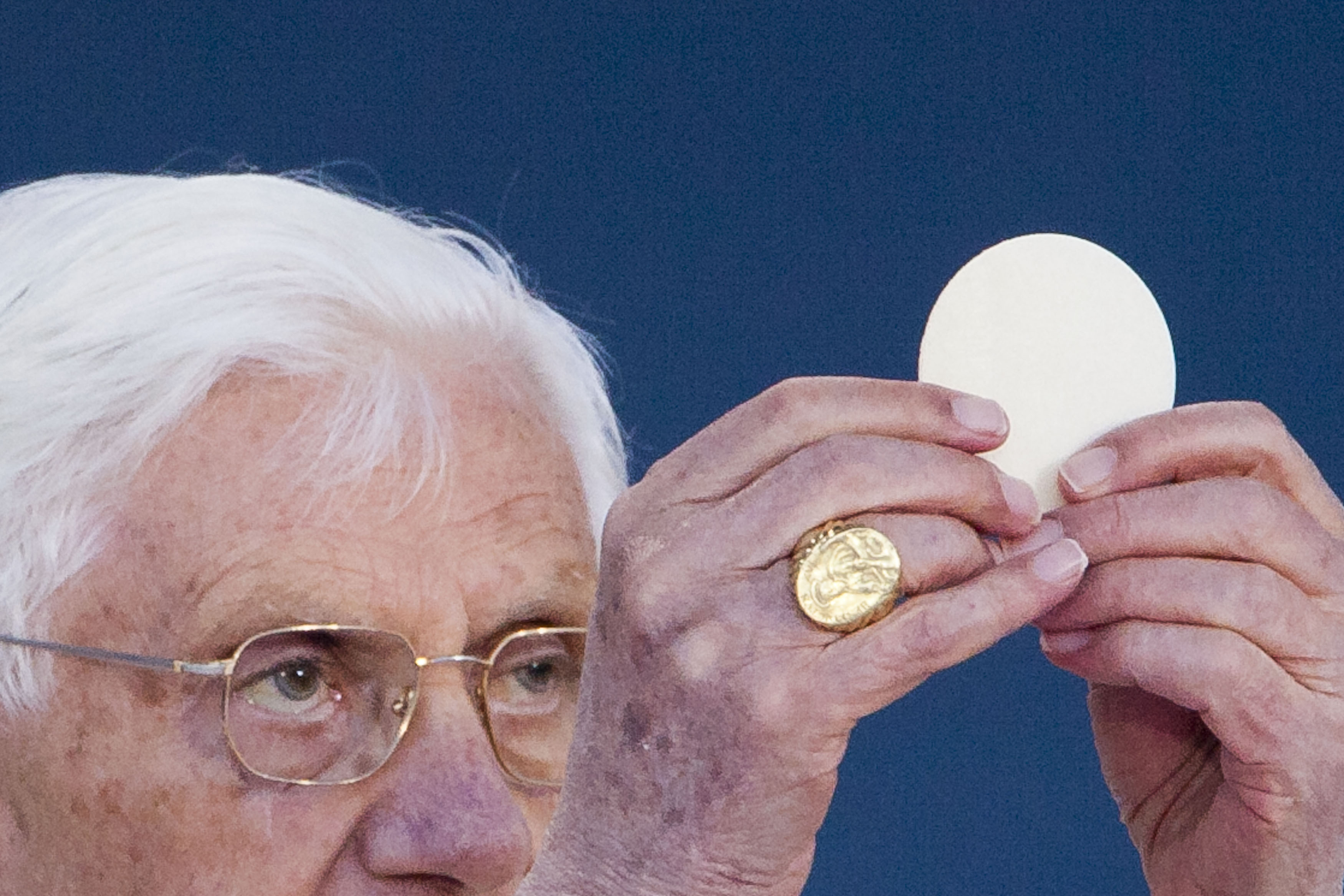
(Photo: Pope Benedict XVI leads morning mass at Domplatz square in front of the Erfurter Dom cathedral on September 24, 2011 in Erfurt, Germany. By Carsten Koall/Getty Images. My entire 1988 essay on Ratzinger is now online at The New Republic. )



 The Dish