Will We Ever Know Why?

VATICAN-POPE-RESIGN-ST PETER

Stephen Marche, noting that in Dante’s Divine Comedy, “the last Pope who gave up his job, basically because he was too good to stomach the politics, ended up spending all eternity upside down in a hole of fire.” But he sees the “mystery” of the Roman Church’s machinations as part of its appeal:

What is so tantalizing about this story is that we’ll probably never know the actual reason, not for decades, anyway. Today the speculations will swirl, but it’ll eventually peter out [sic] when the race for the next Pope takes over the news. The Vatican is simply too opaque to make even intelligent guesses. You know how opaque the Vatican is? The journalist who broke the story heard the Pope giving his announcement to the Cardinals in Latin, and understood it, and then ran with the story. (Let nobody doubt the value of a classical education again.) The Vatican is so opaque that only recently did they release secret files about Pius XII, otherwise known as Hitler’s Pope, that showed him saving the lives of Jewish refugees. Even that bit of magnificently good news for the Church was hidden in the vaults.

Can you imagine what Ratzinger’s full files on the global child-rape conspiracy contain? That evidence of criminality may never see the light of day – like the tapes of torture deliberately destroyed by the CIA. Andrew Brown, claiming that the Pope’s resignation had been “planned” for some time – he even adds that Rowan Williams, the former Archbishop of Canterbury, knew about this before Christmas – believes Benedict deliberately did this as a response to the years of drawn-out, sickly last years of his predecessor, Pope John Paul II:

During the decrepitude of John Paul II, Pope Benedict, as Cardinal Ratzinger, was his right-hand man. It may be that his experience then planted in him a wish to leave office while he was still able to discharge his duties. Modern medicine does not work well with autocratic regimes traditionally renewed by death or disease, and the papacy remains the last absolute monarchy in Europe.

In Benedict’s resignation statement can be seen an implied rebuke to his predecessor, who argued that clinging to life and power for as long as possible was itself a form of witness to Christ’s suffering.

In a helpful summary of the process used to select a new Pope, Alessandro Speciale finds that secrecy and tradition are at the heart of what happens, indicated in part by a term we’re sure to hear much of in the coming weeks – “conclave”:

The word conclave is derived from the Latin phrase for “with a key.”

It was first used by Pope Gregory X in 1274 in a proclamation outlining the procedure for electing a pope in a meeting place that can be securely locked.

The conclave should open 15 days after the pope resigns but could be postponed to 20 days. All cardinals under the age of 80 are eligible to vote for the new pope. Pope Paul VI limited the number of cardinal-electors to 120; currently 118 are eligible.

The cardinals live in seclusion in the Casa Santa Marta, a luxury residence inside the Vatican walls. They meet to vote under Michelangelo’s famous ceiling in the Sistine Chapel, adjacent to St. Peter’s Basilica.

Once the conclave begins, a cardinal-elector may leave only because of illness or other serious reason accepted by a majority of his fellow cardinals. Everyone associated with the conclave — doctors, nurses, confessors, masters of liturgical ceremonies, sacristans and various priest assistants and housekeeping and catering staff — must swear never to tell anything they learn about the election.

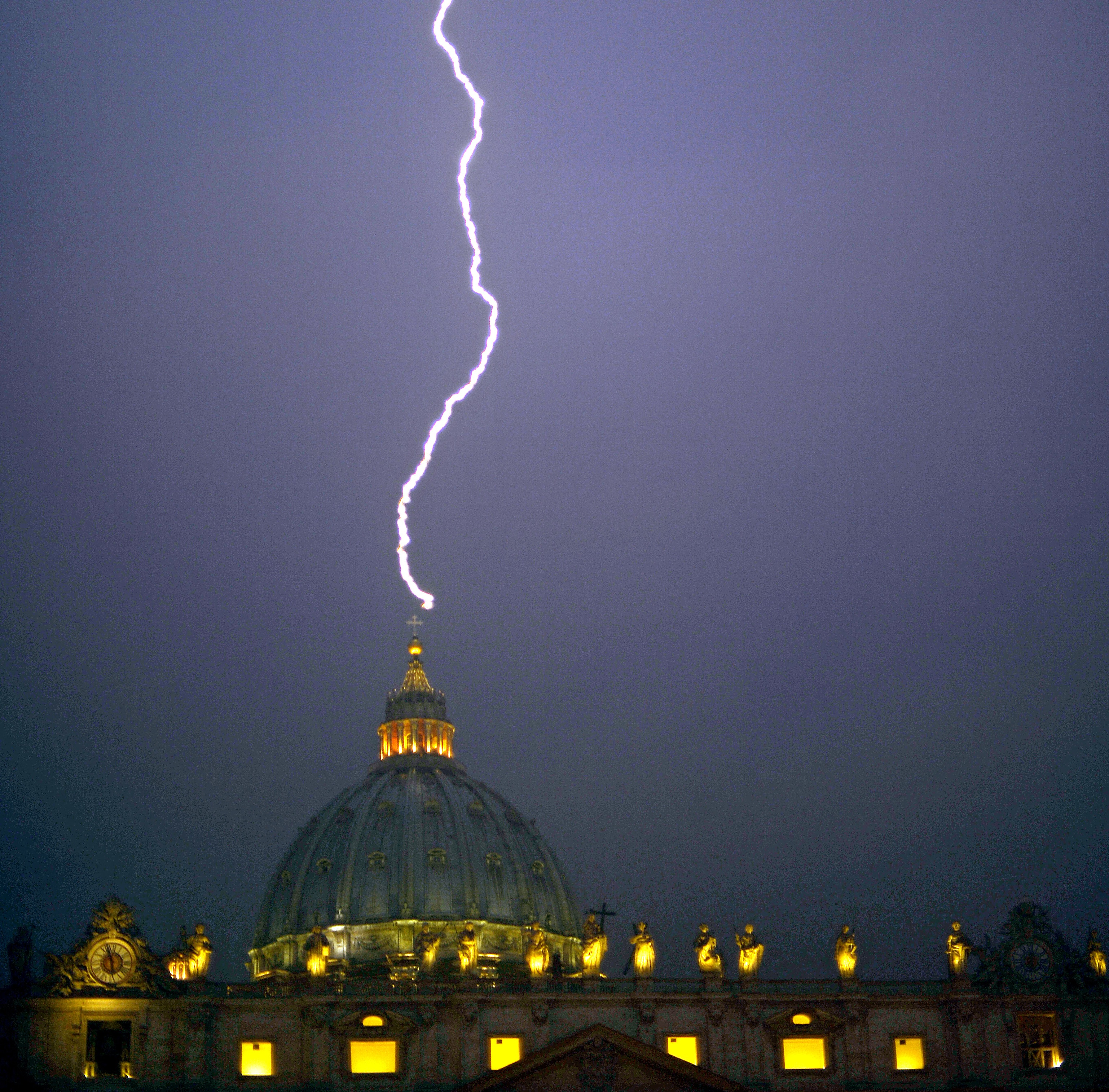
(Photo: Lightning strikes St Peter’s dome at the Vatican on February 11, 2013. Pope Benedict XVI announced today he will resign as leader of the world’s 1.1 billion Catholics on February 28 because his age prevented him from carrying out his duties – an unprecedented move in the modern history of the Catholic Church. By Filippo Monteforte/AFP/Getty Images)

How To Catch A Python

Chris Moody files a dispatch from Florida, where hunters are encouraged to go after the Burmese python, an invasive species of snake “that can stretch to 23 feet and weigh 200 pounds”:

Chopping off the python’s head can lead to a bloodied severed head bearing needle-sharp teeth chomping at your legs. A python brain can remain active for up to an hour after decapitation. Florida officials recommend killing the snake by firing a pressurized bolt into its brain or shooting it in the head with a gun.

Catching the python by hand without a weapon offers a trio of hunters three unappealing choices: Be the sucker who takes on the head and gets a bite on the arm; the sucker who grabs the midsection and ends up with a snake wrapped around your neck; or the sucker in the back who will almost always be covered in urine and feces — a process known politely as “musking” a predator.-

(Photo: BR Slocum carries a snake catcher as he hunts for python’s in the Florida Everglades on the first day of the 2013 Python Challenge on January 12, 2013 in Miami, Florida. The Florida Fish and Wildlife Conservation Commission and its partners launched the month long 2013 Python Challenge to harvest Burmese pythons in the Florida Everglades, a species that is not native to Florida.The contest features prizes of $1,000 for catching the longest snake and $1,500 for catching the most. By Joe Raedle/Getty Images)

Life After Abbottabad

Phil Bronstein interviews the man who shot Osama Bin Laden about his time in the Nacy SEALs, the raid, and his life since then. The whole (extensive) interview is worth a read. Teaser quote:

In my yard, the Shooter told his story about joining the Navy at nineteen, after a girl broke his heart. To escape, he almost by accident found himself in a Navy recruiter’s office. “He asked me what I was going to do with my life. I told him I wanted to be a sniper. “He said, ‘Hey, we have snipers.’ I said, ‘Seriously, dude. You do not have snipers in the Navy.’ But he brought me into his office and it was a pretty sweet deal. I signed up on a whim.”

“That’s the reason Al Qaeda has been decimated,” he joked, “because she broke my fucking heart.”

Sarah Kliff focuses on his life since leaving the SEALs:

Tricare (the health insurance program that covers military service members and their families) does provide 180 days of transitional health insurance “but the Shooter is eligible only if he agrees to remain on active duty “in a support role,” or become a reservist.” Now, the Shooter is purchasing a private health insurance plan for $486 per month, which does not cover some of his treatments.

Update: A reader flags an item from a Stars and Stripes veterans’ blog asserting that the Esquire article “wrongly claims SEAL who killed Bin Laden is denied healthcare.”

Benedict’s Greatest Encyclical

Not a hard choice. My 2006 take on “Deus Caritas Est”:

It’s a beautifully written document: humane, outward, subtle and exactly, in my view, what the Church needs right now.

It’s a reminder of our basis as Church – in the love that Jesus brought into the world and commanded us to live. Benedict’s Augustinian realism that heaven on earth is impossible, that ideologies that pretend to solve all human suffering are lies, that we should not attempt “what God’s governance of the world apparently cannot: fully resolve every problem” – all these are profound truths at the center of our faith.

I’m struck, however, by the near-complete absence in the document of the love of “amicitia,” of friendship. It is far more central to the Gospel message than eros, and under-estimated in our current culture, to our great detriment. I also, obviously, share Benedict’s wonder at conjugal love. I see no conflict between the love of two homosexual men or women for each other and the mystery of heterosexual love. One day, it would be wonderful to see this doctrine of love extend to all God’s creatures. But these are brief, provisional comments. Amy Wellborn has a very insightful short essay on the Enclyclical. So does Rocco Palmo…  And yes, this does surprise me somewhat. It is not as extreme or as repressive as Benedict’s well-earned reputation. It is a sign, one hopes, of a papacy that can change and grow and concentrate on the central truths, not peripheral obsessions.

For that, a great sigh of relief. And, even, yes, hope …

Quote For The Day


“Even if eros is at first mainly covetous and ascending, a fascination for the great promise of happiness, in drawing near to the other, it is less and less concerned with itself, increasingly seeks the happiness of the other, is concerned more and more with the beloved, bestows itself and wants to “be there for” the other… The contemporary way of exalting the body is deceptive. Man himself becomes a commodity‚ he now considers his body and his sexuality as the purely material part of himself, to be used and exploited at will‚ as a mere object that he attempts, as he pleases, to make both enjoyable and harmless‚ it is more or less relegated to the purely biological sphere. The apparent exaltation of the body can quickly turn into a hatred of bodiliness,” – Pope Benedict XVI.

Ratzinger’s Anti-Gay Fixation

<> on June 2, 2012 in Milan, Italy.

Jim Burroway reviews it:

Pope Benedict XVI has been an anti-gay crusader of long standing. In a 2007 message for World Peace Day, in which the  Pope had a whole range of worldly ills which stand as a barrier to peace, he singled out gay marriage as “an objective obstacle on the road to peace.” This, while the Vatican opposed a UN resolution on decriminalization of homosexuality and the removal of the death penalty for those countries which impose it. While the Vatican is credited for exerting its influence against Uganda’s Anti-Homosxuality Bill in 2010, the Pope last December met with Parliament Speaker Rebecca Kadaga, the bill’s supporter, while she was in Italy for, ironically, a human rights conference.

Should he be selected, Ghanaian Cardinal Peter Turkson could be even worse. Ratzinger’s 1986 letter on the “objective disorder” of gay people combined with his subsequent attempt to ban all vocations from homosexuals in entering seminaries was eloquent enough about his own sexual panic.

(Photo: the infamous red Prada slippers, by Getty Images.)

The Stench He Leaves Behind

This embed is invalid

I can’t imagine I’m alone in wishing Hitch were still here to comment on Pope Benedict’s abdication – the video above certainly indicates he’d relish the time between the Pope’s resignation taking effect and the appearance of white smoke in Rome, when no one on earth could claim to be infallible. Though Hitch’s passing means we’ll miss his real-time observations, we still have his writings. Slate just republished this piece of his from 2010, in which he decried the Church’s handling of the child rape scandal – and found the Pope to be at the heart of the institution’s corruption:

Very much more serious is the role of Joseph Ratzinger, before the church decided to make him supreme leader, in obstructing justice on a global scale. After his promotion to cardinal, he was put in charge of the so-called “Congregation for the Doctrine of the Faith” (formerly known as the Inquisition). In 2001, Pope John Paul II placed this department in charge of the investigation of child rape and torture by Catholic priests. In May of that year, Ratzinger issued a confidential letter to every bishop. In it, he reminded them of the extreme gravity of a certain crime. But that crime was the reporting of the rape and torture.

The accusations, intoned Ratzinger, were only treatable within the church’s own exclusive jurisdiction. Any sharing of the evidence with legal authorities or the press was utterly forbidden. Charges were to be investigated “in the most secretive way … restrained by a perpetual silence … and everyone … is to observe the strictest secret which is commonly regarded as a secret of the Holy Office … under the penalty of excommunication.” (My italics). Nobody has yet been excommunicated for the rape and torture of children, but exposing the offense could get you into serious trouble. And this is the church that warns us against moral relativism!

And here’s this, from another essay of Hitch’s from around the same time:

Almost every week, I go and debate with spokesmen of religious faith. Invariably and without exception, they inform me that without a belief in supernatural authority I would have no basis for my morality. Yet here is an ancient Christian church that deals in awful certainties when it comes to outright condemnation of sins like divorce, abortion, contraception, and homosexuality between consenting adults. For these offenses there is no forgiveness, and moral absolutism is invoked. Yet let the subject be the rape and torture of defenseless children, and at once every kind of wiggle room and excuse-making is invoked. What can one say of a church that finds so much latitude for a crime so ghastly that no morally normal person can even think of it without shuddering?

It’s interesting, too, that the same church did its best to hide the rape and torture from the secular authorities, even forcing child victims (as in the disgusting case of Cardinal Sean Brady, the spiritual chieftain of the Catholics of Ireland) to sign secrecy oaths that prevented them from testifying against their rapists and torturers. Why were they so afraid of secular justice? Did they think it would be less indifferent and pliable than private priestly investigations? In that case, what is left of the shabby half-baked argument that people can’t understand elementary morality without a divine warrant?

Earlier today, I asked if lawsuits could proceed against the Pope himself, once he no longer is shielded from legal accountability as a head of state. Not surprisingly, Hitch was there first:

The case for bringing the head of the Catholic hierarchy within the orbit of law is easily enough made. All it involves is the ability to look at a naked emperor and ask the question “Why?” Mentally remove his papal vestments and imagine him in a suit, and Joseph Ratzinger becomes just a Bavarian bureaucrat who has failed in the only task he was ever set—that of damage control. The question started small. In 2002, I happened to be on Hardball With Chris Matthews, discussing what the then attorney general of Massachusetts, Thomas Reilly, had termed a massive cover-up by the church of crimes against children by more than a thousand priests.

I asked, why is the man who is prima facie responsible, Cardinal Bernard Law, not being questioned by the forces of law and order? Why is the church allowed to be judge in its own case and enabled in effect to run private courts where gross and evil offenders end up being “forgiven”? This point must have hung in the air a bit, and perhaps lodged in Cardinal Law’s own mind, because in December of that year he left Boston just hours before state troopers arrived with a subpoena seeking his grand-jury testimony. Where did he go? To Rome, where he later voted in the election of Pope Benedict XVI and now presides over the beautiful church of Santa Maria Maggiore, as well as several Vatican subcommittees.

In my submission, the current scandal passed the point of no return when the Vatican officially became a hideout for a man who was little better than a fugitive from justice. By sheltering such a salient offender at its very heart, the Vatican had invited the metastasis of the horror into its bosom and thence to its very head. It is obvious that Cardinal Law could not have made his escape or been given asylum without the approval of the then pontiff and of his most trusted deputy in the matter of child-rape damage control, then cardinal Joseph Ratzinger.

Well, a legal case against him and his decades of abetting child rape is now a possibility. He is no longer a head of state.