How Much Should A Joint Cost?

800px-Producer_of_marihuana

Christopher Matthews ponders the optimal marijuana tax:

The ultimate goal for opponents of marijuana prohibition is federal legalization. But any serious reform of federal marijuana policy will most certainly include a hefty federal excise tax as well in order to 1) help fund regulatory mechanisms; and 2) garner support from lawmakers who would not otherwise be disposed to reform. Oregon Representative Earl Blumenauer, for instance, has introduced marijuana reform legislation that would enact a 50% excise tax on production.

Proponents of legalization understand that healthy sales taxes are a great tool for furthering their cause. At a certain point, however, high taxes will encourage an illicit market. Where is the line? It’s difficult to know for sure, but if a 50% tax were enacted on the federal level, the marijuana industry in a state like Washington would face at least $1.92 in tax for every $1 of product sold. Whether this level of taxation is enough to encourage a black market is difficult to say.

He goes on to note that prices are also driven up by regulations. Along those lines, Jacob Sullum fears that Colorado will make marijuana sellers follow the 70/30 rule, which would require retailers to grow 70 percent of their product:

Amendment 64 declares that “marijuana should be regulated in a manner similar to alcohol,” which is hard to reconcile with a requirement that retailers produce 70 percent of what they sell. Jack Finlaw, co-chairman of the Amendment 64 task force, observed at Tuesday’s meeting that “if you read Amendment 64 in its entirety, this [recommedation] is going in a pretty dramatically different direction, and I think we need to be prepared to answer questions from the public about embracing a model that is the antithesis of how we regulate alcohol.” Supporters of the 70/30 rule draw an analogy to brew pubs or wineries that sell directly to consumers, but in neither of those cases is everyone who sells the product required to make it; you can still buy beer and wine from retailers who had nothing to do with producing it.

(Image: United States Special Tax Stamp — Producer of Marihuana — July, 1945. “It was probably related to the U.S. Hemp for Victory campaign, which allowed production of hemp for the U.S. WWII effort,” via Wikimedia)

The Right And Marriage Equality: A Breakthrough, Ctd

David Frum shares why he now supports marriage equality:

Like many signatories of the amicus brief, my thinking has been influenced by the fine example of the many committed, devoted same-sex couples I know. At least as much, however, I have also been swayed by an intensifying awareness of the harm culture war politics has done to my party. Culture war politics have isolated the GOP from the America of the present and future, fastening it to politics of nostalgia for a (mis)remembered past. Culture war politics have substituted for relevant cultural policies aimed at encouraging the raising of children within married families. Worst of all, culture war politics has taught the GOP to talk to America as if the nation were split into hostile halves, as if more separated Americans than united them.

If the GOP should have learned one lesson from the last election, it was to stop talking about Americans in fractions and percentages, and to speak to America as one people. To stigmatize the aspirations of some Americans is to break faith with the ideals of all Americans—and to surrender hope of gaining the support of a majority of Americans.

The UN’s Deadly Incompetence

Cholera Epidemic Spreads Rapidly In Haiti

Jonathan M. Katz exposes a UN peacekeeping mission to Haiti responsible for spreading a strain of cholera that has infected more than 647,000 people and killed about 8,000 – cases the agency tried to cover up. Last week the UN refused to compensate the victims, citing legal immunity:

The U.N.’s claim of immunity is ironic in Haiti, where, after all, a lack of immunity was the problem: Haitians had no resistance to the imported disease because they’d never been exposed to it before. That nightmare continues. Though cases have tapered off, there are indications the disease is once again on the rise.

Katz calculates how the UN could cover the damages:

Cholera, which spreads through contamination of food or water, can be prevented with good sanitation. It’s even easier to treat: Medicine is usually not required, just the speedy replacement of lost fluids. The U.N. estimates it would cost $2.27 billion to provide the necessary infrastructure in Haiti over the next 10 years. The victims’ lawyers have asked for up to $100,000 in additional compensation for each of the families they represent. In all, the total cost would probably be shy of $3 billion—a bargain compared with the economic, social, and personal damage the epidemic has brought. To put that figure in perspective, [the peacekeeping mission]’s budget for 2013 alone—again, a quarter of which is provided by the United States—is $644 million. Reduce the size of the nine-year-old peacekeeping mission, which after all is patrolling a country that’s not at war, and you could start paying that debt down quickly.

Katz’s recent dispatch on the ground from Haiti is here.

(Photo: Doudelime Lamarre, 7, lays on her cot as she is being treated for cholera in an International Red Cross cholera treatment facility in the slum neighborhood of Cite Soleil on November 25, 2010 in Port-au-Prince, Haiti. By Joe Raedle/Getty Images)

Weed Warning Labels

Robert Frichtel advocates for them:

The marijuana industry (both medical and recreational) needs to develop production standards concerning pesticides and chemicals and appropriate disclosure on the labels. Warnings should be included about driving or operating machinery and that use by those younger than 21 is illegal. The industry should also create a simple grading system that shows THC potency. It probably wouldn’t need to be as specific as the alcohol-content labels on most beverages, but perhaps based on a scale of “light,” “medium,” “heavy” and “extra heavy.” That way a consumer will be less likely to exceed his or her limit.

Why Hagel Is Hated

Now that Hagel has been confirmed, Beinart reflects on the episode:

The right’s core problem with Hagel wasn’t his alleged anti-Semitism. From Jerry Falwell to Glenn Beck to Rupert Murdoch, conservatives have overlooked far more egregiously anti-Jewish statements when their purveyors subscribed to a hawkish foreign-policy line. The right’s core problem with Hagel was that he had challenged the Bush doctrine. Against a Republican foreign-policy class that generally minimizes the dangers of war with Iran, Hagel had insisted that the lesson of Iraq is that preventive wars are dangerous, uncontrollable things. “Once you start,” he warned in 2010, “you’d better be prepared to find 100,000 troops.”

The point isn’t that Hagel “favors” containment and deterrence. Like virtually everyone else, he’d much rather Iran not get a bomb. But by reminding Americans of the potential costs of preventive war, Hagel was implying that containment and deterrence might be preferable. He was suggesting that if the U.S. can’t stop Iran from getting nuclear weapons short of war, it should make the same tradeoff that Harry Truman and John F. Kennedy made when they allowed the Soviet Union and China to get the bomb.

No Moderates Allowed, Ctd

Krauthammer sees Christie’s exclusion from CPAC as a mistake:

[youtube http://youtu.be/cbWDQkwZucs ]

Frum is in the same ballpark:

If the Republican party contained a self-conscious modern Republican wing, with its own organizational presence equivalent to CPAC, then it would matter less that CPAC excluded the party’s most viable candidates. As is, however, CPAC remains the only such show in town – and Christie’s exclusion sounds an ominous warning about obstacles on the route back to a Republican majority.

Larison explains why Republican pundits talked up Christie in the first place:

As movement conservatives start to sour on Christie, it might be instructive to recall what it was about him that many of them liked from 2009 through last year. For the most part, it wasn’t the content of his agenda, in which most of his admirers had little interest. It was Christie’s willingness to be combative and confrontational that won their admiration. When this was all that most movement conservatives knew about him, Christie’s future in the party seemed very bright, and his name was frequently listed along with such movement conservative heroes as Rubio and Ryan.

Silver looks at why movement conservatives have fallen out of love with Christie:

Mr. Christie was in good graces of CPAC as recently as last June, when he was the headliner at a regional conference the group sponsored in Chicago. So what has changed? Is it Mr. Christie, or is it CPAC? In fact, I’m not sure that either has. Instead, what seems to have changed is the salience of different issues, as driven by major news events over the past year.

And Allahpundit wonders if Christie will move right after reelection:

[W]ith the possible exception of Rand Paul, he’ll be the most interesting Republican to watch for the next year or two. Does he tack back to the right after his reelection to try to atone with conservatives? Or does he actually inch a bit further to the center by partnering with Bloomy on guns, or “evolving” on gay marriage, or maybe pushing reform on marijuana laws to try to get the attention of younger Republicans? He’s got to pick a brand before other people pick it for him.

No More Phoning It In, Ctd

Farhad Manjoo criticizes Mayer’s decision to ban Yahoo employees working from home, pointing to the mounting evidence of the benefits of telecommuting:

It’s not just that the policy completely elides the virtues of working from home. Numerous studies have found that people can be more productive when they’re allowed to work away from the office. One, released this month by researchers at Stanford, showed that when Chinese call-center employees were allowed to work from home, their performance increased by 13 percent. Considering such gains, it’s likely that Yahoo’s new ban will force remote workers to alter their work lives in a way that will lower their productivity. It will also put Yahoo at odds with just about every other tech company in Silicon Valley—firms that don’t impose such rules on working from home, and with whom Yahoo competes for talent.

A reader calls Manjoo’s piece “ridiculous”:

How can journalists compare call center workers, travel agency workers, and journalists to the highly skilled people employed by Yahoo who are going to charged with engineering that company’s revival and manage to keep a straight face? When Marissa Mayer talks about the crucial conversations around a water cooler, that’s not a quaint Mad Men era justification.  Most people are unable to imagine what the actual work done at a tech company is like, and so they make idiotic comparisons to call centers. Mindshare is overwhelmingly important in the tech industry – it really matters to be in the middle of problem solving and then be able to trot across campus and -ask- the guy who wrote the thing you depend on what assumptions he was making, &c.

Marcus Wohlsen suspects that Mayer is running her own experiment in productivity:

Coming from Google, hardly known as a stuffy workplace, she obviously has seen how unorthodox approaches to life at the office can support huge successes—and huge profits. Some current and former Yahoo employees have reportedly said that the new policy will separate out the truly productive workers from stay-at-home slackers who abuse the system. Perhaps Mayer sees the policy as a test of commitment, which, once passed, will help generate a roster of who can truly be trusted with flexibility in where and how they work. Once honed, maybe that leaner organization will lead to a better company.

If O’Brien Won’t Go, Why Is Mahony?

Pope Benedict XVI Holds Concistory

The dynamic in which closeted gay men actively persecute openly gay men as a way of credentializing their own alleged heterosexuality is not exactly news. Some of the most virulent hunters of homosexuals – from J. Edgar Hoover to Roy Cohn – were closeted homosexuals themselves. But when it comes to the disproportionately gay Catholic priesthood, it has, especially under Benedict XVI, intensified to new heights of hypocrisy. The Church in 1975 issued a rather inclusive, if still prohibitionist, view of homosexuality. Almost as soon as he got control of the Congregation for the Propagation of the Doctrine of the Faith, Joseph Ratzinger ratcheted up the anti-gay rhetoric. He called gay people “objectively disordered”, human beings who were somehow born naturally inclined toward an “intrinsic evil.”

So it is no big surprise to find that the Scottish Cardinal O’Brien has been credibly accused of the sexual harassment of other men and barred from the Conclave that will select the new Pope. After all, this is what he wrote a year ago on the subject of gay marriage in the context of the British debate:

Will both teacher[s] and pupils simply become the next victims of the tyranny of tolerance, heretics, whose dissent from state-imposed orthodoxy must be crushed at all costs? In Article 16 of the Universal Declaration on Human Rights, marriage is defined as a relationship between men and women. But when our politicians suggest jettisoning the established understanding of marriage and subverting its meaning they aren’t derided. Instead, their attempt to redefine reality is given a polite hearing, their madness is indulged. Their proposal represents a grotesque subversion of a universally accepted human right.

Gay marriage is madness. It’s a violation of human rights. It’s tyranny. It’s … wait for it:

No Government has the moral authority to dismantle the universally understood meaning of marriage. Imagine for a moment that the Government had decided to legalise slavery but assured us that “no one will be forced to keep a slave”.

Earlier this month, one former and three priests reported O’Brien’s attempts to have “inappropriate contact” with them, going back three decades. One was so traumatized he left the priesthood:

The first allegation against the cardinal dates back to 1980. The complainant, who is now married, was then a 20-year-old seminarian at St Andrew’s College, Drygrange, where O’Brien was his “spiritual director”. The Observer understands that the statement claims O’Brien made an inappropriate approach after night prayers.

The seminarian says he was too frightened to report the incident, but says his personality changed afterwards, and his teachers regularly noted that he seemed depressed. He was ordained, but he told the nuncio in his statement that he resigned when O’Brien was promoted to bishop. “I knew then he would always have power over me. It was assumed I left the priesthood to get married. I did not. I left to preserve my integrity.”

Britain will have no representative at the Conclave because the Cardinals are either too old or too sexually compromised. But Cardinal Mahony of Los Angeles, found unequivocally guilty of hiding and enabling the rape of children, will show up in his red robes. Why exactly is he allowed to go while O’Brien has resigned? Will he grab a sherry with Cardinal Law, another enabler of child-rape actually rewarded by the Vatican with a sinecure in Rome?

And here’s a question: if every Cardinal who had a cover-up of child-rape and abuse under his authority or had had sex with another man were barred from the Conclave, how many would be left?

(Photo: Cardinal Roger Mahony former archbishop of Los Angeles (C) attends the consistory held by Pope Benedict XV at the Saint Peter’s Basilica on February 18, 2012 in Vatican City, Vatican. By Franco Origlia/Getty Images)

The Worst Sequester Cut

Kent Sepkowitz’s pick:

[F]ederal support of the vaccination of children may be the best example of well-spent federal dollars. Because any time vaccination is stopped—­for religious or ideological or personal reasons—disease reappears. In the last decade, the U.S. and Europe have seen the return of pertussis (whooping cough), mumps, and measles due to incomplete vaccination, while Africa and Asia continue to battle outbreaks of polio. The famous Swine flu pandemic of 2009 infected about 60 million Americans and demonstrated the startling reach of a dangerous disease without an effective vaccination. And yet, with the sequester set to shave $2.4 billion off public health initiatives, there will be 840,000 fewer vaccinations—shots not given to infants and children (and a few adults) to prevent infections, all cheap to prevent and expensive to treat.

Two Popes, One Secretary

Benedict XVI Holds Weekly Audience

The damage Benedict XVI has done to the Catholic church and the papacy may be far from over. All I can say about yesterday’s developments is that they seem potentially disastrous and also indicative to me of something truly weird going on underneath all of this.

Benedict XVI has claimed that his almost unprecedented resignation came about simply because of his physical infirmity in the face of what appears to be a growing vortex of sexual and financial scandal inside the Vatican. He said he would quietly disappear to serve the church through prayer and meditation. But we now realize he’s going nowhere. He’s staying in the Vatican’s walls, and retaining the honorific “His Holiness.” He will keep white robes. His full title will be Pope Emeritus. Far from wearing clerical black, returning to the title of Bishop of Rome, and disappearing into a monastery in Bavaria, he’s going to be a shadow Pope in the Vatican. And this, we are told, was his decision:

The Vatican spokesman, the Rev. Federico Lombardi, said Benedict himself had made the decision in consultation with others, settling on “Your Holiness Benedict XVI” and either emeritus pope or emeritus Roman pontiff. Lombardi said he didn’t know why Benedict had decided to drop his other main title: bishop of Rome.

If you were trying to avoid any hint of meddling, of a Deng Xiao Peng-type figure pulling strings behind the scenes, you would not be doing this. The only thing the Pope will give up, apparently, are his red Prada shoes. He has some fabulous brown leather artisanal ones to replace them. But this is what really made me sit up straight, so to speak:

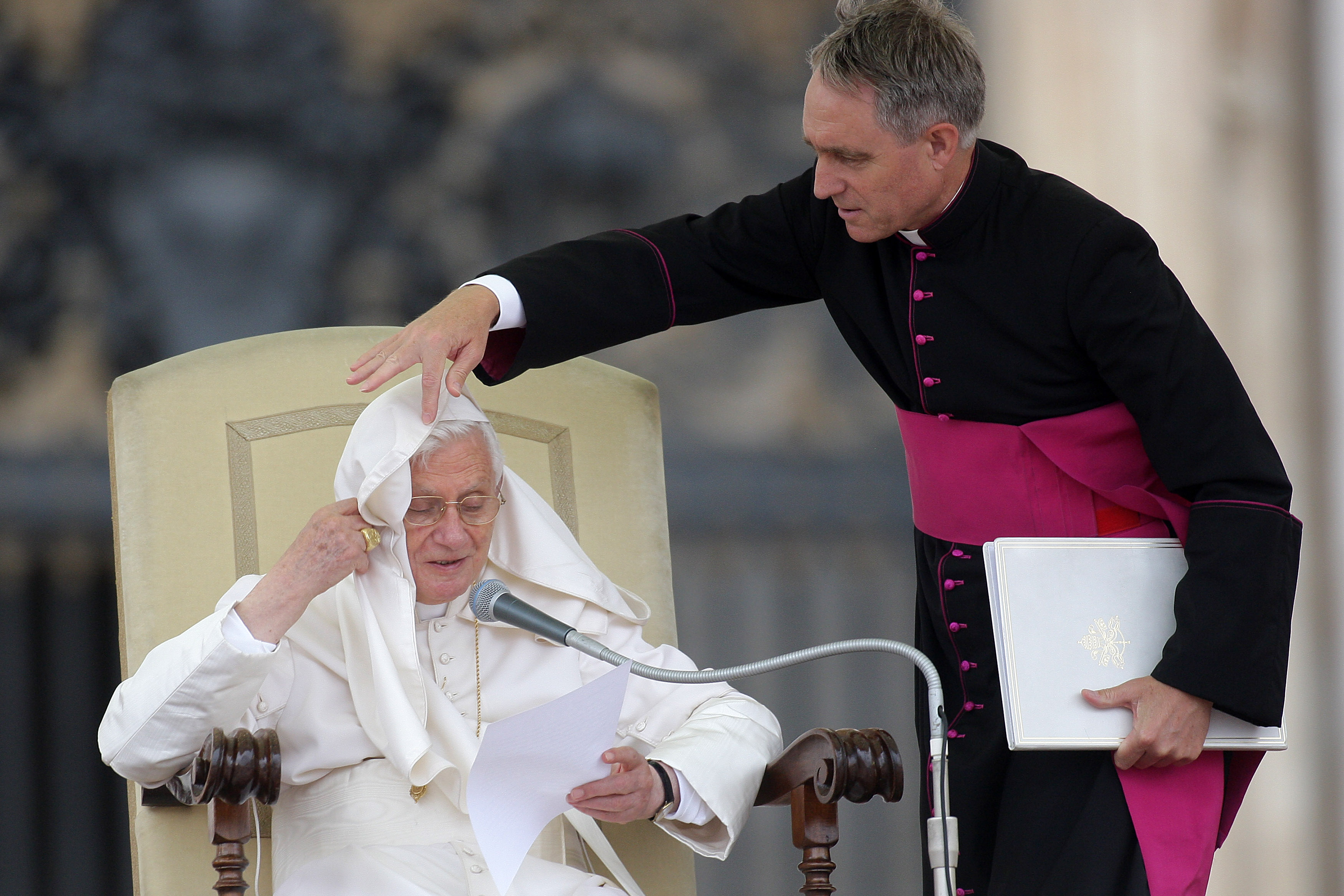
Benedict’s trusted secretary, Monsignor Georg Gänswein, will be serving both pontiffs — living with Benedict at the monastery inside the Vatican and keeping his day job as prefect of the new pope’s household. Asked about the potential conflicts, Lombardi was defensive, saying the decisions had been clearly reasoned and were likely chosen for the sake of simplicity. “I believe it was well thought out,” he said.

So Benedict’s handsome male companion will continue to live with him, while working for the other Pope during the day. Are we supposed to think that’s, well, a normal arrangement? I wrote a while back about Gänswein’s intense relationship with Ratzinger, while noting Colm Toibin’s review of Angelo Quattrochi’s exploration of Benedict, “Is The Pope Gay?”. Here’s Toibin getting to some interesting stuff:

Gänswein is remarkably handsome, a cross between George Clooney and Hugh Grant, but, in a way, more beautiful than either. In a radio interview Gänswein described a day in his life and the life of Ratzinger, now that he is pope:

The pope’s day begins with the seven o’clock Mass, then he says prayers with his breviary, followed by a period of silent contemplation before our Lord. Then we have breakfast together, and so I begin the day’s work by going through the correspondence. Then I exchange ideas with the Holy Father, then I accompany him to the ‘Second Loggia’ for the private midday audiences. Then we have lunch together; after the meal we go for a little walk before taking a nap. In the afternoon I again take care of the correspondence. I take the most important stuff which needs his signature to the Holy Father.

When asked if he felt nervous in the presence of the Holy Father, Gänswein replied that he sometimes did and added: ‘But it is also true that the fact of meeting each other and being together on a daily basis creates a sense of “familiarity”, which makes you feel less nervous. But obviously I know who the Holy Father is and so I know how to behave appropriately. There are always some situations, however, when the heart beats a little stronger than usual.’

This man – clearly in some kind of love with Ratzinger (and vice-versa) will now be working for the new Pope as secretary in the day and spending the nights with the Pope Emeritus. This is not the Vatican. It’s Melrose Place.

(Photo: the Pope’s personal secretary Georg Ganswein adjusts Pope Benedict XVI’s cloak during the weekly audience in St. Peter’s Square on September 26, 2012 in Vatican City, Vatican. By Franco Origlia/Getty Images)