Mary Kaye Schilling interviewed Steven Soderbergh, who is quitting the film business when he turns 50. What he’s learned over his 24-year career:
One thing I do know from making art is that ideology is the enemy of problem-solving. Nobody sits on a film set and says, “No, you can’t use green-screen VFX to solve that because I’m Catholic.” There’s no place for that, and that’s why I’ve stopped being embarrassed about being in the entertainment industry, because I’m surrounded by intelligent people who solve problems quickly and efficiently, primarily because issues of ideology don’t enter into the conversation. …
I look at Hurricane Katrina, and I think if four days before landfall you gave a movie studio autonomy and a 100th of the billions the government spent on that disaster, and told them, “Lock this place down and get everyone taken care of,” we wouldn’t be using that disaster as an example of what not to do. A big movie involves clothing, feeding, and moving thousands of people around the world on a tight schedule. Problems are solved creatively and efficiently within a budget, or your ass is out of work. So when I look at what’s going on in the government, the gridlock, I think, Wow, that’s a really inefficient way to run a railroad. The government can’t solve problems because the two parties are so wedded to their opposing ideas that they can’t move. … That’s how art works. You steal from everything.
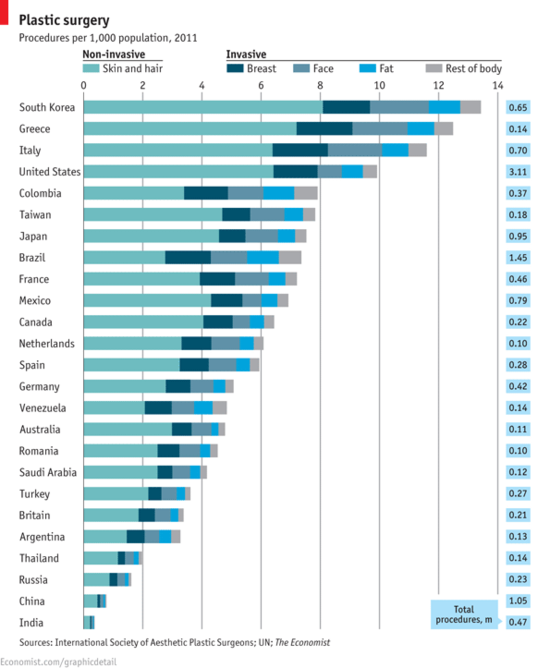
The Economistsurveys plastic surgery around the globe:
Non-invasive treatments to plump out wrinkles, smooth lines and remove hair account for more than half of all procedures: over 3m of these are for botox alone. America is home to more cosmetic enhancement than anywhere else, but accounting for population reveals a different story. On that measure, more primping and preening goes on in South Korea, Greece and Italy, as the chart below shows. The most popular invasive (ie, surgical) operation is fat removal, or lipoplasty, reflecting a growing problem for a fattening world. Breast augmentation, the second biggest surgical procedure, is most commonly performed in America and Brazil. Buttock implants are also a Brazilian specialty, as is vaginal rejuvenation.
In the latest issue of Archives of Sexual Behavior, economist Andrew Francis credits the end of syphilis with spurring the Sexual Revolution. Kate Shaw reviews his theory:
In the early 20th century, syphilis was a dangerous sexually transmitted disease without a particularly effective treatment. As of the mid-1940s, more than 600,000 Americans had recently contracted the disease, and the probability that a random sexual partner would have syphilis was more than 1 in 100. But in 1943, penicillin was found to be an effective treatment for syphilis. Infection and death rates from the disease fell sharply, reaching a low in 1957.
Francis noted that “historical syphilis trends very closely mimic the AIDS epidemic of the last few decades:
The rate of syphilis deaths in 1939 was nearly as high as the rate of AIDS deaths in 1995, and the two diseases accounted for roughly the same percentage of deaths in those years. Additionally, studies suggest that a similar increase in risky sexual behavior may have occurred after the development of an AIDS treatment plan, the “highly active antiretroviral therapy.”
The author’s conclusion: using economic principles to understand how the costs of syphilis, AIDS, and other sexually transmitted diseases affect behavior may improve decisions about health policy during future epidemics.
David Roberts argues that both Sunstein and Salam are failing to “[grapple] with climate situation as we now understand it”:
[This is] the response to the sophisticated objection: The U.S. must act because all people have a moral obligation to act. We have no guarantee that if we act, others will act; we have no guarantee that if everyone acts, it will be enough. But inaction is not a choice. If the danger were an invading army from another planet or a raging global pandemic, we wouldn’t be having these arguments. The need for everyone to act would be obvious. Quibbles over who acts first, or who benefits most from the planet not being invaded, or how to avoid spending “too much” to avoid being annihilated would rightly be seen as verging on sociopathic. Everyone would be eager to act, despite having no certainty of success, because the alternative is simply unacceptable. …
There was a time, not that long ago, when America took pride in leading the world against such dangers. Where is that pride now?
Rob Beschizza flags a compilation of vanity plates banned in various states:
Government Attic queried various states for their lists of forbidden license plates, and has begun posting the results. The most striking quality of the lists are their sheer size: states ban words with wild abandon, from misspelled swear words (COKK, banned in Ark.) to French drinks (COGNAC, unacceptable in Az.) and network engineer humor (FTPLOL, no go in D.C.), including countless variations.
Megan Garber assesses how Internet-speak has infiltrated our plates:
One reason for all this word-banning excess, presumably, is that digital communication — texting, gchatting, emailing — has unleashed unto the world a whole new lexicon of license-plate-brief words and expressions. “ROFLMAO” is a helpful abbreviation both for a chat window and a letter-limited license plate. As a result of which, it is now banned in Arizona. So is “LOLWTF.” And D.C. has banned, more obscurely but perhaps more revealingly, “FAQH8RS.” Txtspk has opened our minds, it seems, to the linguistic power of cheekily abbreviated suggestion: Because of it, we now have new portmanteaus and new acronyms and new ways, in general, to be subversive. “ASSMAN” is for amateurs. In 2013, we have “GR8D8B8.” Or, we would if it the government hadn’t banned it.
Friday on the Dish, Andrew commiserated with Beinart over the mess of yesterday’s Hagel hearing, in which two particular countries loomed large. After revisiting the enigmatic sexuality of New York titan Ed Koch, he approved of the administration’s new bridge between the ACA and religious freedom and observed both honesty and shrewdness in this week’s hearing on gun control. Finally, Andrew updated everyone on the Dish’s migration to its new home, which will open its doors on Monday.
On the political beat, we rounded up reax to the uptick in the jobless rate while Walter Kirn gave thought to the visceral feelings of Americans on either side of the gun debate and readers responded to Andrew’s pro-life argument for gun-control. Lisa Wade broke down the skewered racial demographics of private prisons while Ivory Toldson questioned the foundations of the latest theory on race and achievement. Suzy Khimm measured the length of immigration lines by nationality, Barro doubted that the GOP understands its disconnect from Latinos and we weighed the merits of wonky policy (which Ezra dutifully supplied later on).
Meanwhile, we picked apart the idea of a bona fide right to vote as readers continued to spar over the logic of the military draft system and kept sharing their complex personal connections with the American Boy Scouts. A Syrian activist outlined the anatomy of a revolution, Mitchell Prothero flipped through TV guide with Hezbollah, and Barry Strauss pondered the enduring wisdom of Rome’s greatest republican.
In assorted coverage, Michael Moynihan called for a moratorium on hackneyed journo-buzzwords, Freddie instructed Matt Lewis on his twitter-troubles and Jonathan Matthews raised an eyebrow at the mea culpa of the anti-GM superstar. Ira Glass coached the anxious aspiring artists among us, Forrest Wickman said a good word for Ms. Anne Hathaway, and we surveyed the sloppy research scattered through Zero Dark Thirty. Amy Webb spared no effort to find the perfect partner online, while Miranda Lin grappled with others’ expectations about her own heritage and identity.
Ross Andersen investigated the morals of using mind-altering “love pills,” while Linda Holmes tried to put a stop to snobbery. We lost ourselves in the urban organism that is New York for the MHB, struggled to see through a frosty frame in St. Paul, Minnesota, and one Kashmiri girl shined amid and Islamic celebration for the Face of the Day.
–B.J.
The rest of the week after the jump:
Thursday on the Dish, Andrew reframed the gun-control debate to give some meaning to the term “pro-life.” He meditated on the role of language in our attitudes on immigration, rebutted Douthat on the origins of America’s liberal sexual mores, and laughed off more of the stale arguments for DOMA. Andrew also recoiled at the nasty desperation of the anti-Hagelians, scoffed at McCain’s and Butters’ performance in today’s confirmation hearing, and shook his head at Hagel’s own flip-flop toward the hawkish line. He glimpsed the sketchier side of the Boy Scouts’ founder and dismissed the pseudo-cultural criticism of Breitbart’s disciples.
Andrew also answered more questions from readers about the new, ad-free Dish coming Monday, whose subscriptions have been gaining momentum lately (a trend you can contribute to here.)
In political coverage, Larison gauged Rubio’s angle in the push for immigration reform, Barro tracked GOP maneuverings on gay marriage, and we asked whether the Republicans can pacify their Tea Party caucus. A reader made the case for keeping the military’s draft program as Ilya Somin reviewed the legal history of the male-only system. Amanda Marcotte fumed over a conservative organization of pro-gun gals while Ackerman profiled the typical American mass murderer. Jacob Sullum parsed a new poll on America’s anti-prohibition majority and readers stayed on top of the unfolding Boy Scouts ban on gay membership. Meanwhile, Laura Seay colored herself unimpressed by the media’s Mali analysis, we worried about the simmering tensions in the China seas, and Eli Valley gave a crash course on real anti-Semitism.
In miscellanea, Mark Oppenheimer mapped his road back to pot smoking now that he’s a father, Eli Lake had second thoughts about his beloved e-cigarettes, and E.D. Hirsch contended that building vocabulary is the key to fostering literary youngsters. We listened to the moving story of a reader who refused to conceal his HIV+ status and assessed Netflix’s business model of instant gratification. Elsewhere, we wondered if algorithms could put fact-checkers out of business and fancied slapping our smartphones onto our wrists.
We showcased anthem for the nutritionally challenged in the MHB, watched the sun come out in Long Beach, California, and made eye-contact with an Israeli boy who breathed behind a gas mask in the Face of the Day.
(By Emmanuel Dunand/AFP/Getty Images.)
Wednesday on the Dish, Andrew counted up the dividends of reality brought on by Obama’s re-election, and crossed his fingers for a fresh wave of rationality from American right. He scrutinized Obama’s pitiless border policy in his first term, read some unimpressive excerpts from the legal defense of DOMA, and spoke up in defense of public nudity (in San Francisco, mainly.) Elswhere, Andrew sat down to answer reader queries on Dish health care and its relation to the ACA, and thanked subscribers to the new Dish for the $500k received so far (which you can add to here.)
On the political beat, we collected feedback on the economy’s poor showing last quarter, readers reported on the crumbling of the Boy Scouts’ ban on gay membership, and we paid a visit to the pitiful courtroom antics at Guantanamo Bay. We heard some uplifting news about the safety of Mali’s cultural artifacts, while Gordon Adams decried the US military’s new interest in horning in on Africa. Plumer faced the fact that China and India won’t make future climate policy easy, Ramesh called off the conservative offensive on the president, and Goldblog got real about the far right in Israel—very real. Meanwhile, a heretical Free Republic poster earned an Yglesias Award nomination, joining former RNC chair Jim Gilmore.
In assorted coverage, Evelyn Lamb searched for a better way for journos to communicate science and stats, while Priscilla Long provided some on not-so-identical twins and Joseph Stromberg offered some on the relation between depression and homosexuality. Jesse Lichetenstein penned a sprawling portrait of the Post Office, Mike Dash visited the family time forgot, and Alyssa Rosenberg attended Ai Weiwei’s latest show. Jonathan Evans reported on Denmark’s splitting hairs on gender equality, Burton Pike waved goodbye to the days of artful translation and we explored the feelings of helplessness under the flash of cameras.
Readers fileted David Mamet’s latest blathering on gun control, continued to search for an truly internationalist fast food spot, and set off an avalanche of emails on John H. Richardson’s ode to promiscuity. Others pushed back on suspicions about the NFL’s regard for players’ health, while Rhys Southan responded to Dishheads critical of his essay on veganism. We saw a stark white Park Rapids, Minnesota for the VFYW and awed at the movements of starlings in the MHB. A Chicago radio station’s cool ad asked its listeners to go forth and multiply, and we caught a close look at a bubbly clown in the Face of the Day.
Tuesday on the Dish, Andrew declared the status of same sex couples to be an essential part of now-tangible immigration reform. He mulled over Gerald Scarfe’s controversial cartoon on Netanyahu, and demanded that Fox News (and MSNBC) accept the consequences of peddling propaganda. He and Chait rolled their eyes at Free Beacon’s latest nonsensical screed against Chris Hughes and TNR, wished the Palins all the best in the land of political obscurity, and sighed as Tom Tancredo went back on his promise to smoke, and, what’s more, inhale.
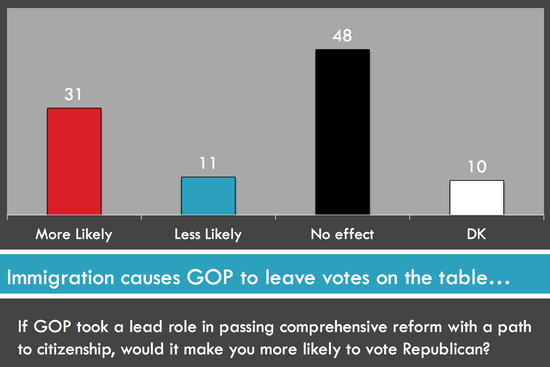
In other political coverage, we suspected that immigration reform will do the GOP itself more harm than good: Harry Enten observed that shifting Latino attitudes wouldn’t affect many too swing states, and Pareene measured serious potential for a rightwing revolt agains any reform at all. Debate broke out at The American Conservative over Obama’s foreign policy credentials as Drum summed up the root of the president’s pragmatism abroad. We sifted through the wreckage of Timbuktu’s library, destroyed by the Malian jihadists, Evan Osnos spied a gulag map on Google Maps, and we anticipated the next debate over women in the military.
Elsewhere, Erick Erickson shared some intriguing personal details as he departed CNN, Danny Hayes noted that the media improved its attention span after the Newtown shooting, while Joe Romm called out George Will for once again muddying climate data. We considered the prosecution of juvenile killers, in light of a tale of gruesome homicide, Naomi Rovnick pulled back the curtain on factory audits in China, and Antigua had a shot at sidestepping copyright.
In assorted news and views, Seth Fischer wrote a dispatch from a world of personal trauma, John H. Richardson appointed promiscuity as a new holy virtue, and Daniel Altman refuted Pixar’s vision of the End of History. Readers sounded off on setbacks to their youthful ambition, Wayne Curtis strapped on jackboots for a tutorial on goose-stepping, and we encountered Ed Kilgore’s alter ego, in name only (Andrew’s, too).
Alison Motluck pointed out a snag in the way we practice fertility medicine, Ta-Nehisi pointed to some unsettling facts about the NFL, and we continued to search for a signal on plans for better Amtrak Wifi. We stared out at a white Vista Verde Ranch in Colorado for the VFYW, met an incoming American in the Face of the Day, and set the millennial generation to music in the MHB. Finally, readers managed to spot Winooski, Vermont in the latest VFYW contest (to Andrew’s great delight).
Monday on the Dish, Andrew piled on David Mamet for his veil of ignorance regarding guns, crime and Hobbes. He took the temperature of America’s economy with Bartlett and Collender, sized up Obama’s (mostly) conservative foreign-policy credentials and noticed a Dish shout-out da Italia. Meanwhile, Andrew asked for some transparency from the anti-Hagel crowd, remained diligent in holding Aaron Swartz’s prosecutor accountable, and chuckled at Kinsley’s quips from his new perch at TNR.
In political coverage, we rounded up commentary on the GOP’s immigration strategy, Drum counted the moments left to get it done, and Ezra Klein broke down the politics of the notorious sequester. While Pete Wehner garnered an Yglesias Award nod for his repudiation of Gingrichism, we witnessed the American workday drive down family time. Elsewhere, we continued dissecting poetry in the age of Obama, highlighted a heart-wrenching passage of Aaron Swartz’s tortured writings, and toured the dilapidated streets of Kabul.
In miscellanea, readers revisited the ethics of charging for obituaries, the discontents of Amtrak Wifi, as well as the merits of online dating. Tim Maly explored stealth chic as Heather Horn revealed the age-old jealousy of artistic prodigies. Robert Krulwich measured our lifelines, Brad Leithauser sung the praises of memorizing verse, and David Carr resurrected Kenny in his report on Matt and Trey. While Emily Anthes opposed circumcision of pooches’ tails, Jeb Boniakowski hankered for a more cosmopolitan Big Mac.
We turned on, tuned in, and dropped out with the Beav during the MHB, glanced at a crisp, clear morning in Boston, Massachusetts for the VFYW, and met a Westminster hopeful in the Face of the Day.
Last weekend on the Dish, Andrew talked testosterone, cast a skeptical glance at American interventions abroad, offered an update on the Obama-as-liberal-Reagan thread, ruminated on Christianity’s non-violent core, and reminded readers about the reasons for Dish independence.
We also provided our typical mix of religious, books, and cultural coverage. In matters of faith, doubt, and philosophy, Gary Gutting defended faith without knowledge, Christian Wiman meditated on suffering, and Karen Swallow Prior reframed the debate about the decline of the religious novel. Peter Berger considered the reasons for the culture wars, Morgan Meis complicated what it means to be a Luddite, Alice Gregory panned a new book about friendship, and Lisa Guenther taught Plato to death-row inmates.
In literary and arts coverage, Natalie Shapero turned to Thornton Wilder’s Our Town to understand the writer’s love life, scientists found that we hear even while reading silently, and J.L. Wall feared the death of the bookstore would limit exposure to the classics. An animated grammar lesson taught us about the proper use of possessives, John Walsh argued that the intersection of romance and class distinctions was part of Pride and Prejudice‘s appeal, and Gordon Marsden hailed Burke and Orwell as prophets. Tim Parks made a paradoxical case for the grammar police, Freya Johnston mused on the source of English sadness, and Johnny Cash sang for prison reform. Molly Erman test-drove Instagram as a dating service, John J. Ross recountedthe medical lives of our favorite writers, and Mark O’Connell explored the art of the epic fail. Read Saturday’s poem here and Sunday’s here.
In assorted news and views, Christopher Benfey investigated our complicated relationship to wolves, Nathaniel Rich reported on the physical toll depth-diving takes on humans, and Ed Glaeser outlined the GOP’s urban problem. Christopher Jobson noticed a philanthropic forger, Gary Wills reflected on the self-defeating South, and Jennifer Senior unpacked the science behind high school madness. Melissa Gira Grant tore into our shameful war on prostitution, Steve Martin downplayed the chances of the opium’s resurgence, Soraya Roberts related the difficulties of being a non-drinker, and James Hamblin explained why you might want to skip that nightcap.
After a series of bad dates following a major heartbreak, mathematically-driven Amy decided to take a quantitative approach to the playing field and started systematically recording various data points about her dates, revealing some important correlations. After one particularly bad date, she decided to formalize the exercise and wrote down everything that was important to her in a mate — from intellectual overlap to acceptable amount of body hair — eventually coming up with 72 attributes that she was going to demand in any future date. She then broke down these attributes into two tiers and developed a scoring system, assigning specific points to each. For 700 out of a maximum possible 1800, she’d agree to have an email exchange; for 900, she’d go on a date; for 1,500, she’d consider a long-term relationship.
It worked: Webb is now married with a daughter. In an interview with Sam Blum, Webb describes how her data-driven approach went “a little overboard” when it came to raising her kid:
[My husband and I] were tracking all possible data. It went way beyond poop. We were trying to figure out when she was most attentive so that we could occupy her – flash cards, me playing piano with her. By her six month visit, we asked her doctor to give her a grade, so that we knew whether or not we were making good progress. He gave her an A, and he gave us a C-. He told us to put the binder away and to stop making scatter plots of her … well, of her everything.
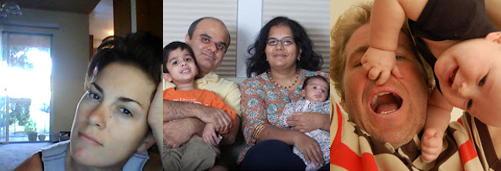
Born and raised by in Canada, Miranda Lin struggles with identity in the land of her ancestors:
I know I look Chinese. Before I came to China, I thought it was because I was Chinese. It had never occurred to me that holding a foreign passport disqualified me from that birthright. But for Chinese people—those whose government papers match their face—race, language, culture, and nationality are inextricably intertwined. … Lacking the necessary “Chinese” mix made me as foreign, and possibly even more alien, than the blond-haired, blue-eyed creatures instantly recognized as “other.”
Ironically, just as my Chinese looks cause much consternation among locals, it causes indifference among the countrymen I psychically reach for. I disappear in the crowd: just another Chinese face in the sea of presumed strangers. The camaraderie shared among foreigners—the exchanges of knowing glances or sympathetic smiles that say, “I feel the same way; I’m there with you”—eludes me. Instead, with over-enunciated enthusiasm, I have repeatedly been told, “Your English is so good.”
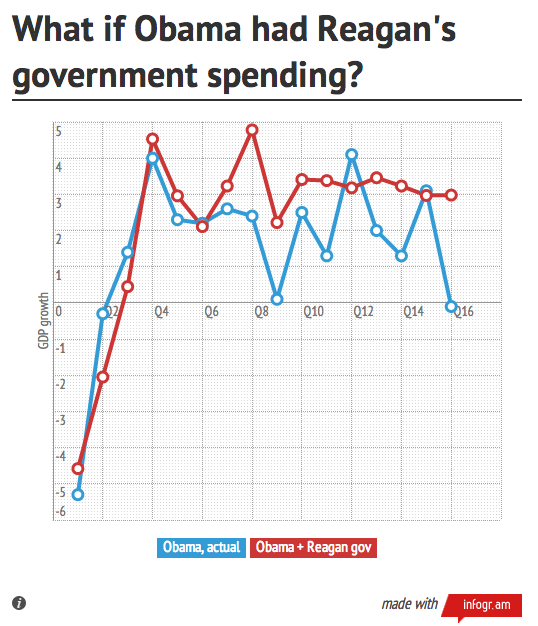
Ezra Klein compares spending under Obama to spending under Reagan and Dubya:
[T]hese graphs simply establish a basic fact about Obama’s term: While deficits have indeed been high, government spending and investment has been falling since 2010. This is, in recent presidential administrations, a simply unprecedented response to a recession. Just for fun, I took Obama’s GDP growth, netted out the effect of government spending and investment, and then added the total government spending and investment numbers — which include state and local government — from Reagan’s first term. The result is a significantly better economy, with growth since 2010 averaging 3.2 percent rather than 2.4 percent.
Contesting Mark Lynas’ status as a “long-time opponent of GM crops,” Jonathan Matthews views Lynas’ recent “turnaround” on GM crops as primarily a PR narrative:
As Mark Tercek says of the man who once shoved a cream pie in the face of Bjorn Lomborg and made sure he had a film crew on hand to record it, ‘Lynas has a knack for the dramatic.’ He is also a compelling story teller. And these elements seem to be at play in his mea culpa. Many people watching the speech have formed the impression that this is an extraordinary moment in which Mark Lynas finally confronts his past as a protester and founder of the anti-GM movement, leading to his heartfelt apology. But, as we have seen, Lynas was not only not a founder but he has been speaking and writing about his change of heart on GM, including apologizing for his past, for years.


 The Dish