What The Hell Just Happened In Italy?

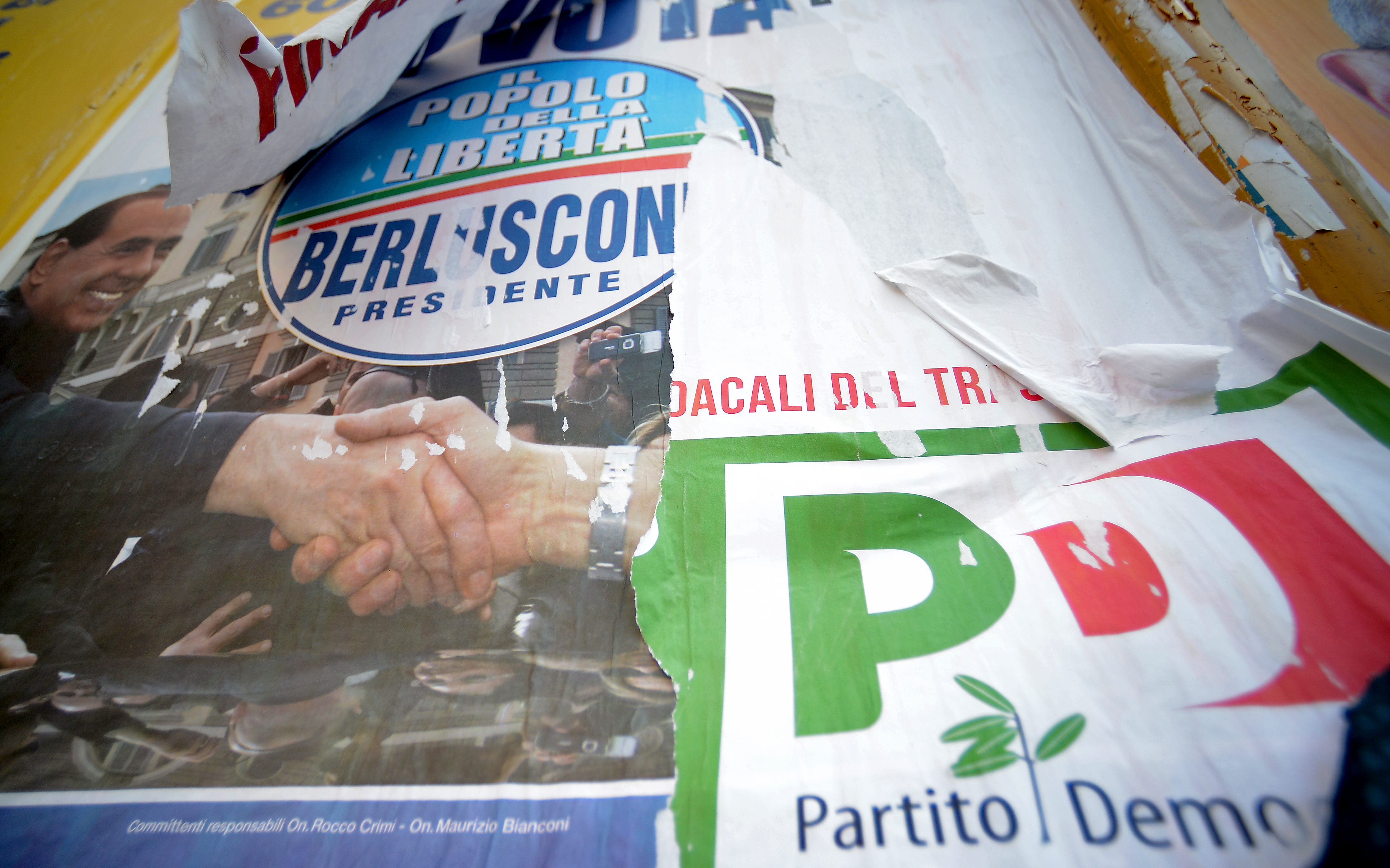
ITALY-VOTE-PLACARDS

This week’s general election has produced the country’s first-ever hung parliament, and the news wreaked havoc on world markets as fears rose of a new Eurozone crisis taking hold. Ryan McCarthy sets the scene:

This has been an election which featured an ex-prime minister who’s about to face trial for allegedly having sex with an underage night-club dancer and who was sentenced to four years in prison for tax evasion; a comedian running on an “antisystem” message; and Mario Monti, the country’s current prime minister, whose campaign a rival compared to a coma, and whose alliance is set to finish in fourth place.

As one Italian newspaper put it this morning: “The winner is: Ingovernability”. Barbie Latza Nadeau explains:

Pier Luigi Bersani’s [four-party] center-left coalition narrowly won in the lower house of parliament and will benefit by an automatic winner’s bonus of 54 percent of the house seats, but he barely eked out a win in the Italian senate, where it counts. There, the divisions are based on regions, and his win does not translate to a majority. His chief nemesis, Silvio Berlusconi, who rose from the ashes of a scandalous resignation in November 2011, was able to steer his center-right coalition to within a hair of the majority, but with no willing partners to help him reach the threshold.

Meanwhile, the anti-establishment “5-Star Movement” organized by comedian and blogger Beppe Grillo grabbed 25% of the vote in Italy’s lower house – more than any other party – as well as 23% of the vote in the country’s Senate. Grillo and his supporters have now earned an apparent kingmaker role for which, as Gavin Hewitt notes, they appear to want no part:

Mr Grillo has tapped into a mood of anger and resentment. He never gave a single interview to Italian TV and yet has nearly 170 seats. The country is in deep recession. Unemployment is rising and industrial production is at its lowest level since the 1990s. Mr Grillo raged against corruption, against budget cuts, against austerity and promised to hold a referendum on continued membership of the euro. He promised “a tsunami” and he delivered. His MPs are young, unproven and without political experience. … One unanswered question is whether Beppe Grillo will be open to a deal. Would his movement support, say, a centre-left coalition in exchange for widespread reforms of the political system? We don’t know. Buoyed up by success he has only promised to clear out the political class.

In fact, Grillo has has maintained his party would not join any coalition, though it would consider proposals on a “law by law, reform by reform” basis. For his part, Silvio Berlusconi has floated the idea of a grand coalition between his center-right coalition and the center-left. Douglas J. Elliot sees that as the most-likely possible solution to the gridlock, though not without its risks:

It would be unstable despite holding a clear majority of seats in both houses, because the views and interests of Berlusconi and the Center-Left only partially overlap. Further, the Democratic Party is fairly committed to continuing on the economic path agreed with its European partners, while Berlusconi campaigned on the idea of rejecting that path. Finding a set of policies that both groups could support and that would not trigger a rupture with Germany and Brussels, spooking the markets, will be difficult.

Joe Weisenthal points to austerity as the primary motivator in the election:

Voters hate austerity. And voters hate when their own politicians are taking their cues from an institution like the European Central Bank, rather than basing decisions on domestic needs. And that’s the phenomenon that came home to roost last night. The political parties seen as continuing along the existing ECB-preferred path did badly. The rebellion voters (Silvio Berlusconi and populist Beppe Grillo) did much better than expected. And this has the potential to undermine all of the progress made in Europe over the past several months.

Indeed 57% of the Italian electorate voted for anti-austerity parties. Nigel Cassidy indicates this sentiment could signal problems for other austerity-besieged countries like Ireland and Portugal. And he sees little hope for Italy:

As things stand, Italy’s economy is still shrinking and its debt is forecast to rise to 128% of GDP by the end of this year. Both the Silvio Berlusconi and Beppe Grillo political camps opposed some of the tax hikes and public spending cuts instituted by Mr Monti. Yet, even if some of these cuts were reversed, it seems doubtful that an economy that has hardly grown in two decades could be turned around anytime soon. Reversing the most recent reforms would also signal that the new government was unwilling or unable to deal with fundamental economic problems. This in itself could lead to spiralling bond yields and the flight of capital invested in Italy could resume. The Five Star Party’s avowed opposition to eurozone fiscal convergence might also slow future progress on banking union and other financial reforms.

(Photo: Ripped off electoral placards showing the Democratic Party (PD) logo and right-wing Silvio Berlusconi (L) are displayed on a wall in Rome on February 26, 2013. By Filippo Monteforte/AFP/Getty Images)

Bach To The Future, Ctd

A reader writes:

I’m a part-time musician, and I consider myself pretty fussy about sound quality, but I can’t tell you how tiresome I find these digital music Luddites and vinyl purists.  The only time anyone (including those with Golden Ears) can detect the “lower sound quality” is when they are sitting in front of a high-end stereo in a good-sounding room.  Not in the car, not while cooking dinner, not at a party.  The places that most people listen to most music doesn’t lend itself to detecting minuscule effects. Digital music has made the listening experience dramatically better for nearly everybody, and those who find it a step backward can still buy vinyl and four- figure turntables if they wish.

Another:

I have to disagree with the assertion that sound quality is going down, and that live, in-person concerts are superior.  I’m a decently musical guy who listens to a lot of classical music, and I thoroughly enjoy going to a classical concert.  But I would never say that the listening experience qua listening experience is better (I’m not talking about live pop/rock/etc concerts).  If I just want to listen to music, I’d prefer even my little iPhone ear buds to being in a concert hall.  There, you have to put up with coughing and sneezing, with people talking, rustling, shifting, and applauding at the wrong places.  Or (and this might be a L.A. thing) you get people who are there not because they like the music but because they like events – they like the concept of being at the symphony.  I can’t stand those people.  I listened to some terrible soprano shriek her way through Bach’s Cantata 51 and the woman beside me lept to her feet in rapturous applause for a performance for which I wanted my money back.

If I really want to deeply listen to something, my iPod/iPhone and a pair of headphone is all I need – jack the volume way up so I feel immersed in the sound.  You just never get that at live concerts.  And I’ll take any marginal loss in sound fidelity in exchange for no lay people sneezing and coughing and shifting around me.

Another:

As a classical musician who has worked for the last 36 years in symphony and opera orchestras, I would like to weigh in on whether old ways of listening are obsolete. I had a rather unpleasant argument with my boyfriend, which actually lead to the beginning of the end of our relationship.

He is a guy who loves technological wizardry, and was asking my opinion about the relative merits of some €12000 loudspeakers compared to some €6000 loudspeakers. My answer was that it didn’t really matter; all I needed was a satisfactory sound quality and my needs would be met. When he asked me why I had such a low bar for listening to music, I reminded him that we were only talking about recordings, which have their place, but that real music is the act of a human being creating music in the presence of other human beings, and that no matter how expensive the speakers, we were still only talking about a recording, which would never be (for me) a truly musical experience.

There followed a somewhat heated give and take about whether a fine recording is a better musical experience than a less-polished live performance, and after trying to get my point across, without success, I finally gave an example which probably crossed the line, but made my point. I asked him if he would make love to Brad Pitt’s dead body. In the silence that ensued, I told him that no matter how beautiful the body was, no matter how perfect, the body could not make love back to him. We musicians who still work in the world of live, unamplified music know that the energy that we stream to the audience is returned to us in an intense simultaneous interchange, an intimate human experience that can not happen with a recording, no matter how perfect.

I am the first to recognise the value of recordings in making all kinds of music available to all kinds of people, but a musician would never mistake one experience for the other. It saddens me that the majority of listeners today are content with their earphones, and don’t even know the the world they are missing.

Another would agree:

No, there is no substitute for live music: Live streaming or telecasts are not the same, nor are live recordings.  And I absolutely agree with Stefan Kanfer – it does not matter if we are talking about a large or a small venue, rock or jazz or classical music.

I was a casual fan of Pearl Jam until I saw them live.  In the space of two or three hours, I went from “Hey, those guys are pretty good!” to “I cannot believe I waited so long to see them live! Maybe if I hustle I can get tickets to every remaining show on their tour!”  The same can be said of classical music: I studiously avoided Mahler until my son showed a passion for music.  Being in Avery Fisher Hall when Alan Gilbert and everyone in the audience quite literally leapt into the air at the end of Mahler’s Fifth Symphony changed all that – what a rush!  No recording could have grabbed my interest and drawn me in like that.

I hope that our ever-advancing technology – and I do love it, my iPod is in so many ways superior to my first Walkman or my not-really-portable Discman – does not kill the concert-going experience.  I’m already watching in dismay as orchestras add “tweet seats” for customers who apparently just cannot bear the thought of turning off their phones and listening to the music they paid to hear.

No More Phoning It In

Yahoo recently distributed a memo prohibiting employees from working from home. Derek Thompson reviews the evidence and concludes that the policy might be misguided:

It’s understandable for executives to want to build an atmosphere where the office becomes a destination, a place where workers want to come together, where ideas percolate and bounce around an office and end up on a memo in the director’s inbox that becomes a Hot New Thing. But these reasonable arguments for building a dense and collaborative workplace culture should be weighed against the preponderance of statistical evidence, which suggests that (1) sometimes people just like to work from home for a change, and (2) they’re really good at it.

A former Yahoo employee with a different view:

For what it’s worth, I support the no working form home rule. There’s a ton of abuse of that at Yahoo. Something specific to the company.

Katie J.M. Baker criticizes the move:

[W]hat about the people — single parents, working mothers, employees with ill family members — who require a certain amount of flexibility? It’s doubtful that Mayer, who famously pooh-poohed maternity leave, really cares. According to Business Insider, Mayer might be making this move because “she knows that some remote workers won’t want to start coming into the office and so they will quit. That helps Yahoo, which needs to cut costs.”

The Shrinking Workforce

Douthat worries about it:

The non-employed working age Americans of the 1950s were mostly married women with wage-earning partners and children at home, with meant that they were members of income-producing economic units and embedded in strong social networks even if they weren’t holding down a 9-5 job. If today’s shrinking employment-to-population ratio were mostly a post-feminist variation on that theme, driven by a combination of married men staying home with the kids while their wives work and professional women taking time off during their prime childbearing years, then it would be less troubling that what we’re seeing today. But instead today’s decline in work is concentrated among the unmarried and less-educated — populations, that is, that tend to lack precisely the sources of social capital and economic advancement that participation in an even a low-paying job can help supply.

So while a decline in workforce participation is not inherently problematic, the fact that it’s happening among people who lack other sources of community and other means of socioeconomic ascent means that it’s more likely to compound existing trends toward stratification and atomization, hardening the lines of class and making individual lives unhappier even if the economic pie continues to grow.

Against “The Good Old Days”

Amber Forcey uses Flannery O’Connor’s famous short story, “A Good Man is Hard to Find,” to critique the concept:

Essentially, a “good old days” response to the problems of our time is a form of blind self-righteousness, an attitude that says we and our time (or the time we yearn after) would have never committed the same errors of the present age; people were at one time good (or polite, kind, safe, etc.), but no longer.

However, as Christians, we cannot accept this attitude. First of all, we must continually be aware of and preaching that since the Fall, all men are broken and evil, from all times and places. The pendulum of culture and civilization swings from one extreme to another, but each time, each era and century and decade, has its flaws, most of which are unrecognized by those within it. As believers, we must do the work of first reminding ourselves of our own personal and cultural brokenness (both in the present and the past) and of working to make ourselves aware of the real vices of our own age, vices which we are most likely unaware of. Second, we must work to rid ourselves of this subtle and dangerous form of self-righteousness, one that masks itself in fuzzy nostalgia. We must recognize that all people, past and present, including (and especially) ourselves, are all Misfits in need of the only One who ever raised the dead.

When Climate Change Hurts Work

On hot and humid summer days, our bodies are less able to cool themselves due to the moisture in the air around us. Joseph Stromberg explains the impact this might have as the planet warms:

According to a study published yesterday in Nature Climate Change, increased heat and humidity has already reduced our species’ work capacity by 10% in the warmest months, and that figure could rise to 20% by 2050 and 60% by the year 2200, given current projections.

The Princeton research team behind the study, led by John Dunne, came to the finding by combining the latest data on global temperature and humidity over the past few decades with American military and industrial guidelines for how much work a person can safely do under environmental heat stress. …

[T]hinking about how the study defines “work” can lead to a troubling conclusion: in 2100, throughout much of the U.S., simply taking an extended walk outdoors might not be possible for many people. The economic impacts—in terms of construction and other fields that rely upon heavy manual labor—are another issue entirely. Climate change is certain to bring a wide range of unpleasant consequences, but the effect of humidity on a person’s ability to work could be the one that impacts daily life the most.

Lauren Morello provides some comparisons:

The combined heat and humidity in Washington, D.C., would be more stressful than conditions in today’s New Orleans. New Orleans, in turn, would experience more heat stress than Bahrain does now. And in Bahrain — an island in the Persian Gulf where temperatures already hit 120°F in summer months — heat stress would creep close to the limit that humans can endure for more than a few hours at a time.

Life And Death In The Ring, Ctd

A reader writes:

I’m a long time reader, but this is the first time I’ve felt compelled to write a response to one of your posts. Bullfighting is a subject I’m familiar with, but I find most Americans are not. An ethical option does exist.

My family is of Portuguese ancestry; specifically, my grandparents were all born in the Azores Islands, landing on American shores around a century ago. Most Azorean-Americans have settled in Massachusetts and Central California. I’m not certain about Massachusetts (maybe some Mass. readers will weigh in), but here in California you can find legal, Portuguese-style, “bloodless” bullfighting. You see, the Portuguese do not kill the bull. We actually find the blood sport of slaughtering the beast in the arena to be disgustingly cruel and wasteful. Portuguese bulls are put back to stud, where in the U.S. and the Azores they live the life of an average farm bull (and sometimes reused in the arena), and in mainland Portugal they’re pampered stud animals, with the best commanding the highest fees for their services. In fact, the bullfighting industry in Spain often uses Portuguese bulls for stud since they’ve wasted their own.

California bullfights are not allowed by law to spill a drop of blood, so a Velcro pad is placed over the bull’s shoulders where the Velcro tipped bandarilhas (small spears) attach. This is done primarily by cavaleiros or cavaleiras (horsemen or horsewomen) riding beautifully adorned horses skilled in dressage. In Portugal some blood is drawn this way since a small dart is stuck into the fatty hump between the bull’s shoulders (as pictured in your post). It looks messy, but it only serves to piss the bull off and make him all the more dangerous. Personally, I prefer the Portuguese-American Velcro method.

After the cavaleiros, traditional matadores finish tiring the beast out, and then it’s time for the most amusing part: forcados, or the “suicide squad” as we call them here in Central California.

Eight young men, usually in their late teens and early twenties, often slightly sauced-up on some liquid courage, line up single file facing the bull. It’s the job of the lucky first in line to coax the bull into charging where he takes the full force of the hit with a pega de cara (face plant), wrapping his arms around the horns and riding backward into his buddies who pile on. One will grab the tail, and often hands full of bullshit, while they all try to bring the animal to a full stop for a few seconds to declare victory. If they get scattered like bowling pins they were not successful, but they can lick their wounds and be happy they survived to risk their lives all over again at the next occasion.

Believe me, it’s the forcados who get injured, not the bull. A successful, but hard-fought, attempt in Portugal [seen above] here and very unsuccessful attempt in California here.

After the forcados spectacle is over, a small herd of cows is ushered into the arena so the bull will follow them out to his retirement. Many years ago, while I was attending a bullfight on the Azorean island of Terceira, one of the cows refused to leave, causing the matadores to run for cover. They were genuinely more afraid of a scrawny cow than they were an 1,100 to 1,600 pound, pissed-off, testosterone-pumped bull! I turned to my dad and asked why. He grinned at me and replied; “Cows don’t close their eyes when they charge.” It took men with shields and very long poles poking the cow in the forehead to get her to leave.

Animal rights activists who take issue with rodeos also take issue with bloodless bullfights. I respect their concerns about the well-being of the animal, but as Nusbaum mentioned, which life and death would be preferred? I’m sure many readers will disagree with me, and I may just be old fashioned and as enamored with my ancestral culture as those who support bull-killing are, but I can’t consider it inhumane to simply torment a huge (my father always claimed the head alone weighs around 300 pounds), dangerously aggressive beast for less than an hour when he’s going to live a life of leisure and copulation for many years to come.

The Tensions Of Tradition

Noah Millman contemplates the meaning of “liturgical conservatism,” arguing that “a living tradition is one that inspires a kind of passionate engagement” with a faith’s formalities:

There’s a tension in any modern person approaching a traditional liturgy, between two conflicting desires. On the one hand, there is the desire to say what you mean. Praying for, say, the restoration of animal sacrifice feels to a lot of people I know problematic – because they don’t want to see the Temple literally rebuilt and animal sacrifice restored (and, in fact, there’s rabbinic warrant for questioning whether the messianic age would really require such restoration). On the other hand, there is the desire to mean what you say, to have the words transform you by saying them. Praying for, say, the resurrection of the dead feels problematic to some people because it feels like a literal absurdity – but on another level, that’s precisely why you pray for such a thing, because it is an absurd hope.

Rejecting that kind of tension – resolving it neatly either by eliminating anything you don’t feel “comfortable” saying or by rejecting out of hand the possibility of emendation – strikes me as a spiritual mistake. It’s not true that our ancestors never changed anything, and if we act as though we have no right to change anything, we’re saying, in some sense, that we are a lesser sort of being. The implication is that the liturgy can’t mean for us what it meant for them – and that seems to me like a dangerous concession. By the same token, only somebody who doesn’t really care about the object of prayer would cavalierly make our own psychic “comfort” the proper standard by which to judge the adequacy of the liturgy.

Dreher adds:

Latin Mass Catholics, archconservatives who prize the pre-Vatican II liturgy, are probably outliers here. They are the ones who make us think that liturgical conservatism goes along with moral and cultural conservatism, but it’s just not true. It seems like it ought to be true, but somehow, it isn’t. In my experience, high-church Episcopalians tend to be quite liberal, but hold on to the more conservative liturgical practices because of their aesthetic beauty. When I lived in DC years ago, the most gay-friendly, liberal Episcopal parish was also the one known for having the most elaborate liturgies. Which makes its own kind of sense, if you think about it…