The Dish: Now Just $1.99 A Month! Ctd

199reax

As we promised from the beginning of the new venture, feedback from readers at every stage:

Something clicked for me with the rollout of your monthly payment option. I’ve been reading the Dish for a thousand years and it’s only now that I can treat it the way I treat NPR – something I depend on every day, but pay for every month. There’s something seriously satisfying about doling it out this way, and it turns out it’s not the free tote bag. I don’t know how many others will have this sort of reaction, but it was a sudden and beautiful solution to a problem I didn’t even know I had. And best of all, I can still feel that smug elitism that comes from knowing I’m one of those people paying for what all those freeloaders are getting for free.

The tote bag would help, though. You know. Just saying. If you have one around. Doesn’t have to be nice, I’m just going to use it for groceries. Just putting that out there.

On the full disclosure front, here’s the impact of adding the $1.99 option a month in the last week:

Screen shot 2013-03-28 at 12.53.43 PM

That suggests to me that we made the right call. We’ve shifted the daily revenue from the $1K range to $2K, and new subscribers from around 50 a day to around 100. That will surely go down in time, and may be distorted by a big news week – but it’s encouraging for now. Another reader:

I’d like to see an economist or finance analyst look at your monthly pricing, but my instinct is that you underpriced it by a dollar.

At $1.99, the person is paying just about the suggested subscription price.  Why bother to subscribe – you can graze forever and skip some months etc.  I understand you want to nudge people to start paying, but you need a little more pain.  At $2.99, the person is spending 50% more than a straight subscription, but the price is low enough to get someone to decide he or she might as well pay for the subscription. Those of us who bought subscriptions are also buying into the idea that you need to pay for web content that is high quality, edited, thoughtful etc.  Your pricing should reward the committed, not the grazers (but allow for grazing at a surcharge).

We like the simplicity of $19.99 a year or $1.99 a month (or more if you want to set your own price). Another:

Just read your $1.99 subscription post and it made me wonder if you have an option for us to give monthly/annual gift subscriptions? (I subscribed in February, so I don’t recall if that was an option.) In this day and age when so many of us have way too much stuff and we don’t need one more thing, I have found magazine/newspaper subscriptions to be terrific gifts.

Gifting is definitely in the works. Another:

I think if the Dish really wants to start doing long-form journalism and if you guys really want to be more ambitious you cannot rely on just reader support alone. At this point I would be honestly surprised if you managed to reach 900k by the end of the year. My question is, why don’t you just follow the model of Pandora.com or spotify? Have advertisements for the people who have not subscribed to the blog and none for those who have not subscribed. You’ll generate some revenue and it’s more then fair. The fact is the limit is easy to get around and how many newspapers or magazines have ever been fully supported just by readers? A reader support base is just too unstable to rely upon in the long term.

We have been thinking over that option as well. Another:

Wintery economic conditions, even at the $1.99 level (which I realize with a certain sober fright), have prevented me from joining the “New Model.” As an every day reader and supporter of e journalism with all it’s warts, I fully intend to hand over my money and will do so proudly once my financial outlook seems less dire.

But please STOP saying “this may not work.” As much as I appreciate your candor and humility, I think you often stay the hand with such statements. I wonder if I’m going to be the last dope who pays before the site winds up back on the Beast. Perhaps a little conviction? Burn that bridge. Take off those training wheels.

Or maybe you’d be better off not taking advice from someone who can’t find $1.99 a month to rub together.

Another:

I really don’t mean to show a lack of empathy for anyone out there, but I’m pretty shocked that any significant number of your readers – who in general are well-educated professionals on the average – can’t pony up $20 in cash for your site and need $1.99/month. If that is really the reason many aren’t subscribing, may I just say … budget? Check out www.youneedabudget.com for a great program. There’s no reason people shouldn’t be able to come up with $20 for something they want. We aren’t talking about a huge sum here: we’re talking about the price of 2 movie tickets.

(Full disclosure: I have not subscribed. But not because I can’t find the money, I’m still not convinced it’s worth my money right now. I’m sure there are readers who can’t spare $20, and I feel for them; but I also suspect many can’t find the $20 because they’re bad at managing their cash. Budget, people. Budget.)

(Dish readers’ Gmail profiles pics used with permission)
Greater Israel Watch

Here’s a statistic worth pondering:

Over the past 33 years the Civil Administration has allocated less than one percent of state land in the West Bank to Palestinians, compared to 38 percent to settlers, according to the agency’s own documents submitted to the High Court of Justice.

It took a while to get this information from the Jewish state. As usual, Israelis – not American Jews – forced the issue. Meanwhile, AIPAC’s successful strangling of Obama’s attempt at peace-making has borne fruit:

The number of approvals for home construction plans in the settlements leaped in 2012 compared with the two previous years, says the Israeli non-governmental organization Peace Now. Building plans for 6,676 residential units were approved in 2012, the vast majority in settlements east of the fence. This represents a huge increase from 1,607 housing units approved for construction in 2011 and the several hundred housing units approved in 2010.

When you look at the details, all you can do is marvel at how the Greater Israel Lobby can still maintain a straight face and say it wants peace via a two-state solution. They’re world-class bullshitters:

The Civil Administration subsequently provided the court with the following details: 671,000 dunams of state land is still held by the state. Another 400,000 dunams were allocated to the World Zionist Organization. Most of the Jewish settlements, both residences and agricultural land, are on this land.

Another 103,000 dunams of state land were allocated to mobile communications companies and to local governments, mainly for the construction of public buildings.

Utilities such as the Mekorot water company, the Bezek communications company and the Israel Electric Corporation received 160,000 dunams, 12 percent of the total state land in the West Bank.

Palestinians have received a total of 8,600 dunams ‏(2,150 acres‏), or 0.7 percent of state land in the West Bank.

The Long Journey From Execution To Marriage

If SCOTUS punts, Linda Hirshman won’t be discouraged:

[I]n Poe v. Ullman, Justice Harlan’s dissent from the Court’s standing decision was a rough draft for his opinion four years later in Griswold, and, indeed, is one of the most-cited and influential opinions in the modern era. If the Court votes to duck on Perry, it may very well happen that Justice Ginsburg will write a similarly persuasive dissent. This feminist luminary cannot be pleased to see her egalitarian writings about the abortion case used to urge the Court, as several legal commentators have done, to withhold equal protection from another disadvantaged group like gay and lesbian people. Although she says she is staying on, time passes, and she is unlikely to see another case of this magnitude directly in the area of her legacy.

burning_of_sodomites

While we are still on the topic, I recommend David von Drehle’s time-line of the movement from its very beginnings. (Also a must-read: a profile of Mary Bonauto, truly our Thurgood Marshall.) I’m particularlygrateful for the mention of Jeb Boswell, the astonishingly brilliant Yale historian whose book, Christianity, Homosexuality and Social Tolerance, lit the same fire in me as it did Even Wolfson, when we were both coming of age. It’s a world-shifting book, and all I can say is that I wish he’d had time to perfect his subsequent book on early same-sex unions in Christianity. He died of AIDS, like much of his generation. But the texts he found for Christian rites of union for two people of same gender were never in dispute as artifacts – just in dispute as to cultural meaning. Aaron and I used a prayer from an 8th century male-male union rite in our own wedding.

But when I say “very beginnings”, I mean simply the legal and cultural shift in the US from the early 1990s onwards. There’s a dangerous tendency to believe that somehow, this was the first time in human history that gay people had sought marriage, or deemed themselves worthy of it. That’s not true – and my anthology finds examples from 14th century China to Native American culture to African matriarchies. Here is Montaigne, writing in the late 16th Century, of an incident he had heard of:

On my return from Saint Peter’s I met a man who informed me humorously of two things: that the Portuguese made their obeisance in Passion week; and then, that on this same day the station was at San Giovanna Porta Latina, in which church a few years before certain Portuguese had entered into a strange brotherhood.

They married one another, male to male, at Mass, with the same ceremonies with which we perform our marriages, read the same marriage Gospel service, and then went to bed and lived together. The Roman wits said that because in the other conjunction, of male and female, this circumstance of marriage alone makes it legitimate, it had seemed to these sharp folk that this other action would become equally legitimate if they authorized it with ceremonies and mysteries of the Church.

Eight or nine Portuguese of this fine sect were burned.

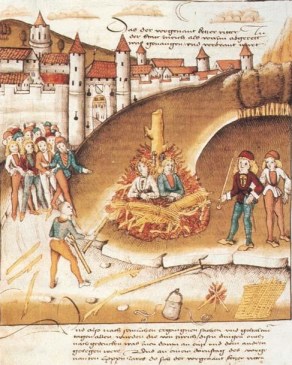
“This fine sect”… “these sharp folk”. Montaigne was one of the first supporters of marriage equality. But he had to tell us in code. As we congratulate ourselves, let us recall the profound pain this stigmatization caused for so many throughout history, and the brutal repression they had to endure – even being burned alive for seizing their own destiny and declaring the church their own.

(Illustration: Burning of two sodomites at the stake outside Zürich, 1482, by Spiezer Schilling)

How The Democrats Have Evolved

In the below video, various Democrats rail against marriage equality. Given her recent change of heart, Hillary Clinton’s 2004 speech is particularly jarring – but not surprising – to watch:

This embed is invalid


Weigel comments:

The new Democratic advocates for SSM fall into two camps. The first consists of people who always liked the idea of this but worried about losing national elections. In his memoir, Democratic consultant Bob Shrum remembers John Kerry fretting that the Massachusetts Supreme Court had forced Democrats to talk about gay marriage before they were ready to. “Why couldn’t they just wait a year?” he asked Shrum, mournfully. The second camp consists of people who really do oppose the idea of gay people getting married. Republicans argued that this second camp was tiny, and that liberals were hiding behind it. They were right!

I’m not so sure. But Kerry’s position was that of most of the Democratic pols and they were backed up through the 1990s by the Human Rights Campaign, who wanted nothing more than to kill this issue they deemed premature (while their number one goal back then, the Employment Non-Discrimination Act, remains unaccomplished). In some ways, I find the opportunism of the Clintons – who did more substantive harm to gay people in eight years than any other administration – more disgusting than the fundamentalist hostility. At least the Christianists were sincere. The Clintons have always been phonies and opportunists and for Bill Clinton to proclaim the sanctity of marriage and sign DOMA while cigar-fucking his intern tells you a lot about him. On no issue were they as shameless as on this one – portraying themselves as civil rights advocates while kicking those of us fighting for equality squarely in the groin.

The former president still refuses to apologize for what he did to us. He cannot own it. But history will.

American Royalists

Mark Dery, author of England My England: Anglophilia Explained, ponders America’s supermarket-tabloid monarchism:

The American infatuation with the inbred members of a small, stunted Anglo-Teutonic family, sustained as a kind of a curiosity by the good-natured charity of the British people, is as complex as it is perverse. It has something to do with the comparative brevity of our history, as opposed to the storied traditions of the mother country, and something to do with a yearning, weirdly, for the feudal hierarchies swept away by capitalism and industrialism (as Marx famously noted), which result in a sociocultural disorientation — a class vertigo, so to speak — that makes some Americans yearn for a world where everyone knows his place, even if that sense of community and identity is purchased at the price of a boot on your neck.

Or a dowager on your television.

A Bigger Fig-Leaf For The Atlantic

The Atlantic, to their credit, appear to be beefing up the difference between their corporate propaganda masquerading as editorial product and their actual editorial product. Here’s the first iteration of their whored-out-to-corporations model:

Screen shot 2013-03-27 at 11.52.35 AM

And here’s the new version:

Screen shot 2013-03-27 at 11.53.47 AM

Notice the new yellow Atlantic banner; how the Sponsor Content label has been increased in size and punch. Better still, we have this disclaimer after the by-line:

Screen shot 2013-03-27 at 11.59.02 AM

That’s all good news. I hope others follow if they have to pursue this revenue model.

An Expensive Leather Fetish

In the past few years, Buzz Bissinger spent $638,412.97 on high-end clothing, primarily leather products:

I bought at least a dozen items that cost over $5,000 each but did not fit, the hazard of online purchasing, since sizing by high-end retailers is often like Pin the Tail on the Donkey. I bought items I wore once, or never wore at all, the tags still hanging from the collar. Yet I returned very little: The more the closets in the house filled, the more discerning I became, the more expensive the items, the more I got off on what I had amassed.

Fallows calls Bissinger’s article “one of the most subtly skillful and elaborate April Fool’s Day hoaxes anyone has ever pulled off … or one of the most unintentionally embarrassing, you-have-to-turn-away-because-it’s-cruel-to-keep-watching acts of unaware self-humiliation anyone has ever committed.” Dodai Stewart notes how the piece upends gender roles:

“Shop til you drop” is assumed to be the battle cry of giggling gals; for every sneakerhead dude hellbent on acquiring Airforce Ones, there’s a Mariah or Kimora or Imelda Marcos with a truly obsessive collection. But of course men shop. And of course men shop to excess. But drop the phrases “shopaholic” or “shopping addict” in a conversation and the average person will assume said shopper is female.

Alyssa adds:

Bissinger is not wrong to argue that there’s powerful, unexplored territory out there when it comes to men, fashion, and the presentation of their sexuality. He’s just missing the fact that it’s not just his personal style, but powerful business interests, that are going to push that discussion forward—and in ways that he and other men might find as difficult and uncomfortable as women have for years.


Is Farmland Peaking?

Peak Farmland

Ronald Bailey passes along research (pdf) on “peak farmland,” the point at which the amount of land we need to feed the world population begins to decline. This farmland decrease is possible because the amount of crop produced per hectare is increasing at a faster rate than the global population:

Cranking various population, economic growth, and [crop] yield trends through the ImPACT equation, the authors conservatively conclude that in 2060 “some 146 million hectares could be restored to Nature, an area equal to one and half times the size of Egypt, two and half times France, or ten times Iowa.” Under a slightly more optimistic scenario—one where population growth slows a bit more, people choose to eat somewhat less meat, agricultural productivity is modestly higher, and there’s less demand for biofuels—would spare an additional 256 million hectares from the plow. That would mean nearly 400 million hectares restored to nature but 2060, an area nearly double the size of the United States east of the Mississippi River.

Federalism’s Double-Edged Sword

Tom Goldstein explains how using states’ rights to strike down DOMA could box in SCOTUS on Prop 8:

[I]f DOMA is going to be decided as a federalism case, Hollingsworth [v. Perry] becomes a much harder case for the plaintiffs. That ruling in Windsor implies that California should have a parallel right to decide the definition of marriage for itself – i.e., that Proposition 8 should be upheld.

In fact, there is a realistic chance that the Court’s most conservative Justices understood that dynamic from the beginning and for that reason voted to grant certiorari in Hollinsgworth. In effect, they would put the Court in the box fully grappling with the implications of a ruling invalidating DOMA. To then also invalidate Proposition 8, the Court would have to go quite far in applying heightened scrutiny and invalidating the traditional definition of marriage, notwithstanding its professed concerns for states’ rights.
