Yes, it was an issue. It has always been an issue. Garance Franke-Ruta has a great piece on the struggle from the period. And yes, it sure was very 1970s.
Month: March 2013
Fiscal Conservatives For Marriage Equality
It makes sense, as Josh Barro explains in a must-read:
Even though the cost components are different, the net effect would probably be similar at the state and federal levels: positive, but very small. The Williams Institute at UCLA School of Law has reached this conclusion in fiscal analyses across various states; for example, they estimated in 2009 that legal same-sex marriage in Maine would generate $8 million in annual fiscal benefits for the state, mostly through reductions in Medicaid and other public assistance payments.
The fiscal benefits aren’t a crucial reason to support same-sex marriage, but they do lend support to one of the “conservative” cases for it. Marriage is a structure through which people depend on each other, so they don’t have to depend on the government. For gay men and lesbians to take advantage of that fiscally friendly option, the government has to make it legal for us to marry.
The Transcript Of The Oral Arguments
Steady As She Goes
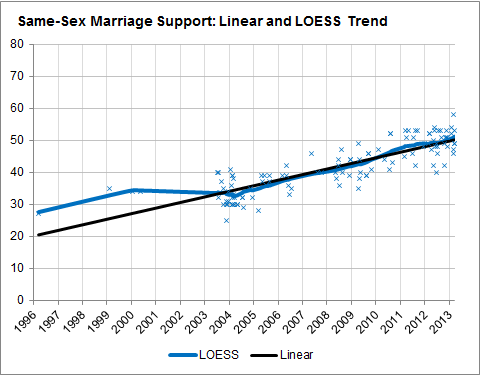
Nate Silver’s tea-leaf reading reaches a solid conclusion:
One no longer needs to make optimistic assumptions to conclude that same-sex marriage supporters will probably soon constitute a national majority. Instead, it’s the steadiness of the trend that makes same-sex marriage virtually unique among all major public policy issues, and which might give its supporters more confidence that the numbers will continue to break their way regardless of what the Supreme Court decides.
The Argument For Minimalism
Here’s a succinct and simple case from Cass Sunstein for SCOTUS going small:
In its 1971 decision in Reed v. Reed — its first serious effort to engage the problem of sex discrimination — the court took the path of minimalism. Striking down an odd Iowa law that gave a preference to men over women as administrators of estates, the court declined to issue a broad pronouncement that would immediately threaten all discrimination on the basis of sex.
Instead it began a long series of case-by-case rulings — accompanying, but not pre-empting, democratic judgments — that ultimately produced strong safeguards against such discrimination.
With respect to same-sex marriage, the court might be able to adopt a similar approach. For example, the Justice Department has sketched some ways for the court to rule relatively narrowly, striking down the laws in question while avoiding the broadest pronouncement about marriage equality.
Moderation Triumphs
If Tom Goldstein is correct, then I’m celebrating:
Justice Kennedy seemed very unlikely to provide either side with the fifth vote needed to prevail. He was deeply concerned with the wisdom of acting now when in his view the social science of the effects of same-sex marriage is uncertain because it is so new. He also noted the doubts about the petitioners’ standing. So his suggestion was that the case should be dismissed.
If those features of the oral argument hold up – and I think they will – then the Court’s ruling will take one of two forms. First, a majority (the Chief Justice plus the liberal members of the Court) could decide that the petitioners lack standing. That would vacate the Ninth Circuit’s decision but leave in place the district court decision invalidating Proposition 8. Another case with different petitioners (perhaps a government official who did not want to administer a same-sex marriage) could come to the Supreme Court within two to three years, if the Justices were willing to hear it.
Second, the Court may dismiss the case because of an inability to reach a majority. Justice Kennedy takes that view, and Justice Sotomayor indicated that she might join him. Others on the left may agree. That ruling would leave in place the Ninth Circuit’s decision.
In other words:
NBC’s Pete Williams: ‘It’s quite obvious the Supreme Court is not prepared to issue any kind of sweeping ruling about gay rights.’
— HuffPost Media (@HuffPostMedia) March 26, 2013
(Photo: Jewel Samad/AFP/Getty.)
Not Just Civil Rights; Civil Responsibilities

More than a decade or so ago, in the Weekly Standard, David Frum warned that if we gay activists kept up the campaign for marriage equality, he would favor putting more police power behind enforcing sodomy laws. Today, he stood in front of the Supreme Court and gave a speech. Money quote:
Marriage is a source of great joy. But – and I speak as one who’ll celebrate a 25th anniversary this summer – it’s also a solemn undertaking: an undertaking to care for another person, to nurse that person when ill, to sustain her or him in time of trouble, to raise children together, to provide for those children, to mourn when it comes time to mourn.
No agency of government can ever begin to do for anyone what loving spouses do for each other. The stronger our families are, of every kind of family, the less government we’ll need.
Today your families gather before this house of the law to claim the right to live as others do, without shame and without fear. The mind of a nation is changing. It’s an awesome thing to see – and to be part of. Your words – your actions -and your example have power. And will overcome.
And with David’s help – along with increasing numbers of principled conservatives – we will. And in many ways already have.
SCOTUS Tweet Reax
Breaking: key vote Kennedy VERY uncomfortable striking down #prop8. Suggests dismissing case. Would leave in place 9th Cir pro-#ssm ruling.
— SCOTUSblog (@SCOTUSblog) March 26, 2013
Arguments done. #scotus won’t uphold or strike down #prop8 bc Kennedy thinks it is too soon to rule on #ssm. #prop8 will stay invalidated.
— SCOTUSblog (@SCOTUSblog) March 26, 2013
This means that California will now join the other states in granting marriage equality: a vast step forward.
First #SCOTUS take: Very significant questions about whether the proponents had standing to bring the #Prop8 appeal at all.
— Chris Geidner (@chrisgeidner) March 26, 2013
Ted Olsen says it would be a win for them should #SCOTUS decide case does not have standing.
— Brian Ries Verified! (@moneyries) March 26, 2013
Second #SCOTUS take: Justices also were very skeptical of the “nine-state solution” advanced by the Obama administration.
— Chris Geidner (@chrisgeidner) March 26, 2013
Ted Olsen: “I have no idea which way the court is leaning.” #prop8
— Matt Jamieson (@THEmattjamieson) March 26, 2013
Totally baffled after hearing today”s #ssm args. No clear winner. #scotus
— Jeffrey Toobin (@JeffreyToobin) March 26, 2013
The next half hour or so will have a lot of SC prediction. But remember healthcare last year, which looked dead after SC hearing.
— Ted Johnson (@tedstew) March 26, 2013
Justice Kennedy suggests children of same-sex couples suffer “immediate legal injury” from California’s ban | bloom.bg/16eSsvn
— Bloomberg News (@BloombergNews) March 26, 2013
Scalia: “considerable disagreement” about the “consequences” of same-sex couples raising children. #SCOTUS #Prop8
— Ryan J. Reilly (@ryanjreilly) March 26, 2013
Scalia: “I take no position on whether it’s harmful or not, but it’s certainly true there is no answer to that scientific question…”
— Ryan J. Reilly (@ryanjreilly) March 26, 2013
Scalia warns there’s no “scientific” evidence saying there’s no harm from same-sex marriage. Yes. Science must disprove a non-existent harm.
— Angelo Carusone (@GoAngelo) March 26, 2013
Supreme Ct update: J. Kennedy asks about 40,000 CA kids in LGBT families.“The voices of those children is important in this case, isn’t it?”
— Adam Winkler (@adamwinkler) March 26, 2013
My daughter’s reaction when my wife explained gay marriage: “I want two Moms!!” #NotTakingItPersonally
— Adam Winkler (@adamwinkler) March 26, 2013
Alito: “On a question of such fundamental importance, why should it not be left to the people?” #prop8
— Sahil Kapur (@sahilkapur) March 26, 2013
“For The First Five Years, They Laughed At You”
Quote For The Day III
“The right to marry whoever one wishes is an elementary human right compared to which ‘the right to attend an integrated school, the right to sit where one pleases on a bus, the right to go into any hotel or recreation area or place of amusement, regardless of one’s skin or color or race’ are minor indeed. Even political rights, like the right to vote, and nearly all other rights enumerated in the Constitution, are secondary to the inalienable human rights to ‘life, liberty and the pursuit of happiness’ proclaimed in the Declaration of Independence; and to this category the right to home and marriage unquestionably belongs,” – Hannah Arendt, Dissent, 1959.
 The Dish