The WSJ On Marriage

US-JUSTICE-GAY-MARRIAGE

If you watched Charlie Rose last night, you’ll know that my position on the cases in front of the court today and tomorrow is not a hope for a sudden 50-state Loving vs Virginia-style resolution. If I had my druthers, the perfect outcome would be dismissing the challenge to the ruling striking down Prop 8 on “standing” grounds, thereby allowing civil marriages to continue in California, striking down that part of DOMA which forbids the federal government from recognizing a state’s valid legal marriage licenses, on federalism grounds, and on heightened scrutiny grounds, striking down the “separate-but-equal” segregation of civil unions which are substantively identical to civil marriage.

The end result would be 17 states with marriage equality recognized by the feds, and the debate could then continue democratically as it should state by state. This is close to where the Journal comes out, with some critical differences. Here are my dissents. First off, the word “liberal,” as in:

Liberals do not merely contend that laws based on sexual orientation lack any “rational basis.” They also claim the only motivation for such laws is prejudice against gays. They therefore want the Court to designate homosexuals as a legally protected group like minorities or women and apply to Proposition 8 the highest levels of constitutional protection, called strict or heightened scrutiny.

Is Ted Olson now a liberal? Is Ken Mehlman a liberal? The argument that government discrimination against a tiny, long-persecuted minority could be viewed as worthy of heightened scrutiny is not restricted to liberals. And marriage equality was kick-started in part by gay conservatives. Just as some leftists have tried to air-brush the role of gay conservatives out of this movement (check out the far left smear artist here) so now some straight conservatives are too. They are both lying – for purposes of propaganda, left and right.

Second, since when do conservatives believe that the federal government should dictate to states what marriages should be?

The answer to that, of course, is 1996, when conservatives abandoned any pretense of being federalist and the Christianist right, aided and abetted by the most substantively anti-gay president in history, Bill Clinton, passed DOMA. Here’s the WSJ’s argument for the federal government stomping on states’ rights in 1996:

Doma doesn’t usurp state prerogatives or outlaw experimentation, or else those nine states could not have legalized gay marriage since Doma passed. In the Constitution’s system of dual federal-state sovereignty, each coequal sovereign has the power to define marriage for its own sphere.

Some scholars of federalism claim Doma was meant to express a policy judgment about gay marriage that is not supported by the federal government’s enumerated powers. But Doma embodies federalism at its best by keeping the channels of democracy open. Section 2 says one state does not have to accept another state’s definition under the Constitution’s full faith and credit clause, preserving each sovereign’s right to decide for itself.

How many times does one have to repeat this before it sinks in? The full faith and credit clause does not now and never has required one state to recognize another state’s marriages. Even today, there are very different standards – age, consanguinity, etc – that make marriages different in various states. For centuries, the federal government tolerated diversity in the states with respect to inter-racial marriage, and simply respected those inter-racial marriages that were legal in their respective states. That is federalism. The breach was not Hawaii’s aborted attempt to provide gay couples with equal protection – but DOMA itself, which says the federal government should recognize only those state marriages it approves of. This was the unprecedented move – the anti-conservative move, the first ever attempt of the federal Congress to distinguish between various states’ marriage licenses.

Overturning DOMA is to overturn radicalism not conservatism, and restore the traditional balance between the federal government and the states on civil marriage. The feds have no role in this apart from recognizing whatever a state wants to do. Period. DOMA was a mixture of panic, misinformation, political opportunism (Rove, Bush, Morris and Clinton) and yet another betrayal of conservatism by the fundamentalist wing of the GOP. Repealing it is the conservative thing to do.

(Photo: Supporters of same-sex marriage gather in front of the US Supreme Court on March 26, 2013. By Jewel Samad/AFP/Getty Images. )
The Benefits Of Marriage

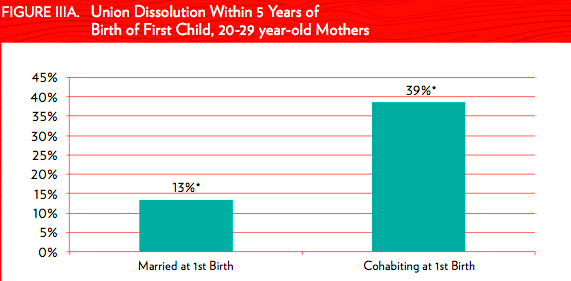
Ezra rounds-up various charts from a report on the consequences of delayed marriage. Among them:

Union Dissolution Chart

Frum spells out other advantages of marriage:

Children born to single parents face much longer odds in life than children born to married parents. (A new study by ThirdWay.org suggests that the harms are especially intense for boys, less so for girls.) “Odds” are not rules, of course. There are always exceptions.

On average, however, children born to married mothers and fathers are more likely to finish college, more likely to avoid prison and more likely to form marriages themselves than children born to single parents. And precisely because the harms of single parenthood tend to be self-replicating, the breakdown of marriage threatens to harden into a caste divide, with some families launched into cycles of downward mobility because of the unstable relationships of parents or grandparents or great-grandparents.

Which helps us see the other group of people directly affected by what is being argued in the Supreme Court as I blog this: children. Do not the children of gay couples deserve not to be stigmatized by having their parents deemed inferior to their heterosexual peers under the law? And does not civil marriage itself operate as a core mechanism for the stability and longevity of relationships? Why would we not all want to support gay couples as well as straight ones? Marriage is always work. But it matters.

Quote For The Day II

“Let us all hope that the dark clouds of racial prejudice will soon pass away and the deep fog of misunderstanding will be lifted from our fear drenched communities, and in some not too distant tomorrow the radiant stars of love and brotherhood will shine over our great nation with all their scintillating beauty,” – Martin Luther King Jr, 50 years and ten days ago.

Quote For The Day I

Supreme Court Hears Arguments On California's Prop 8 And Defense Of Marriage Act

“Defeatism is more often than not a psychological instrument designed to relieve one of the responsibility to act (if change is impossible, then I have no reason and no obligation to work or take risks for it). That is bolstered by the effort of all ruling interests to instill a sense of powerlessness and hopelessness in those they suppress; systemic power abuses are, above all else, designed to persuade people of the futility of opposition, to adopt a defeatist mindset. But it is a mindset that finds little to no support in political history. The rapid and relentless dismantling of the anti-gay legal and societal framework in the US is yet more proof for that proposition,” – Glenn Greenwald.

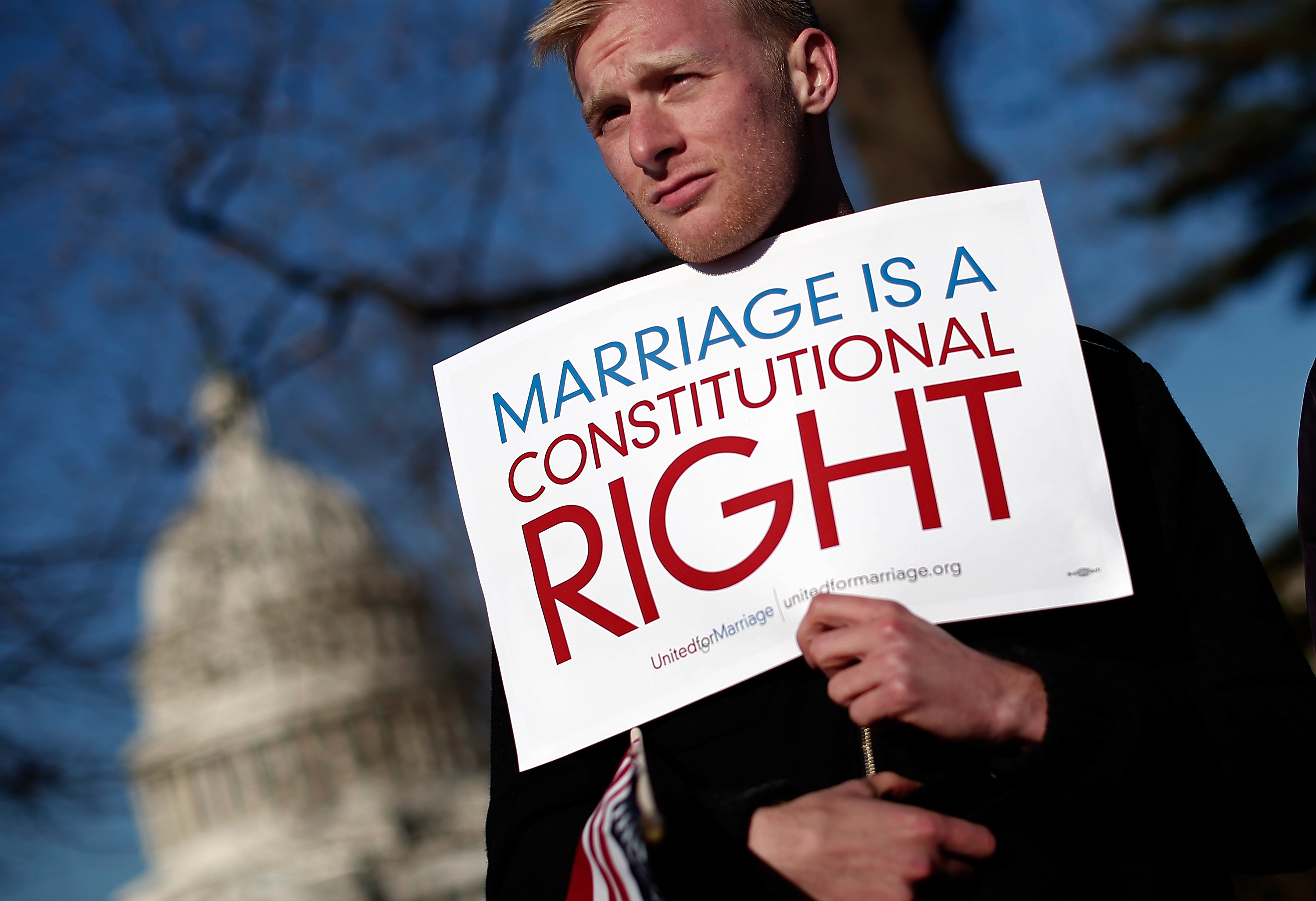
(Photo: Alex Wilson, of Los Angeles, California, watches a rally from across the street in front of the U.S. Supreme Court on March 26, 2013 in Washington, DC. The Supreme Court is hearing arguments March 26, in California’s proposition 8, the controversial ballot initiative that defines marriage only between a man and a woman. By Win McNamee/Getty Images.)

Are Prenups Pernicious?

W. Bradford Wilcox is against prenuptial agreements:

My research suggests that couples who embrace a generous orientation toward their marriage, as well as those who take a dim view of divorce, are significantly more likely to be happy in their marriages. A National Center for Family and Marriage Research study finds that couples who share joint bank accounts are less likely to get divorced. In fact, married couples who do not pool their income are 145 percent more likely to end up in divorce court, compared to couples who share a bank account.

So, the kind of partners who wish to hold something back from their spouse in a marriage — emotionally, practically and financially — and to look out for No. 1 instead are more likely to end up unhappy and divorced. If that is your aim in marrying, go ahead and get a prenup.

Erik W. Newton, on the other hand, argues that every “married couple has a prenup, whether they want one or not” because the “laws covering marriage and divorce in every state are nothing more and nothing less than premarital agreements”:

For the majority of couples, a state’s default prenup is perfectly sufficient. It has been crafted over hundreds of years both through common law and common sense. That said, a couple can’t know if it works for them unless they take the time to explore the law. We enter into a nuptial contract when we say “I do” but not very many of us know the exact terms of it.

A couple should use the existence of a “state prenup” to discuss finances before getting married. Challenging topics will inevitably arise during a marriage. Many of these topics are addressed in the law, but some might be more delicately handled with a customized prenup.

Poll Of The Day

Californians now overwhelmingly support marriage equality:

As the Supreme Court hears oral arguments today on California’s Proposition 8 banning same-sex marriage, a new SurveyUSA poll shows that 67 percent of Californians believe same-sex couples deserve the legal benefits of marriage. Only 30 percent believe those benefits should be limited to “a man and a woman.”

Will Perry Be Another Roe?

Stephen Presser claims that, if “the Supreme Court rules that the federal Constitution requires gay marriage, the political uproar that will ensue may well make the reaction to the court’s Roe v. Wade decision look tame.” David Fontana disagrees:

We know that a Court decision about an issue intensifies opinions about that issue; there is evidence that state court gay marriage decisions have done exactly this. But there is reason to think that the reaction of an intense minority might not be quite so significant. One reason: Just as there has been a shift in preferences about gay marriage over the past two decades, there has also been the shift in the intensity of these preferences. It used to be the case that opponents felt much more strongly than supporters. It was easy to organize state ballot initiatives banning gay marriage because so many opponents of marriage equality were motivated to go door-to-door, solicit signatures, and organize rallies. These days, supporters of gay marriage care more deeply than foes, with one poll indicating that only about one-third of Americans are strongly opposed to gay marriage. There might not be enough strong opponents enough to create the political or social momentum to do something about an unfavorable Court ruling, even in a small number of states.

The Cure For Earworms

Science is here to help:

We humans — cognitively, at least — like to finish what we’ve started. So even when our conscious minds move on to a new thing, our unconscious minds can still be preoccupied with our unfinished business, leading to dissonance. … To defeat an earworm, [researchers at Western Washington University] suggest, you just have to fool your brain into solving another puzzle — a non-musical puzzle. The best way to do that? Give it actual puzzles to concentrate on. Do a quick crossword. Tackle an anagram. Spend a few minutes, even, reading a novel. Replace the earworm with another worm, tricking your mind out of its need to finish what it started by giving it something else — something simple, but not too simple — to focus on.

Taped-Delayed SCOTUS Live-Blogging

SCOTUS will release the audio from the Prop 8 oral arguments no later than 1 pm today. As soon as the audio is released, I’m gonna live-blog my thoughts as I listen. I’ll do the same thing on Wednesday with the DOMA oral arguments audio, which SCOTUS has promised to release by 2 pm tomorrow. After mulling over the real options, that seemed like the best compromise.

I had a chance to be there, if only huddled in a corridor, unable to see the Justices, and like other reporters, barred from using my laptop to live-blog. So I figured I’d listen to the arguments in delayed real time and give my impressions. At this point, while I would have loved just to be there for the day, I have a job to do.