The Smartphone Theft Epidemic

Some startling statistics:

Cell phone theft in major cities has become a national criminal epidemic, like the car stereo crime wave of the 1990s. In San Francisco, about half of all robberies now involve mobile phones, and in New York there was a 40% increase in mobile thefts in 2012. One recent Harris poll of phone owners found that nearly 10% of cellular users said their phone had been stolen at one point.

The reason is simple: The black market resale value of the devices, like car radios two decades ago, is high. “Your mobile phone is probably the most expensive thing you carry around with you,” says Kevin Maheffey, co-founder of Lookout, a mobile security company. “It’s like holding $400 up to your head.”

Chart Of The Day

Popularity And SCOTUS

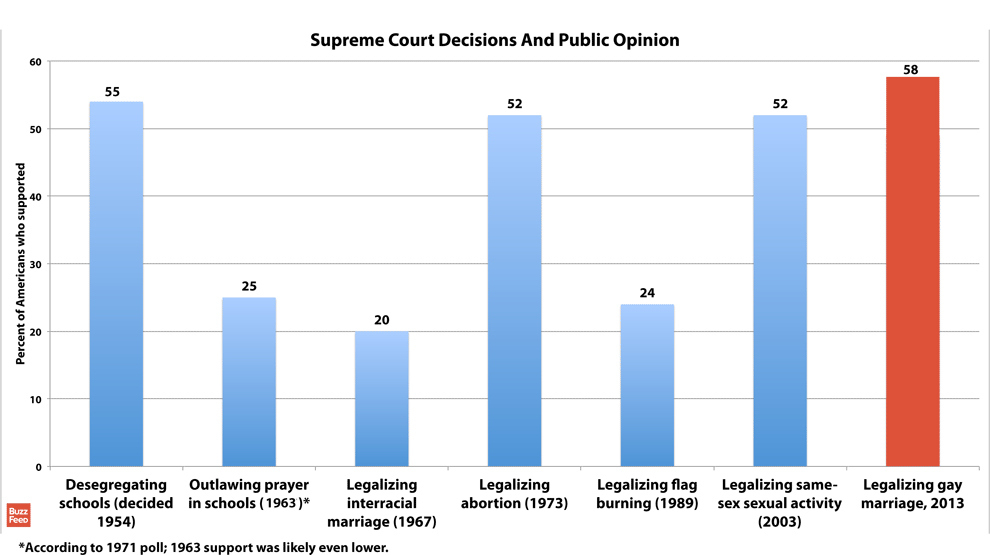
SCOTUS often doesn’t do what’s popular:

In the cases of Loving v. Virginia, which struck down state laws banning interracial marriage; Abington School District v. Schempp, which declared Bible reading in public schools unconstitutional; and Texas v. Johnson, which found flag-burning to be constitutionally protected, large majorities of Americans at the time disagreed with the Supreme Court’s decision. On interracial marriage, public opinion is now aligned with the Court’s decision — on flag-burning and prayer in schools it’s not, though it may be moving in that direction.

The Smart Watch Cometh, Ctd

Freddie dismisses the hype:

[W]ith tech in particular, I merely continue to observe constantly repeated human nature: many of us become convinced, over and over again, that there is one missing element of our lives, and often it’s a better phone or a new computer or our first tablet. We salivate over it, we wait for it, and it arrives, and for maybe a couple days we get the expected rush of endorphins as we play with it. And then, somehow, our lives are still just our lives– hectic, harried, incomplete, vaguely dissatisfying. Then we decide we need a new product, or a new service (once I use Evernote I will be unstoppable!), and the cycle continues. And we never, ever learn. It just seems that the tech heads are the most likely to engage in unlikely flights of fancy about how cool their lives are going to be, and the most susceptible for falling for their own hype. Brian Ries’s revolutionary, life-changing Pebble watch is a couple of months from being the slow pain in the ass that he feels obligated to wear and is tired of talking about.

Training Neighborhood Narcs

Crimestoppers

Police and anti-crime group Crimestoppers are distributing cannabis “scratch and sniff” cards in Britain:

The cards, which replicate the distinct smell of growing marijuana, will be mailed to homes in 13 areas throughout the country, in the hope that they will help people to identify cannabis factories in their communities.

Alex Moore sighs:

The weird thing is that they got this idea from the Netherlands, where the cards seemed to have actually worked despite weed consumption being legal—and you’d think widely familiar—there. (Growing pot is still illegal there.) After sending out 30,000 cops in the Netherlands were able to bust “hundreds” of cannabis production facilities, according to Time. Good job, Europeans—you just created more work for Mexican drug cartels.

(Image, via NPR, from Crimestoppers)

TNC In Paris

In the deep end, yet again:

But I was in the pâtisserie thinking of of my wife, who beat me here by seven wise years because she is a woman whose vision sends me to sonnage. I have always been a simple man, and left to my devices, my guiding principles would revolve around warm snugglies, World of Warcraft and intravenous pizza. Except that I have never really walked alone. Instead I’ve been surrounded by people who insisted upon other languages. When I was nine my mother remanded to the tender clutches of a man who taught swimming out in the county in his back yard. On the first day I learned to hold my breath. On the second I floated. On the third I front crawled. On the fourth, I cried as he tossed me into the deep end over and over. And on the fifth, I crawled in the deep end, and it was all I ever wanted.

Money Madness

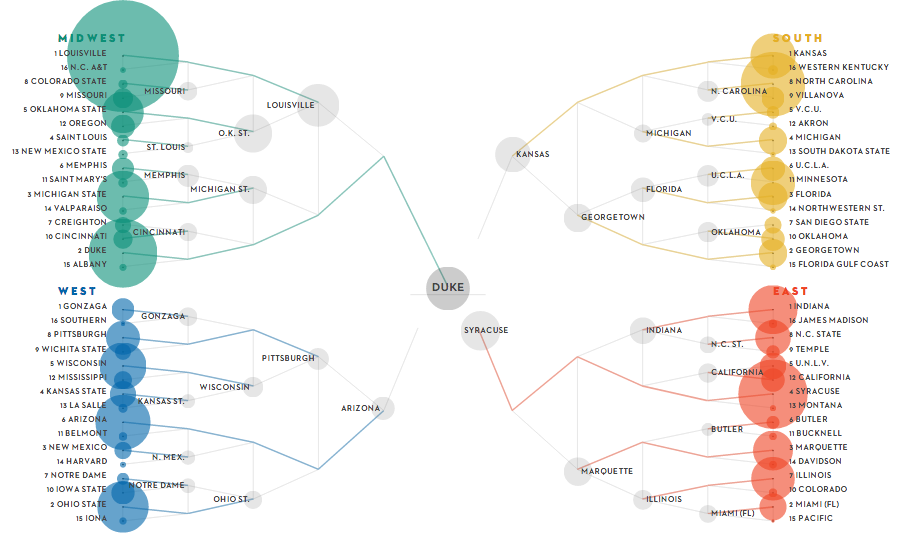
The New Yorker drafted a prediction “in which the biggest spender always wins” the NCAA basketball tournament:

Go here to interact with the brackets yourself. Meanwhile, a Freakonomics/Marketplace podcast crunched the ad numbers for the annual tourney:

[Kantar Media researcher Jon Swallen] tells us that two years ago, CBS and Turner may have lost money on March Madness, as they pay roughly $770 million a year for broadcast rights but took in only $728 million in TV ad revenue. But last year, Swallen says, CBS and Turner — which broadcast ever single game in the tourney — took in more than $1 billion. This makes March Madness “the most lucrative sports TV franchise in the country in terms of advertising revenue,” Swallen told us, “bigger than the Super Bowl, bigger than the entire NFL playoffs, and larger than the combined revenue that’s brought in from the Major League Baseball playoffs, plus the NBA, plus the National Hockey League.”

With that sort of windfall in mind, Dave Barri doesn’t think that giving scholarships to players is adequate compensation:

To illustrate, consider the Indiana Hoosiers this season. An examination of the player statistics reveals that Victor Oladipo produced 7.37 wins for Indiana (the Wins Produced calculation for college basketball was similar – in fact, amazingly similar — to what has been done for the NBA).   We are working on the economic value of a win in college basketball, but a conservative estimate is that a win is worth at least $100,000 for a program like Indiana.   Given the number of wins Oladipo produced and the conservative value of a win, Oladipo’s production was worth (i.e. his Marginal Revenue Product) about $737,000 (and again, this is a crude and conservative estimate).

A scholarship to Indiana is valued at less than $30,000.  So at least nine of these players were exploited (which simply means they were paid less than their Marginal Revenue Product).

He argues for a “free-market approach to college sports.” The Dish has debated the topic at length.

Another Hacker Hounded By The Feds, Ctd

A reader provides some excellent pushback:

The commenters you cited in the Andrew “Weev” Auernheimer case seem to be missing the point when it comes to what Auernheimer did wrong. Ryan Tate says “the jailing of Auernheimer criminalizes the act of fetching openly available data over the web.” That data was openly available in the same way your property is openly available if you forget to lock the door to your house when you go out. You should lock your doors, and companies should make sure their websites are secure, but in neither case does (or should) the failure to act grant intruders the permission to rummage around inside.

I’m a software developer, and I’ve seen and fixed exactly the type of vulnerability Auernheimer exploited. This wasn’t something he stumbled upon; he was searching for ways to access data that he knew was confidential. What’s more, according to Tate’s description of events, the vulnerability only allowed Auernheimer to access one email address at a time. I can understand the argument that groups like Auernheimer’s are providing a public service by searching for vulnerabilities in large corporate websites, and in publicly shaming corporations when they fail. If he had contacted AT&T and the media after first discovering the vulnerability, I’d probably be supporting him right now.

But that’s not what he did.

Instead, he exploited the vulnerability to extract as many email addresses as possible, and worse, shared the tools he used to do so with unknown third parties. Only then did he notify AT&T. That’s not whistle-blowing; that’s theft and the enablement of theft. What’s more, keep in mind this was personal information he stole; there’s no claim of political activism a la Aaron Swartz.

Was his sentence overly harsh? Perhaps, but I think the US sentencing guidelines are too harsh in general. Comparing his sentence to the Steubenville rapists’ is absurd; their crime was much more serious, but they’re also juveniles and he is an adult. Given his complete lack of remorse and failure to understand what he did wrong, I’m not at all surprised the judge decided to throw the book at him.

Look, I’m sympathetic to the argument that the American justice system fails to intelligently distinguish between harmful and harmless hacking activity, both by law and in prosecutorial practice. The lack of technical knowledge on the part of judges, lawyers and juries is a real problem, and likely does result in miscarriages of justice. Arguing that that is what happened here, however, strikes me as a real stretch.

The Dish: Now $1.99 A Month

dustygate

[Re-posted from earlier today]

Well, you [tinypass_offer text=”asked for it”]. In fact so many asked for it, so quickly, we feel bad it took us this long to get there. But today, we can announce a new way to subscribe to the Dish, which will, we hope, accommodate those of you (a considerable number) who are going through tough economic times and could use a lower barrier to entry and the option of canceling in the future if your budget tightens again. Here’s how one reader put it:

I’m not sure if your clan has considered it, but setting up monthly subscriptions would be a great option for those of us happy to pay more than $20/year but who just don’t have the all-at-once cash. I’d happily sign up for $5/month which would work out to three times the subscription rate.

That’s a super-generous offer. $1.99-a-month seems a more reasonable sum – an app-like fee that simply gives you more options for payment. Like the $19.99-a-year option, we’re also leaving it up to you if you’d like to pay more – even if that’s only $2 or as much as $5. The point of course is to make this available to as many people at as many Screen shot 2013-03-25 at 1.34.34 PMprice points as you want and need, above a minimum baseline. You can buy your new full access $1.99-a month subscription [tinypass_offer text=”here”].

As for our progress, we are purring along. Our gross income is now $653,000 toward a goal of $900,000 by next January 1. That’s 72 percent of our goal in almost three months – but almost all the likeliest subscribers have joined already. It gets tougher from here on out. That $900,000, by the way, is simply the sum of our fixed costs (servers, legal costs, health insurance, salaries for staff, video equipment, photo agencies etc.) and an attempt to pay the three co-owners of the company, Chris, Patrick and me, something close to what we were paid in the past. Alas, it can’t pay for much more than that: our desire to start commissioning the kind of long-form journalism that is disappearing from many magazines, and acquiring a long-form editor to craft the essays, reports and arguments we want to run. But we really do want to reinvent the whole concept of a magazine – starting from a blog outwards – and by the most honest and simple way possible: purely reader support.

It may not be possible; but we didn’t think what we’ve done already would be possible not so long ago. You made it possible – and a large number of media outlets are watching this experiment closely to see if they can follow us. We hope they can, and we can begin to rebuild a model for serious, calm journalism in an era of page-view mania, sponsored content, noisy comments sections and cheap SEO gimmicks.

Think of it: $1.99 a month for a noise-free, carefully edited, always lively, provocative daily read. It isn’t much – but it could help set a model to recapitalize and re-stabilize an entire industry. You can help build this new model by getting an annual or monthly subscription [tinypass_offer text=”here”]. Please help us. It could also at some point help a hell of a load of others.
The Daily Wrap

US-POLITICS-OBAMA

Today on the Dish, Andrew teamed up with a liberal lawyer to promote marriage equality, applauded the truth evident in Will Portman’s coming out, and called attention to the lack of data showing any harm to children of same-sex couples. Meanwhile, he cheered Rand Paul’s sanity on pot, drew parallels between conservativism and taoism, regretted the US’ choice to embrace torture in order to depose a torturer, and explained the new monthly subscription option on the Dish.

In political coverage, Obama worked his magic in Israel and struggled to reclaim his earlier levels of popularity. Ben Merriman considered conservativism in Kansas, the justice department jailed another hacker, and Julia Ioffe investigated Russia’s role in the Cyprus banking scandal. On the eve of the Prop 8 hearings, Tim Murphy set the deadline for marriage equality evolutions.

In assorted coverage, we added more details on name-changing customs at home and abroad, educational attainment was inherited, clinics offered à la carte pricing, and Rob Rhinehart gave up solids. Christian Caryl brought war imagery to the fore and Hitler convinced with his conviction. While goats thrived on global warming, Eduardo Porter worried about natural gas leakage, Tom Chatfield tried out a better keyboard, and David Zax reached the limits of his innovation.

As Passover began, Maxwell House monopolized the Haggadah, while elsewhere a reader sought a softer high, and Matt Soniak explained why toothpaste ruins orange juice. George Eliot couldn’t fool Charles Dickens, Lord Byron gave rise to vampires without writing a word, and Piers Anthony coped with his unhappy childhood. German shepherds frolicked in the MHB, and winter stuck around past its expiration date in the VFYW and the FOTD.

D.A.

(Photo: Vice President Joseph R. Biden reacts as President Barack Obama speaks about signing the First State National Monument in Delaware, Biden’s home state, bill during a ceremony in the Oval Office of the White House March 25, 2013. Obama used the Antiquities Act to designate five new National Monuments. By Brendan Smialowski/AFP/Getty Images)