The Liberal Lawyer And The Conservative Writer

enhanced-buzz-22008-1364186812-0

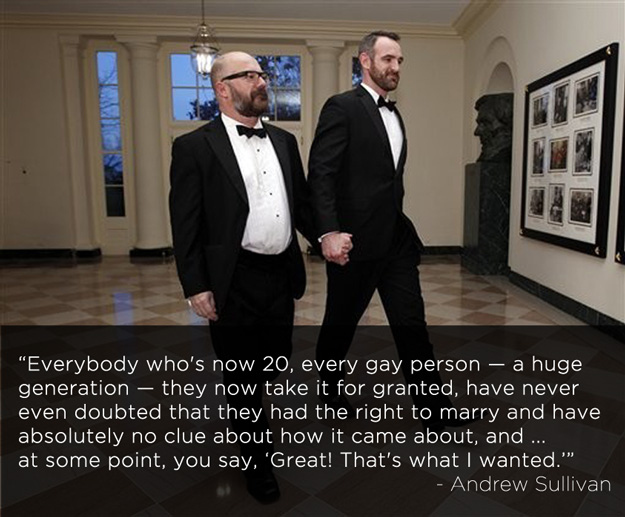
Here’s Chris Geidner’s profile of Evan Wolfson and me – who were once the only two gay activists of our generation who, despite core philosophical differences, made the once ludicrous idea of gay marriage the cause of our lives. It was a thrilling time in a way – because it seemed simply impossible, yet to us, utterly irrefutable as a logical and legal argument. We used to joke, as we toured the country, went on every cable show, spoke on campus after campus, agreed to talk-radio grillings, and wrote essays and legal briefs and books and strategy sessions, how funny it was we were so busy fighting for marriage that we didn’t have time to have a boyfriend.

And then the big surprise. We both became the victims of our own arguments:
enhanced-buzz-26929-1364172764-3

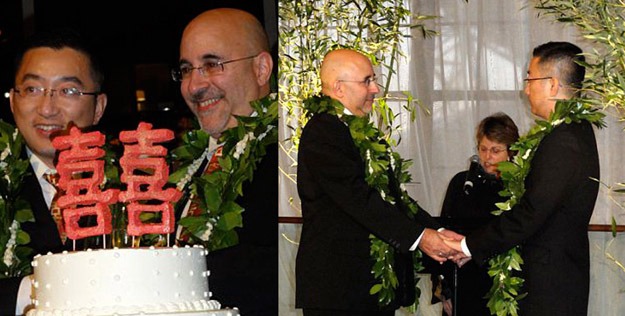
Sullivan met his now-husband nine years ago at a gay circuit party — “which is not exactly where you think traditional marriage begins: semi-naked on the dance floor at 4 a.m. in the morning,” he joked.

Looking at his phone, which occasionally lights up with a text message from his husband, Sullivan added, “But, we just said goodbye, he’s walking the dogs, and we’re still living together and sharing our lives together.”

“Even me, I was shocked,” Sullivan said of the experience of getting married. “I think there were two moments in my life when I was really shocked by the way I felt. The first was how much shame I felt when I found out I was HIV-positive. And the second was how much joy I felt when I got married. I didn’t anticipate either of those things. And that’s the arc. That’s what we’re really talking about. We’re talking about the human heart here, and its ability to heal.”

Drug Sanity Watch

Rand Paul advocates for less draconian drug policy (and Chris Wallace gets it):

Paul is wrong about pot. Sure, it can undermine productivity – but no more than video games or a hangover. Responsible recreational use – always outside the workplace – is, in my view, a clearly positive thing for the society as a whole, for its creativity and sanity, especially as the virtual cult of ADD contemporaneity threatens to swallow us all. Riggs sees Paul as part of a larger movement on the right:

If you compare Paul only to his colleagues in the Senate, yes, he sounds like a pioneer. But if you broaden the comparison to include Republicans outside the Senate, Paul is coming late to this way of thinking. Former drug warriors Newt Gingrich, Ed Meese, Asa Hutchinson, and Bill Bennett have all come out against incarcerating low-level nonviolent drug offenders. Republican Governors Dennis Daugaard of South Dakota, Nathan Deal of Georgia, Chris Christie of New Jersey, and John Kasich of Ohio have not only come out against imprisoning low-level, nonviolent drug offenders, they’ve signed legislation that diverts more of those offenders from prison into community supervision programs.

Ian Millhiser of Think Progress worries that Paul will will outflank Democrats on this issue. I sure hope so. It’s about time the right began to get ahead of the left with the next generation – on a question of core individual liberty and absurd, cruel abuse of our incarceration system.

Coming Out Through The Evening News

New US Trade Representative Rob Portman

Will Portman speaks up about his Dad’s announcement:

It has been strange to have my personal life in the headlines. I could certainly do without having my sexual orientation announced on the evening news, or commentators weighing in to tell me things like living my life honestly and fully is “harmful to [me] and society as a whole.” But in many ways it’s been a privilege to come out so publicly. Now, my friends at Yale and the folks in my dad’s political orbit in Ohio are all on the same page. They know two things about me that I’m very proud of, not just one or the other: that I’m gay, and that I’m Rob and Jane Portman’s son.

I’m of an utterly different generation than Will, and, to be perfectly frank, I look up to his. Coming out in the 1980s – as the plague began to cull more and more gay men – was an alternate universe, and drenched with much more trauma. But in my case, I simply kissed a man and the world that had been in black and white was suddenly drenched in color. Dishheads will know that one of my vices is pathological indiscretion, so, true to form, I told everyone I knew over a couple of months; then my folks; and then it was over. Done. Back to reading and teaching Kant and Machiavelli and sending my jejune prose to be eviscerated by Mike Kinsley’s editing skills.

Or so I thought. Then, writing the marriage equality cover-story in 1989, being made editor of TNR in 1991, changed everything. Marty asked me if I intended to make a big issue out of it. I told him I didn’t but I wouldn’t lie. To his immense credit, he knew I wouldn’t. And all I ever really did was answer yes to a question all my colleagues and friends and family already knew. But suddenly I was the gay poster-boy, Gap-ad and all. In retrospect, I would have given far fewer interviews, but I wouldn’t have held back on adding gay stories to TNR where they had been relatively rare (but not absent) before me. The early 1990s were critical ones in getting Washington to take the issues of marriage equality and military service seriously. But I was absurdly naive about what being so publicly gay would mean – at a time when many fewer people were, and about what being openly conservative would mean to a gay community of solidly left-wing leadership. But it truly was not an act of courage. It was simply an act of not lying.

In the end, it’s about one’s willingness to lie, to put calculation before truth. And with all due respect to Will, we know more now than that he is Rob and Jane Portman’s son, or that he is gay.

We’ve learned something much simpler and more important: that he tells the truth.

(Photo: New US Trade Representative Rob Portman (C) is sworn-in by White House Chief of Staff Andrew Card before President George W. Bush, Portman’s daughter Sally (lower left), son Will (rear) and wife Jane (R) on May 17, 2005. By Paul Richards/AFP/Getty Images)

Cannabis Lite, Ctd

A reader responds to this post:

I’m one of the users who attempts to reach an after-work glass of wine-like buzz. I can get close to accomplishing this by placing a small amount of pot in a vaporizer, but I still have very little certainty that I’ve got the dose right. Unlike alcohol, where the proof is written on the bottle and assured by regulators, you can only gauge THC levels through trial-and-error or your dealer’s sales patter.

What’s worth mentioning is that increasing purity is another natural economic consequence of prohibition, as manufacturers seek to mitigate risk by reducing the volume of product and increasing per-gram profit margins. It’s infuriating to see the DEA and ONDCP point to increased THC levels of marijuana as a talking point against legalization.  They hope to convince middle-aged parents with fond memories of gentle buzzes from the 1970s that the harmless weed of their day has morphed into a powerful narcotic that could harm their children. Yet somehow they can’t see that their very actions have contributed to the incentive to amp up THC levels.

The Dictator’s Temper Tantrums

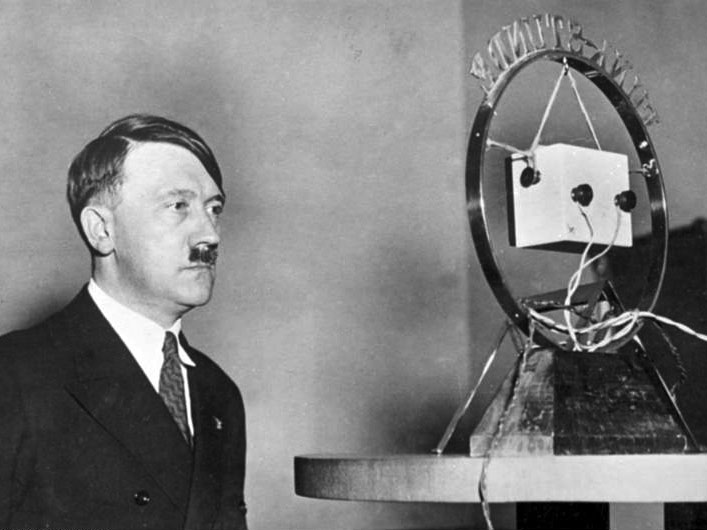
Adolf_Hitler_vor_Rundfunk-Mikrofon

In a review of a number of new books on Adolf Hitler, Carlin Romano turns to Laurence Rees’s Hitler’s Charisma to understand the connection between the Nazi leader’s mercurial temperament and mass appeal:

Rees observes that Hitler “found it impossible to debate any issue. He would state his views and then lose his temper if he was systematically questioned or criticized,” and was “the least likely person in the world to change his mind on any issue he thought was important.” Hitler specialized in “screams, tantrums, rapid changes of mood, sulks.”

Rees notes, however, that the “overconfidence” implicit in such behavior was widely “perceived as a mark of genius” and persuaded millions—in part because Hitler made “in an extreme form” arguments already in the minds of his German listeners. Was that not a canny use of reason? Hitler understood, says Rees, that it’s smart to present oneself as “infallible.” Hitler may also have thought it effective to appear volatile. Rees writes that Hitler rooted his hatreds in “an emotionality that was given such free rein as to appear out of control. The ability to feel events emotionally and to demonstrate that emotion to others was a crucial part of his charismatic appeal.”

German listeners, according to Rees, thought of Hitler as someone who spoke with “conviction” and an “absolute certainty” that they liked.

(Photo of Hitler in 1933, from the German Federal Archives, via Wikimedia Commons)

The War That Wasn’t Covered

Iraq Archive 2007

Christian Caryl accuses journalists of failing “to show the [Iraq] war as it was”:

Americans who did not serve may think that they have some idea of what the war in Iraq was like, but they’re wrong. The culprit here is a culture of well-intentioned self-censorship that refuses to show the real conditions of modern warfare.

You can search the seven years of US broadcast news from Iraq almost in vain for images of dead US soldiers, or the grotesque effects of a suicide bombing on buildings or bodies, or the corpses of Iraqi families who had been riddled with bullets by nervous young Americans manning nighttime checkpoints. (The photo of the blood-spattered Iraqi girl taken by the late Chris Hondros is one of the most disturbing exceptions.) For writers the task was somewhat easier: reporters like Peter Maass, Dexter Filkins, and C.J. Chivers were able to confront their readers with gruesome realities. But the problem remains. We can hardly expect Americans to comprehend the grisly reality of wars like the one in Iraq until we’re prepared to show the consequences of the policies we so blithely adopt. The Iraqis themselves, of course, need no counseling on this matter. The war was never invisible to them.

The Dish’s stance on posting graphic images of war is here.

(Photo: The remains of three US servicemen, their equipment and a Humvee lay scattered on a dirt road after a massive IED vaporized their vehicle on August 4, 2007 in Hawr Rajab, Iraq. By Benjamin Lowy/Getty Images)

The See-Saw State

Ben Merriman contemplates the conservatism of Kansas:

Though Kansans vote overwhelmingly Republican, there are seventeen states where a higher proportion of residents self-identify as “conservative.” Because most Kansans will vote Republican most of the time, but most Kansans do not identify themselves as conservatives, the results of low-turnout primary elections can lead to dramatic political swings. The protracted contest over evolution, for instance, hinged on Republican primaries for seats on the State Board of Education, with extremists, moderates, extremists, and moderates winning in four successive elections. Evolution is now firmly installed in the state curriculum, though the leader of the anti-evolutionist group, Steve Abrams, is firmly installed in the State Senate, where he serves as Chair of the Education Committee.

The Weekend Wrap

SONY DSC

This weekend on the Dish, we provided an eclectic mix of religious, books, and cultural coverage. In matters of faith, doubt, and philosophy, Thomas Merton taught us how to pray, Reinhold Niebuhr found the essence of Christianity, and Jody Bottum pondered the ways Pope Francis eludes contemporary political categories. Dominique Ovalle urged us to believe in the beautiful, Marc Hopkins investigated the ways jazz music can contribute to Christian worship, Valerie Weaver-Zercher sized up the market for Amish romance novels, and Richard L. Rubenstein remembered a guru’s advice about outgrowing religion. Andrew Ferguson argued that philosophical materialism can’t be lived, Emma Woolerton revealed why Lucretius presented his philosophy in the form of poetry, Kurt Gray explained why playing the victim is the best way for a guilty person to escape blame, and Caitlin Doughty noted the benefits of confronting one’s own death.

In literary and arts coverage, T.R. Hummer mused on a possible recording of Walt Whitman, Darryl Pinckney recalled an embarrassing  encounter with James Baldwin, and Tom Jokinen asked if a certain amount of infatuation led to writing good biography. Brad Leithhauser contemplated various authors’ versions of Hell, Colin Dickey surveyed the literary career of opium addict Thomas De Quincey, David McConnell discussed his book about six notorious killings committed by straight men against gays, and Grady Hendrix fondly looked back at MAD magazine’s film satires. David Mamet ruminated on the role of the dramatist, the herbalist Olivia Laing considered the symbolism of Shakespeare’s plants, Greg Bottoms penned an open letter to photographer William Eggleston, and Tom Bissell thought about the literary potential of the video games. Read Saturday’s poem here and Sunday’s here.

In assorted news and views, Lizzie Plaugic unpacked a report on marriage among the millenials, a couple survived long-distance dating with the help of technology and the photogenic dog they shared, Eric Jett lamented missing the golden age of the booty call, and Garance Franke-Ruta offered a theory about why women have difficulty climbing the corporate ladder. Peter Foges told us all about rose champagne, Martha Harbison wondered if some beer drinkers could be addicted to hops, and Katie Arnoldi described how cartels have seized control of the human trafficking business. MHBs here and here, FOTDs here and here, VFYWs here and here, and the latest window contest here.

– M.S.

(“The Deposition” by Dominique Ovalle)

Why Take His Name? Ctd

This embed is invalid

A reader writes:

A friend of mine did something I haven’t seen mentioned yet in this interesting thread.  He is a second-generation Greek-American, and his grandfather Americanized the family name to something quite bland and WASPy.  When they got married, he and his wife took that original Greek name as their new married last name.  So he had a new last name too, and their kids will have the last name of their immigrant forebears.  Very creative and a great way to connect to the past while also creating a new future: the American way!

Another:

Another factor is race. I’m in an interracial marriage, and my Chinese-American wife said she would have felt very weird having a European last name – that it would have felt like a kind of ethnic betrayal. (I don’t really believe in changing one’s name regardless, so I was surprised she’d even considered it.) I haven’t seen numbers on this, but I bet women in Asian/non-Asian couples take the last names of their husbands far less often than do women who marry inside their race. And I bet that’s about equally true for both white and Asian women.

Several more readers add to the post on foreign customs:

I work with schools and teachers in Honduras’ mountains, mostly below poverty level areas. I love it. But my comment comes from a conversation one evening with friends there. The women could not understand why any female would want to take the name of their husband.

Everyone’s last name comes from the father, and when the woman marries, she keeps that last name. She doesn’t change it and they all think it’s crazy to do that. Children they have then get the name of the father. This seem fairly logical to me. They explained it as the way of keeping the family line going.

I’ve often thought that the change to the husband’s name is a left-over from women as property. ‘You are mine!” is just another way of the ‘patriarchal’ society that keeps women under wraps.

Another:

Not that we’ll ever do this, and not that it isn’t patriarchal in its own way, but I’ve always thought the Icelandic naming custom was kind of cool. In Iceland if you’re a son and your father’s name is Sven then your last name – for all of your life – will be “Svensson”. However if you’re a daughter and your father’s name is Sven then your last name – for all of your life (even if you marry) – will be “Svensdottir”.

Another:

In Kentucky, when I was married about 15 years ago, the clerks insisted that my name would change with marriage and that if I wanted to keep my name I had to have it legally changed back. That’s right, I had to pay court costs to keep my name, but do nothing to change it.

Another:

I am surprised that this thread has been running so long and you haven’t yet mentioned the Spanish practice of how last names are passed down.  It’s complicated for Americans but makes perfect sense.  A friend of mine who lives in Spain told me that most women don’t change their last names anymore and it does not cause confusion since one of her surnames is still passed down to the child.  In fact, it makes it quite easy to trace genealogy.

The Norweigian surname practice was far more confusing.  There was a geographical custom of taking the surname of the farm upon which one lived.  So, if one purchased a farm, one’s surname changed as well.  Many Norweigians who immigrated into the US before 1923 practiced this custom and took the farm name of the most recent farm upon which they lived in Norway.  This is exactly what happened to one branch of my husband’s family.  I was surprised to see that 70% of Norweigian immigrants acquired their surnames in this way.