Is a certain amount of infatuation necessary for a good biography?
Leon Edel, who wrote five volumes on the life of Henry James, said that writing biography was a little like falling in love. “Of course,” he added, “it’s a one-sided love affair since the love object is dead or, if alive, relatively unwooable.” In other words, a proper biography is an exercise in safe stalking: no one gets hurt, and the subject is too busy or dead to care. Without the passion it’s a chronicle of schooldays and grocery lists and letters to insurance adjusters. But if we end up learning as much about the author (and his obsession) as we do about the subject, the story can come alive. The best biographers end up as stealth characters in their own books: they fall in love, they follow the trail, they fall out of love, they lose their way, they find their way, and the subject is revealed almost by accident. The story is the search, not the discovery. And if the searcher is motivated by love—even a weird, obsessive, cockeyed, never-to-be-resolved love—even better.
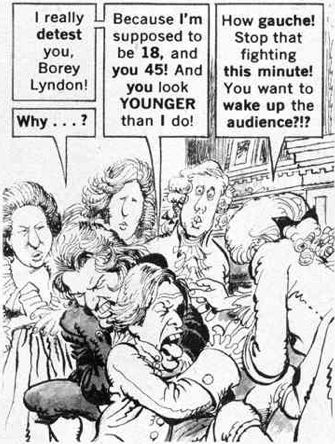
Grady Hendrix fondly recallsMAD magazine’s film satires:
Always happy to aim over the heads of its target audience of teenaged boys (issue 28 featured a guide to IRS form 1040), MAD was parodying movies like Barry Lyndon (Borey Lyndon) and Blow-Up (Throw Up) to a readership with little awareness of these movies beyond their newspaper ads. Long before most kids were old enough to see R- and X-rated movies like Dressed to Kill, Altered States, and Midnight Cowboy, they were familiar with Undressed to Kill, Assaulted State, and Midnight Wowboy. While film studies majors gasp over the deconstruction of genre in the works of David Lynch and the meta-movies of Charlie Kaufman, “the usual gang of idiots” over at MAD have been deconstructing, meta-narrativing, and postmodernizing motion pictures since the very first movie parody (Hah! Noon!) appeared in 1954.
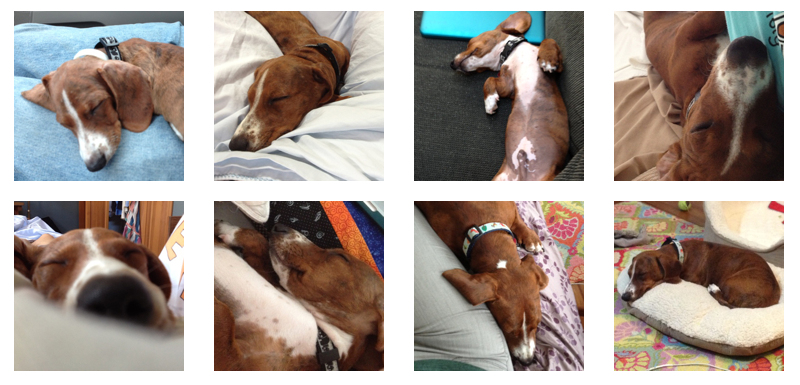
Matt Flag and his girlfriend were able to endure long-distance dating with the help of technology and the photogenic dog they share:
I’m not suggesting that pictures can make a relationship work. And I’m not exactly sure why dog pictures are more effective for me than Skype or the telephone or texts. Suffice it to say that, with or without any kind of modern technology, living with half the continental U.S. between you and your significant other is difficult and, bottom line, an entirely mediated relationship is sub-ideal: the things around you will always be more immediate and grass is quantifiably greener when it isn’t piped through the internet before it appears on a screen. …
At the same time, though, this dog — something very much a product of our ability to raise it but at the same time independent, separate, us mediated into dog-life — has made a huge difference. And somehow, the camera, a known liar, manages to capture his personality, and once a day I laugh at him and, more abstractly, see some kind of diffracted reflection of how good my girlfriend and I are together. Somehow, through all the wires, the pictures are genuine and uplifting. That, to me, is the magic of creativity, technology done right: just when you think it can’t help but lie, obfuscate, confuse, it seems to reach out and give you something real.
You have until noon on Tuesday to guess it. City and/or state first, then country. Please put the location in the subject heading, along with any description within the email. If no one guesses the exact location, proximity counts. Be sure to email entries to contest@andrewsullivan.com (the old address still works as well). Winner gets a free The View From Your Window book. Have at it.
Maria Bustillos interviews author and gaming aficionado Tom Bissell about the literary potential of the medium. Bissell was encouraged by a game version of The Walking Dead:
Obviously it’s got zombies, and so it’s both incredibly violent and upsetting, but, unlike most zombie games, you’re not just constantly pulling the trigger. It’s not a shooter. It’s not a shooter. In fact, it’s using the devices of one of the purer, more literary game genres out there: the old-school, point-and-click adventure game. You walk around static environments, looking at stuff, picking stuff up, and talking to people. That’s really what the game is about: talking to people, forming relationships. The relationship between the two main characters (a disgraced black academic and a little girl) is genuinely affecting. I wouldn’t put it on the same level of affecting-ness that you’d find in a really good literary novel, but there are times when it comes tantalizingly close to that. So it’s a writer’s game, in that sense. It’s a game that manages to create high drama out of deciding whether or not to cut a little girl’s hair, believe it or not, because if he keeps her hair long, a zombie will be able to grab it. And you have to have this conversation with her, and sort of allow her to see why she needs to get her hair cut without really telling her why, because you don’t want to alarm her. It must sound like pulpy nonsense described in this way, but the way the game humanizes these people really pays emotional dividends.
More and more, I’m seeing that games are mining good, old-fashioned human anxieties for their drama, and that’s really promising. Games, more and more, are not just about shooting and fighting, and for that reason I’m optimistic and heartened about where the medium is heading, because I think game designers are getting more interested in making games that explore what it means to be alive.
Relatedly, Liel Leibovitz reviews “Applied Design,” a new MoMA exhibition of 14 video games:
While art is bound only by its creator’s imagination, code is bound by the limitations, more numerous than you’d imagine, of computer comprehension.
Code can’t, like Joyce’s Finnegan’s Wake, abandon logic and decide to imitate the sounds of nature instead. It can never be poetry, just a series of if/then statements. Code has more in common with the hinges that connect the museum’s doors to their frames than it does with Nude Descending a Staircase.
This divide between code and image, between the algorithms responsible for the experience of play and the pixels representing its visual manifestation, is what makes games so complicated and compelling. MoMA, however, has chosen to largely ignore this question: A number of the games displayed in its exhibition are merely loops of video footage, allowing visitors to watch, as the museum put it, “guided tours of these alternate worlds,” but not to play the games themselves.
The question, then, is not whether video games are art, but whether whatever is currently gracing MoMA’s walls could even be called video games. Anyone who has ever been truly transformed by a game—that is, anyone who realizes that games, unlike paintings or movies or books, are made not to be observed but to be actively played, repeatedly and over long stretches of time—knows that the answer is no.
Herbalist Olivia Laing, a fan of Shakespeare, recounts her training in phytotherapy:
We used Ophelia’s flowers day in, day out. Rosemary, Rosmarinus officinalis, was deployed as a kind of mild stimulant, to sharpen the mind and improve concentration and circulation. Pansies, Viola tricolor, I mixed most often for childhood eczema. Fennel, Foeniculum vulgare, that marvellous aromatic and carminative (aid to digestion), which was likewise good for promoting milk flow (an action known as a galactagogue), and gentle enough to be taken by a child.
Did we have rue, Ruta graveolens, which flowers a sour yellow and stands in floriography for both regret and the grace of God? I don’t remember. I certainly studied it. It grew in my boyfriend’s garden, and I once idly mashed a leaf back and forth between my fingers. The next day there were red weals and pustules all over my hand, which itched and burned for almost a week. Like many dangerously toxic plants, it had been used traditionally as an abortifacient (‘It expellethe the dead childe,’ wrote Gerard in his Herball of 1633) and so became associated in folk memory with regret, especially in women. This is why Ophelia gives it to Gertrude, Hamlet’s mother: a statement of disgust masquerading as respect.
In the second part of her series on the problems of prohibition, Katie Arnoldi describes how the cartels have seized control of the human trafficking business:
In the old days, crossing into the U.S. was an unorganized system of independent men working as guides for migrants. Typically a friend of a friend, who had experience crossing the border, would show you the best route for a few hundred dollars; families would refer one another to their favorite guide, and it was mostly done by word of mouth.
It’s very different now, very organized. The drug trafficking organizations have essentially eliminated the independent guide. Either the coyote works for the cartel, or he doesn’t work at all. They control the smuggling routes and have armed militia on both sides of the border insuring that no one poaches on their territory.
Today a migrant can expect to pay several thousand dollars to cross with a guide. There are opportunistic bandits everywhere and trigger-happy border agents on the U.S. side. Even with the cartel assistance it’s incredibly dangerous. Women have an especially difficult time; more often than not they are forced to perform sexual favors if they want to arrive safely at their destination. It is said that rape is part of the price of admission when crossing illegally into the United States.
(Photo: A cow skull, probably hung by an immigrant smuggler, points the way up a backcountry trail into Arizona from Mexico near Green Valley, Arizona on July 31, 2010. By John Moore/Getty Images)
Citing the success of Casablanca, David Mamet contemplates the role of the dramatist:
A man thinks he’s getting over a problem, the problem reasserts itself (Bergman shows up), he tries to deal with it through revenge and then through fantasy (they can pick up where they left off), but finds these do not answer the question. The question is, “How does one deal with Betrayal?” He has tried distance, rage, and alcohol, and they do not work. The true solution, he finds, is, “DO NOT BETRAY OTHERS.” The answer, then, is found because the hero reformulates the question. It used to be, “What do I do about Ingrid Bergman?” but the deeper question, which alone has an answer, is, “WHAT KIND OF MAN AM I?”
This is great melodrama. … The lazy drama informs us, at the end, “It was in you all the time!” This is handy as a way to get offstage, but, as anyone who’s ever talked to a mediocre counselor will tell you, “It just ain’t helpful.” For the essential question is, “WHAT was in me all the time?”
He goes on to discuss the melodrama in Phil Spector, the HBO film written and directed by Mamet that premieres tomorrow. Matt Zoller Seitz slams the film:
Mamet has always had a thing for righteous macho martyrs — see Oleanna, about a professor whose pending tenure is scuttled when he is accused of sexual harassment by an ambitious young female student*, and Hoffa, which compared the mobbed-up labor leader to Jesus and wasn’t remotely joking — but now that he’s entered a right-wing troll phase of his career, he’s cranked up the persecuted truth-teller affectation to the point where you can picture Mel Gibson talking him off a ledge. I’m pop-psychoanalyzing Mamet here not because I particularly enjoy it, but because Phil Spector’s tone and thesis are so out-of-nowhere weird that it doesn’t really make sense as anything but an example of an artist projecting himself onto another artist and saying, “I feel you, bro.”
Garance Franke-Ruta offers a theory as to why women have difficulty climbing the corporate ladder:
Men learn early that to woo women, they must risk rejection and be persistent. Straight women, for their part, learn from their earliest years that they must wait to be courted. The professional world does not reward the second approach. No one is going to ask someone out professionally if she just makes herself attractive enough. I suspect this is why people who put together discussion panels and solicit op‑eds always tell me the same thing: it’s harder to get women to say yes than men. Well, duh. To be female in our culture is to be trained from puberty in the art of rebuffing—rebuffing gazes, comments, touches, propositions, and proposals.
Sensing that they are not prepared for the world they have entered, many professional women seek still more academic credentials. I’ve come to think of this as intellectual primping—the frequently futile hope that one more degree will finally win notice, and with it, that perfect job or raise.




 The Dish
