A YouTube version of “the enemy of my enemy is my friend”:
Month: March 2013
The Time Divide
It’s grown wider:
Today, whether you’re male or female, if you’re taking home an upper-middle-class salary you’re expected to work an average of 50 hours, and probably more, a lot of it after you’ve gone home. As of 1997, the average workweek for a man with graduate education was 50 hours, and for a women 47—that three-hour difference can be accounted for, of course, by all the women who went on mommy tracks. Among American dual-career couples, in the 1990s, 15.2 percent of those with at least college degrees worked a joint 100 hours a week or more, whereas only 9.6 of couples without diplomas did that. Try to imagine what that 100-hour workweek looked like to a child: that’s five 10-hour days, plus commutes, for both parents. And those are just averages—for people at the top of their fields, the numbers were a great deal bigger.
That the workweek is ballooning for America’s educated, salaried classes, even as it’s shrinking for less educated, hourly workers, or turning into part-time work, has been called the “time divide”—the increasing inequality of time spent working, which tracks with the rise of economic inequality. As of 2002, for example, Americans in the top fourth of earners toiled an average of 15 hours more than earners in the bottom fourth.
The Frontlines Of Live-Blogging
Young British blogger Eliot Higgins (aka Brown Moses) is turning out to be one of the key sources on Syria’s civil war:
Higgins goes through about 450 YouTube channels from Syria every evening. The list includes uploaded footage from activists, rebel brigades and Islamist groups, as well as from Assad supporters and state TV footage. “If EastEnders isn’t on I get straight on the laptop. On a good night when nothing much has been posted, it will take me an hour and a half, but I’ve been looking more closely recently.”
Charity By Class
Ken Stern finds that the wealthy give a smaller percentage of income to charity than the poor and that the rich give to less “humanitarian” causes:
The poor tend to give to religious organizations and social-service charities, while the wealthy prefer to support colleges and universities, arts organizations, and museums. Of the 50 largest individual gifts to public charities in 2012, 34 went to educational institutions, the vast majority of them colleges and universities, like Harvard, Columbia, and Berkeley, that cater to the nation’s and the world’s elite. Museums and arts organizations such as the Metropolitan Museum of Art received nine of these major gifts, with the remaining donations spread among medical facilities and fashionable charities like the Central Park Conservancy. Not a single one of them went to a social-service organization or to a charity that principally serves the poor and the dispossessed. More gifts in this group went to elite prep schools (one, to the Hackley School in Tarrytown, New York) than to any of our nation’s largest social-service organizations, including United Way, the Salvation Army, and Feeding America (which got, among them, zero).
The Passion Of David Kuo
His wife, Kim, tells us the latest news:
After breaking his ribs, David’s health deteriorated rapidly, and Thursday (nearly 3 weeks ago) we re-admitted him to the hospital. They ran a number of tests, and found that the tumor had grown quickly – now on both sides of the brain. He had a great deal of swelling as well. For 2 or 3 days, we spent talking, sobbing, praying, and deciding whether to do any further treatments. Without treatment, he would have two months to live. There was no promise any treatment would work, it was simply month to month monitoring. And we had to balance potential extension of life, with how much his body could take and what negative side-effects could happen. As well as expense, and overall burden on our family.
So, he ultimately decided to “throw everything we had left” at the tumor. Things were going very well for about a week. He moved out of the hospital into the rehab center, and experienced more strength and motion in his left arm and leg than he’d had since surgery.
Then on Sunday, he started experiencing severe head and neck pain, and got a fever. Over the next two days, our angelic doctor stepped in and got him back into the hospital, and yesterday into ICU. His pain was off the charts – worse than any surgery. He had a fever, was nauseous, and overall just in bad shape. This morning, he had to do a surgery to try to wash out an infection around the surgical area, and they confirmed he had meningitis. It was an excruciating day. Watching that level of suffering – even after all we’ve been through – was too much. He was writhing in pain, and mumbling incoherently unless he could eke out “help me, help me” which meant he needed pain meds.
His body has just been through too much. Over the next 2-3 days, we’ll be able to figure out if he snaps back and could consider a lighter course of treatment (one in particular “Avastin” really seemed to work well on the tumor). But if he struggles to recover from the meningitis, he won’t be able to do any tumor treatments. So, we would be back to the 2 month prognosis.
So, please pray for his comfort and peace. For discernment, and definitely for supernatural peace to overwhelm Aidan and Olivia as we tell them the full weight of this for the first time. I’m not sure when I’ll be able to write again.
Please pray for David and for Kim, and his children Aidan and Olivia. They all now desperately need our love.
Flies Collecting On A Wound
My friend and former colleague, Conor Friedersdorf, takes me to task for my demonization and dismissal of anti-war protesters a decade ago. He is right to, and I certainly don’t take it personally. I would have been disappointed if he had left me out – because it would not be consonant with Conor’s integrity as a writer.
I could quibble. But I simply do not have the standing to do so at this point. Still, here are a few salient issues that I think have been missed in this necessary reflection.
The first is the 2000 election. In some ways, 9/11 wiped that vivid, searing, deeply divisive event from the public consciousness. But it played a part, I think, in the polarized climate that made the post-9/11 debate so poisonous. In the summer of 2000, when I foolishly found myself wanting Al Gore to lose (Excelsior!), it was not a strong emotion. In the campaign, Gore was the advocate for a larger defense budget and Bush was all about being a “humble” nation. I figured there wasn’t much difference between them (and I still think Gore would have launched the Iraq War as well). But when the vote ended up a statistical tie in a key state, Florida, stances hardened.
I was a lonely Bush supporter in TNR offices back then, and I felt something I’d never felt before, even in the polarized, back-biting, ego-colliding of that era’s TNR. My colleagues felt that the election was being stolen in front of their eyes – and there was almost a cold civil war mood emerging. They also knew, as I did, that Bush would be a president without a majority of the national popular vote. Worse, Bush, instead of governing in a way that calmed the waters, and acknowledging his weak position, acted from the get-go as if he had won a landslide. America was in a constitutional crisis months before it was embroiled in a second Pearl Harbor. The very legitimacy of the entire democracy was in the air. It was in that profoundly polarized atmosphere that the catastrophe happened.
I succumbed to the polarization, and had become far more attached to the new president than I ever expected to a year before. Others also got carried away:
It may have seemed meaningless at the time, but now we know why 7,000 people [sic] sacrificed their lives — so that we’d all forget how Bush stole a presidential election.
My horror at 9/11, combined with crippling fear, compounded by personal polarization was a fatal combination. This is not an excuse. It’s an attempt at an explanation. And my loathing of the left had been intensified earlier that year by a traumatizing exposure of my own sex life by gay leftists determined to destroy my reputation and career because of my mere existence as a gay conservative.
I had spent much of the 1990s at war with the gay left, and I think it had embittered me. That those battles were over my campaign for marriage equality and military service as the two biggest priorities of the gay rights movement makes for a strange irony today. Nonetheless, when you have been smeared, physically threatened, picketed and despised by the gay left, you dig in and begin to see nothing but bad in that political faction. And earlier that same year, I had been publicly humiliated by parts of the gay left for being HIV-positive, and trying to find other HIV-positive men online for sex and love. That made my embitterment deeper. When I really examine my emotional state that year, I can see better now why my anger at the left in general came out so forcefully in the wake of such a massacre. It was a foolish extrapolation from a handful of haters to an entire political tradition. Again, this is not an excuse. But if I am to understand my own personal anger at the anti-war left, it is part of the story.
Second, I was marinated in the knowledge of Saddam Hussein’s unique evil. At TNR in the 1990s, the consensus was that this dictator truly was another Hitler type (and in many ways, he was). My moral umbrage was exacerbated, I think, by this previous history. You can see it in the blog – as early as September 11, the day the mass murder occurred. Here’s the post:
Check out this 1995/1996 Public Interest essay on the first World Trade Center bombing. Some of it sends chills down your spine with its prescience. But its most important suggestion is that Iraq might have been behind the bombing. Ditto today. Saddam is not only capable but willing – especially against a nemesis like the son of the first George Bush. More evidence that Colin Powell’s tragic abandonment of the war against Saddam might well be one of the biggest blunders in recent history. If this coordinated massacre needed real state-sponsored support, which nation would you pick as the prime suspect?
This was an instinctual response, not a rational one. Notice I am not stating that Saddam had WMDs or had any connection to al Qaeda. I’m just raising the question. But by merely doing that on the day of the attacks, I’m revealing something important about the neoconservative mind. I had been prepped for something like this – prepped to see Iraq behind it. And so the pivot to Iraq for me was not a surprise. It felt like the obvious response. And it took me three more years to even thoroughly doubt the necessity for taking him out. That epistemic closure, that surrender of the mind to the gut, that replacement of analysis with anger: this was part of it.
This was the mother of all confirmation biases. It was also the very beginning of the blogosphere, and I had not yet learned the brutal lessons of writing instantly with reason-crushing emotion pulsing through my brain. The one silver lining was this blog – and the necessity to write every day in real time for the years that followed. That effectively denied me cover for my massive misjudgment and bias. You forced me to confront a reality I had never wanted to see, or had blinded myself to.
I cannot undo the damage and do not seek to put this behind me. Instead it is in front of me, a constant reminder that fixed convictions are dangerous, that premises should not be mistaken for conclusions, that confirmation bias is real … and can play a part in the murder of tens of thousands and even today, the birth of babies allegedly deformed horrifically by the depleted uranium we left behind. I cannot take responsibility for all of this; but I must take responsibility for some of it, for the pain and evil it fomented:
Trust your wound to a teacher’s surgery.
Flies collect on a wound. They cover it,
those flies of your self-protecting feelings,
your love for what you think is yours.Let a teacher wave away the flies
and put a plaster on the wound.Don’t turn your head. Keep looking
at the bandaged place.That’s where the light enters you.
And don’t believe for a moment
that you’re healing yourself.— Rumi
The Situation In Cyprus
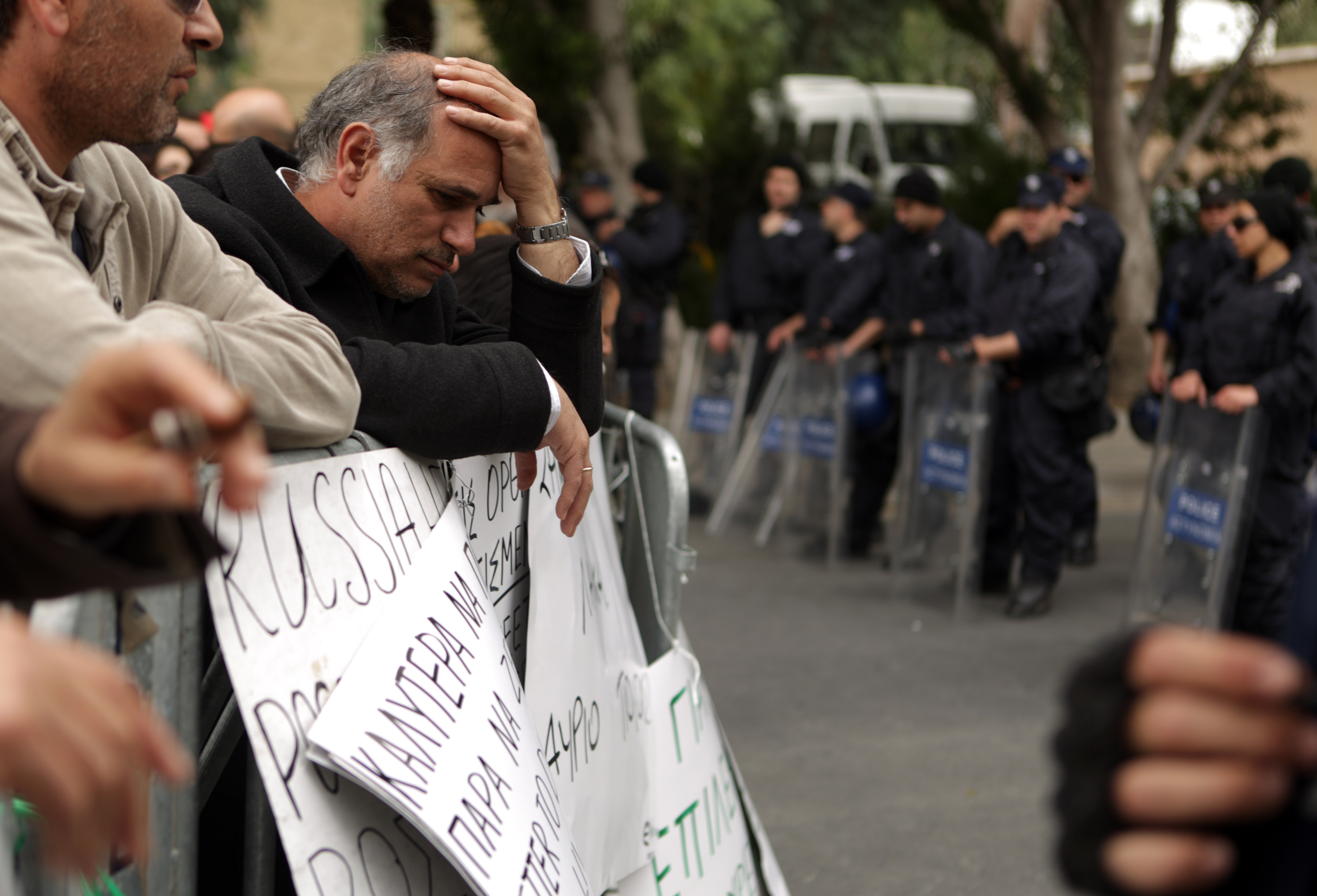
Ezra zooms out from it:
A half dozen [EU] countries have unemployment in the 15 to 25 percent range, with youth unemployment in the 30 to 60 percent range. Politics isn’t stable amidst that sort of pain — particularly when there’s a perception that some of the pain is being forced upon the country by richer, wealthier outsiders.
That’s what’s happening now. Christopher Pissarides, a Cypriot economist, won the Nobel prize in economics in 2010. But in an interview with BusinessWeek, his fury at the more powerful countries in the euro zone was sparklingly clear. “Small countries, be warned when joining the euro zone,” he said. “You could be bullied any time by your big brothers if it suits their political objectives.”
And that, again, is the view from Cyprus’s Nobel-prize-in-economics contingent. The man on the street, it’s safe to say, is even angrier.
Drum puts the Cyprus negotiations in perspective:
[T]he EU/IMF plan requires Cyprus to come up with about $7.5 billion as its share of the bailout. That’s roughly a third of their GDP. To put that into local terms, it would be as if the United States were being asked to pony up $5 trillion. This is about equal to all government spending—federal, state, and local—for an entire year.
Yglesias adds his two cents.
(Photo: An employee of Cyprus Laiki (Popular) Bank reacts as he takes part in a protest outside the parliament in Nicosia on March 22, 2013. Cyprus is locked in ‘hard negotiations’ with a troika of lenders to save the eurozone member’s banking system and economy in general from ruin, government spokesman Christos Stylianides said. By Patrick Baz/AFP/Getty Images)
Will Obama’s Israel Speech Matter?
Judis doesn’t expect the speech to do much good:
First, Israeli Prime Minister Benjamin Netanyahu’s narrow ruling coalition can’t survive without the support of Naftali Bennett’s Habayit Hayehudi party, which controls twelve seats in the Knesset. Bennett’s party is opposed to a two-state solution and exacted an agreement from Netanyahu that it would be part of a special super-committee that would oversee any negotiations with the Palestinians. Except for Tzipi Livni’s Hatnuah party, none of Netanyahu’s coalition partners, and few of the members of Netanyahu’s own Likud-Beiteinu party, favor meaningful negotiations with the Palestinians. Avigdor Lieberman’s Yisrael Beiteinu party, for instance, favors creating a two-state solution based on denying citizenship to Israel’s Arabs.
Second, the Palestinians do not appear ready for negotiations. Mahmoud Abbas has not proven to be the kind of strong political leader that could sell an agreement to his people. Hamas, which controls Gaza, and still has supporters in the West Bank, has said it will accede to an agreement along the lines of the 1967 borders, but it’s not clear that Abbas can get, and that Netanyahu will accept, an agreement along those lines. In the meantime, the Palestinian leadership remains deeply divided, which makes fruitful negotiations difficult.
Greening The Papacy
After the Pope’s inauguration on Tuesday, Alessandro Speciale notes Francis’ focus on the environment:
The pope’s homily was striking for its repeated references to environmental protection, highlighting what is likely to be a central theme of his papacy and setting up the 76-year-old pope as a leading activist against climate change.
When mankind fails to care for creation and for the weak, “the way is opened to destruction and hearts are hardened. Tragically, in every period of history there are ‘Herods’ who plot death, wreak havoc, and mar the countenance of men and women.” Francis addressed himself to “all those who have positions of responsibility in economic, political and social life,” asking them to be “’protectors of creation, protectors of God’s plan inscribed in nature, protectors of one another and of the environment.”
Maybe not a surprising stance from a fan of public transportation. And certainly not from a man who took the name Francis. In my view, the Church has a key role to play in defending creation from frenzied exploitation, in advancing the value of stewardship of nature, in seeing the protection of the planet not as a right or left issue, but as a sacred human duty, a reminder that this speck in a galaxy in an expanding universe is not ours alone, that our species’ dominion over it must always be balanced by care and love.
Boris For Britain?
Massie examines the growing possibility for London’s eccentric mayor to replace David Cameron as Tory leader:
[M]any Tories still consider Boris the Clown Prince Across the Water. This despite a record of achievement that is, by objective standards, negligible. Boris has performed adequately as mayor of the capital city, but even his staunchest admirers are hard-pressed to produce any lengthy list of achievements he has to his name. London’s mayor has relatively few powers. Like being governor of Texas, it sounds a weightier position than it really is. There is a fear that, just as the United States was lumbered with George W. Bush, so Britain could be stuck with Boris. Like Bush — whom Boris once described as a “cross-eyed Texan warmonger” — Johnson’s appeal is as much a matter of style as substance. He talks “Real Tory.” From his euroscepticism to his enthusiasm for lower taxes, Boris tickles the Tory party’s erogenous zones. And he does so in a fashion that seems to entertain the public.
I knew Boris when we were both late teenagers at Oxford and did what little I could to help him succeed me as president of the Union. He was then a natural – utterly unembarrassed by his privileged background, wallowing in his plummy upper crust accent, rushing around everywhere with that mop of blond hair. In subsequent years, he has had more sex scandals than one can easily recall, and as Alex notes, is basically a figurehead as mayor of London. I suspect he has found the perfect perch for his populist skills.
But Cameron is flailing. His austerity program has not delivered growth; his party is languishing in the polls against a jejune Labour leader, Ed Miliband; his relative moderation toward Europe has allowed a rival far-right party, UKIP, to grow like the Tea Party (without the fundamentalism). Last week, in another chaotic, incompetent move, Cameron even signed on to a Royal Charter, backed by what Hugh Grant has called a “dab of statute” to regulate press conduct, an unforgivable dismissal of the long British tradition of a free and raucous press.
When Boris became mayor of London, I was gob-smacked. But he has defied categories before and may again. He possesses charm in bucket-loads. He’s an instinctual Tory. His sense of humor – arguably the most important virtue in the British psyche, is priceless. He won re-election handily as London mayor and the Olympics were clearly another personal triumph. BoJo could win any Tory seat offered him – and immediately overshadow many cabinet members.
And Britain has had some truly dull but effective prime ministers – my faves are Baldwin and Major. But it is also the party that gave us Benjamin Disraeli and Margaret Thatcher. There is a radical streak in British conservatism that every now and again provides a truly memorable leader who reshapes the culture as well as politics. I never thought Boris could pull that off. Increasingly, I suspect he might.
 The Dish