Was The Iraq Insurgency Inevitable?

FILES--IRAQ 3 YEAR ANNIVERSARY PACKAGE--

Michael Ware, arguably the most intrepid of all the reporters in the country, emphatically argues: no.

There were Sunni interlocutors ready to cooperate with the US as early as the summer of 2003. Ware spoke to them. The rigidity of the ideology fomented by Bremer et al – the tribes no longer existed, the insurgency was a myth, all Iraqis were elated by liberation – blinded the US to the sectarian opportunities and pitfalls that lay in front of them. They were perhaps influenced by such writers as Bill Kristol and Lawrence Kaplan who wrote before the invasion the following encouraging sentences:

Predictions of ethnic turmoil in Iraq are even more questionable than they were in the case of Afghanistan… Unlike the Taliban, Saddam has little support among any ethnic group, Sunnis included, and the Iraqi opposition is itself a multi-ethnic force… [T]he executive director of the Iraq Foundation, Rend Rahim Francke, says, “we will not have a civil war in Iraq. This is contrary to Iraqi history, and Iraq has not had a history of communal conflict as there has been in the Balkans or in Afghanistan…”

Bill Kristol has suffered not a whit from this grotesque misjudgment (and never apologized), while thousands of young Americans lie dead because of it. But to ignore sectarianism in Iraq – to declare it a non-issue beforehand –  remains the most serious misunderstanding of the whole enterprise – and thus made swift adjustment to reality harder. History can turn on moments like this one:

My friend [a Sunni former Baathist] said: ‘could you explain something for me?’

‘If I can, of course. You know that.’

‘Then tell me. I used US satellite imagery to kill Iranians in the eighties. Some of us did Ranger or Pathfinder training in the States. Al Qaeda? Never in this country. Right?’ he asked, rhetorically. ‘We had no great love for Saddam, and didn’t mind you taking him down. If you came for the oil, then take it; we have to sell it to someone. And, we’re happy if the occupier becomes a guest and we host US bases, akin to Germany and Japan.’

He paused.

‘So, how is it we end up on the opposite sides of this thing? I don’t get it. I just don’t get it.’

And there it was. Spoken. An insurgency.

The war’s ultimate goal, he told me, to much nodding approval around the room, was for the Sunnis to fight and negotiate their way to a seat at the table of power in the country. A seat they felt they’d been egregiously denied.

But in the weeks and then months I was being told such things, I could not find a single attentive ear within the US mission. Government authority then rested with the Coalition Provisional Authority of proconsul Paul L Bremer. Along with declaring so foolishly that the tribes of Iraq were effectively dead, CPA officials I encountered merely sniffed at the insurgents’ desire to converse. They would buckle under the heel of a new, soon-to-be democratic government. There was absolutely no palpable interest in encouraging a dialogue. Perhaps, even, quite the contrary.

Eventually, the rapprochement happened, and allowed us to leave with some face. But what if the “enemy” had been engaged as a potential ally in the summer of 2003? How many lives would have been saved? And what would we be saying now?

(Photo: US Marines from the 2nd battalion/8 MAR, prepare themselves after receiving orders to cross the Iraqi border at Camp Shoup, northern Kuwait, 20 March 2003. By Eric Feferberg/AFP/Getty Images.)

Netflix Adultery

Maureen O’Connor confesses:

Three weeks ago I cheated on my boyfriend. He was perhaps twenty feet away from me, sleeping in my bed with the door open while I betrayed his trust on the living room sofa. At one point, he woke up and walked right by. “You’re not watching House of Cards without me, are you?” he asked. “No,” I lied without hitting pause. With my ear buds in, you could say Netflix was actually inside of me as my boyfriend returned to bed. I stayed in the living room and kept watching.

A few days later I confessed my crime. “But when?” he asked, at first in disbelief. “Wait, that night you stayed up late? And I asked what you were doing, and you said ‘working’? Mauree-ee-een!” Feebly, I offered to re-watch the episodes. “It won’t be the same,” he said. Overwhelmed with guilt, I lied again: “I only watched two episodes! You can catch up!” I had watched five episodes in one night and finished the season.

Yes, my husband committed adultery while I was traveling recently in exactly the same way. But he made up for it by watching it with me again. Speaking of House of Cards, readers offer feedback on my recent review of the series. One quotes me:

“It has some clumsy compressions, some melodrama, and a main character so close to Shakespeare’s Richard III I wonder whether Kevin Spacey’s breaking the fourth wall isn’t some sly reference to Richard’s chillingly fun soliloquies to the audience.” Have you not seen the BBC original?  There, the Shakespearean models are patent.

“MacBeth” is evoked in the Scottishness of Ian Richardson’s Francis Urqhardt and the chilling complicity of his wife.  The direct address to the audience is even more pronounced, and it excites the same conspiratorial engagement that the device does in “Richard III.”  What’s more, Richardson’s performance is more comical/cynical and seductive/sexy than Spacey manages (or dares).

I can only imagine the American producers played down these aspects for an audience they thought would be less familiar with the Elizabethan precursors and less likely to appreciate a theatrical device on television.  It is the loss of the Netflix version.  It strikes me as perverse to jettison an aspect that made the original series so novel. We’ve seen any number of Shakespeare plays cast in modern dress, but far fewer modern political drama presented in Shakespearean drag.

Another:

For the life of me, I can’t recall if you had mentioned seeing Kevin Spacey as Richard III when he played the role in a traveling production of the Shakespeare play, or if you were aware that he had. Spacey and/or the writers are no doubt drawing on the experience. I had the good fortune to see the play in San Francisco. He was fantastic in the role.

Another:

Not subscribing to Netflix, I haven’t seen the new House of Cards. But your comments on this series reminded me of the greatness of the British original. I own a DVD set of the original series and watch it every few years. In the British version, the anti-hero, Francis Urquhart (“FU” – subtle, huh?) seems to me to clearly be a Tory. The genius of the show is the breaking of fourth wall, as you mentioned. But this occurs most effectively early in the series, when FU is taking us into his confidence. He’s truly delighted to be so clever, and his delight sweeps the viewer along, in effect making the viewer a co-conspirator. Of course, by the end he’s not the one who’s quite so clever or ruthless.

Moore Award Nominee

“I advise everyone to pay very close attention to [Republican Senate candidate] Dan Winslow’s platform. He has a 100 percent ranking from the gun lobby and he’s for the legalization of marijuana. He wants us armed and stoned,” – Elizabeth Warren. Update from a reader:

Elizabeth made her remarks at the annual St. Patrick’s Day Breakfast, which is Boston’s version of the White House Correspondents’ Dinner. It’s filled with politicians launching zingers at each other. “St. Patrick drove snakes out of Ireland … to Wall Street.” Nominating Dish awards out of these speeches would just be too easy, and not exactly fair.  Context matters.

The Power Of Coming Out

Jorge Pazos v Orlando Cruz

Barro describes coming out of the closet as a “duty”:

San Francisco Supervisor Harvey Milk got this right in 1978, when he admonished his fellow gays and lesbians to come out of the closet in order to build opposition to a ballot measure that would have banned gays and lesbians from teaching in public schools: “Come out to your relatives. I know that is hard and will upset them but think how they will upset you in the voting booth.”

This obligation is only stronger now that social acceptance of gays and lesbians is higher, meaning the cost of coming out has declined. And it lies particularly with those in positions of privilege and power, who have the resources to withstand negative reactions. Coming out was stressful for me like it is for most people, but let’s be real: Announcing that you’re gay in a wealthy family in a progressive suburb of Boston as you’re about to enter Harvard University is a pretty easy hand to play.

I’m afraid I have the same conviction, possibly burned more deeply by the memory of the plague. I remember one HRC dinner back in the day when I was asked to speak. I asked people who were out to their families, friends and co-workers to put their hands up. In a well-heeled, tuxedoed, bejeweled crowd, only about a third put up their hands. I asked who were not out – and another third went up. I then said, in words I reiterate today to anyone in the closet writing checks to gay groups, “Why don’t you leave right now and come back when you’ve done something for gay rights?”

If you’re reading this, and your hand went up as in the closet, my question stands.

(Photo: Openly gay pro boxer Orlando Cruz celebrates victory over Jorge Pazos at Kissimmee Civic Center on October 19, 2012 in Kissimmee, Florida. By J. Meric/Getty Images.)

The Derangement Of Tony Blair

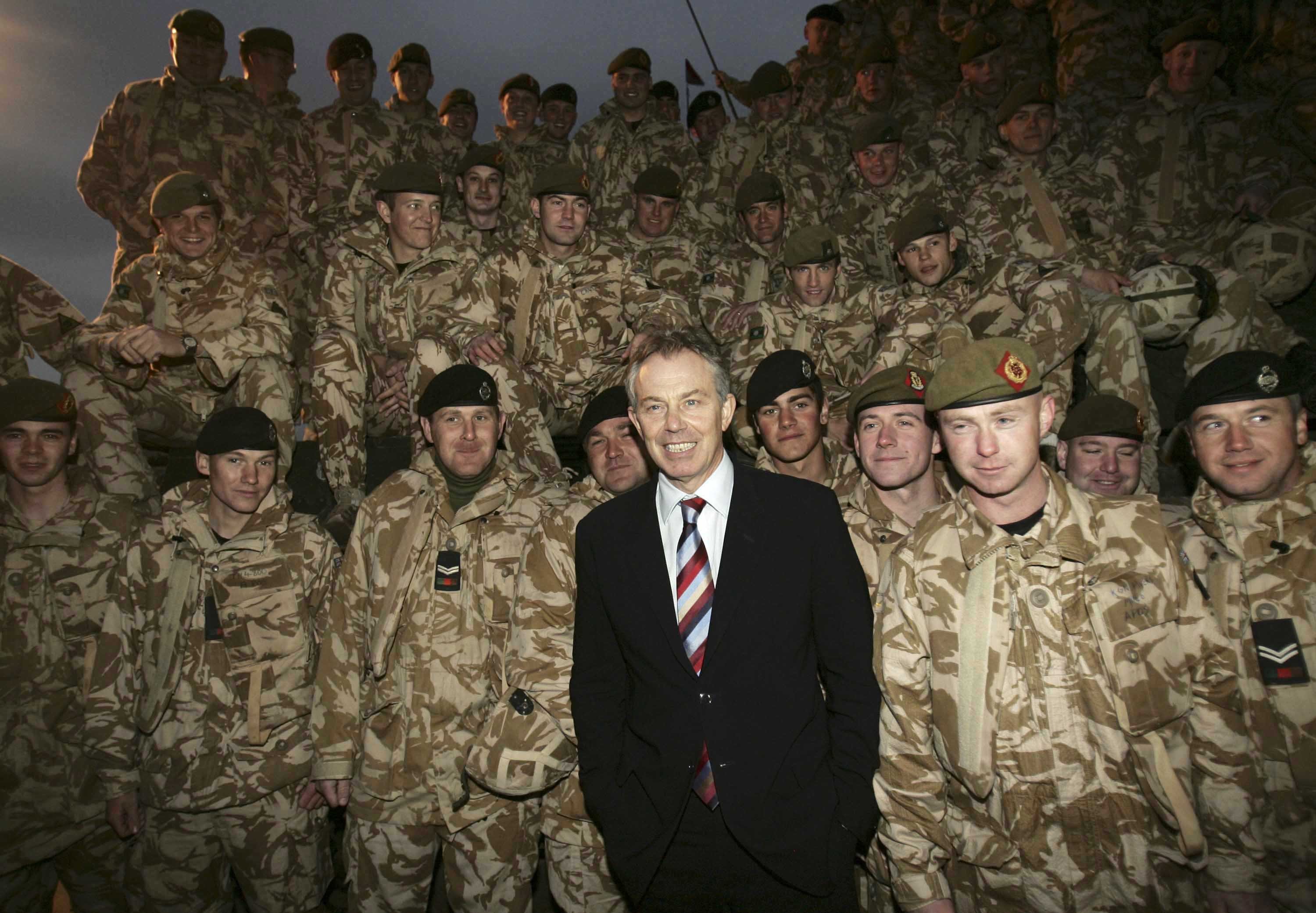
Tony Blair Meets With British Troops in Basra

Obviously, I can sympathize with his stance in 2002 and 2003. It was mine. His case for war was never as connected to the presence of WMDs as Bush’s, and more to the eradication of a tyrannical monster, and so he was less undermined by the falsity of the evidence he vouched for. But the denial here is phenomenal:

“When people say to me, you know, ‘Do you regret removing him?’ I say, ‘No, how can you regret removing somebody who was a monster, who created enormous carnage?'”

He added: “And if you look at what’s happening in the Arab Spring today, and you examine what’s happening in Syria — just reflect on what Bashar Assad, who is a twentieth as bad as Saddam, is doing to his people today, and the number of lives already lost, just ask yourself, ‘What would be happening in Iraq now if he had been left in power?'”

But the over 100,000 Iraqis who died were living in a country occupied by UK and US forces obligated by international law to keep order, not one governed by a despotic brutal dynasty whose record of slaughtering its own people is not in dispute. (And one twentieth as bad as Saddam? Ask the people of Homs.) And Blair’s argument that the Arab Spring proves that Iraq under Saddam could well have become another Syria if the Shiites had revolted again, while well-taken, nonetheless presumes some kind of Western responsibility to somehow minimize or direct forces of change we neither understand nor control. It’s a benevolent imperial impulse – without connections to vital national interests.

That was Blair’s error, as well as part of mine. What you see still in Blair is a refusal to think about unintended consequences. He retreats to an a priori moral defense of unseating a monster, without weighing the devastating ripples from that mighty fall. I remember thinking before the war started that it had to be worth it, purely because ridding the earth of a man who tortured children was so moral a thing it outweighed every other doubt. Self-righteousness blinded me to the extent my critical faculties were failing. I guess if Blair were to admit that, he would have to admit some responsibility for the mass slaughter and chaos the war fomented. That’s hard to do. But it tells you a lot about Blair that he cannot.

(Photo: Prime Minister Tony Blair meets with British soldiers on duty in Basra on December 17, 2006 in Iraq. By Peter Macdiarmid/Getty Images)

Journalist Accountability Watch

It was heartening to see the NYT’s editorial on the Iraq War today, with its ringing conclusion:

The Iraq war was unnecessary, costly and damaging on every level. It was based on faulty intelligence manipulated for ideological reasons. The terrible human and economic costs over the past 10 years show why that must never happen again.

And where is the acknowledgment that the NYT, especially Judy Miller, played a critical role in reassuring skeptics that the WMD threat was real? I wish newspapers would hold themselves accountable in the same way they expect government officials to.

Why Take His Name? Ctd

The thread continues:

I’ve recently been considering this because my friends have been getting married lately.  Taking the husband’s last name seems antiquated, keeping your original last names seems standoff-ish (much less what last names do your children get?), and hyphenated names seem like a future disaster where hyphenated people marry other hyphenated people (e.g. The Tikki Tikki Tembo Kerfluffle). Imagine three generations down the line of only people with hyphenated last names getting married.  Bubbling-in last names for the SATs would be a mess.

Solution?  Blended last names.  Take the best of each last name and combine it to form a new family name.  Yes, your family name wouldn’t last (tribalism is lame anyway), but imagine the fun!  Say a Jones marries a Bloomberg.  You could go Joomberg, Blones, Bloomes.  The possibilities are endless.  Couples could have fun picking their new last names, signifying their independence and new beginning, and you could go any number of different directions – ironic names that you regret later, serious names, names which hold a special significance, etc.

Bonus:  Future genealogists would hate it.  The improved record keeping of the 20th and 21st century would be complicated by fun, new puzzles for future historians.

Another:

My wife and I came up with a novel solution to the problem – we came up with a new name.

And no, I do not mean a hyphenated name.  Our new last name is a combination of the two names that uses one instance of each letter to make a new last name while at the same time retaining the sounds of both.  Thus Lohr and Miller became Mihloer.  Our two children were the first to have the new name since it turns out to be a bit complex to change your own last name to something that isn’t your spouses.  Children, on the other hand, can literally be given any name (see Louis CK for more on this [above]).

Despite the difficulties, we love it. We came at it from the perspective that all last names are invented (often arbitrarily based on trade or location) and are relatively young in the scheme of things.  In some cultures, last names are transient. In Iceland, for instance, a man named Erik Gustavson could have a son named Gustav Erikson and daughter named Ingrid Erikdottir.  So we decided to create something new – as in, our new family starts “now”. Whether our children keep their name (we have both a son and a daughter) because it’s special or go along with mainstream tradition is yet to be seen, but it is all very fun, sorta like a surname adventure!

Another wasn’t quite as creative:

I never planned to change my name directly to a husband’s and I married a man who would have been uncomfortable with a woman who would do it without thinking.  In fact, as one of three sons himself, none of the three wives/daughters-in-law changed their names!

We did attempt to find a good combination of our two names, but none of the combos worked at all.  We ended up trading last names for middle names, so I’m Myfirstname Hislastname Mylastname, and he’s Hisfirstname, Mylastname, Hislastname.  In the end, he was the one who ended up giving up a name – his middle name.  My mother had tired out by her fourth child and gave me no middle name, figuring I’d just lose it when I got married anyway.

For our children we decided that boys would have his last name and girls mine – the other as the middle name.  Then we went on to have all boys, so no one knows about that plan unless we explain it.  However, we met another family at school who has a daughter with the mom’s last name and a son with the dad’s last name.  We also ran into an older woman in the neighborhood who had done the same.

In many ways, it’s easier.  Before caller ID, I knew that calls for Mr. Mylastname or Mrs. Hislastname were solicitations and those imaginary people were never here.  I don’t care at all if I’m called Mrs. Hislastname by kids at their schools or the like, nor does my husband mind the other.  Our oldest son (early 20s) is pretty adamant that he wouldn’t want to marry someone who would want to change their name.  I point out that it’s a choice, albeit one that should be made with thought.

Political Parties Can’t Flip Flop?

Seth Masket points out that dramatic shifts are very rare:

The Democrats’ shift from being the party of white supremacy to the party of civil rights was pretty much a singular act in American political history. Parties rarely pull off a major shift on a hot-button issue (that’s what killed the Whigs in the 1850s), and indeed it was a very costly shift for the Democrats, breaking their electoral lock on the southern states and ultimately ending their four-decade run of controlling the House of Representatives. To be sure, parties do evolve slowly on some issues, but the parties are much better defined by consistency than change.