Crowdsourcing On Steroids, Ctd

Readers keep the popular thread going:

I think most people who “donate” on Kickstarter think of themselves as something like small-scale patrons of the arts. I know it sounds silly when applied to a TV show instead of a symphony or museum, but people with less money and low(er)brow tastes are allowed to donate some of their money towards art too. I agree there are issues here with respect to Warner Bros being a corporate interest that stands to make money off of this, but that’s not really enough in my mind to condem the entire thing. Everyone who donated already knew that.

Another is more skeptical of the movie corporations:

I think supporters of the Veronica Mars Kickstarter campaign are missing what a dangerous precedent it sets. If the studios realize they can mitigate financial risk simply by crowdsourcing funds from the fans of established properties, what’s to stop them doing it for more and more, larger and larger productions? And why stop at production expenses? “Oh no, Firefly fans! We got the new movie made, but we can’t afford to distribute it to theaters! Donate $50 and you get a deluxe Blu-ray!” While I’m sure Veronica Mars creator Rob Thomas is not being cynical in this situation, one should never doubt the power of Hollywood studios to cynically manipulate consumers if it means they can save a buck.

Rob Thomas emails the Dish and, in part, addresses our readers’ concerns over corporate influence:

The least important thing I’ll say is this. I am thrilled this debate is happening. I am an avid reader and early subscriber to The Dish. I live on this site. Before we launched the Kickstarter drive, I wondered if there would be a Dish debate about the auspices of the Veronica Mars movie. I am so pleased that there is.

I have likewise followed with great interest the way you handled the transition on the Dish to subscriber service. I knew that they were similar appeals in that both projects have such a community feel to them. We’re very different products, but the people who follow us are devoted. I paid for the subscription for the content, yes, but also because I really wanted it to be successful. I know there’s probably quite a bit of that with our Kickstarter as well.

Other people have made the case effectively that we’re not asking for charity. We’re not asking for people to donate for the greater good. I understand why it is totally appropriate for public television to offer a $5 tote bag for a $100 donation, but it would be unseemly for our project to do that. We’re not. We’re offering great rewards for the pledges.

A script, a T-shirt and a download of the movie for $35? That’s a helluva deal. What we’re doing here is pre-selling the movie. You can think of the Kickstarter page as a store. If you like the product we’re selling, buy in; if not, don’t. What Veronica Mars fans are doing is taking the risk out of making the movie by showing Warner Brothers there is demand for the product. I think everyone wins here. The fans get to see a movie they wouldn’t see otherwise. Kristen Bell and I get to finally make our passion project, and, God-willing, it’s profitable and Warner Brothers makes more movies this way and we get to see more of our favorite titles get a second life.

The other important point I want to make – the studio people I am working with on this? They are not chomping on cigars and demanding to see balance sheets. They want to make this movie. They’re fans of the show. They’re fans of movies in general, and they’re excited about opening up an avenue that could allow them to make more cool projects. There’s actually a lot of bravery on the part of the executives who pushed to make this happen. The easiest thing at a big corporation is to say no. They knew there would be a vigorous debate about this model. They said yes because they believe, at the end of the day, the consensus will be that everyone benefited.

Hey, if Freaks and Geeks follows our model, I will happily pledge whatever I can to make that movie happen.

Today In Counterfactual History

A combo shows (L): Iraqi ringing a rope

Bobby Ghosh believes that Saddam would have survived the Arab Spring:

Saddam forbade satellite dishes, and economic sanctions–in place since his troops were kicked out of Kuwait in 1991–meant Iraqis could have neither personal computers nor cell phones. That meant no Facebook, no Twitter, not even text messages. And no al-Jazeera to spread the word from Baghdad to other cities. Unlike Ben Ali and Mubarak, Saddam would have had no compunction ordering a general slaughter of revolutionaries; and unlike the Tunisian and Egyptian military brass, the Iraqi generals would swiftly have complied. They had already demonstrated this by killing tens of thousands of Shi’ites who rose against the dictator after his Kuwaiti misadventure.

Max Fisher thinks that possibly “the most apt comparison for how Saddam Hussein’s Iraq would fare in the Arab Spring isn’t Syria, but Algeria”:

Though Algeria is ruled by an authoritarian, nationalist, military-aligned government, and though popular discontent appears high, there has been no revolution. There are many theories for why this might be, but one of the most persuasive comes down to uprising exhaustion. The county endured an awful civil war from 1991 to about 1999, which the regime won. In the thinking of some Algeria analysts, the legacy of that conflict has left the would-be protesters too tired, too wary of bloodshed and too weak to rise up again. In this thinking, the case for Hussein’s survival isn’t that he would crush an uprising, but that the uprising, like in Algeria, would never really happen.

(Photo: A combo shows (L): Iraqi ringing a rope around a giant bronze statue of toppled Iraqi president Saddam Hussein in Baghdad’s al-Fardous (paradise) square on April 9, 2003. (R): Iraqi women sitting under the newly erected ‘Statue of Hope’ at the square that has taken the place of the former statue of Saddam. By Ramzi Haidar (L) and Timothy A. Clary (R) /AFP/Getty Images)

Dreaming Of An Online Utopia

Discussing his new book, Evgeny Morozov takes aim at Silicon Valley’s culture of “solutionism”:

“Solutionism” for me is, above all, an unthinking pursuit of perfection—by means of technology—without coming to grips with the fact that imperfection is an essential feature of liberal democracy. As I point out in the book, there have been many “solutionist” impulses in the past—lots of other authors have addressed it, albeit under different names (like “rationalism” or “high modernism,” for example). What makes today different is that the overall excitement about “the Internet”—I find this concept so sickening and suffocating that I use it in scare quotes throughout the book—makes us blind to the pitfalls of solutionism and justifies many silly interventions and reform agendas.

Previous Dish coverage of Morozov’s book here.

A History Of Plaudits

Megan Garber looks back at “how we liked things before we Liked things”:

Before telephones allowed for Gallop-style surveys, before SMS allowed for real-time voting, before the Web allowed for “buy” buttons and cookies, Roman leaders were gathering data about people by listening to their applause. And they were, being humans and politicians at the same time, comparing their results to other people’s polls — to the applause inspired by their fellow performers. After an actor received more favorable plaudits than he did, the emperor Caligula (while clutching, it’s nice to imagine, his sword) remarked, “I wish that the Roman people had one neck.”

(Image by Tom B from the blog Thumbs and Ammo, which replaces guns with some positive reinforcement)

A Free Education Until Employment

App Academy “offers a 9-week, 90-hours-a-week boot camp to turn programming novices into code jockeys.” Students don’t pay tuition until they get a job:

“We don’t want to charge up front because we feel pretty strongly about tying the payment to the outcome,” says [co-founder Kush] Patel. “If they can’t find a job, we’ve screwed up somehow.”

In tech hubs like Silicon Valley, he’s not wrong. Qualified programmers in cities like San Francisco and New York fend off recruiters as multiple companies bid for their services. New recruits signing up for App Academy promise to pay 15 percent of what they earn during their first year on the job, payable over the first six months after they start working. For the school, the math isn’t too shabby if they succeed at placing their students. If 15 students get jobs at $80,000 salaries, that works out to a $180,000 commission.

The Reputation Economy

Om Malik wonders what effect the ability to rate everything will have on employer-employee dynamics. He notes that freelance drivers for Uber, the app that connects people to luxury car service, protested after their “accounts were deactivated because of passenger feedback”:

It is easy to understand [Uber co-founder and CEO Travis Kalanick’s] standpoint – our customers don’t like these drivers, so we are cutting them out. And I can understand the drivers’ point of view: They have never been rated and discarded like this before, and are rightfully angry. … In the industrial era, labor unrest came when the workers felt that the owners were profitting wrongfully from them. I wonder if in the connected age, we are going to see labor unrest when folks are unceremoniously dropped from the on-demand labor pool. What are the labor laws in a world where workforce is on demand? And an even bigger question is how are we as a society going to create rules, when data, feedback and, most importantly, reputation are part an always-shifting equation?

Meanwhile, in an effort to highlight the benefits of this “state of connectedness,” Ryan Lawler points to a recent case in which an Uber driver was accused of sexual assault:

Do a quick search on Google or Google News for “cab driver rape” and you’ll find no shortage of articles detailing such cases. What stands out about the news stories in those links is the unfortunate and sad truth that sexual assaults by taxi drivers are not as unusual as they should be.

But Uber’s got something that regular taxi or limo services don’t have. So do SideCar and Lyft. They have an identity system that connects a driver to a ride. They have rating systems to help determine which drivers are doing a good job, and which aren’t. They have feedback systems through which unhappy passengers can report something that went wrong. And, in the case of a crime, they have time, date, and ride logs so they can quickly identify perpetrators. Which means, if you were a criminal and somehow got through the pre-vetting process for any of these new services, you’d have to be an absolute idiot to commit a crime while on the job.

The Iraq War Still Has Supporters

Iraq Mistake

Gallup found that 53% of Americans think the war was a mistake and 42% percent do not. Kevin Drum is puzzled:

How is it, ten years after the fact and with the benefit of hindsight, that 42 percent of the country still believes that invading Iraq wasn’t a mistake? What would it take to convince these people?

A HuffPost/YouGov poll asked a slightly different question: “All in all, considering the costs to the United States versus the benefits to the United States, do you think the war with Iraq was worth fighting, or not?” The response:

Only 24 percent of respondents to the new poll said they thought the war had been worth fighting, while 54 percent said it had not been. Another 22 percent said they were not sure. Three-quarters of Democrats and 55 percent of independents said the Iraq War was not worth fighting. But Republicans were more likely to say that it was worth the cost than it was not — by a 47 to 30 percent margin.

Climate Change Can’t Be Undone?

Joe Nocera makes the claim (NYT) that reducing emissions from Chinese coal plants “would do far more to help reverse climate change” than preventing the construction of the Keystone pipeline. Joe Romm fumes:

This notion that we can reverse climate change by cutting emissions is one of the most commonly held myths — and one of the most dangerous, as explained in this 2007 MIT study, “Understanding Public Complacency About Climate Change: Adults’ mental models of climate change violate conservation of matter.”

The fact is that, as RealClimate has explained, we would need “an immediate cut of around 60 to 70% globally and continued further cuts over time” merely to stabilize atmospheric concentrations of CO2 – and that would still leave us with a radiative imbalance that would lead to “an additional 0.3 to 0.8ºC warming over the 21st Century.” And that assumes no major carbon cycle feedbacks kick in, which seems highly unlikely.

He goes on to insist that this “doesn’t mean climate change is unstoppable — only that we are stuck with whatever climate change we cause before we get desperate and go all WWII on emissions.”

Choosing To Stay Home

Work week by sex

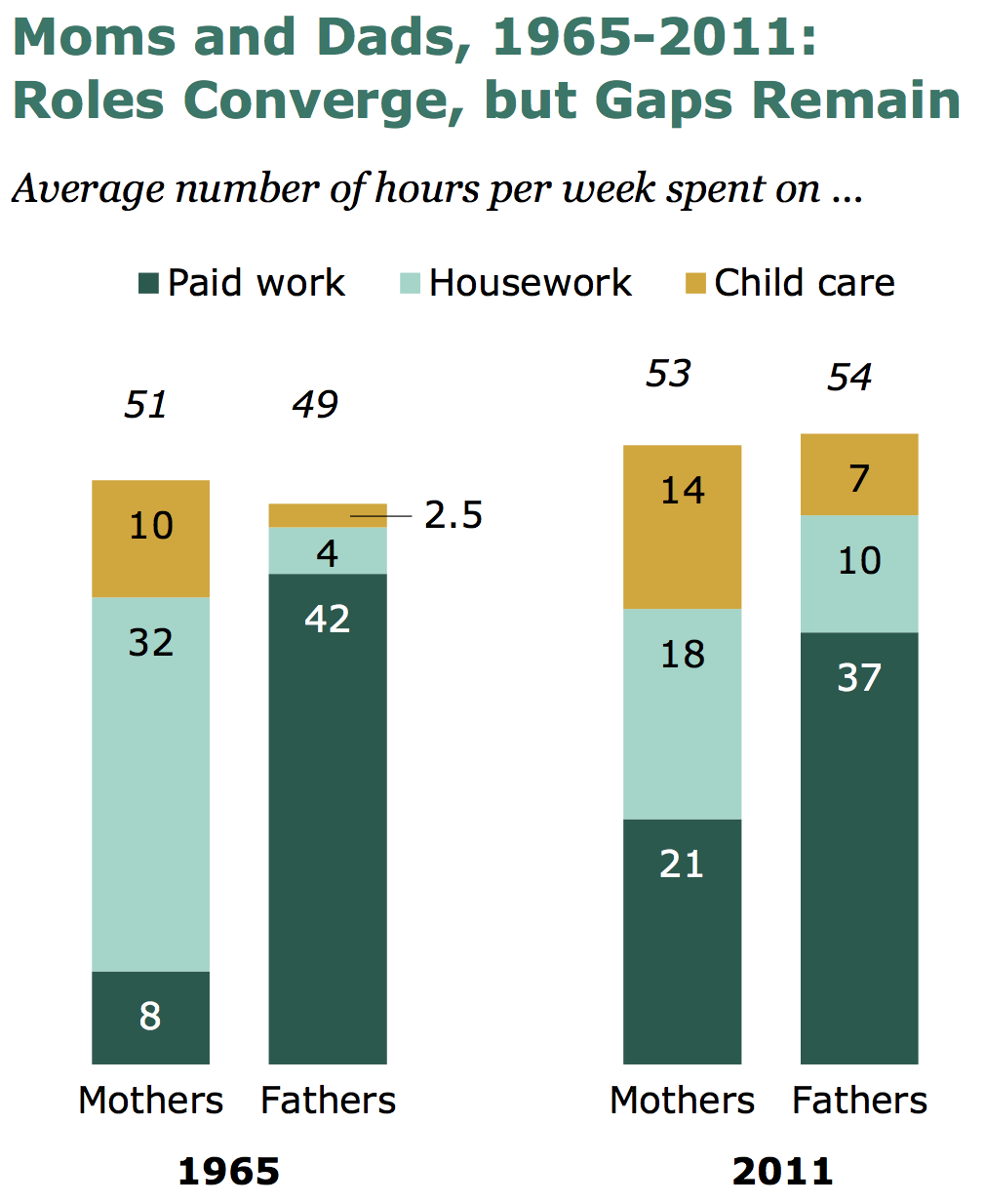
Lisa Miller sticks up for feminist stay-at-home moms:

Feminism has never fully relieved women from feeling that the domestic domain is theirs to manage, no matter what else they’re juggling. There is a story, possibly apocryphal yet also believable, of an observer looking over Secretary of State Madeleine Albright’s shoulder during a Cabinet meeting in the late nineties. On the pad before her, the secretary had written not “paths to peace in the Middle East” but “buy cottage cheese.” (Albright declined to comment for this story, but while promoting a book in 2009, she told an audience that all her life she made it a point always to answer phone calls from her children, no matter what else she was doing. “Every woman’s middle name is guilt,” she said.)

Jessica Grose objects to the premise of Miller’s article and reframes the issue:

[W]hen you strip away the weird gender essentialism and the fact that the article is ginning up a trend where there is none, you do see the core of what the current “problem that has no name” is. It’s time. When you’re in a marriage where both people have not-extremely-lucrative careers and you throw a child into the mix, something, someone has to give. As Miller puts it, “When two people need to leave the house at 6 a.m., who gets the children ready for school? When two people have to work late, who will meet that inflexible day-care pickup time? And who, finally, has the energy for those constant transactions?” No wonder some families are deciding one parent will take on primary responsibility for the kids in this morass.

(Chart from Pew)