The Cost Of Free Libraries

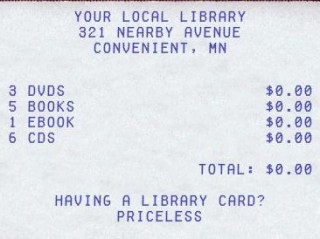
D. J. Hoek isn’t a fan of an image (seen below) that has been bouncing around social media recently:

[L]ibraries, as we know, do not exist for free. They cost their communities—whether composed of taxpayers, tuition-payers, donors, or a combination—a substantial amount of money. It’s well-intentioned to emphasize that libraries
provide materials and services without exacting immediate payment from users for each transaction. But today it is at best a mistake and at worst self-destructive to underrepresent the considerable ongoing investment that the members of a community make to have library collections, technology, personnel, and facilities available to them. … Rather than promote the “free library,” let’s remind our communities of their great investment and of the tremendous wealth of returns they derive from that investment: materials, specialized assistance, and programming. That doesn’t mean libraries are free. It means that the cost of libraries is worth every cent.
Claire Kelley considers one possible solution to library budget cuts:

As libraries respond to the challenges facing them, some have suggested adding a small circulation fee—something like fifty cents—to make up for cut funding. Last year in The Atlantic, Keith Michael Fiels, executive director of the American Library Association, responded to an Atlantic editorial that argued for instituting such a policy. He worried that collecting fees would be a barrier for entry for the people who needed library access most, and that the amount of revenue generated would be less than what public support and municipal budgets could provide.

Why Take His Name? Ctd

Readers continue the recent thread sparked by Jill Filipovic:

One of the most common complaints I hear from women who don’t want to change their name is the fear that their family name will “die out,” and I’ve heard the reverse from men as well. So I think the default last name of a newly married couple should be whichever one of their names is shared by the fewest guests at their wedding … and negotiations can go from there.

Another reader:

The truth is, it’s easier when you share a last name, and it’s a wonderful symbol of your shared life. That said, it doesn’t have to be *his* name; I have friends where the husband took her last name, where they both hyphenated. My husband and I chose a new last name – a shared family name.

Another:

When my wife and I first got together and were talking about marriage, without even prompting her, I said simply “Hey, what would you think about me taking your last name?” Why did I offer?

Because I come from a family of all boys. If my father has any concerns about “his name passing on”, he has three sons to do it for him. I know both of my younger brothers are far too close-minded to ever consider it themselves, so why not be the first one to go a different route?

She was surprised I offered, but as we talked about it, we at least got to a point where it wasn’t an assumption but a conscious choice of which direction we were going to go. We did ultimately decide to retain my name and she dropped her “maiden” name. (Notice we still call it a “maiden” name, a term that hasn’t been relevant for at least 500 years …)

Another:

This June I will have been married for 20 years.  When my wife and I got married, she chose to continue to go by her maiden name.  I wasn’t thrilled, probably because it threatened my manhood.  Over the last 20 years my views on so many things have changed but not on this issue.  The problem for me is that it feels like hedging your bets in case things go wrong or possibly infers, whether true or not, a lack of commitment, like we are not really a family but rather a group of individuals working together, at least for now.  So the real issue for me (at this point in life) is not the woman taking the man’s name, but rather the family unit having separate names.

We will most likely be in the position in the near future of adopting a foster child and I wonder how she would feel if we told her she won’t be getting my last name or my wife’s.  I can only think she would feel that maybe it’s because we might want to give her back some day.  And if we don’t do that, whose name does she get and what does that mean to her?  There is something about a unit of people calling themselves by the same name, family or group or otherwise, that seems to naturally pull us together.

One more:

Since I was a teenager I’ve adopted the quip: If I get married, the only way I’ll change my last name (my first name being Dorian) is if I marry someone with the last name ‘Gray.’ When I cavalierly explained this to my future husband, I got a stunned silence. I felt bad that it didn’t even occur to me that he would just assume that I’d take his name when we got married and thus be shocked that I announced that I wouldn’t be. “Are you ok with that?” I asked. “Uh, yeah I guess – it just never occured to me that you wouldn’t change your name,” he said.

I tried to explain that it’s very much a part of my identity, of who I was, that it’s the name of my business and had been for years so it wasn’t practical to change it, and not least of all, the whole connotation of ‘ownership.’ And then to make a point, I asked him if he’d be willing to change his last name to mine and he looked horrorstruck: “No!” “Well,” I said, “that is how I feel about not wanting to change mine.”

A lightbulb went off and I think he really saw what it meant for a person to give up their name.

More reader discussion at our Facebook page.

Cruzing For A Bruising

Orlando Cruz is an openly gay boxer who just won his second fight as an out figure, wearing a rainbow-adjusted Puerto-Rican flag on his pants, smacking his opponent on the ass, and then punching him out. Money quote from Andres Duque:

That’s not the way a gay boxer is supposed to act: The first key moment happened during the second round and it is one of those things that people in gender study classes love to deconstruct in 300-page analytical books.

The Daily Wrap

Screen shot 2013-03-18 at 2.31.16 PM

Today on the Dish, Andrew continued to work through Washington’s (and his own) failures leading up to the Iraq War, unpacked the latest polling data on marriage equality, and liked Francis as we filled in the details on his past. In home news, he dove into the details on our first month behind the meter and dissected the similarities and differences between the Dish and Veronica Mars.

In political coverage, Bill Clinton drastically underestimated the scope of the Iraq War,  a Republican pot prohibitionist was forced out of the cannabis closet, and favorability for the death penalty declined in the face of bad PR. As Hillary voiced her support for equality, some readers saw an empathic deficit in Portman’s sudden reversal on same-sex marriage, while others cheered his progress. Overseas, the Cypriot financial sector struggled through the weekend, with potentially dire consequences for the rest of Europe.

Elsewhere, Bjørn Lomborg pointed out the irony of Earth Hour and we debated resurrecting recently extinct species. Technological advancements graduated from the Defense Department to your kitchen and banished UFOs. Rebecca Davis O’Brien brought us along on her morning commute, Greg Beato employed big data in hiring and firing, while Chris Albon felt tied down by the digital record. Christine Haughney showed us that quality still matters in journalism, Google Reader’s coming death opened up an opportunity for Twitter, and authors tried to game the Amazon rankings,

In arts and leisure coverage, Scott Tobias had his fill of formulaic documentaries, Steven Sodergbergh’s latest film twisted us around, and while sound engineers spun audio gold from everyday noises, we were left with unanswered questions about the explosion of the Death Star. Amanda Nazario walked us through a day in the life of a dog-walker-for-hire, diet soda may be to blame for ballooning waistlines, and whiskey makers stretched their boundaries. We crossbred a horse and a naked mole rat in the FOTD, framed a frost-covered tree in the VFYW, and Ze Frank instructed us on the finer points of fecal flirting in the MHB.

D.A.

Should We Bring Species Back To Life?

Dinosaurs are out of the question now, but Stewart Brand pushes to revive more recent extinctions:

Close examination of the genomes of extinct species can tell us much about what made them vulnerable in the first place. Were they in a bottleneck with too little genetic variability? How were they different from close relatives that survived? Living specimens will reveal even more.

Stuart Pimm disagrees:

In every case, without an answer to “where do we put them?”—and to the further question, “what changed in their original habitat that may have contributed to their extinction in the first place?”—efforts to bring back species are a colossal waste.

Taking Risks With Whiskey

Bourbon distillers, long bound to the traditional barrels of American oak, are beginning to experiment:

[Distiller Chris] Morris put standard six- to seven-year-old Woodford Reserve in a maple wood barrel as well as former sweet wine casks to lend more chocolate, nutty and dark cherry flavors not usually found in bourbon. Much like the original Woodford Reserve mingled with the new charred American oak barrel, the “Four Wood” chemically reacted with its barrel wood to produce a particular set of flavors. The former fortified wine barrels had wine soaked into the wood and are larger than standard whiskey barrels, giving the Woodford Reserve a larger surface-to-whiskey ratio as well as the small-scale fruity flavors that remained from the barrel’s former alcohol. …

Aging has even gone beyond stationary warehouses.

For its Ocean-Aged Bourbon, Jefferson’s Reserve placed several barrels on a 126-foot ship and let the casks cruise at sea for nearly four years. The increased oceanic air pressure (compared with its warehouse), along with the Panama Canal’s extreme heat pushed the whiskey deeper inside the wood, causing the wood sugars to caramelize and add a rumlike black hue. The whiskey breathed a little easier, too, says Trey Zoeller, who co-founded Jefferson’s Reserve. “The porous nature of the barrel not only allows for evaporation of bourbon out of the barrel, but also [for] the barrel to breathe in the salt air, giving it a briny taste,” Zoeller notes.

Update from a reader:

Larger barrels will have a smaller surface-to-volume ratio than smaller barrels.  This applies to other objects as well – it’s why small animals lose heat faster than large animals in cold environments.

Should Trans Surgery Be Covered? Ctd

College student Lucas Waldron shares his own struggle to afford $8,400 top-surgery:

There is little hope that private insurance companies will start covering transgender surgeries because of their consistent argument that the procedures are “cosmetic” or “unnecessary.” The Affordable Care Act has been falsely identified as a progressive and inclusive program for transgender individuals when, in reality, the act only limits discrimination by medical providers. Under ObamaCare, an insurance company cannot consider my transgender identity a “pre-existing condition,” but they sure as hell can refuse to cover my surgery.

Previous coverage of Donnie Collins’ story here and here.

Face Of The Day

Prince Charles And The Duchess Of Cornwall Visit Middle East - Day 8

A pink horse rests ahead of its appearance in a cavalry event in honour of the Prince of Wales and Duchess’s of Cornwall’s visit on the eighth day of a tour of the Middle East in Muscat, Oman on March 18, 2013. The Royal couple are on the fourth and final leg of a tour, taking in Jordan, Qatar, Saudia Arabia and Oman. By Chris Jackson/Getty Images.

The Bestseller Game

Gabe Habash tries to calculate how many book sales it takes to become an Amazon bestseller, something Amazon refuses to reveal:

Like everyone else, [we] couldn’t get sales numbers from Amazon, but by studying the print bestseller list for a two-week period, we were able to determine that a title in Amazon’s top five averages 1,094 print copies sold across all channels, including other retailers, on a typical day. And because the general industry thinking is that Amazon accounts for about 30% of print sales, that means it likely takes around 300 copies per day to reach Amazon’s top five, depending on the day of the week and the time of year.

Or you could just hire a company to buy your way to the top (WSJ):

[Author Soren] Kaplan purchased about 2,500 [copies of his own book] through [a marketing firm named] ResultSource, paying about $22 a book, including shipping, for a total of about $55,000. Mr. Kaplan says he also paid ResultSource a fee in the range of $20,000 to $30,000. With 3,000 copies sold in its first week, [Kaplan’s book] hit No. 3 on the Journal’s hardcover business best-seller list. It hit No. 1 on BarnesandNoble.com on Aug. 7. By Nielsen BookScan’s count, about 1,000 print copies have been sold in the six months since.