Sounds Of The Silver Screen

Gautam Pemmaraju marvels at the work of the foley artist:

If you have ever been set the peculiar task of imagining and creating the sound for ‘Alien Pod Embryo Expulsion’ and found yourself at a loss, not to worry, a quick web search will provide an answer. One of the suggestions on this excellent resource is to use canned dog food, or more precisely, the sound of the food coming out of the can: “The chunky stuff isn’t so good, but the tightly packed all-one-mass makes gushy sucking sounds when the air on the outside of the can is sucked into the can to replace the exiting glob of dog food”. …

Several other helpful solutions are at hand here: ‘pitched up chickens’ can substitute for bat shrieks, the spout of a 70’s coffee percolator can apparently do the trick for a bullet in slow motion, rotten fruit for ‘flesh squishes’, and for depth charges, i.e., anti-submarine explosive weapons, the slowed down by half sound of a toilet flushing with a plate reverb effect on it could possibly be entirely satisfactory.

Some cool examples from Star Wars:

The Imperial Walkers sound was created from a machinist’s punch press and the sounds of bicycle chains; the TIE fighter sound is a modified elephant bellow; the Ewokese language was created by a complex layering of Tibetan, Mongolian and Nepali speech – the range of experimentation for Star Wars was, if anything, groundbreaking (see here).

For more, check out this Youtube entitled, “The 10 Greatest Sounds from Star Wars.” On the other hand, Julie Sedivy wonders if “being made to do some mental work is a vital part of what makes a movie rewarding and pleasurable”:

For instance, in his 2012 Ted talk, filmmaker Andrew Stanton argued that humans have an urgent need to solve puzzles and that “the well-organized absence of information” is what draws us into a story—a theory that he says was amply confirmed by his work on “WALL-E,” a film entirely without dialogue.

In this lovely video clip, Michel Hazanavicius, writer and director of the 2011 silent film The Artist, talks about how something was lost when films acquired sound technology. With sound, he suggests, viewers can “watch” a film while checking their cell phones, because the sound allows them to track the story line. But silent films require them to pay attention.

The Dish Model, Ctd

A reader writes:

What I find particularly brilliant about the Rob Thomas/Veronica Mars Kickstarter project is that the producers of a good have found a way to exploit certain consumers’ higher willingness-to-pay for that good as a means of financing the good’s production.  I’m sure most of your readers have at least a vague recollection from Econ 101 of intersecting supply and demand curves, and the notion that customers towards the left of the demand curve were willing to pay more for that good than the market-clearing price.  Until now, there hasn’t really been a way to charge $50 a ticket, or $500 a ticket, to the people who really value the movie that much, while only $10 a ticket to the customer whose interest in the movie is only marginal.  But then you dangle the carrot that the movie will only exist if the customers with high willingness-to-pay step up … and suddenly you’ve found a way to tap into that enthusiasm.

Another crunches some numbers:

The project currently has about 46,500 backers to a tune of 2.79 million dollars. That means everyone gave on average 60 dollars each, which is far more than a ticket price of 10 dollars. That also means that without a Kickstarter model, if those 46,500 people simply went to see the movie, it would make only 465,000 dollars – a pittance, not worth Warner Brothers’ time.

Similarly, if the Dish had not allowed readers to set their own price, the current subscriber base of 23,644 would be yielding $472,644 in revenue rather than the current total of $641,944 – which translates to an average price of $27.15, or 36% more than the required minimum of $19.99.

Also like the Dish, the creators of the Veronica Mars movie are tapping into a preexisting fan base; the Veronica Mars TV show aired for three seasons under institutions of Warner Brothers and the UPN network, similar to the Dish’s six years under Time, The Atlantic and Newsweek/Daily Beast (though the blog started as an independent entity).

But one big difference between the Dish model and the Kickstarter model is that the latter takes the safer approach of not spending any money on the project until a critical mass of supporters pledge the minimum amount needed to fund the project. The Dish, on the other hand, was leaving the Beast and spending the necessary start-up capital – my savings, if worse came to worse – regardless of whether any readers signed up. Thankfully that wasn’t the case; we jumped off the fiscal cliff and you caught us. But if we had not generated enough subscriptions to fund the Dish for the first year, it would have disappeared. And technically, if enough current subscribers decide not to renew for next year, or the year after that, the Dish could still end.

Will Twitter Replace RSS?

Joshua Rothman hopes so:

Reader was made for absurdly ambitious readers. It’s designed for people like me—or, rather, for people like the person I used to be—that is, for people who really do intend to read everything. You might feel great when you reach Inbox Zero, but, believe me, it feels even better to reach Reader Zero: to scroll and scan until you’ve seen it all.

Twitter, which has replaced Reader (and R.S.S.) for many people, works on a different principle. It’s not organized or completist. There are no illusions with Twitter. You can’t pretend, by “marking it read,” that you’ve read it all; you don’t think you’re going to cram “the world of ideas” into your Twitter stream. At the same time, you’re going to be surprised, provoked, informed. It’s a better model.

Joshua Gans, on the other hand, sees RSS and Twitter as complements:

Take Mark Thoma. His blog and twitter feeds have a huge following. Why? Because he reads all of the Econ blogs and picks out what he thinks is best. If you read Thoma, chances are you don’t need Google Reader. He is the social web. But how does Thoma operate? My guess is that he uses a feed reader and has a system for tagging good posts and forwarding them on to others. Sometimes it is just a link. Other times he provides a quote and a little commentary. Remove his tools and his job gets harder.

The Death Penalty’s Bad Press

It’s had an impact:

In “The Decline of the Death Penalty and the Discovery of Innocence,” political scientists Frank Baumgartner, Suzanna DeBoef and Amber Boydstun found that since the mid-1990s, news coverage of the death penalty has increasingly focused on exonerations and wrongful executions. In earlier eras, the debate in the media was more frequently about other issues, such as capital punishment’s constitutionality or cost.

This shift in media coverage, which has highlighted problems in the death penalty’s application, has encouraged the public to evaluate capital punishment in terms of fairness, especially the potential for innocent people to be sent to death row. As a consequence, Baumgartner, DeBoef and Boydstun find that along with a decline in the U.S. murder rate and other high-profile events (such as former Illinois governor George Ryan’s (R) 2001 mass commutation of death row inmates), negative news drove down support for capital punishment.

How much did public opinion move? By one measure, 86 percent of Americans in 1995 said they favored the death penalty for people convicted of murder. But by 2006, just 70 percent did.

New Dish, New Media Update

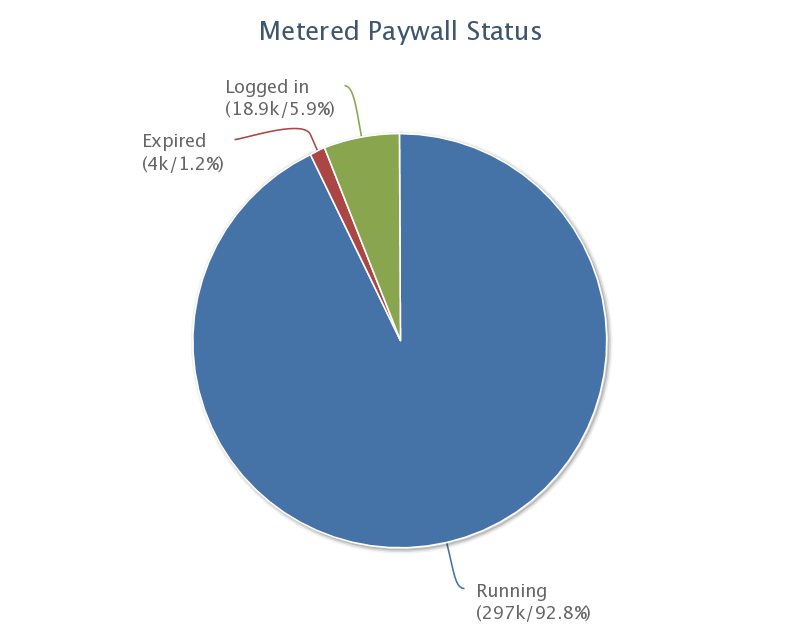
Here is a snapshot of the Dish’s pay-meter at the end of last month:

Meter Peak Pie

As you can see, in February, only four thousand readers hit more than seven read-ons and were asked to pay. That’s only 0.4% of the total monthly unique visitors and 1.2% of the readers who hit at least one read on. Here’s a breakdown of the readership that didn’t hit more than seven read-ons:

Meter Peak Bar

When we set the meter at seven read-ons per month we knew that seven might be too high, but we wanted to err on the side of generosity. The good news is that our overall traffic didn’t decline in any way from being free to all to being metered: over a million people visited last month. But what we didn’t fully account for is that a high percentage of readers consume the Dish on multiple devices (work PC, home PC, smartphone and/or tablet) and that each of these devices gets seven free read-ons, thus many readers got 14, 21 or even 28 free read-ons. As one recently wrote:

I feel tremendous loyalty to the Dish and, as soon as the new revenue model was announced, I knew that I would subscribe. I waited to do so, however. I have been involved in several start-ups and other small businesses and I am always curious to learn more about them, so I planned to wait to be prompted to subscribe to see how the mechanism worked. I continued to read the site daily using the same practices I always had. I expected to be prompted to subscribe soon after February 4. The prompt never came.

Another was more succinct:

Early subscriber, daily reader, have never hit the subscription request.  I have four devices that I tend to use depending on how my day goes, so my presence on the site is clearly under reported.

So after reading dozens of similar emails and looking over all the data with the Tinypass team, we’ve decided to lower the meter to five free read-ons and extend the reset period from 30 days to 60 days. In all other respects, the meter will remain the same.

We want for the Dish to be as accessible as possible. But, since we’ve launched, for the vast majority of readers, it’s as if the meter doesn’t exist. Given how lax the meter has been, it’s remarkable how much of the readership has subscribed. Nevertheless, in the following chart of daily sales figures since the meter launched, you can clearly see how sales flat-lined once the meter reset for most people after March 8:

Sales Since Launch

So far, we have brought in around $644K in gross revenue, which is an incredible start to our goal of $900K for the year. We are immensely grateful to all the readers who have invested in the Dish with $19.99 or more. But we are eager to begin commissioning long-form journalism and other projects like podcasting, and we can’t begin that in earnest until we have our basic operations funded.

Now to reader reax on various aspects of the whole endeavor. Yes, I took a deep breath before reading some of these.  One writes:

I know that the irritation is a deliberate part of the subscription model, but why can’t ‘Read On’ be automatic for subscribers like me?  That would be something worth paying for in itself, turning a bug into a feature.  (If you think some people enjoy the extra clicking, you can make a toggle setting for it, and learn the truth by monitoring its use.) Your recent feminism post is a good example of what I worry about – a long post that’s mostly available but with a tiny bit at the end held off for no reason than apparently to nag for subscribers.

For years the Dish has used read-ons for an editorial, non-commercial purpose: to tuck a portion of a long post behind a read-on so the front-page isn’t excessively long. The toggle feature the reader recommends probably would not be worth the time and money it would take to develop, but please keep the ideas coming. Another reader:

Hope this finds you well. I am a long-time Dish reader, probably should subscribe, but haven’t. I always talk myself out of spending more money that I don’t have. But to be honest, being a (relatively) poor 20 something living in New York City, I get excited about finding ways to get things for free.

Hence, Google Reader.  I figured out a while ago that simply subscribing to your blog via Google’s Reader service allows me to access all of the content behind the jumps, thus basically making your pay wall irrelevant. I love Reader because it brings all the blogs I love in one place for easy access. However, it is not nearly as aesthetically pleasing and enjoyable to read your blog through Reader, and I prefer to read the content on your site. However, because of the pay wall I feel like I resort to cheating and anytime I am requested on your site to become a member, I simply switch tabs and continue reading.

Not sure why I am giving up this gem – maybe out of principle or respect for you and what you are doing. I love the concept you are going for, and while it’s nice to get things for free, I feel like you should know. I waited nearly two months for you to find this error and expected it to finally get changed, but hasn’t.  I guess I am turning myself in and letting you know.

Our reader must have missed our early posts where we acknowledge the free and unfettered access offered through our RSS feed. Though intended that from the beginning, we have recently discussed whether we should try to meter the RSS or opt for RSS-specific advertizing. But that debate might be irrelevant now that Google Reader is shutting down soon. Another reader:

After reading your post today updating your readership on the State of the Dish (my phrase, not yours!), I finally broke down and subscribed. I didn’t have to. I have read the Dish for years in my Google Reader. When y’all switched over, my access didn’t even stutter. I didn’t really want to. I am 29 years old. I am a digital native. The idea of paying for online content is almost anathema to me. On top of that, like many members of my generational cohort, I am seriously underemployed at the moment.

But I subscribed anyway. Why? Because I value The Dish. Because I rely on you and your staff to collate large chunks of the Internet for me and point me in the direction of stuff that interests me. Because, like many members of my generational cohort, I hate that we are labeled “freeloaders” by many outside of our cohort. Because you asked.

So I got out my credit card and spent $20 that I don’t really have to, in order to show that I care (I hope you appreciate the extra cent!). So even though I added another $20 to my debt load, it might actually, dollar for dollar, be a better value than my $60k in student loan debt. Thanks for keeping me informed.

Another adds:

That is one of the reasons I subscribed to the Dish (besides the great quality of your blog): as long as you continue to offer full posts in your feed, I will continue to subscribe.

Another reader who helped us get some valuable perspective on the new meter:

I’m no revenue person, but I’ve conducted a lot of mail surveys over the years, and the response rates are often similar to what you’ve shown in your graphs. Based on a quick scan of your sales numbers and a general knowledge of your readership (which are similar to the groups I tend to survey in terms of education), I’d recommend you tighten that meter sooner rather than later. I think you are right to worry that subscriptions will not maintain the pace of the first month’s rate, just as the high number of “early subscribers” (people who paid as soon as they heard) and “over-subscribers” (people who paid more than $20) gave you your biggest revenue gains before the meter even began.

I don’t know how much your subscription rate will diminish over the next few months, but I’d be surprised if you managed to match half the rate of the February numbers by mid-summer without some meter tightening. I’d expect something closer to 10 or 20% of your February numbers by the end of next year. The committed have had over two months to join, so you are now working on the slugs who are still waiting to see if they can freeride. They will need a bigger push (or you’ll need to collect more from the rest of us in the future).

On a final note, I really appreciate all the transparency. It’s the only way I would have subscribed in the first place.

Many thanks for all the feedback from readers; we couldn’t do this without you.
Is Diet Soda Making Us Fat?

Maybe:

It’s not yet clear how diet soda would cause us to pack on the pounds, if it does. It could be that artificial sweeteners serve to train our flavor preferences, meaning that the additives dull our taste for healthy foods and prime our mouths for sugar. (Animal studies show that a sweet tooth can be induced, even in the womb.) If sweet taste is addictive in this way, then artificial flavors might worsen our dependence.

Another theory holds that artificial sweeteners fool our bodies from within. Sugar substitutes may lock onto receptors in the gut—receptors that have only lately been discovered—and gum up the body’s metabolic mechanisms. That way the additives could produce a hormone spike affecting hunger and digestion, even though they offer few if any calories of their own.

When Will The GOP Evolve On Marriage?

Screen shot 2013-03-18 at 2.31.16 PM

As a new ABC News/WaPo poll finds a new 58 percent high for support for marriage equality, including a staggering 81 percent of those under 30, Nate Silver finds relatively low support for marriage equality among Republicans:

[O]nly 26 percent of Republicans support same-sex marriage rights as compared with 54 percent of independents and 66 percent of Democrats. Attitudes among Republican voters may shift on the issue by 2016, particularly if more respected conservatives like Mr. Portman announce their support for same-sex marriage, but it is less than clear that his position will reflect a broadly acceptable viewpoint among Republican primary and caucus voters by that time.

The fact that Indies and Dems are close on this – and that the GOP is such an outlier – is what strikes me the most. That’s dangerous electoral territory. More to the point, the public now favors SCOTUS reversing state laws and constitutional amendments. Then there’s the split between Christians and Christianists. Mainline Christians, including Catholics, back marriage equality strongly. Evangelical Christianists don’t:

Among non-evangelical white Protestants, 70 percent in this poll support gay marriage, compared with fewer than half as many of those who describe themselves as evangelicals, 31 percent. But that’s up by a nearly identical 25 and 24 points among these groups, respectively, since 2004. Support for gay marriage also is up, by 19 points, among Catholics, to 59 percent.

So Catholics now favor marriage equality by the same proportion as the country as a whole, even slightly ahead. Congrats to the American bishops who have doubtless helped our cause by attacking it with such disproportionate ferocity. Ambers eyes the evangelical resistance:

The party platform won’t be written by devotees on Jon Huntsman. The GOP cannot win the presidency without evangelicals voting heavily. There is no magic coalition for Republicans right now that does not place social conservatives at its core. That may change as the electoral cohort shifts, but we’re a few presidential cycles away from that now.

He goes on to argue that being “pro-gay and Republican won’t incur a financial penalty” because nearly “every big donor in the party either actively or tacitly supports gay rights.” But I do see this as a major problem going forward. Even Scott Walker conceded that yesterday:

GREGORY: Are younger conservatives more apt to see marriage equality as something that is, you know, what they believe, that is basic rather than as a disqualifying issue?

WALKER: I think there’s no doubt about that. But I think that’s all the more reason, when I talk about things, I talk about the economic and fiscal crises in our state and in our country, that’s what people want to resonate about. They don’t want to get focused on those issues.

But fundamentalism makes this non-negotiable; and for the next generation, that fundamentalism, in so far as it translates into discrimination against their gay peers, remains toxic. The GOP cannot easily dismount this tiger; or defang it. So they’ll stroke it and distract it.

If they can.

Why Did We Invade Iraq?

Beinart blames “hubris born of success”:

From Panama to the Gulf War to Bosnia to Kosovo, America spent the decade preceding 9/11 intervening successfully overseas. As a result, elites in both parties lost the fear of war they felt after Vietnam. In 1988 Reagan had been so afraid of another Vietnam that he refused to send ground troops to Panama. In 1990 John McCain had responded to Iraq’s invasion of Kuwait by declaring, “If you get involved in a major ground war in the Saudi desert, I think [public] support will erode significantly … We cannot even contemplate, in my view, trading American blood for Iraqi blood.” In his emotional 1991 speech opposing the Gulf War, John Kerry had mentioned Vietnam 10 times. In his 2002 speech supporting the invasion of Iraq, by contrast, he mentioned Vietnam only once.

Hubris combined with real fear. I plead guilty to both.