Diary Of A Dog Walker

4903209928_ff87d58fd3_b

Amanda Nazario fondly recalls working as one in her twenties:

How to explain what it feels like to walk three dogs through Greenwich Village, as your job, on a beautiful spring day in the full flower of your youth? Some people are incredulous when I tell them this was my favorite job, the one I might not have minded having forever—especially when they learn about the dogs that bit me, the bounced paychecks, the “emergency” calls I got that forced me out of meals and bed. I refer them now to the stretch from Danny Boy’s back to Sam’s at noon, jogging to beat the Don’t Walk signs, cruising past stately linen-curtained windows of apartments I wished I could live in, channeling my best friend on the walkie-talkie, watching the three tails wag like metronomes. …

For dog walkers, the Village is the best neighborhood in New York.

The Upper West Side, where I worked all through grad school, isn’t bad – I remember crisp Februaries in Riverside Park, snow melting and the puddles reflecting the sky, little windows of blue glass. But the Village is better. The clients are friendlier; the architecture is more fun to look at; the buildings are closer to each other, so you can walk a lucrative route without ever having to get on the subway. If your energy is flagging, you are always near a smoothie parlor. And the people you encounter – tourists, students, doormen – are more fun to interact with; they’re enjoying the beautiful day as much as you are. Me: sweaty, messy-haired, smiling. Ethan Hawke: sweaty, messy-haired, smiling.

For more, consult the Dog-Walker Whisperer.

(Photo by Kristine Paulus)

Why Portman Matters

A far less cynical take than today’s dissenter:

It was a miracle I was with my mom Friday. She’s here in NYC visiting me for the weekend from Cleveland, when the news about Rob Portman came through. My mother had the only response an Ohio mother of a gay son could possible have: “Holy shit.” We were in such shock we had to rewind the DVR and make sure we heard it right.

My mother is a proud Ohio Democrat and phone-banked many times for the reelection of Senator Sherrod Brown this past election. We both disagree with Mr. Portman’s views on a majority of the issues – except for one (as of this morning).   Hearing those words come out of his mouth was astounding. Not because of what it meant about Portman, but because of the change it represented for Ohio.

I still remember my mother calling me the morning after election day 2004 in tears.  Not because George W. Bush had been re-elected for another term (well, maybe a little bit) but because Ohio had passed a constitutional ban on same-sex couples getting married.

It was devastating to her.  Almost like a personal rejection of her son.  She kept apologizing to me, as if it was her responsibility to reach every household in Ohio and tell them that her son was a good person. If they just got to know him they would see that he should have the same rights.  It was heartbreaking to hear this. Suddenly I felt like the parent and tried to console her by promising that things will change and that we have to keep fighting.

That’s why watching a Republican from Ohio support marriage while sitting next to my mother was so meaningful and thrilling.  Who would have thought that in less than nine years, our Ohio would have two senators (yes both!) supporting marriage quality?!

Some don’t want to celebrate this news. I understand the reservations about Portman receiving any accolades.  He shouldn’t.  This didn’t happen because of political courage. Politicians move with the polls and rarely act with courage.  I say let’s celebrate the polls!  Celebrate those who have been moving those polls steadily in our favor for decades.  Through its relentless activism, the LGBT movement created a friendly enough environment for a Republican to support marriage equality.  Not to mention a world where a senator’s son could even broach the subject of his homosexuality with his father.

That leads me to the other person who deserves accolades for today. At the age of 19, Will Portman came out to his parents.  We all know it is rarely easy. However, I think Will gets some bonus points for coming out to the dad with the anti-gay voting record who is considered presidential material by a party with anti gay rhetoric all over its platform.  Maybe his coming out was a little harder than some.

More importantly, Will’s example shows that Harvey Milk was right when he said “Gay brothers and sisters … You must come out. Come out… to your parents… I know that it is hard and will hurt them but think about how they will hurt you in the voting booth!”  Those words are especially true when your father’s voting booth is located in the United States Senate chamber.  Will has proved once again that the greatest asset the LGBT community has is that we are in everyone’s family. We just need to make sure they know it.

Francis Emerges, Ctd

Pope Francis Gives His First Angelus Blessing To The Faithful

At mass yesterday, you could feel something intangible in the air. Not to go all Peggy Noonan on you, but I sensed both hope and apprehension about the new Pope – as well as a certain distance. Under Benedict, many of us had continued with our faith as if underground, seeing little to connect to in his fastidious liturgy and tone-deafness and weak authoritarianism. Traumatized by the hierarchy’s response to the child-rape epidemic, we clung to our pews with whiter knuckles than usual, reminding ourselves that the church is not its hierarchy, but the people of God seeking the love Jesus promised and the freedom Christianity can unleash in the soul. But we would look up at times to the public leadership, wincing mostly, but still gleaning some nourishment (Deus Caritas Est, for example), before succumbing to anger at the crimes not acknowledged let alone brought to justice, at the hypocrisy and wealth and corruption, at the scandal of a creature like Maciel and a coward named Law.

But now, more heads are poking up a little, like the stubs of new tulips in the softening ground. In the last few days, we’ve found out some more about Francis, and much of it, to my mind, is reassuring. This piece by the usually judicious Thomas Reese relieved me of many worries about his time under the junta. There is no question that Francis was not a profile in courage or an aggressive dissenter in those times, but neither, I think, is it fair to see him as in any fundamental way a collaborator or betrayer of his own priests. Reese goes through the charges methodically. One worth noting:

It is said there is written evidence in the Argentine foreign ministry files that Bergoglio gave information on the Jesuits to the military. The alleged conversation took place when Bergoglio was trying to get the passport of one of the Jesuits extended. Not only did this take place after they were arrested and after they were released, it was after they were safely out of the country. Nothing he could say would endanger them, nor was he telling the government anything it did not already know. He was simply trying to convince a bureaucrat that it was a good idea to extend the passport of this man so he could stay in Germany and not have to return to Argentina.

More recently, Cardinal Bergoglio was involved in getting the Argentine bishops to ask forgiveness for not having done enough during the dirty war, as it was called in Argentina.

How hostile was this man to liberation theology? Again, this is a more complicated question than might at first appear:

What do we mean when we use a hegemonic and singular umbrella term like “liberation theology?” Are we referring to the particular texts that arose in the 1960s and 1970s from the academic and professional theologians like Gustavo Gutiérrez and Leonardo Boff? Both of whose work, by the way, varies in style, method, and outcome. Do we mean the pastoral legacy of the slain Archbishop of San Salvador, Oscar Romero? Do we mean the Jesuits and diocesan priests who took up arms in El Salvador against the will of Romero who, according to the critiques of now-Pope Francis, might also be labeled “opposed to liberation theology” in this context? What exactly do we mean?

If we mean the importation of the materialist arguments of Marxism into Catholic theology, then it seems perfectly clear to me that any Archbishop would oppose it. And should oppose it. But if we mean by it an aggressive posture always in favor of the poor, then we have simple orthodoxy, of the kind Jesus clearly taught. In that respect we have these new words from this new Pope to understand where he is coming from:

And those words came to me: the poor, the poor. Then, right away, thinking of the poor, I thought of Francis of Assisi. Then I thought of all the wars, as the votes were still being counted, till the end. Francis is also the man of peace. That is how the name came into my heart: Francis of Assisi. For me, he is the man of poverty, the man of peace, the man who loves and protects creation; these days we do not have a very good relationship with creation, do we? He is the man who gives us this spirit of peace, the poor man … How I would like a Church which is poor and for the poor!

I know I have a serious confirmation bias at work here. I desperately want reform in the church and although I remain of the conviction that this has to start with us, its ordinary members, the signals and signs of the hierarchy do convey the faith to millions – and that matters.

And so in yesterday’s Gospel, we found ourselves with Jesus and the adulteress again. The gospel passage is one of the most disarming – because it is about disarmament of the ego, openness to the other, and forgiveness. “Neither do I condemn you,” Jesus says, in an astonishing embrace of humanity in all its flaws, left finally alone with a woman facing imminent death by stoning.

His move is a lateral, not hierarchical one – the mysterious, ineffable, sudden crouch that Jesus goes into when questioned by other rabbis. He writes in the sand – words or signs we will never know. The forgiveness is overwhelming – too overwhelming for us to accept it most of the time. And so the Holy Father yesterday spoke directly to me when he called so many Catholics out for not feeling worthy of forgiveness:

Meditating on the Gospel passage (John 8: 1-11 — “Let he who is without sin cast the first stone”), Francis said, “This is Jesus’ message: mercy. On my part, I say it with humility; this is the the Lord’s strongest message: mercy. He himself said: ‘I did not come for the righteous.’ The righteous can justify themselves.… Jesus came for the sinners.”

“‘Oh, Father,’” Pope Francis continued, relating what people often say to priests, “‘if you knew my life you wouldn’t say that.’”

“Why? What have you done?”

“Oh, I’ve done bad things.”

“Good! Go to Jesus; He likes you to tell him these things. He forgets. He has the special ability to forget. He forgets them, kisses you, embraces you, and tells you only, ‘Neither do I condemn you. Go and sin no more.’ He only gives you this counsel. A month later we are the same.… We return to the Lord. The Lord never tires of forgiving us, never! We are the ones who get tired of asking forgiveness. Let us ask for the grace to never tire of asking forgiveness, because he never tires of forgiving us.”

This incomprehensibly comprehensive forgiveness is God in the Christian sense. It allows us to start anew, to see, as Saint Francis did, the forgetfulness of nature itself, its capacity for regrowth, for healing, to look into the buds on the trees in spring:

Last year is dead, they seem to say,
Begin afresh, afresh, afresh.

(Photo: People gather in St Peter’s Square ahead of the arrival of Pope Francis who will give his first Angelus Blessing to the faithful from the window of his private residence on March 17, 2013 in Vatican City, Vatican. The Vatican is preparing for the inauguration of Pope Francis on March 19, 2013 in St Peter’s Square. By Dan Kitwood/Getty Images.)


What The Hell Just Happened In Cyprus?

CYPRUS-EU-FINANCE-PARLIAMENT

Krishnadev Calamur explains the proposed details of the unorthodox EU bank-bailout bargain:

The deal reached Saturday imposes a one-time levy of 6.75 percent on all deposits under 100,000 euros and a 9.9 percent levy above that amount. The levy is expected to raise 5.8 billion euros. Cyprus’ bailout follows those for Greece, Portugal, Ireland and Spain’s banking sector, but it is the first time eurozone states and the IMF have dipped into people’s savings to pay for a bailout. The deal has met with widespread anger in Cyprus, a run on bank deposits over the weekend and fears that the public unease might spread to other at-risk EU countries such as Spain and Italy.

Thomas Pascoe finds the deal “disgraceful”:

The principle that there is no division between your private property and communal property which may be appropriated by the government whenever it sees fit is an outrageous one in any system other than Communism. The idea that a government which has chronically misspent may order the banks to close and deduct a sum of its choosing from a person’s balance before allowing it to re-open is beyond parody.

Barry Ritholtz takes a chill pill:

Would Cypriot depositors have lost more money by leaving the eurozone and suffering a currency devaluation? We think so, Ask the Venezuelan depositors who had their currency devalued more than 40 percent a couple weeks ago. Then compare to the 6-10 percent deposit tax.

Felix Salmon argues that the burden is falling on the people least able to afford it:

What we’re seeing here is the Cypriot government being forced to break one of its most important promises — the promise that if you put your money in the bank, and your deposits total less than €100,000, then they will be safe. What’s more, there’s no good reason for insured deposits to be hit in this manner: the same amount of money could be raised just by taxing the uninsured deposits at a slightly higher rate. The insured depositors are being hit, it seems, just so that the uninsured depositors can be taxed at single-digit rather than at a double-digit rate. … Someone with €8,000 of life savings in the bank can ill afford to lose an arbitrary €540, but that’s exactly what is going to happen.

Schumpeter worries about the reaction in other EU nations:

Euro-zone leaders will spin the deal as reflecting the unique circumstances surrounding Cyprus, just as they did the Greek debt restructuring last year. But if you were a depositor in a peripheral country that looked like it needed more money from the euro zone, what would your calculation be? That you would never be treated like the people in Cyprus, or that a precedent had been set which reflected the consistent demands of creditor countries for burden-sharing? The chances of big, destabilising movements of money (into cash, if not into other banks) have just shot up.

Kevin Drum has the same fear:

Is Cyprus unique? Or, more precisely, can ordinary depositors and big investors be persuaded that Cyprus is unique? Because if they can’t, then they’re going to start pulling their money out of Spanish and Greek and Italian and Portuguese banks. And that would be very, very bad. It would turn the slow-motion bank runs of the past few years into the honest-to-God, high-speed, economy-ruining kind of bank runs.

Joshua Tucker, meanwhile, focuses on the political implications:

By announcing an immediate tax on all bank deposits, every Cypriot citizen with money in the bank knows exactly how much money they have just lost. … [T]here may be an economic rationale for this form of bailout (but even that I assume will be swamped by negative side effects if the bank runs spread to other European countries), politically it seems hard to come up with something more likely to generate immediate and relevant ill will.

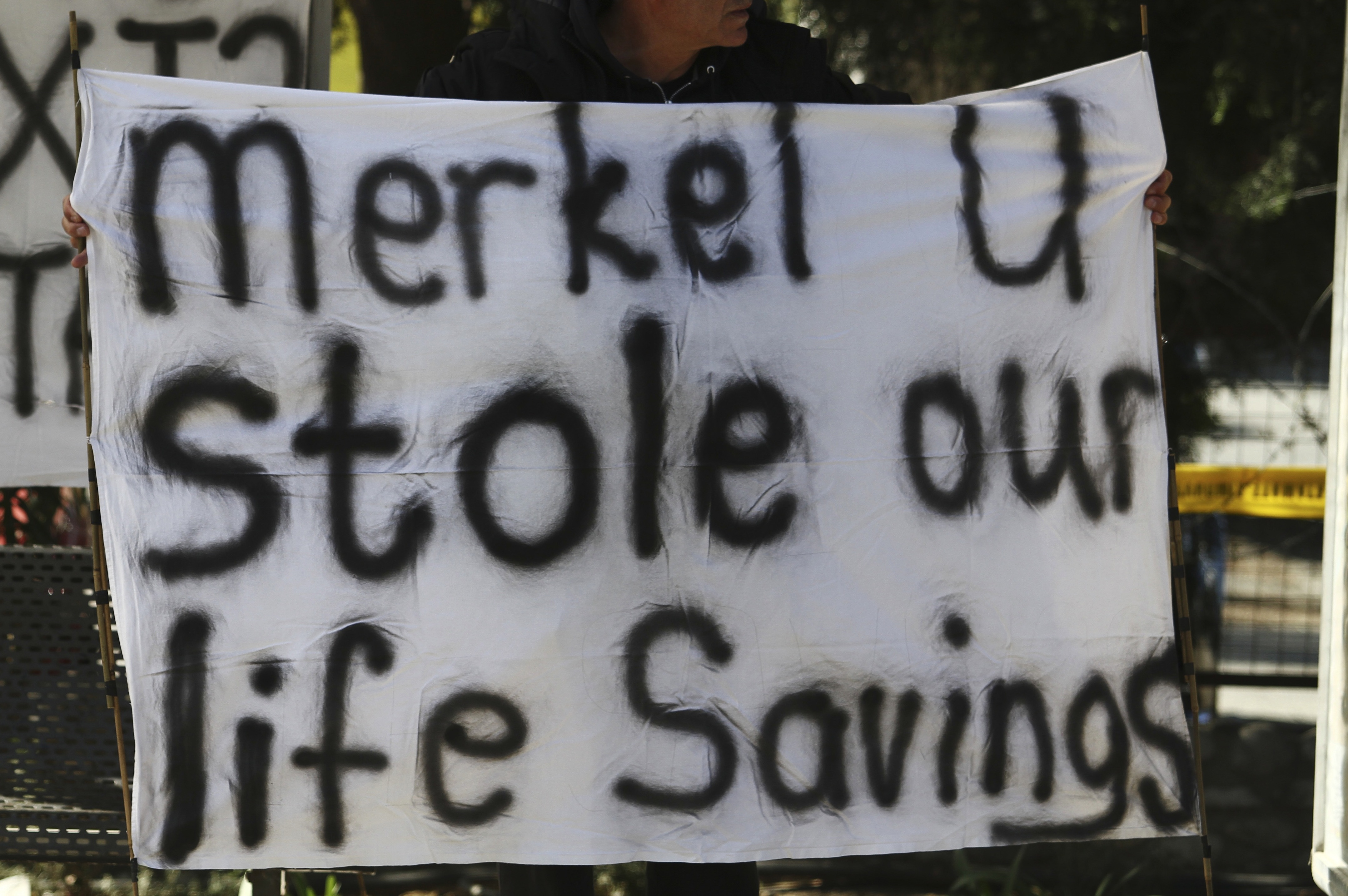
(Photo: A Cypriot man holds a banner against the EU bailout deal and German Chancellor Angela Merkel’s call for Cyprus to follow economic reforms outside the parliament building in Nicosia on March 18, 2013. Cyprus President Nicos Anastasiades was seeking the backing of MPs for the bailout deal that slaps a levy on bank savings under harsh terms that have jolted global markets and raised fears of a new eurozone debt crisis. By Yiannis Kourtoglou/AFP/Getty Images)

This Just In: Journalism Sells!

Christine Haughney breaks down Time‘s recent sales numbers:

Publishing a 36-page cover article called “Bitter Pill: Why Medical Bills Are Killing Us” certainly didn’t seem like a shameless attempt to bolster newsstand sales for Time magazine. But the 25,000-word article that Steven Brill wrote for the magazine’s March 4 issue appears to be on course to become its best-selling cover in nearly two years. Ali Zelenko, a Time spokeswoman, said the issue sold more than double the typical number of copies. …

The most surprising attention came from younger readers on social media who are less immediately concerned with medical bills. The article was shared 100 times more often on social media than the average Time article in 2013, and the #BitterPill hashtag was mentioned nearly 6,000 times on Twitter.

Long-form journalism has a future among readers. But among many editors and publishers? Alas, they’re too busy asking advertisers what they want to peddle. For my part, if we can raise the revenues, it makes the Deep Dish project for long-form non-fiction more exciting. The market is open. The writers need a platform, as general interest magazines cling to survival. We’re not there yet, but you can help us get there by one simple thing: [tinypass_offer text=”subscribe”]! And we’ll deliver.

Dissent Of The Day

Many readers are pushing back against my perspective on Portman’s reversal on marriage equality. A representative email:

As a liberal, I become more and more convinced that Republicans (and, frankly, conservatives) suffer from an empathy deficit.  They actually don’t have the imagination to understand the pain of others until they are subjected to pain themselves.

Now we have Rob Portman, who changes his position on gay marriage because his son is gay and he wants him to have the same opportunity to marry the person he loves that he and his wife had and that his other children will have.  Assuming that Portman was aware that other gay people exist, and that other parents have gay children, he either doesn’t care about the pain inflicted on gay people who are not his child – or he does care, but not enough to actually take a tough stand (for a Republican).  I’m glad he has switched his position, and in a public way, but why is it that the issue only matters if it affects him?

Likewise, Republicans like Nancy Reagan and her ilk who support stem-cell research because their own loved one has a disease for which a cure may rest on such research.  I suppose they all need to have their homes washed away in a storm to believe in climate change.  And while I would never wish rape on anyone, perhaps they would understand the plight of a pregnant teenager better if they themselves had an unwanted pregnancy.  And I guess I should wish they all have children in interracial marriages, so they can come to believe that racism actually exists.

It’s terribly sad, really.  They have no imagination at all.  Or maybe they just don’t give a shit.

Or maybe they’re human beings with complicated feelings, beliefs and associations who take time to change on some unusually challenging changes. But even if they are pure opportunists, as a civil rights cause, it shouldn’t matter. What matters is support for marriage equality. Period. Late-comers should be as welcome as the pioneers. Yes, that takes a little magnanimity in victory.  But Churchill was dead right about that.

The Cannabis Closet, Ctd

Republican lawmakers are in it as well:

Assemblyman Steve Katz, a 59-year-old Republican who voted no last year on a bill to legalize medical marijuana, had been traveling 80 mph on I-87 through Coeymans, N.Y., where the speed limit is 65 mph, state police said. During the speeding stop, police said a trooper noted the odor of marijuana and found Mr. Katz in possession of a small bag.

Maybe copping to the pleasures of weed is a little like acknowledging you have a gay son. It could help change the non-libertarian right’s rigidity on the question. More on the long-running Dish series here.

(Hat tip: Cord Jefferson)