Iraq Now: A Catastrophe Foretold

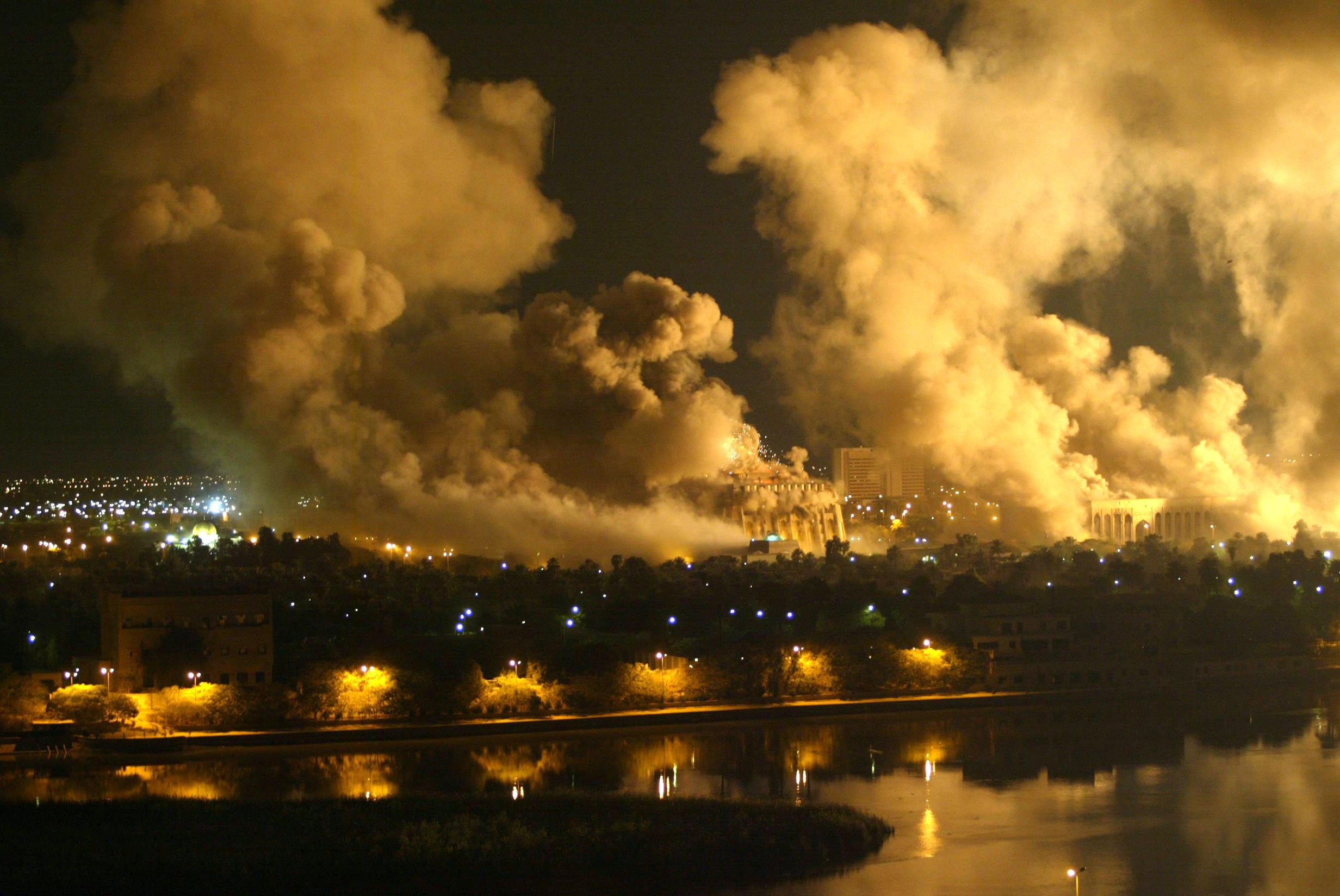
Smoke covers the presidential palace com

John B. Judis, one of the most intellectually principled writers and thinkers I have ever worked with, was right before the war, and now tries to understand how almost all of Washington, including myself, fell for it. He names names at TNR (the dissenters) and recalls the silenced dissent of many in the CIA and military. Money quote:

My own experience after Powell’s speech bears out the tremendous power that an administration, bent on deception, can have over public opinion, especially when it comes to foreign policy. And when the dissenters in the CIA, military, and State Department are silenced, the public—not to mention, journalists—has little recourse in deciding whether to support what the administration wants to do. Those months before the Iraq war testify to the importance of letting the public have full access to information before making decisions about war and peace. And that lesson should be heeded before we rush into still another war in the Middle East.

It’s a good sign TNR ran this piece. It’s glasnost over there. David Corn follows up with another damning recollection: on this day, ten years ago, an article appeared in the Washington Post, titled “Bush Clings to Dubious Allegations About Iraq.” It was by Walter Pincus and Dana Milbank. Over to David:

That last article … is particularly noteworthy. It began:

As the Bush administration prepares to attack Iraq this week, it is doing so on the basis of a number of allegations against Iraqi President Saddam Hussein that have been challenged—and in some cases disproved— by the United Nations, European governments and even U.S. intelligence reports.

This story appeared on page A13 of the newspaper.

I was an integral part of the problem. I drank deeply of the neocon Kool-Aid. I was also, clearly countering the trauma of 9/11 by embracing a policy that somewhere in my psyche seemed the only appropriate response to the magnitude of the offense. Prudence, skepticism left me. I’d backed Bush in 2000. I knew Rummy as a friend. And my critical faculties were swamped by fear. These are not excuses. These are simply part of my attempt to understand how wrong I was – and why.

(Photo: Smoke covers the presidential palace compound in Baghdad 21 March 2003 during a massive US-led air raid on the Iraqi capital. Smoke billowed from a number of targeted sites, including one of President Saddam Hussein’s palaces, an AFP correspondent said. By Ramzi Haidar/AFP/Getty Images.)

The Carbon Footprint Of Good Intentions

Bjørn Lomborg lambasts Earth Hour, the annual tradition of turning off the lights, this year on March 23:

In fact, Earth Hour will cause emissions to increase. As the United Kingdom’s National Grid operators have found, a small decline in electricity consumption does not translate into less energy being pumped into the grid, and therefore will not reduce emissions. Moreover, during Earth Hour, any significant drop in electricity demand will entail a reduction in CO2 emissions during the hour, but it will be offset by the surge from firing up coal or gas stations to restore electricity supplies afterwards.

And the cozy candles that many participants will light, which seem so natural and environmentally friendly, are still fossil fuels – and almost 100 times less efficient than incandescent light bulbs. Using one candle for each switched-off bulb cancels out even the theoretical CO2 reduction; using two candles means that you emit more CO2.

Side Effects May Include Plot Twists

Nick Olson’s unpacks Steven Soderbergh’s latest film, Side Effects:

Soderbergh describes his approach as, in a sense, mathematical in a recent interview with Ignatiy Vishnevetsky, and Vishnevetsky does well to identify a few recurring Soderberghian interests that, in my opinion, enable a kind of quantified space for his craft: therapeutic psychiatry, economic/market forces, and the secret plans of con-men/con-women–all of which, notably, are in play here. But these sort of contexts not only give a distinct narrative shape; they also provide the impetus for narrative conflict–a playful space for missing, manipulated, and/or generally disorienting narrative variables. That is, we can become unaware of the side effects of antidepressants, or that the reason we’re prescribed a particular pill has unseen economic implications, or that we are being conned. This allows Soderbergh the ability to deceive us, but in such a way that we’re invested in the baseline way of seeing the math add up.

Millman feels that “best thing about the film is the way in which Soderbergh builds his trap for us”:

For much of the earlier part of the film, we’re “with” Mara, and both the way it is shot and the way it is scored encourage us to believe the story we are being told, about a woman with terrible depression. It’s not just a matter of tricking us about her character – it’s also a matter of tricking us about what genre of film we’re in, which is to say, in part, what kind of moral universe we are in: a world in which intentionality and fault are fuzzy concepts because we understand too well their chemical origins, and in which medical professionals elide easily into repositories for our discarded moral sense, the people who are ultimately responsible for our actions, though they are, in reality, just human beings like ourselves.

But the shift of genre upends this world.

The Transitory Web

Chris Albon longs for an online experience with less permanence:

The Web is quickly coming to the point that everything you say or do online can be used against you in the court of public opinion. Some say we could be looking at the end of forgetting, where the past can be accessed with the click of a mouse. Over the years, people have adapted, becoming for vigilant about what they post or have posted about them online. We have become increasingly experienced at online self-censorship. But we shouldn’t need to. …

We deserve an ephemeral Web; one with communications unburdened by permanence. We deserve to have the Web—at least some of the time—forgive and forget. Hopefully, applications like Snapchat are just the beginning of that ephemeral Web. With luck, in time there will be a whole class of applications from email applications to microblogging platforms whose killer app is that they capture nothing, remember nothing.

Documentary As Agitprop

Scott Tobias criticizes formulaic documentary filmmaking, which uses “a hearty gruel of talking heads and archival footage, spooned out as artlessly as the school lunches A Place At The Table criticizes so vociferously”:

[A Place At The Table is] pure propaganda—well-meaning propaganda, and at times crudely effective propaganda, but nonetheless a form of cinematic activism where art is of secondary concern. For the makers of A Place At The Table, that may not matter: They want to call attention to an urgent issue, and if it takes the battering ram of statistics and testimonials to do it, all the better.

Why that excuse isn’t good enough:

Indifferent filmmaking shouldn’t be tolerated in any form, but documentaries tend to get a pass, perhaps because the information they provide is considered more valuable than the way they provide it. But accepting documentaries made in tired, cut-and-paste formats only encourages more like them, and even undermines the legitimacy of films that try different things. It wasn’t that long ago that Errol Morris’ The Thin Blue Line, with its then-radical use of staged reenactments, was disqualified from competing for a Best Documentary Oscar; he won one 15 years later with The Fog Of War.

Plight Of The Megacommuter

Rebecca Davis O’Brien confesses she’s “one of the nearly six hundred thousand Americans who travel at least fifty miles and ninety minutes to and from a full-time job each day”:

I am fortunate to have a job that I love, for which I am willing to spend roughly fifteen hours a week as a prisoner of my car, and an editor who lets me work from home when I am on the cusp of vehicular manslaughter. Even so, I am often overwhelmed by diffuse resentment—of my job, which is beyond the reach of New Jersey’s public transportation system; of my grad-student husband, who walks each day to the campus library; of my city friends, with their smug MetroCards.

The Weekend Wrap

Pope Francis Holds An Audience With Journalists And The Media

This weekend on the Dish, Andrew marveled at Pope Francis’s first press conference, shared the latest installment of his debate with Hitch, asked if Krauthammer would offer a retraction, noted an egregious example of Instapundit’s use of sponsored content, and pondered the latest in Obama’s drone strategy.

We also provided our usual eclectic mix of religious, books, and cultural coverage. In matters of faith, doubt, and philosophy, Andrew Byers sought a more substantive spirituality, Adam Kirsch traced the invention of religion, and Rachel Aviv remembered when the gods fell silent. A.N. Wilson noted C.S. Lewis’s kinky side, Sam Tanenhaus profiled the controversial Catholic Garry Wills, and Marcus Mumford expressed ambivalence about the label “Christian.” The Pilgrims proved to be fond alcohol, Giles Fraser unpacked the secularized Christian assumptions behind the belief in progress, and Ed Voves highlighted the spiritual side of the Pre-Raphaelite painters. Theodore Dalrymple categorized the varieties of pessimism, Stephen Asma defended favoritism, and David P. Barash outlined the convergences between evolutionary biology and existentialist philosophy.

In literary coverage, Tocqueville became a surprise bestseller in China, Justin E.H. Smith praised George Saunders’s distinctly American idiom, and Andrea Barrett mused on the way writers don’t feel at ease in the world. Francine Prose rejected her 7th grade teacher’s writing advice, Alexis Coe looked at Virginia Woolf’s tumultuous relationship with her servant, and Sara Davis ruminated on how we portray death’s inevitability. Read Saturday’s poem here and Sunday’s here.

In assorted news and views, a reader sounded off on corporate feminism and the class divide, Evan Soltas described the graying of the workforce, and Jordan Weissmann wondered why private colleges need public money. Tessa Johnson revisited the first commonly prescribed tranquilizer, Christopher Ryan painted a dark picture of the future of human sexuality, and an adult film star gathered data about orgasms. Katie Arnoldi continued the conversation about cannabis not being so green, Matthew Power investigated the urban explorer movement, and Alex Cornell mapped ideal seating arrangements for dinner guests. MHBs here and here, FOTDs here and here, VFYWs here and here, and the latest window contest here.

– M.S.

(Photo: A detail of the shoes of newly elected Pope Francis as he attends his first audience with journalists and media inside the Paul VI hall on March 16, 2013 in Vatican City, Vatican. The pope thanked the media for their coverage during the historic transition of the papacy and explained his vision of the future for the Catholic Church. By Franco Origlia/Getty Images.)

The Industrial Kitchen Complex

All that defense spending goes straight to our hips:

It isn’t surprising, given the superpower ambitions and imperatives of the last century, that many of the great technological kitchen leaps were the inadvertent results of research at the industries and agencies that helped us win the Second World War, not to mention our Cold War/star wars with the Soviets. (One exception is the refrigerator; the application of thermodynamic research to refrigeration also took place in Europe with, among others, Albert Einstein, who patented his own fridge in 1930. Another is the gas oven; the first safe and successfully enclosed ovens came from Britain.) NASA scientists developed the technology for freeze-dried food—like ice, smoke, and salt, a milestone in the history of preservation. And we owe the microwave oven to Percy Spencer, the engineer who helped develop the Navy’s radar system, and the Cuisinart to Carl Sontheimer, the engineer who invented a microwave direction finder for the Apollo moon mission.

Data-Driven HR

Greg Beato digests the news that “work force analytics consultants can now determine what attributes and propensities are associated with success in a given position”:

Employees who live within 10 minutes of the office may be 20 percent likelier to stay at the company at least six months than ones who live 45 minutes away or further. Employees who have a college degree may be less inclined to stick with a call-center job than those who do not. According to The Wall Street Journal, Evolv, the company assisting Xerox in its recruitment efforts, determined that the ideal candidate to staff the company’s call centers “uses one or more social networks, but not more than four.”

Beato finds “liberating, empowering aspects to this kind of data analysis”:

For example, by analyzing thousands of work histories, Evolv determined that there is “very little relationship between the number of jobs an employee has held and their current tenure,” and that “companies that screen out job hoppers and the unemployed have been needlessly limiting their candidate pool.” Even more strikingly, Evolv suggests that while many companies refuse to hire applicants who have criminal records, including some who have only been arrested, its analysis shows that “crimes committed before a person entered the workforce had no predictive value for any counterproductive workplace behaviors,” and that “people with records who stay arrest-free for four to five years are only as likely as the average person to be arrested again.”

Video Killed The UFO

Sightings have greatly declined:

[UFO sceptic Ian Ridpath, speaking at a conference organised by the Association for the Scientific Study of Anomalous Phenomena] stressed that there had been no classic UFO sightings since the advent of the new generation of technology, and, especially, the mobile-phone camera, whose ubiquity, it might have been thought, should almost have guaranteed convincing photographic evidence of the inquisitive green men and their conveyances. This leads to a further, hopeful, thought: could it be that the advance of technology and information-sharing is finally, after several thousand years, making us less gullible and credulous?