A relatively sane music video directed by the mad genius Eric Wareheim, starring Laura Palmer’s dad:
Wareheim’s work featured on the Dish here.
A relatively sane music video directed by the mad genius Eric Wareheim, starring Laura Palmer’s dad:
Wareheim’s work featured on the Dish here.
His show – where I’ve appeared regularly – has a 50th anniversary special on the Beatles this weekend. Joe Klein and Chuck Todd are among the nostalgics. Consider this just a plug for what is often the most honest political show on Sunday mornings, and the most entertaining. Who else but Chris would get all emotional about the Fab Four? Oh, and happy St Paddy’s Day, while I’m at it.
Francine Prose rejects the advice of a 7th grade teacher who cautioned students, “Never end a story with, ‘It was all a dream!’”:
Literature is full of dreams that we remember more clearly than our own. Jacob’s ladder of angels. Joseph saving Egypt and himself by interpreting the Pharoah’s vision of the seven fat and lean cows. The dreams in Shakespeare’s plays range as widely as our own, and the evil are often punished in their sleep before they pay for their crimes in life. Kafka never tells us what Gregor Samsa was dreaming when he awakens as a giant insect, except that the dreams were “uneasy.” Likely they were not as uneasy as the morning he wakes into.
She credits Tolstoy’s Anna Karenina with the boldest use of a dream in fiction:
Tolstoy showed it was possible to give a character a dream that strikes the reader as plausible, convincing, important enough to pay attention to, without being heavy-handedly symbolic or portentous. Or boring. What’s harder to recreate on the page is anything remotely resembling the experience of actually dreaming, with all the structural and narrative complexities involved, the leaps, contradictions, and improbable elements. Maybe that was my seventh-grade teacher’s problem: She’d read too many middle-school accounts of dreams that were nothing like dreams.

Sara Davis conceives of the still life and the artistic portrayal of zombies as two forms of memento mori – a symbol of death’s inevitability:
For the 17th century Dutch merchant class, a still life was a shrine to the beauty and pleasure that money can buy: luxuries, delicacies, fine things that could be held in the hand or captured in oils, a small and fine possession in itself. But for contemporary society, the ultimate shrine and symbol of prosperity is the well-kept body — that is, a body that falls into a fairly narrow category of healthy, beautiful, and athletic. Despite all the goods and brands and tech toys, so much more of our collective wealth is sunk into sculpting or tightening, brightening or darkening, coloring and trimming, running, counting calories, and swallowing gallons of “smart” water.
It makes sense, then, that today’s bogeyman and morality tale is a decaying body, a walking (or running) death’s head that all the cardio and training in the world can’t outrace. Zombies mock us, like the half-eaten fruits of the Dutch golden age and the weary speaker of Ecclesiastes, that though we may define ourselves by what and how we consume, it is all a pretty distraction from how we will be consumed.
Speaking of zombies, A.J. Kandathil draws lessons for writers from The Walking Dead.
(© Paulette Tavormina, Flowers and Fish III, After G.V.S., 2012, Courtesy of Robert Mann Gallery, New York, from the series Natura Morta)

“A Coat” by William Butler Yeats (1865-1939):
I made my song a coat
Covered with embroideries
Out of old mythologies
From heel to throat;
But the fools caught it,
Wore it in the world’s eyes
As though they’d wrought it.
Song, let them take it,
For there’s more enterprise in walking naked.
(Photo: William Butler Yeats in 1933, via Wikimedia Commons)
Alexis Coe marvels at the tumultuous relationship Virginia Woolf had with her servant of 18 years, Nellie Boxall:
Boxall was hired as the Woolf’s live-in servant at 52 Tavistrock Square, where the writer would draft Mrs Dalloway and launch Hogarth Press. All the while, Nellie was hard at work in the background, pumping the water, lighting the lamps, making the beds, and emptying the chamber pots — more than her title of “cook” suggests, though she did that as well, serving multiple courses three times a day.
Few scholars have parsed Woolf’s diaries without commenting on her frequent, detailed, and often vitriolic accounts of Boxall. Their brand of melee was firmly mired in a cycle, each arguing her points with the tools available to them. Boxall howled and cried, and then threatened to leave, which she would not, but the threat greatly destabilized and embarrassed Woolf. For her part, Woolf recognized, if not predicted, the attraction, writing, “If I were reading this dairy…I should seize with greed upon the portrait of Nelly & make a story — perhaps make the whole story revolve around that.”
More details of their toxic dynamic:
Boxall certainly facilitated optimal writing conditions at times, and greatly hindered them at others. Her complaints were not unfathomable, given her substantial work load. Swollen ankles and a bad back might have been tolerated in relative silence if, she seemed to tell Woolf, her efforts were appreciated. “Nellie Boxall was one of the majority throughout history who had made their presence felt through surliness or tears, downright disobedience, petty acts of revenge (like spitting up on soup) or vicious talk,” wrote [Alison Light, author of Mrs. Woolf and Servants]. Nellie communicated her grievances through dramatic scenes, which Woolf found distracting and “degrading,” but nonetheless chose to obsess over them for nearly two decades.
Woolf recounted and appraised “the famous scene” at Tavistock Square in London over and over again in her diary. After a particularly bad argument, Boxall ordered Woolf out of her room, one she inhabited but technically belonged to her masters. “In her closest relationships — with Vanessa, Leonard, Nellie, Vita, and Ethel — Virginia knew she wanted mothering and protection but she also distrusted ‘the maternal passion,’” explained Light. This was not weak moment for Woolf, and she did not need to be reminded of instances in which Boxall had played the stern but kind parental figure. She could not decide if Boxall, by ordering her out of the room, had treated her like a child or a servant; in the end, it did not matter, for Woolf was resolute. This time, Boxall would go. She spent the following weeks rapt with expectation, engrossed in preparation for any possible scenario. She copied out and practiced reading aloud various replies to what she expected Boxall to say. “I am sick of the timid spiteful servant mind,” wrote Woolf, the very same woman who had railed against men’s use of ‘the female mind.’”
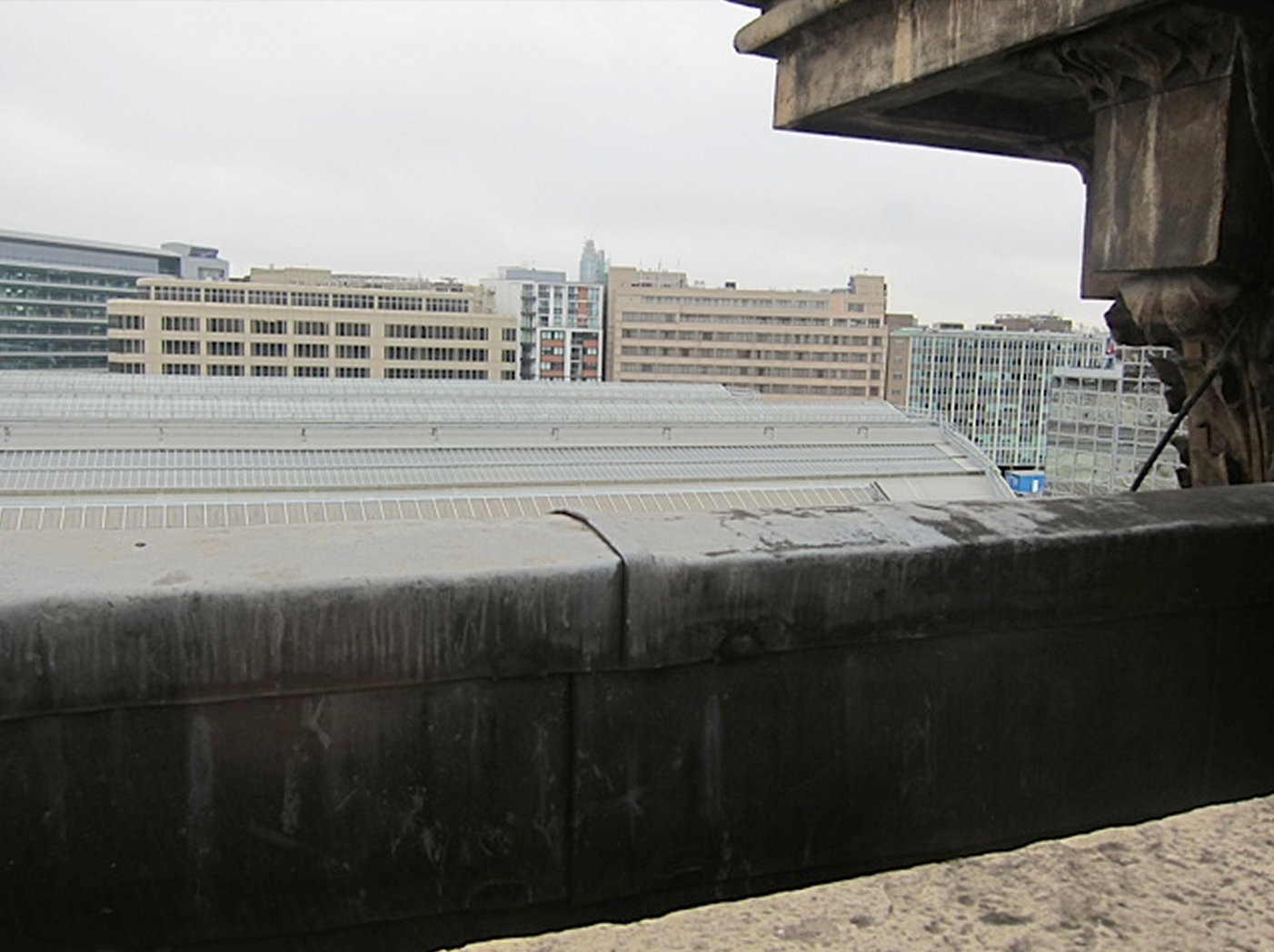
You have until noon on Tuesday to guess it. City and/or state first, then country. Please put the location in the subject heading, along with any description within the email. If no one guesses the exact location, proximity counts. Be sure to email entries to contest@andrewsullivan.com (the old address still works as well). Winner gets a free The View From Your Window book. Have at it.
Jordan Weissmann points out that, if the government slashed aid to private colleges, it could “cover the tuition bill at every public college in the country”:
With the money that’s either going to private colleges, or or being paid to the public sector in a roundabout way via tax breaks, we could probably make tuition at public institutions — which educate about 76 percent of American undergrads — either free, or ridiculously cheap.
Daniel Luzer pushes back:
Any attempt to move all federal aid directly into state universities would result in a vast and angry outrage (and lobbying efforts) from America’s private universities (not to mention for-profit companies that offer higher education).
“You’re cutting off aid to poor students,” they’d complain. And they’d be right. The reality is that while Princeton or Amherst could continue to exist fairly well without federal financial aid, University of Phoenix would go bankrupt. Also destroyed under this plan would be a huge swath of small private colleges that educate many middle and working class Americans.

Matthew Power profiles the urban explorer movement known as Urbex, whose followers “over several years had infiltrated an astonishing array of off-limits sites above and below London and across Europe: abandoned Tube stations, uncompleted skyscrapers, World War II bomb shelters, derelict submarines, and half-built Olympic stadiums”:
They had commandeered (and accidentally derailed) an underground train of the now defunct Mail Rail, which once delivered the Royal Mail along a 23-mile circuit beneath London. They had pried open the blast doors of the Burlington bunker, a disused 35-acre subterranean Cold War-era complex that was to house the British government in the event of nuclear Armageddon. The London crew’s objective, as much as any of them could agree on one, was to rediscover, reappropriate, and reimagine the urban landscape in what is perhaps the most highly surveilled and tightly controlled city on earth.
Power tagged along with some of them to scale Notre Dame Cathedral in the middle of the night:
I passed so closely by a carved gargoyle I could see the furrows of its brow, could almost smell its breath. Atop the first roof we found ourselves in a long gallery of flying buttresses, which spanned outward like the landing struts of some alien spacecraft. Each buttress framed a fifty-foot arched stained-glass window, darkened from within, and as we climbed to the next level, I pulled myself up next to one. I spun slowly on the rope, and for a heart-stopping instant my shoulder rested gently against the glass. I was so close I could see the seams of lead that connected the thousands of pieces of colored glass, the end result of centuries of labor at the hands of nameless artisans. I felt in that moment I would rather fall than damage it.
(Photo: “Behind the Gare St. Lazare” by Dan Foy)
In 2008, Katie Arnoldi volunteered for a team in charge of cleaning up emptied marijuana sites on public lands in California. On one single operation, they “pulled out 27 miles of irrigation pipes, and over 2,000 pounds of fertilizer, pesticides, rodenticides and hundreds of bags of trash.” In the first of a five-part series, she describes what she saw:
When I got into the active grow-sites, I was struck by the fact that there was absolutely nothing alive. No bugs. No animals. No snakes or lizards. Every single site was a dead zone except for the thriving, chemically drenched plants. And the thing is, all these chemicals leach into the soil. And then when the rains come they’re washed into the drainages where they pollute the waterways and kill the fish. Ultimately it all ends up in the ocean. These pot farms are permanently destroying our protected wilderness.
Even more disturbing, we are inhaling the results:
According to a 2010 HIDTA report, California supplied three-quarters of all marijuana to the US market. Most of the pot was coming directly from the huge cartel grows. People are smoking these terrible chemicals and they don’t even know it. When I worked on the Growsite Reclamation Team, I helped collect samples of the fertilizers, pesticides and rodenticides so that they could be analyzed by a lab. The results were scary. For instance, the lab determined that a quarter teaspoon of one of the Mexican pesticides, found out in the foothills of the Sierras near Sequoia, was so toxic that it in its undiluted form it could kill a 200-pound man. The growers will take a big scoop of this stuff, mix it with water, and spray their crops on a regular basis. That’s what people are smoking. Who knows what the long-term consequences will be?
Probably worse that the munchies. Previous Dish on the environmental impacts of prohibition here and here.
 The Dish
