The Frontrunner, By A Mile

Micah Cohen puts Hillary’s 2016 early-polling lead in historical context:

Her lead in the polls we have so far exceeds that of any other candidate — of either party — in any election cycle in our sample. Many observers have pointed out that Mrs. Clinton also had a large lead in early polls of 2008 and yet lost that race. But her 2016 lead over Mr. Biden (33 percentage points) exceeds even her 2008 lead over Mr. Obama (22 percentage points). And she may benefit from the sense of being “the next in line,” having been the runner-up in her party’s last open contest — a dynamic seen in several recent Republican primaries.

Is RSS On The Way Out?

Buzzfeed_Reader

Felix Salmon fears so:

RSS has been dying for years — that’s why Google killed Reader. It was a lovely open format; it has sadly been replaced with proprietary feeds like the ones we get from Twitter and Facebook. That’s not an improvement, but it is reality. Google, with Reader, was really providing the life-support mechanism for RSS. Once Reader is gone, I fear that RSS won’t last much longer.

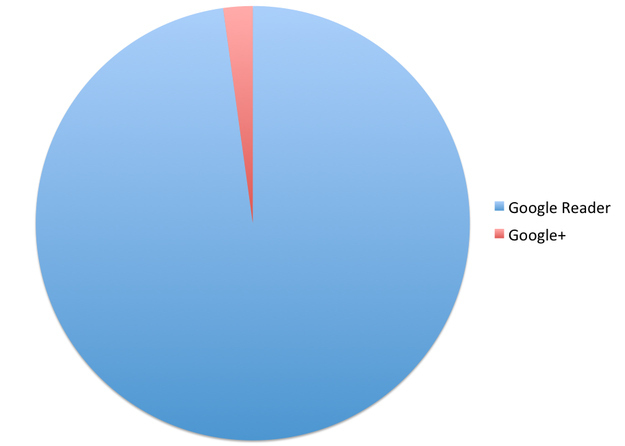
That would be a sad coda to the death of Aaron Swartz, who at the age of 14 was part of the team that invented RSS. The end of Google Reader, and RSS more generally, could also hurt blog traffic. Buzzfeed provides the above chart:

According to data from the BuzzFeed Network, a set of tracked partner sites that collectively have over 300 million users, Google Reader is still a significant source of traffic for news — and a much larger one than Google+. The above chart, created by BuzzFeed’s data team, represents data collected from August 2012 to [yesterday].

Defense Isn’t Untouchable Anymore?

Josh Green unpacks the politics of the sequester’s defense cuts:

Anti-tax activists steamrolled the defense crowd. Why? The answer probably lies in the composition of the Republican caucus, especially in the House: Nearly half its members—48 percent—were elected in 2010 or after. These Republicans are genetically different from those who held power in the 1980s and ’90s.

They came of age during a period of two failed wars in the Middle East and exploding budget deficits. “This is a group that got elected to rein in spending, not to protect Cold War-era defense,” says David Wasserman, House editor for the nonpartisan Cook Political Report.

But individual Republicans are starting to complain about sequester cuts that impact their districts.

The Pope On The Bus

Giotto_-_Scrovegni_-_-26-_-_Entry_into_Jerusalem2

Of course that detail has resonance. The implicit rebuke to the Liberace of Popes, Benedict XVI, is somehow not disrespectful, yet obvious. Saint Francis refused to ride on a horse. It gave him, as far as he was concerned, too much haughtiness, too much power over others, too much visibility. He would walk, and if he needed a way to transport things with him, he used a donkey. For a while, Franciscans followed this stricture carefully, while eventually the norm became that Franciscans could ride on donkeys, never horses, if they really couldn’t walk. And the legend has it that on his death-bed, Francis thanked his donkey for his long service and that the donkey wept.

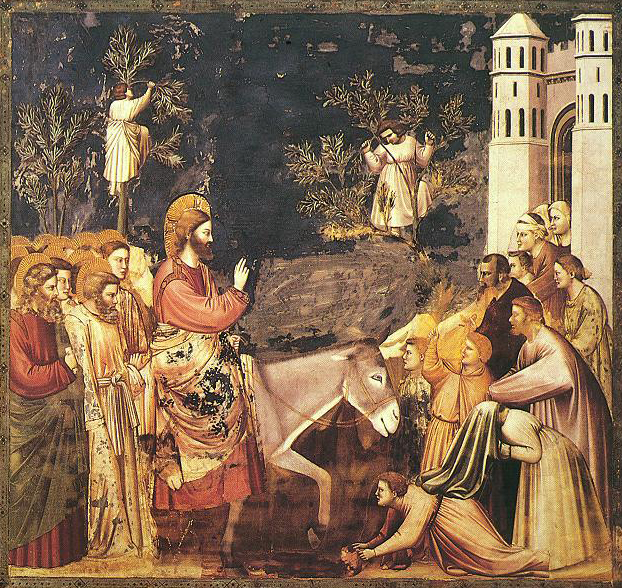
Jesus’ celebrated arrival in Jerusalem, when the crowds that would soon call for him to be tortured to death were throwing palm fronds at his feet, was on a donkey. Here we had the Son of God insisting on making a paradoxical entrance – on the lowliest creature. “Lowly Yet Chosen” as Pope Francis put it in his first statement. And so we hear more and more stories of his insistence on an absence of pomp, of not placing the priesthood or even the papacy on a lofty pedestal, getting on the same bus as is fellow cardinals, paying his own bills at a local hotel, telling his fellow Cardinals to wear black rather than Benedict’s fabulous scarlet near-burlesque.

For much of my time in high school, I rode the public bus every day. I went to what Americans would call a “magnet school” which was a long way, in an English sense, from my home. For close to seven years, I spent two and a half hours a day on that lumbering vehicle, wending its way with painful slowness through the darkness of the English winter or the absurd green orgasm of every spring. And I think there is something valuable about that simple public exposure, day after day, that reminder that you are not better than anyone else, that if there’s no seat available, you stand, that if an old or infirm or pregnant person gets on the bus, you offer them your seat, that the strangers you stare at have lives you will never fully know – unless a conversation happens to begin, or a stranger on the same bus every day becomes a kind of unknowable friend. I can still close my eyes and see faces I would see at various stops along the way. We were English so mere nods of recognition sufficed.

This is one reason I love Catholicism: its human and cultural catholicity.

The parishes I’m drawn toward are sprawling, diverse, different congregations. I never wanted to go to a gay mass, although I respect those who choose to. For me, it was the lack of uniformity that grabbed me. To walk to communion behind a student or a construction worker or a Latino immigrant or a pregnant mother or a gay senior or an old lady in a veil is to experience the sheer, glorious wounded mess of humanity – walking to be healed by the Body of Christ. I deeply believe this is integral to Christianity – a lack of hierarchy, an insistence that what the world elevates is not what matters, that the first shall be last, and the last first. Letting go of the notion that you are worth more or less than anyone else, accepting your physical fate as dust, and embracing humanity without borders or labels – as the Samaritan did in the parable, as Francis did with lepers, as Mychal Judge and Jorge Bergoglio did in washing the feet of people with AIDS – this is Christianity.

It wounds me to see so many young people think of it as the opposite (and not without reason). A hierarchy determined to defend its privilege and prestige even at the expense of raped children, a Pope almost disappeared in his own regalia, a stream of statements ostracizing a group of human beings – gays – and refusing even to listen to the perspective of half of humanity, women: this is what Francis inherited, and he was not free of it. But the new name gives new hope and points in a new direction.

Perhaps the answer is to get back on the bus again. And in one of her most poignant posts yet, Judith O’Reilly responded to the new Pope by doing just that:

Why did I feel I had to ride this bus this morning? Because I wanted to know why a cardinal did not ride in a leather-seated, tinted-windowed limo though the streets of Buenos Aires, but chose instead to travel among the faithful and less-than-faithful, bumping and swaying, the wheels on the bus going round and round. What did Jorge Mario Bergoglio get from those bus-rides around the city? Stories? Comfort? Warmth? An understanding what it is to work hard, to be tired, to be lonely, to have to stand when you want to sit, to know you are going home or going far away? Maybe too, I wanted to get on the bus, any bus, because we are on our own journeys and right now at least so far as faith goes, I don’t know where I am heading. Maybe, I thought, if I catch a bus like a Pope, I’ll arrive at a destination called Faith.

And maybe we will.

(Painting: Jesus’ arrival in Jerusalem, Giotto).
Bergoglio And Torture, Ctd

One of those kidnapped and tortured Jesuits priests who some argue were abandoned by Pope Francis during the dirty war has come to the defense of the new Pope:

“It was only years later that we had the opportunity to talk with Father Bergoglio … to discuss the events,” Jalics said Friday in his first known comments about the kidnapping, which occurred when the new pope was the leader of Argentina’s Jesuits. “Following that, we celebrated Mass publicly together and hugged solemnly. I am reconciled to the events and consider the matter to be closed,” he said.

That doesn’t exactly exonerate Bergoglio on the facts but when the victim has reconciled with the alleged violator, and considers the matter closed, we can look forward rather than back.

It Gets Better

Senator Rob Portman, prompted to rethink the issue after finding out that his son is gay, has announced that he supports marriage equality:

British Prime Minister David Cameron has said he supports allowing gay couples to marry because he is a conservative, not in spite of it. I feel the same way. We conservatives believe in personal liberty and minimal government interference in people’s lives. We also consider the family unit to be the fundamental building block of society. We should encourage people to make long-term commitments to each other and build families, so as to foster strong, stable communities and promote personal responsibility.

One way to look at it is that gay couples’ desire to marry doesn’t amount to a threat but rather a tribute to marriage, and a potential source of renewed strength for the institution.

Weigel puts this in perspective:

Up to now, a lot of the Republicans making bold strides toward gay marriage were consultants (whose corporate work would benefit from the stance) or retired pols. Portman is one of the acknowledged thought leaders of the congressional party.

Timothy Kincaid thinks Portman’s change of heart “is a bit risky”:

Ohio Republicans are a different breed from the New Hampshire strain. But I’m going to hazard a guess that this wont much hurt Portman. It might even help him.

For my part, I’m thrilled by his acknowledgment of the equal humanity and citizenship of his own son. We hear a lot about “family values” from the GOP, but we rarely see them in action as clearly as we do in Portman’s reversal. And the clarity of his essentially conservative argument for marriage equality – the same one I made two and a half decades ago – has to resonate. No conservative not in thrall to religious fundamentalism can regard this reform as somehow anti-family. It is pro-family; it is socially integrative; it heals wounds, rather than opening them; it helps create more marriages that act as a critical civil society that keeps government at bay. Now I have a husband, I have a First Responder to all the crises of life. I have less need of government help, if I have a spouse’s help first.

Some will wonder why Republicans only seem to get this question when they have a gay member of their family.

And you can indeed argue that conservatives tend to embrace social justice only when they are directly affected. I’d prefer to look at it the other way round. These Republicans, unlike some others, have actually confronted the issue face to face – and the good ones immediately become some of the strongest supporters of marriage equality. Once they see us as them, they realize the hurt and pain and cruelty of ostracizing from civil society core members of that society and full members of their own families. Ask yourself: how many out gay Republicans actually oppose marriage equality? Almost none that I know of. When a community’s entire right wing and entire left wing back a reform, when their families back it, it becomes not a matter of left and right. It’s really a matter of right and wrong.

Sometimes, reforms threaten conservatives, as they should. Conservatism, properly understood, remains an important restraint on our utopian impulses or our certainty about anything. It asks us of to consider unforeseen consequences of reform, to consider carefully the pluses and minuses, to prefer federalism to sudden, national decisions. As this process has taken place, even as religious fundamentalism has swept the GOP, those capable of adjustment, those who understand that to preserve the vitality of a social institution, you sometimes have to change it a little: they are coming around.

Eating Like Which Caveman?

Laura Miller summarizes arguments from Marlene Zuk’s new book, Paleofantasy, which calls the “paleo diet” fad pseudoscientific:

[G]eneralizations about the typical hunter-gatherer lifestyle are spurious; it doesn’t exist. With respect to what people ate (especially how much meat), the only safe assumption was “whatever they could get,” something that to this day varies greatly depending on where they live. Recently, researchers discovered evidence that people in Europe were grinding and cooking grain (a paleo-diet bugaboo) as far back as 30,000 years ago, even if they weren’t actually cultivating it. “A strong body of evidence,” Zuk writes, “points to many changes in our genome since humans spread across the planet and developed agriculture, making it difficult at best to point to a single way of eating to which we were, and remain, best suited.”

Yglesias agrees with Zuk:

None of which is to say that adopting a paleo diet won’t “work.” Any sufficiently stringent, somewhat arbitrary set of dietary restrictions is likely to lead you to snack less and be more mindful of what you’re eating. But the paleo concept is a marketing gimmick that doesn’t have much basis.

#1 In Distracted Driving

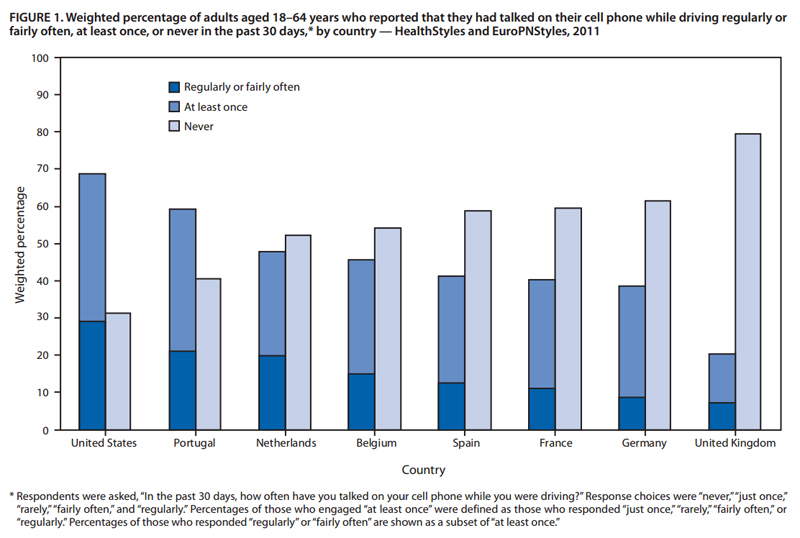
A new report finds that Americans are more likely than other Western countries to talk and text while driving:

Distracted Driving

Sarah Johnson summarizes:

The United States had the highest rate of both texting and talking while driving of any country in the survey. For adults 18-64 in the U.S., 69 percent reported talking on the phone while driving in the past 30 days at least once, and 31 percent reported texting or emailing while driving — tying with Portugal for the highest rate.

Plumer adds:

Why the disparity? One theory: All those European countries have laws against driving while talking on a hand-held phone. In the U.S., by contrast, fewer than half the states forbid adult drivers from driving while talking. See here for a legal overview.

Driving On Sunshine, Ctd

A reader writes:

With regard to solar highways, a more inclusive solar policy would be to modify building codes to require re-roofing to be done with solar-collecting roofing tiles. If the homeowner was willing to fund the full cost of the solar roofing, they would own the electricity generated by their roof. Their electric bill would be reduced by using the energy from their roof and they could sell any excess power to the utility company (as is often done today). The twist would be that if the homeowner didn’t want to pay the additional amount for solar tiles and hook up to the grid, a government subsidy could bridge the difference between a traditional roof and a solar one. In that scenario the energy created by the homeowners roof would belong to “the commons” and the homeowner would receive the usual electric bill for all the power consumed by that household.

This method would allow utilities to expand solar service in a very predictable way that allows the business to ramp up production with a real knowledge of future demand. Also, within 30 years, the entire county would be a giant solar collector.

A wonky reader responds to another recent post on solar energy:

Loving the recent focus on energy issues, attacked with the usual vigor.

The Bloomberg analyst has it exactly right: Suntech is the most recognizable, reputable Chinese brand, and the government won’t let it go down. There are certainly a number of other high-quality Chinese manufacturers, but there is a lot of substandard product coming from that country, as in other industries. Given that they’ve just effectively vanquished the U.S.-based manufacturers, it seems crazy that they’d fold now. As long as the U.S. incentive structure holds up (barely, for now) there will still be demand here, and most consumers unfortunately don’t know enough about solar brands to distinguish between the junk and the premium manufacturers. The loss of Suntech’s production share would be significant for the U.S. market.

I also doubt the warranty issues is as big a concern for companies like SolarCity and SunRun. Most of these systems are closely monitored, and they don’t fail terribly often. When they do, it’s more likely to be wiring or the inverter, rather than the panel itself. Since the large installers buy high-quality product, there’s every likelihood that most panels will perform at or above spec for their full warranty life. Many “solar guys” proudly display still-working arrays from the first solar boom in the 70’s. The industry touts a 1%/year efficiency degradation rate but it’s probably often better than that.

One thing that’s commonly misunderstood about solar panels is that once you’re beyond the level of the solar cell itself, a typical PV panel is just about the least complex form of energy generation in existence. They have no moving parts. The panel itself is encased, usually rated to withstand hail or whatever type of weather is appropriate for the region. You could crack one if you kicked it really hard (I never tried), but they’re not what I would call fragile. The only “mechanism” is a wire attached to the back which transmits the current. Some systems have microinverters attached on each panel, but those are warrantied separately, and are more likely to be U.S. manufactured.

I’m talking off the cuff here though, and while having to eat the warranty on Suntech panels might not kill a company like SolarCity right away, it’s just as easy to imagine their already-thin margins getting nibbled to death over time under those circumstances.

The long game here – and this ties into your post from the other day about fracking – is that solar is pretty close to an economic tipping point in the U.S., and it drives solar industry guys nuts when academic renewable energy guys talk about “costs need{ing] to come down”. We don’t need more research; we need more demand. The only way solar gets any cheaper anymore is for guys in harnesses and helmets learn how to do their jobs better. We don’t need another scientist at MIT setting a cell efficiency record, or another “expert” telling the politicians that they should cut demand incentives to fund research. Doubly so for the whole “the sun doesn’t shine at night” bit – how much electricity demand is there in the middle of the night? Solar produces power when it’s needed – the middle of the hottest day in the summer when everyone turns on their air conditioners at once. If energy were priced in real-time, solar would get top dollar. Instead, we have a regulatory regime that effectively guarantees that all electricity is the same price no matter how much is purchased or when.

Even with our distorted electricity market, solar has almost reached grid parity, or the point where solar electricity competes with natural gas-generated grid electricity without subsidies. As long as solar prices declining and the boom-bust incentive cycle doesn’t cause the industry to lose the manufacturing knowledge and economies of scale – again – solar could go pretty big in the next few years. Moreso if we fixed the electricity markets, not just to price pollution but price electricity supply and demand in real-time. The utilities that see this future as inevitable or desirable are the ones pushing smart meters, by the way. Trust me, these things are good for you.

Sorry for the lengthy note; these issues are so often misunderstood, so rarely discussed well. Between school and work I spent the better part of a decade trying to unpack them, before burning out late last year. I have a friend who just spent a night in jail protesting Keystone XL. After working with Congress on energy for four years, I sometimes wonder if guys like him are the only ones making a difference.