Assisi, Not Xavier

Confirmed:

Applause broke out in the Sistine Chapel for Bergoglio when he crossed the threshold of 77 votes, and again when he said “Accetto,” I accept, according to Dolan, who himself had been considered a candidate for the throne. Dolan told reporters that Bergoglio “immediately said, ‘I choose the name Francis in honor of St. Francis of Assisi,’ ” referring to a rich man’s son who took a vow of poverty.

From Pope Liberace to Pope Francis. That’s a lot of drag to put away.

How Racism Was Made, Ctd

kids-race

Readers continue the debate:

I take your point that you “don’t believe the law created racism any more than it can create lust or greed or envy or hatred.” I think, though, that this depends on how you define racism. It seems that what you’re describing is less racism than prejudice.  I agree that you cannot totally erase prejudice – that unconscious separation of those “like me” from those “unlike me” – from people’s psyches.  The origins of that are surely evolutionary, and were once very valuable on the savannahs of Africa.  But racism is an institutionalized system of discrimination based on prejudice.  In short, it’s prejudice plus power.  That is something that can and should be addressed in policy. In fact, there’s no other way to address it.

Another adds, “Government policy may not be able to “end” racism, but it can definitely reduce it to levels where it may be effectively extinguished.” Another:

It fascinates me how a guy who is clearly one of the most brilliant people out there still has this strange blind spot when it comes to the use of the term “race.” Maybe it’s because “race” took on a different connotation when you grew up in England than it does in the U.S.

Group loyalty may be part of our DNA. But what you fail to understand is that how the “groups” are determined is a separate question altogether. Each of us identifies with dozens of “groups” in a lifetime. Those loyalties change, they can be invoked in countless ways, and circumstances can alter them dramatically. All TNC – along with practically every historian of “race” in America – is trying to illustrate is that the way we’ve chosen to draw up “races” (i.e. groups) in America is not a part of nature. A mere survey of racial imaginings throughout the world will illustrate, for instance, that “the one drop rule” is distinctively American.

And not also Nazi? Or South African? Another:

I suspect that you and TNC may agree more, or at least disagree less, than you realize when it comes to his assertion that racism is created by policy. The issue is, I suspect, a difference in terminology rather than TNC’s “utopianism.” Note that both your and TNC’s uses are options in the following Dictionary.com definition:

rac·ism, [rey-siz-uhm] noun

1. a belief or doctrine that inherent differences among the various human races determine cultural or individual achievement, usually involving the idea that one’s own race is superior and has the right to rule others.

2. a policy, system of government, etc., based upon or fostering such a doctrine; discrimination.

3. hatred or intolerance of another race or other races.

In short, I think you and TNC are using the term racism in different but not contradictory, and even complementary, ways. And I am not sure TNC is suggesting that eliminating existing racist institutions or correcting past ones will eliminate human prejudice (although we are witnessing how these hatreds diminish as people of younger generations gain increasing exposure to difference, which would not be possible without the dismantling of policies that keep them separate from other groups).

Another reader:

I have a very distinct memory of being a small child, probably no older than 5 or 6, and, wanting to be more grown-up, announcing to my parents that I had a “girlfriend” (who of course was just some random fellow kindergartener in my class). They were amused. The punchline, of course, is that she was black (and I am white). At the time, it literally did not register that this aspect of her appearance had any significance whatsoever. I think anyone who works with small children will say my example is typical, and race is simply not important to a child who has not been taught racism. Clearly, then, racism is learned, not innate.

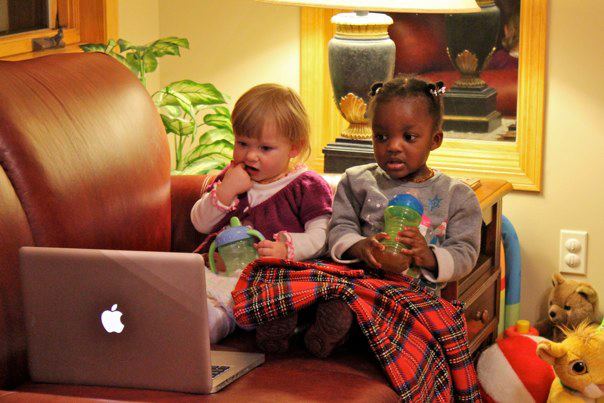
Along those lines, another sends the above photo:

I agree with TNC that racism is taught. I also take your point about evolutionary urges. The attached photo tells more than my words could ever muster. My granddaughter, Lilian, the white one on the left, has spent every week of her life interacting with Adrielle, the black baby to the right. We have been told that when Lilian is at her large community daycare, she wants to play with the black toddlers as her first choice. If racism can be taught, acceptance sure as hell can be taught as well. We chose the latter.
Slingshotting Onto TV


America’s favorite smartphone game is becoming a cartoon series:

“[Angry Birds] Toons” will release a new two minute and 45 second episode each week for 52 weeks. Broadcast episodes will run first on Saturday mornings and then go live in the app and on video on demand on Sunday. Angry Birds fans can also find the series on Samsung smart televisions and Roku set-top boxes. All of the ads will be 15 second pre-roll videos. “We know on mobile people consume content in snackable bites, so this is enough time to tell a story and still be accessible to users,” [Michele Tobin, Rovio’s head of brand partnerships and advertising in the US] said.

Kit Eaton notes the advantages of Rovio’s innovative app-inclusive distribution strategy:

This effectively gives the cartoon a distribution network of 1.7 billion “screens,” which equates to the number of times (in total) the Angry Birds apps have been downloaded. … This innovation is claimed to be creating one of the biggest TV “networks” ever.

I won’t watch, even though I’m still powering through Angry Birds Star Wars. The great trick of it is to engage you actively, not passively. The wit of the characters is best left alone as visual parts of the game you fill in. But maybe I’ve become some kind of purist addict. I turn the sound off as well. Angry Birds is a kind of therapy for multi-taskers. There is just one task: get three stars. Mentally, it’s like going to the gym and is part of my own self-medication as a long-distance-blogger.

Plus, for some reason, you want to do it more than you want to meditate for twenty minutes. And fifty minutes later, you wonder where your afternoon went.

How Long Will Francis Last?

Older Popes

Nate Silver – veering ever so slightly into self-parody between election seasons – charts the reigns of popes from the past 500 years:

[O]ne question is whether [the cardinals] saw his advanced age as a liability — or an asset. How might Francis’ age be advantageous? One reason is that, if he were to serve 5 to 10 years, that would actually be very well in line with historical precedent. Beginning with St. Peter in 33 A.D., there have been 266 popes in 1,980 years, or about one new pope every seven and a half years. Benedict XVI’s regime, which lasted for seven years and 315 days before ending in February, was also well in line with this historical average.

Charles Pierce thinks the conclave intentionally voted “for a guy with the actuarial tables lined up against him”:

[H]e’s 76-years old which means, quite honestly, that the man’s a caretaker, or that there is a real faction within the cardinal-electors arrayed against the idea of very long papacies on the order of that of John Paul II. The last pope, in a conclave that was a bigger fix than the 1919 World Series, was the obvious choice, but he also was 78 upon his election, and he reigned only eight years. It’s hard to imagine Francis I going much longer than that. It’s also hard to imagine that this wasn’t some kind of plan all along.

Benedict was also a care-taker, remember? But we’ll see. There are growing worries among some of my Catholic friends, experts and sources, I have to say. My concern is that the one critical thing the Vatican lost under Benedict XVI was moral authority. And an Archbishop at the very least acquiescent to a military junta that murdered and tortured countless liberals and leftists is not exactly the antidote. But notice also this US diplomatic cable from 2007 on him, retrieved by McClatchy:

“Many on the political left allege the church was complicit with atrocities committed by the state and believe the church has failed to account or atone for its actions,” the cable said. “The church has not yet disciplined nor defrocked Von Wernich but has sought to distance itself from the unauthorized, maverick operations of rogue priests. Nonetheless, at a time when some observers consider Roman Catholic primate Cardinal Bergoglio to be a leader of the opposition to the Kirchner administration . . . the Von Wernich case could also have the effect, some believe, of undermining the church’s (and, by extension, Cardinal Bergoglio’s) moral authority.”

In an earlier cable, dated May 10, 2007, the embassy noted that Bergoglio had actively opposed Kirchner initiatives despite having said “that the church would not get involved in politics.” “The government appears irritated at the cardinal’s apparent preference for the opposition in this electoral year,” the cable said.

An Archbishop taking on the role of leader of the political opposition on all the issues that fracture the Catholic church in the West: women’s rights, abortion, homosexuality, contraception. Here’s hoping that is not the Pope we will now get.

And Emerson Wept, Ctd

More scintillating IBM prose from the magazine that once published Mark Twain:

The successful CMOs will be the ones who will drive change across the enterprise to ensure that every touch point is building brand equity instead of diluting it. Companies will also need to start paying attention to a whole new set of metrics in this new world. They need to understand who their brand advocates and detractors are, and what shapes their attitudes and drives their behavior. They need to keep track of near-advocates, and what type of interactions will turn them into advocates.

Similarly they need to keep a close eye on near-detractors, and what type of actions can reduce the probability of them turning into active and vocal detractors.

Not running this kind of corporate crap as sponsored journalism would help.

Google Reader, RIP

Citing declining usage, Google announced yesterday that it will shut down its Google Reader RSS service in July. Tom Watson thinks Google is pissing off the wrong crowd:

Google Reader is used and loved by a very loud – and as some would no doubt say, very influential – core user group. Any app builder would kill for this following – any social entrepreneur would walk a thousand miles for this crowd. And make no mistake, Google Reader is something of an important public accommodation, a real point of differentiation for a company whose motto is “don’t be evil.” Google was doing a public service for the news and blogger community by keeping Reader going. Understandably, the Reader shutdown [is being] received not just as the end of an era but almost as an attack on those who count on it for traffic and attention.

Drew Olanoff pins the blame on RSS’s lack of consumer appeal:

I’ve heard many smart people try to explain RSS to normal folks, such as “turning content into television stations, allowing you to subscribe only to what you want to consume.” That one didn’t work. Neither did any other explanation, because RSS as a technology is too nerdy, too behind-the-scenes and lacked general consumer appeal. Nobody ever took RSS under its wing and “mentored” it. In essence, Twitter is a big RSS reader, allowing you to “follow” the people sharing content that you’d like to consume. That simple concept of following gripped, but subscribing to feeds simply did not, at least how Google Reader and other popular readers let you do it.

Zooming out, Alex Kantrowitz argues that Reader’s demise is proof that no service on the Internet is forever:

The death of Google Reader reveals a problem of the modern Internet that many of us likely have in the back of our heads but are afraid to let surface: We are all participants in a user driven Internet, but we are still just the users, nothing more. No matter how much work we put in to optimize our online presences, our tools and our experiences, we are still at the mercy of big companies controlling the platforms we operate on. When they don’t like what’s happening, even if we do, they can make whatever call they want. And Wednesday night, Google made theirs.

Yglesias hopes that Google Reader’s death will spur innovation:

Google Reader wasn’t a viable business that Google was investing in and improving. If anything, they were making it worse in flailing efforts to integrate it into a real business strategy. But it was essentially impossible to compete with them either. They were the 800-pound gorilla in the RSS space, but like a hobbled 800-pound gorilla that wasn’t going anywhere.

Marco Arment argues along the same lines:

It may suck in the interim before great alternatives mature and become widely supported, but in the long run, trust me: this is excellent news.

Meanwhile, Whitson Gordon rounds up some alternatives for the soon-to-be Reader-less.

A Poor Education

Yglesias focuses on the differences in college application strategies between rich and poor students:

High-income, high-achieving students generally do what you’d expect. Most of their applications are to schools where the median admissions test score is similar to what they got. But they apply to some reach schools and most to a safety school. Generally they apply to the local flagship state university campus, which is sometimes a match and sometimes a reach depending on the state.

Low-income students are very different. Fully 53 percent of them apply to zero schools whose median SAT or ACT scores are similar to their own. Many of these smart, poor kids apply only to a single unselective school. Only a very small percentage of these kids—8 percent of them, the authors estimate—act the same as high-achievement kids from prosperous families by applying to selective schools, including some reaches and safeties.

Reality Check

This embed is invalid


Blumenthal examines the president’s approval rating:

Despite the recent decline, Obama’s overall approval rating remains well ahead of the 46 to 47 percent levels on the Pollster trend line during the spring and summer of 2012. The open question is whether the recent shifts result more from newly negative views of Obama’s handling of the economy or an end to a bubble of approval fostered by Obama’s November victory and January inauguration, a period in which the usual partisan invective fades, albeit temporarily.

Our Constant Struggle With Stress

Dana Becker, who has a new book on stress, dislikes contemporary understandings of the term:

Instead of thinking about stress as something outside us, it’s now become integral to the self. So the problem of stress has become our own personal predicament to solve, and there’s no dearth of advice about how to do this: eat more kale, get some therapy, take a yoga class. The message is: change yourself, change your lifestyle, or learn to adapt to the stress. Consider what it means to accept this way of thinking about stress. If women believe that it’s our job to manage the stress of combining paid employment and family work, we’re more likely to “de-stress” by putting more bath oil in the bath and less likely to work toward changing family-unfriendly workplace policies or to agitate for universal daycare.

Alexander Nazaryan reviews Becker’s book:

[T]oday, not only has the notion of being stressed-out come to embody a whole host of issues that may have non-mental underpinnings, but we are constantly told that we can marshal what the poet John Berryman smirkingly called our “inner resources” to wage an effective battle against this invisible enemy. This is Becker’s objection to the culture of stress: Stress exists, but it’s been blown out of proportion, falsely rendered, and has spawned an entire ecosystem of pseudo-psychological empowerment, from therapy to VitaminWater that purportedly offers relaxation.

Stress is not the issue, Becker says. Life is difficult, unknowable and often harrowing, and there is no use pretending that two minutes spent in downward dog is going to change all that. One more inclined to philosophy than sociology might note that we have replaced Kierkegaard’s prevailing anxiety about existence with a far more mundane unease, one we think we can eliminate precisely because it is earthbound.