The government just released a massive study on the factors that influence a soldier’s reintegration into normal life after a deployment to Iraq or Afghanistan. George Zornick focuses on the effects of sexual trauma, reported by 48,100 women and 43,700 men:
The study focuses on what these traumas mean for female veteran’s health: as noted, it concludes that women who have suffered a sexual assault in the military are nine times more likely to develop PTSD than female veterans with no history of sexual abuse. Female victims are also at much greater risk for a wide variety of other problems upon return: anxiety, depression, substance abuse and family troubles.
These results explicitly control for other factors that lead to PTSD. Contrary to many conservative talking points when Obama lifted the restriction on women in combat, the research cited in this study found that women handle combat-related stress just as well as men—military sexual trauma is a singular factor bumping up the prevalence of PTSD among women.
Previous Dish on rape in the military here, here, here and here.
All illegal drugs combined are to alcohol as the Mediterranean is to the Pacific. We have our whole navy in the Mediterranean. And that’s true both of the drug policy machinery and those who are fighting the drug war, and of the drug reform movement, which, it seems to me, neglects the problem with the one drug we’ve legalized. Any sentence about drug policy that doesn’t end with “raise alcohol taxes” is an incoherent sentence.
He continues:
Taxation is just about the perfect way to control alcohol use. It’s not complete, because you need controls for the real problem drinkers. But if we tripled the alcohol tax it would reduce homicide by 6 percent. And you’re not putting anybody in jail. But instead we spend our time talking about doing marijuana testing for welfare recipients.
The University of Pennsylvania Health System recently announced that they will no longer hire smokers in any of their Pennsylvania facilities. Harald Schmidt, Kristin Voigt, and Ezekiel J. Emanuel argue that policies like this are misguided:
The broader claim that it is fair to exclude smokers because they are responsible for raising health care costs is too simplistic. It ignores the fact that smoking is addictive and therefore not completely voluntary. Among adult daily smokers, 88% began smoking by the time they were 18, before society would consider them fully responsible for their actions. Much of this early smoking is subtly and not so subtly encouraged by cigarette companies. As many as 69% of smokers want to quit, but the addictive properties of tobacco make that exceedingly difficult: only 3 to 5% of unaided cessation attempts succeed. It is therefore wrong to treat smoking as something fully under an individual’s control.
David Asch, Ralph Muller, and Kevin Volpp are more supportive:
[W]e conducted a randomized trial comparing the use of employer-provided financial incentives for smoking cessation, aided by counseling, with an approach in which the same sorts of counseling programs were made available to employees but no incentives were given — effectively comparing enabling choice (rung 3) with guiding choice through incentives (rung 5). In one sense, the results were dramatic: during 12 to 18 months of follow-up, employees in the incentive group had a quit rate that was approximately three times that in the comparison group.5 But in absolute terms, even the incentive group had an 18-month quit rate of only about 9% — meaning that even with an aggressive system of rewards, 91% of employees who wanted to quit could not. We believe that the severe harms of smoking justify moving higher up on the ladder when lower-rung interventions don’t achieve essential public health goals.
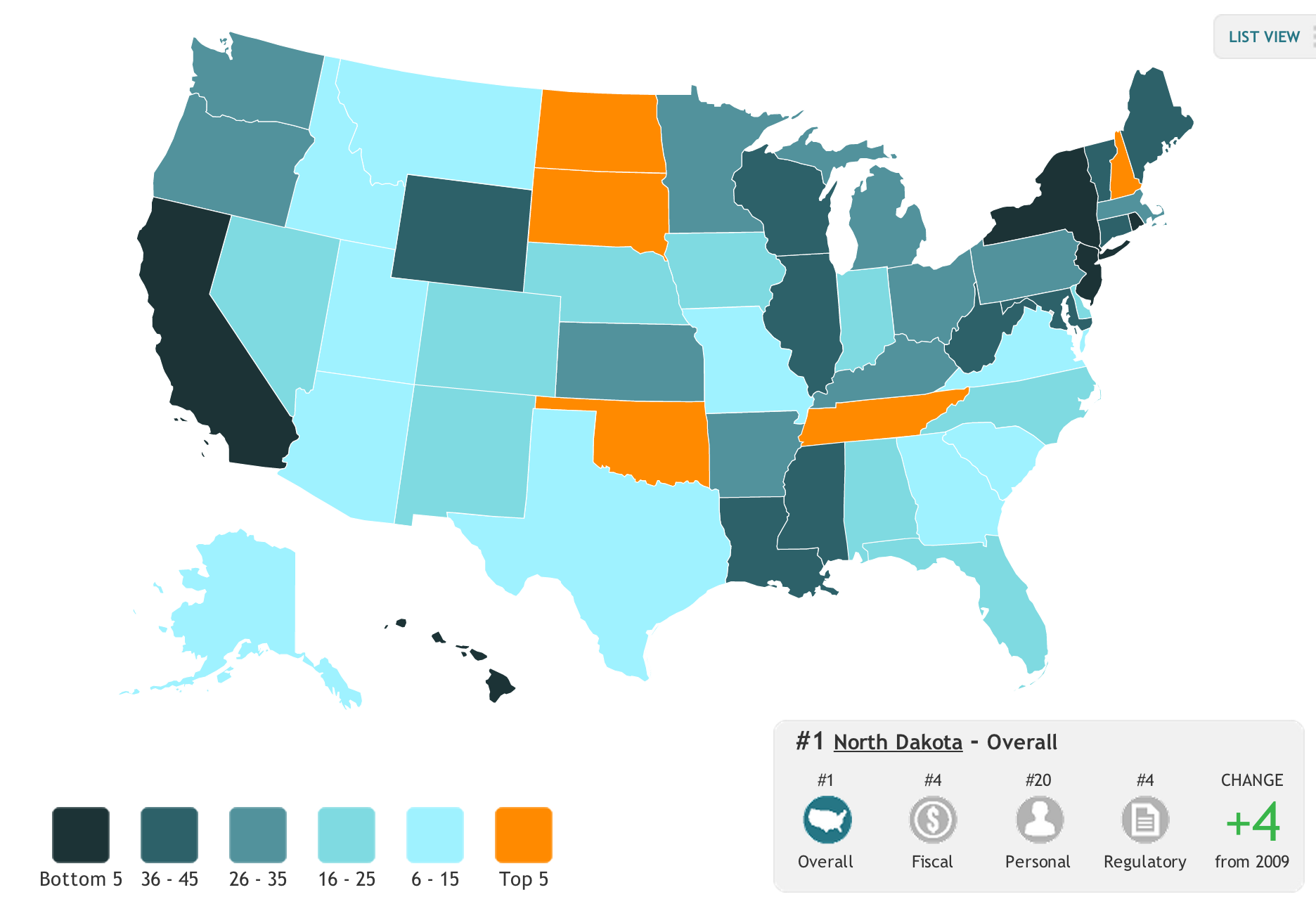
The Mercatus Center, which skews Libertarian, has ranked the 50 states in terms of freedom. The results:
Timothy B. Lee asks “whether it makes sense to have a political ideology that’s focused on freedom, narrowly defined, to the exclusion of other values”:
There are some obvious problems with Mercatus’s methodology. Theoretically, libertarians are “economically conservative and socially liberal,” but the libertarians at Mercatus have given economic policy more than twice as much weight as “personal freedom.” On top of that, it uses a pretty right-leaning conception of “personal freedom.” The right to smoke is given almost twice as much weight as marriage equality. The right to own a gun is given five times as much weight as the “civil liberties” category, described as a “grab bag of mostly unrelated policies, including raw milk laws, fireworks laws, prostitution laws, physician-assisted suicide laws, religious freedom restoration acts, rules on taking DNA samples from criminal suspects, trans-fat bans, and laws that can be used to prosecute people who audiorecord public officials in the performance of their duties.” Reproductive freedom isn’t taken into account at all. Little surprise that the top of the list is dominated by red states.
Despite the over-hyped headlines, Will Oremus isn’t worried about Chinese superkids. But he recognizes the issues raised by advances in preimplantation genetic screening for embryos:
[T]he line between screening for disorders and selecting for traits can be blurry. If it’s OK to screen for Down syndrome, is it OK to screen for a genetic predisposition to alcoholism, depression, or obesity? Where do you draw the line between developmental disabilities and low IQ?
Your reader who complained about having to pay $500/month in alimony “just because he was a man” might not have told the whole story. If I’m wrong I apologize, but it may also have been because he was bailing on the marriage and the wife did not want to divorce. I suppose it depends on which state that was. I was divorced in California, and the divorce was mutually agreed by my wife and I. Part of the divorce settlement was a division of property agreement that we filled out and agreed upon together, and signed and presented as part of the petition. Since the divorce was uncontested, the mutually agreed terms were basically rubber stamped by the judge. In this case, no children were involved either. When children are involved it leads to more judicial intervention.
The case being described by your reader sounds like it was a contested divorce, not an uncontested one with mutual agreement. I may be wrong, but I think a decision like this is likely if the husband wants to divorce but the wife does not, or if the husband and wife can’t agree mutually on a property settlement. So it may have been because he was a man AND because he was unilaterally initiating a contested divorce.
Considering it this way, a prenup is like planning for divorce in advance. Going into marriage without a prenup means you are committed to making it work, unless both can agree on a settlement. I suppose couples who fear they can’t make it work or agree on a settlement, and thus need the protection of a prenup, should think twice, three, four, or more times before marrying.
Even if you don’t email the Dish, you can still add your two cents to the thread:
This embed is invalid
An emailer shares a dramatic tale of woe:
I was married when I was 24. It was a bad marriage. I tried to call the engagement off four times, but was coerced back into it each time with threats that she would kill herself if I left. She was generally this awful every day. We were married for two years, which is how long it takes for someone to call someone’s bluff on that threat. When I left, I was shocked by the state of our finances.
I made about $30-35K per year. I believe she made about $75K. I had a car payment and a student loan payment. She had a car payment. Rent was reasonable. There was no reason for any credit card debt.
A few days after I left, she sent me a spreadsheet of assets and debts. Under assets, she listed things of mine like my guitars and a piano that was a gift from my best friend. However, on her side, she didn’t count things like a several thousand dollar ring as an asset. That was the beginning of the fucking-over. She also had over $30K in credit card debt that I didn’t know about. Not only that, without my knowing, she had applied for these cards in both of our names.
She proposed that all of the debt should be mine and all of the assets hers. The way she saw it, the only property I should retain was my clothes. This carried an additional threat of her family having money and mine having none, and she would therefore do everything she could do to give me all of the debt and none of the assets, to cripple me for years.
I saw a lawyer about this. She said that it would cost me at least $10-15K and a lot of stress to properly contest everything. I could barely afford my Corolla, so this was out of the question.
I then realized that the only leverage I could have would be if I left and didn’t divorce her. She wanted to wrap things up and fuck me over quickly while emotion was still involved. I told her I didn’t want to go through with the legal process and was willing to wait two years until she could file for divorce on the grounds of abandonment … unless she met in the middle on the debt that she accumulated (my lawyer said I would be held liable for half, since she put the cards in my name, unless the proceedings were to get really expensive). After a few more days of threats from her, and me not backing down, she agreed to 50% of her debt, and I would get to keep my guitars, piano and iPod. Nothing else. No wedding gifts. Nothing at all. Good enough for me.
Then I went to my lawyer. We went over my finances. This debt she threw on me, in addition to my car payment, put me in an unmanageable position, which forced me into bankruptcy. I reaffirmed the car loan, to save some semblance of a credit rating, but in order to expunge the debt that she accrued, my credit rating dropped from 780 to the cellar. Five years later, it’s finally back up, but that really fucked me over when I wanted to buy a new car or rent an apartment.
If you’re struggling to get by, a prenup can save you. But more importantly, don’t marry an awful person.
A much happier story:
My mom was 68 when my dad died. They had lived modestly in a small town (Dad owned a general merchandise store), but he had made a couple of smart investments during the depression and had held on to those investments for almost 50 years. When he died, his estate was enough that if invested frugally could help support my mom’s lifestyle – modest but comfortable.
When she remarried some 6 years later, my sister and I stayed with her the night before the wedding. As we were sitting at her table talking, she dropped two envelopes on the table which, much to our collective shock, was a prenuptial agreement! I had no idea that mom even knew what a prenup was, much less how to go about getting one and convincing her soon-to-be new husband to agree. When we asked her why, she said very simply, “Your dad and I worked hard to put money away for the two of you and I just want to make sure that if I die first that there is no question about who inherits. And my new husband agreed – for his children as well. We are combining our future income (social security) but the past is different.”
My mom had to leave high school after her freshman year, after her mom died, to take care of her dad and brother but she obviously learned a lot by living and working along side my dad for 47 years. She outlived my stepdad by 12 years and I am still in awe of how smart she was!
Conor unpacks the findings of a recent report on NYC’s surveillance programs on Muslims, which he thinks produced more paranoia than intelligence:
Many regular mosque-goers have decreased their attendance, “and those who attend do so to just pray and leave, looking over their shoulders for eavesdropping spies the entire time. One young woman who is responsible for organizing youth activities in her mosque noted how congregants have internalized the need to self-edit religious Sunday school curriculum: ‘It’s very difficult, it’s very hard, you don’t know what to say, I have to think twice about the sentences I say just in case someone can come up with a different meaning to what I’m saying.'”
He rightly questions super-nanny Bloomberg’s reputation as a defender of free speech and religious freedom:
Suffice it to say that the NYPD’s surveillance program significantly affected the lives of its targets for the worse, making them frightened, paranoid, mistrustful of one another, less willing to participate in the civic process, and more inclined to practice their religion in isolation. If Catholics or Jews were targeted by a municipal police department in this way, utterly changing the dynamic of their faith communities for years on end, Americans would be outraged, doubly so if the surveillance produced zero leads and no evidence of averting any serious crime.
“I’m a Christian not because of the resurrection … and not because I think Christianity contains more truth than other religions … and not simply because it was the religion in which I was raised (this has been a high barrier). I am a Christian because of that moment on the cross when Jesus, drinking the very dregs of human bitterness, cries out, “My God, my God, why hast Thou forsaken me?” … The point is that he felt human destitution to its absolute degree; the point is that God is with us, not beyond us, in suffering,” – Christian Wiman.
Gay rape is more common than I think is generally acknowledged, and not just in prison settings. I can only offer my own anecdotal evidence but I would imagine a lot of gay men have similar stories. When I was in my thirties, I frequented a local, suburban “cruising” spot (woods adjacent to a park). I met a guy there and struck up a conversation. He was a few years younger than I was. We engaged in some light sexual activity and agreed to meet again a few days later. He seemed nice, funny, open about being gay.
At our second meeting, we went deeper into the woods to find a more secluded spot. We engaged in the same activity (kissing, touching, oral sex) but then he demanded more. I declined his offer – clearly I would say – but his demeanor changed and he got more physical. He was bigger than me, and heavier by at least twenty pounds. Despite my protests, I found myself pinned up against a tree while he violated me and threatened further violence (he hissed his threats into my ear). Afterwards, he was grudgingly apologetic but at the same time commented on how “hot” it had been and that I had clearly enjoyed it. I just remember saying, flatly, “You raped me.” I pulled my clothes on and got out of there. I saw him again about a week later but he again denied that he had crossed the line, only saying that we had both enjoyed it. I never saw him again.
Did I enjoy it? No. Did I put myself in a dangerous position? Yes. Is this a hard case in which to draw a bright line about consent? Probably. But the fact is I told him no and he didn’t stop. Isn’t that the definition of rape?
Another also shares a difficult story:
I have been reading your work for years, yet until today I have never felt compelled to write or add my own voice to a discussion. The post on gay rape triggered an avalanche in me and I kind of broke down for a bit. Your reader asked if gay rape is a thing, and I will confirm that it is because it happened to me about 18 years ago.
Without going into too many details, I was violated during my college years as I was trying to deal with my conflicted sexuality. In the middle of coming to terms with my same-sex attraction and a Catholic upbringing that taught that such feelings are sinful and should be suppressed, someone took advantage. It was awful enough that I went back into the closet for eight more years, and it wasn’t until I started going back to ManRay (for the goth nights, which I miss so so dearly) that I started to explore again. Even now I am deeply wary of men who express attraction to me because of the PTSD of the event.
So the usual question I get when I share this with those closest to me is, “Why didn’t you report it?” From the outside it seems the logical and right thing to do. The problem is, you can’t report a crime if you – and everyone else – doesn’t believe the crime actually exists.
Ever hear someone jokingly say, “You can’t rape the willing”? I have, from almost every straight friend I have ever had. There is a general societal perception that men CANNOT be raped because men always want sex and real men can control their sexual encounters. A man who claims to have been raped is not really a man; either he’s lying to cover something up, or he deserved it (a common view in the more homophobic parts of the country) or he’s a pussy who can’t fight off another man and thus less of a person. Male-on-male sexual assault goes unreported because of this – men don’t get raped, men just have bad sex and move on. Add on top of this the usual negative views of homosexuality, and someone who has been attacked in such a way will find any excuse to deny it ever happened.
And in my case, that’s how I dealt with it. My brain interpreted the event as “bad sex”. At the time, with virtually nothing else to compare it to, I thought the violent act WAS gay sex, and obviously I just didn’t like it, so obviously I wasn’t gay. At that point I could not admit it happened to anyone, as that would both expose my “sin” and it would call into question every aspect of my masculine identity, I just suppressed it as an experiment gone awry and tried to move on, despite the obvious damage it did. It wasn’t until I came back out, nearly a decade later, and admitted my attractions that I could look back on that event for what it really was.
I sincerely hope the topic of same-sex rape gets a little bit of exposure here now that it has been brought up. While any kind of sexual assault is awful no matter what genders are involved, and any discussion on how to prevent or respond to it is worth having, gay rape gets virtually no coverage and has been swept under the proverbial rug as something that simply never happens. I wish that were true; my life may be very different right now.

 The Dish