
Another Iraq War Fallacy

An Iraqi searches for body parts in a po

This one – part of Jim Fallows’ series of posts – is one I really should never have held. But I did. I prided myself on a conservatism that understood that democratic norms are only built from within cultures through centuries of conflict and compromise. You cannot remake that overnight. Partly, I was overly influenced by the new democracies of Central Europe – but I should never have listened to the apolitical utopianism of the neocon right or the liberal hawks, even though many of them may have meant well. I sure did. But moral certainty combined with historical ignorance is not a prudential position. Here’s Fred Kaplan telling it like it is:

Ten years later, it’s clear that the Iraq war cast “a very large shadow” indeed, but it was a much darker shadow than the fantasists who ran American foreign policy back then foresaw. Bush believed that freedom was humanity’s natural state: Blow away the manhole-cover that a tyrant pressed down on his people, and freedom would gush forth like a geyser. Yet when Saddam Hussein was toppled, the main thing liberated was the blood hatred that decades of dictatorship had suppressed beneath the surface.

As we see in Syria and Iraq, the imperial borders of the region make a mockery of thinking of it as post-Soviet Europe, and the intervention was bound to unsettle things further. Back to Kaplan:

The question is how far this unraveling goes. Will civil wars erupt in one artificial state after another? That is, will the path of Syria be followed by Lebanon, then Jordan, then (hard as it may be to imagine) Saudi Arabia? Will Sunnis or Shiites, or both, take their sectarian fights across the borders to the point where the borders themselves collapse? If so, will new borders be drawn up at some point, conforming to some historically “natural” sectarian divisions? There have been many such alternative-maps proposed over the years, none of them quite alike, which raises the possibility that the definition of “natural” borders may itself be a contentious matter, likely to set off its own disputes or wars. Will these new borders conform to the results of these new battles? (Borders, like histories, are usually drafted by the winners.)

Or will it simply unleash a new round of warfare and ethnic conflict? The Iraq war, in retrospect, may be seen as breaking more than a country, but an entire region. As someone once put it:

Those who in the Elysian fields would dwell.
Do but extend the boundaries of hell.

(Photo: An Iraqi searches for body parts in a pool of blood and sewage at the site of a powerful car bomb which exploded in a Baghdad market, 06 May 2007. The blast sent shrapnel scything through a crowd in the Bayaa neighbourhood, a mainly Shiite district lying on one of the city’s many dangerous sectarian faultlines, killing at least 20 people and wounding 45 more. By Ahmad Al-Rubaye/AFP/Getty.)
Wealth That Doesn’t Trickle Down

Bruce Bartlett explains why the rising stock market has had a limited impact on the rest of the economy:

The latest research – by the economists Karl E. Case, John M. Quigley and Robert J. Shiller – shows a $1 decline in housing wealth reduces consumption by 10 cents per year, whereas a $1 increase in housing wealth raises spending just 3.2 cents. This suggests that homeowners will spend $500 billion less this year than they would if home prices were at their 2006 level.

By contrast, changes in stock-market wealth have a much smaller effect on spending. Consumption rises or falls about 2.5 cents for each $1 change in stock market wealth. Therefore, the $4 trillion increase in financial wealth from 2011 to 2012 will add only about $100 billion to spending this year.

Marginalizing Neocons

Glenn Beck’s new attempt at serious “Sixty Minutes”-style reporting gets its debut this week. It doesn’t seem like Breitbart or Daily Caller fabulism. But its examination of the relentless growth of the national security state echoes Rand Paul’s constitutional concerns about unfettered executive power in a forever war with no geographical boundaries.  Some of us were on this case when the abuse was much greater – under Bush. But the secrecy seems to have become close to hermetic under Obama and the CIA still seems a government unto itself – above the law, above accountability, even permitted to destroy evidence of war crimes with impunity.

What if the libertarian right begins more and more to realize that the neoconservative vision is incompatible with constitutional freedoms? What if this stops being a “fringe” idea and starts to reintegrate into its natural home: American conservatism. The wild card? Israel, of course, where Christianists believe theology should dictate foreign policy. But we could end military aid, couldn’t we? And I’m beginning to see the strong chance that if the neocons get close to their next war on Iran, the GOP might not be unanimously behind it.

The Partisan News Population

Partisan News

It’s relatively tiny:

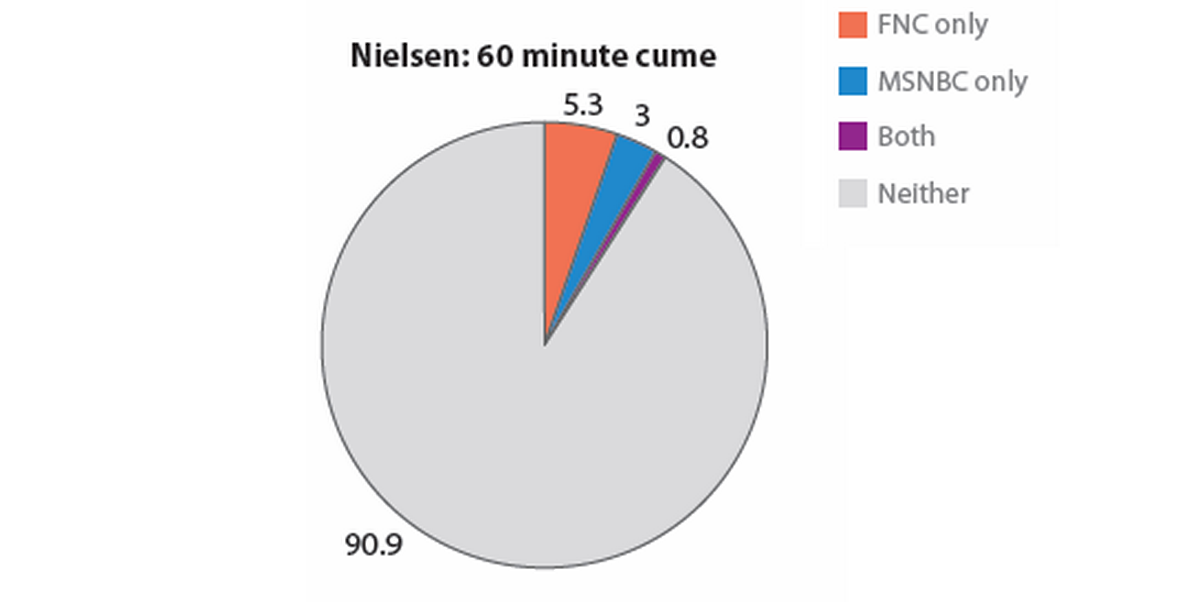
What percentage of Americans watches cable news for 10 minutes or more per day?  Only about 10-15%, if you simply add up the audiences for Fox News, CNN, and MSNBC.  This is based on calculations by political scientist Markus Prior, drawing on detailed data about what people actually watch and not what they report in a survey. Survey reports of news consumption are often highly inaccurate.

The Conclave’s Blind Spots

Anthony Judge examines the cardinals’ educational backgrounds. Tom Jacobs wishes for more diversity:

Theology is the most popular subject by some distance, with philosophy taking a solid second place. Of the handful of other disciplines, only four of the cardinals have studied psychology, and only one economics.

While on one level, this isn’t at all surprising, it’s worth contemplating. These men—and one of them in particular—will be handing down decisions that spell out ethical rules impacting a variety of fields, including medicine. Wouldn’t it be nice if the group included some voices that could explain the latest scientific understanding of the workings of mind and body?

It would indeed. But the kind of priesthood that would include that kind of experience would not insist on celibacy. If women and married priests were admitted, the range of skills, backgrounds and experience would definitely help the church convey its message more effectively. A reclusive, effeminate theologian like Benedict XVI is almost guaranteed to lack the worldly skills needed – just in rooting out corruption in the Vatican. But this self-selected group – almost all appointed by Wojtila and Ratzinger – are unlikely to see that. It’s the blind leading the blind.

Remote Control Colleagues

The Economist reports on “telepresence robots”:

Several start-ups are introducing new telepresence robots this year, and sales are growing as costs fall. RoboDynamics of Santa Monica, California, for example, has sold more than 100 of its $10,000 TiLR robots since 2008; its sleeker Luna model went on sale in January for $3,000, and its proposed 2015 model is expected to cost less than $1,000. Businesses commonly buy telepresence robots to inexpensively bring distant employees back “into the fold” at the office, says Fred Nikgohar, the company’s boss. Later this year a Pennsylvania start-up called Bossa Nova Robotics will start selling a 1.37-metre-tall telepresence “ballbot” called mObi that rolls around on a football-sized sphere, a design which enables it to weave through cluttered offices and turn on a dime.

Tom Simonite, who test drives a telepresence robot in the above video, reported on the technology a few years ago. We should reiterate that, unlike the Atlantic’s cover-story on IBM’s robots, we have not run oodles of sponsored content from the company that makes the robot.